电子

Search documents
德国总理默茨明日访华!随行阵容庞大,将访问宇树科技
Hua Xia Shi Bao· 2026-02-24 10:00
Group 1 - The visit of German Chancellor Merz to China is significant as it marks his first official visit since taking office, with meetings scheduled with President Xi Jinping and Premier Li Qiang to discuss bilateral relations and mutual concerns [1][3] - China and Germany are described as comprehensive strategic partners, with close high-level exchanges and deepening practical cooperation that benefits both nations [1][3] - The trade relationship between China and Germany has been robust, with trade volumes exceeding $200 billion and bilateral investment stock surpassing $65 billion, accounting for nearly a quarter of China's total trade with the EU [3][8] Group 2 - The German delegation accompanying Chancellor Merz includes approximately 30 executives from leading companies in sectors such as automotive, chemicals, biopharmaceuticals, and machinery, indicating a strong desire from Germany to deepen economic ties [3][7] - The visit is expected to focus on traditional cooperation areas while also exploring new opportunities in clean energy, intelligent technology, biotechnology, and industrial digitalization [4] - Recent statistics indicate that China has surpassed the United States to become Germany's largest trading partner, with projections suggesting that trade between China and Germany could reach €251.8 billion by 2025, reflecting a growth of 2.1% [8]
东兴证券晨报-20260224
Dongxing Securities· 2026-02-24 09:35
Core Insights - The report highlights the structural expansion of the rubidium and cesium market driven by the increasing penetration of perovskite solar cells and the development of space photovoltaics [7][12][13] Industry Overview - Perovskite solar cells (PSCs) are identified as a new type of solar cell with advantages such as low cost, high efficiency, lightweight, and flexibility compared to traditional silicon cells [7] - The report predicts that the penetration rate of perovskite solar cells in the photovoltaic market will rise significantly, from 1.3% in 2025 to 30% by 2030, driven by their cost-effectiveness and efficiency [9][12] Market Dynamics - The demand for rubidium and cesium is expected to grow substantially, with a projected CAGR of 115% from 2025 to 2030, as the perovskite battery market expands [12][16] - The report estimates that global demand for rubidium will increase from 37 tons in 2025 to 1696 tons by 2030, correlating with the anticipated growth in perovskite solar cell production [12][16] Technological Advancements - The stability of perovskite solar cells is a key challenge, but the addition of rubidium and cesium is expected to enhance their performance and longevity [8] - Flexible perovskite solar cells are anticipated to find applications in various fields, including building-integrated photovoltaics (BIPV), wearable devices, and automotive power generation [10][11] Future Outlook - The report suggests that the period from 2026 to 2027 will be crucial for the industrialization and validation of perovskite solar cells, with significant advancements expected in their application in space photovoltaics [13][14] - The integration of perovskite solar cells in space applications is projected to drive demand for rubidium significantly, with estimates indicating a potential need for 220 tons by 2030 due to space solar power initiatives [15][16]






资金跟踪系列之三十三:个人是节前主要卖出力量,北上重新回流
SINOLINK SECURITIES· 2026-02-24 09:17
Group 1: Macroeconomic Liquidity - The US dollar index has declined, and the degree of "inversion" in the China-US interest rate spread continues to narrow, with inflation expectations also decreasing [2][16] - Offshore US dollar liquidity has marginally tightened, while the domestic interbank funding situation remains balanced, with the yield spread between 10Y and 1Y bonds narrowing [2][23] Group 2: Market Trading Activity - Market trading activity continues to decline, with most indices experiencing increased volatility; sectors such as media, building materials, light industry, and telecommunications are above the 90th percentile in trading activity [3][29] - The volatility of major indices like the Shanghai Composite, CSI 300, and CSI 500 has increased, while the military industry sector's volatility is above the 80th percentile [3][34] Group 3: Institutional Research - Research activity is high in sectors such as banking, electronics, computing, electric new energy, and military industry, with the textile and apparel sectors showing a month-on-month increase in research activity [4][46] Group 4: Analyst Forecasts - Analysts have adjusted the net profit forecasts for the entire A-share market for 2026 and 2027, with increases in forecasts for sectors including non-ferrous metals, media, building materials, chemicals, and electronics [5][19] - The proportion of stocks with upward adjustments in net profit forecasts for 2026 and 2027 continues to rise across the A-share market [5][18] Group 5: Northbound Trading Activity - Northbound trading activity has slightly decreased, but there has been a net purchase of A-shares; the trading volume ratio in sectors like telecommunications, electronics, and electric new energy has increased [6][31] - Northbound investors primarily net bought in the electronics, telecommunications, and electric new energy sectors, while net selling occurred in media, food and beverage, and utilities sectors [6][33] Group 6: Margin Financing Activity - Margin financing activity continues to decline, reaching a relative low since July 2025, with a net sell-off across various sectors [7][35] - The financing buy-in ratio has increased for sectors like telecommunications and non-bank financials, while net selling has occurred across various styles of stocks [7][39] Group 7: Fund Activity - Active equity funds have increased their positions, particularly in media, computing, and military sectors, while reducing positions in chemicals, automobiles, and electronics [9][45] - The correlation between active equity funds and large-cap growth/mid-cap value has increased, while the correlation with mid-cap/small-cap growth and large-cap/small-cap value has decreased [9][48]
马年全年展望:三重支撑夯实基础,结构性重估可期
Xin Lang Cai Jing· 2026-02-24 09:13
Market Overview - During the Spring Festival period (February 16 to 23), the Hong Kong stock market showed a fluctuating upward trend, with the Hang Seng Index rising by 1.94% [1] - The materials and energy sectors performed strongly, with increases of 7.37% and 4.66% respectively, driven by rising international precious metal and energy prices alongside heightened geopolitical risks [1] - In contrast, both essential and non-essential consumer sectors experienced slight declines, indicating cautious expectations regarding the pace of consumer recovery [1] Sector Performance - The technology sector underperformed overall, with the Hang Seng Technology Index only increasing by 0.47% for the week, although it showed signs of recovery with a significant rise of 3.64% on February 23 [1] - The structural characteristics observed in the Hong Kong market during the holiday period may also reflect in the A-share market post-holiday, with cyclical industries linked to resource sectors expected to gain traction [1][2] A-share Market Outlook - The A-share market is anticipated to focus on two main lines post-holiday: resource products and technology manufacturing [2] - The recent market differentiation is not merely a short-term rotation but reflects a shift in risk preference from high-valuation growth sectors to more comfortable valuation ranges [3] - The strong performance of resource sectors indicates a growing consensus among global investors regarding the strategic value of assets like precious metals and oil amid geopolitical risks and a weak dollar [5] Economic and Industry Fundamentals - The Chinese economy is at a convergence point between the bottom of the inventory cycle and a new round of industrial upgrades, with industrial profits expected to improve in 2026 [6] - High-tech manufacturing is projected to be a core support for profit recovery, with significant growth in profits expected in sectors like electronic equipment and smart consumer devices [7] - The liquidity environment remains supportive, with a stable monetary policy and a trend of declining risk-free interest rates enhancing the attractiveness of equity assets [7] Long-term Market Drivers - The market's cautious expectations regarding economic growth may lay the groundwork for future recovery, with policies aimed at boosting domestic demand and consumption being prioritized [8] - The ongoing evolution of new industries, particularly in technology, is expected to support long-term growth, with no significant bubbles observed in the technology sector despite recent valuation increases [8] - The market is likely to experience structural revaluation supported by a recovering profit cycle, declining interest rates, and the acceleration of new productive forces transitioning from policy planning to industrial implementation [9]
联创电子(002036.SZ):2026年度第一期科技创新债券发行完成
Ge Long Hui A P P· 2026-02-24 08:44
Core Viewpoint - The company has successfully issued its first phase of technology innovation bonds for the year 2026, raising a total of 30 million yuan with a fixed interest rate of 2.80% [1] Group 1 - The bond issuance was completed on February 13, 2026, and the funds were received on the same day [1] - The bond is named "联创电子科技股份有限公司2026年度第一期科技创新债券" and is referred to as "26联创电子SCP001" [1] - The bond has a maturity period of 100 days, with a repayment date set for May 24, 2026 [1]

A股马年开门红!9只千亿市值巨头股价井喷,三环集团、润泽科技、天孚通信、长飞光纤、亨通光电等搭上AI产业链快车
Sou Hu Cai Jing· 2026-02-24 07:49
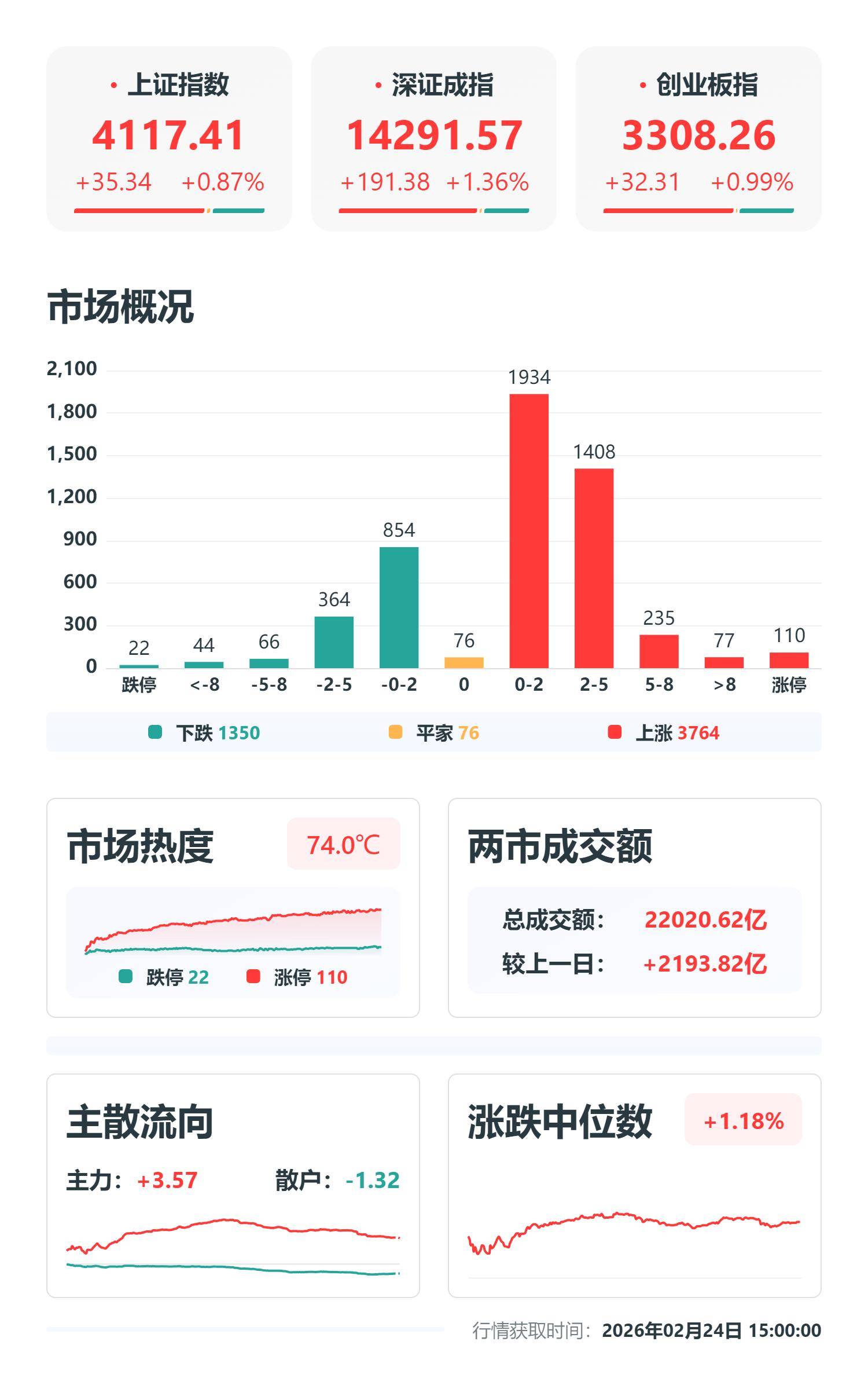
Market Performance - On February 24, the first trading day of the Year of the Horse, A-shares experienced a strong opening with all three major indices rising collectively, with intraday gains exceeding 1% [1] - By the close, the Shanghai Composite Index rose by 0.87% to 4117.41 points, the Shenzhen Component Index increased by 1.36% to 14291.57 points, and the ChiNext Index gained 0.99% to 3308.26 points [1] Trading Volume and Capital Flow - A total of 3764 stocks rose, while 1344 stocks fell, and 82 stocks remained unchanged, with a total trading volume of 2.20 trillion yuan, an increase of approximately 219.84 billion yuan compared to the previous trading day [7] - The net outflow of major funds from the market was 3.178 billion yuan, with significant inflows into the electronics sector (5.550 billion yuan), non-ferrous metals (5.393 billion yuan), and communication equipment (4.873 billion yuan) [7] Notable Companies and Market Movements - Nine major companies with market capitalizations exceeding 100 billion yuan saw their stock prices rise by over 10%, including Sanhuan Group (16.21%), Runze Technology (13.46%), and Tianxue Communication (12.65%) [8] - Companies benefiting from the booming AI-driven industry chain opportunities during the holiday include Sanhuan Group, Runze Technology, Tianfu Communication, Changfei Optical Fiber, and others [8]



20cm速递|科技行情节后启动,科创创业ETF国泰(588360)收涨超1.1%
Mei Ri Jing Ji Xin Wen· 2026-02-24 07:35
Core Viewpoint - The technology sector is expected to lead the market, with a focus on technology and cyclical stocks, driven by recent catalysts in the domestic technology industry during the Spring Festival [1] Group 1: Market Performance - The Guotai Science and Innovation ETF (588360) rose over 1.1% on February 24, indicating positive market sentiment towards technology stocks [1] - The Science and Innovation 50 Index (931643), which the ETF tracks, includes 50 large-cap emerging industry companies, reflecting the overall performance of representative emerging industries [1] Group 2: Industry Trends - The acceptance of AI among residents is increasing, with the proliferation and application of domestic large AI models suggesting a potential for China to achieve a competitive edge in AI [1] - Four robotics companies showcased their products during the Spring Festival Gala, highlighting China's advantages in humanoid robotics, including cluster control, hardware manufacturing, and mass production capabilities [1] Group 3: Investment Focus - The current investment strategy should focus on sectors such as computing hardware, AI applications, robotics, intelligent driving, and energy storage, which are expected to benefit from industry catalysts [1] - The technology sector is anticipated to continue unlocking valuation limits under the Kondratiev wave cycle, with robotics and AI-related industries likely to respond first to market changes [1]

金禄电子(301282.SZ):暂未涉及存储芯片业务
Ge Long Hui· 2026-02-24 07:12
Group 1 - The core point of the article is that Jinlu Electronics (301282.SZ) has stated it is not currently involved in the storage chip business [1] Group 2 - The company has communicated this information through an investor interaction platform [1]
永争第一!中国最强省,出手了
Xin Lang Cai Jing· 2026-02-24 04:55
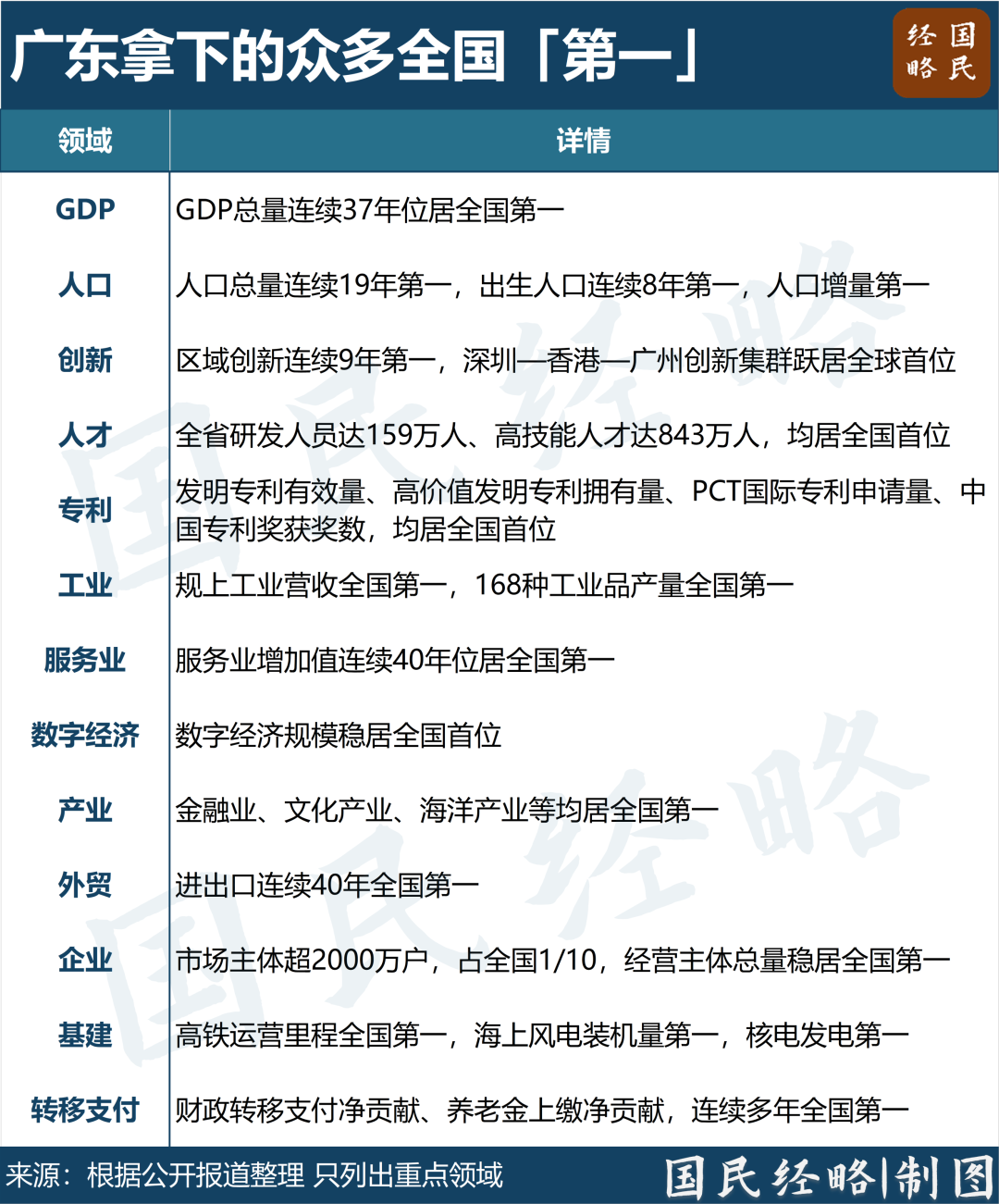
Core Viewpoint - Guangdong aims to double its economic output by 2035, reaching approximately 25.8 trillion yuan, showcasing its ambition to maintain its status as China's leading province in various sectors [1][11]. Economic Performance - Guangdong has maintained the highest GDP in China for 37 consecutive years, with a projected GDP of 14.58 trillion yuan by 2025, ranking 11th globally, surpassing countries like Australia and South Korea [3][11]. - The province's population reached 129 million in the previous year, with a net increase of 790,000 and a birth rate of 1.003 million, all ranking first in the nation [3][11]. Innovation and Competitiveness - Guangdong leads in regional innovation for nine consecutive years, with significant achievements in patent applications and awards, indicating a strong capacity for industrial technology integration [2][7]. - The "Shenzhen-Hong Kong-Guangzhou" innovation cluster is set to rank first globally by 2025, surpassing established tech hubs like Tokyo and San Francisco [8][7]. Industrial and Service Sector Leadership - The province's industrial revenue and service sector value added are both ranked first nationally, with Guangdong accounting for one-eighth of China's industrial scale [4][11]. - Guangdong has established ten trillion-yuan industrial clusters across various sectors, including electronics, information services, and new energy [4][11]. Fiscal Contributions - As the top fiscal contributor, Guangdong generates over 2 trillion yuan in domestic tax revenue annually, with a net contribution of approximately 800 billion to 1 trillion yuan after transfers [6]. - The province has contributed over 500 billion yuan in pension funds since 2018, exceeding the total contributions of all other provinces combined [6]. Future Growth Strategy - To achieve its 2035 GDP target, Guangdong needs to maintain an annual nominal growth rate exceeding 5%, which poses challenges given the current economic transition [11][13]. - The focus on the synergy between manufacturing and service industries is crucial for sustaining economic growth and enhancing competitiveness in a rapidly changing global landscape [9][11].
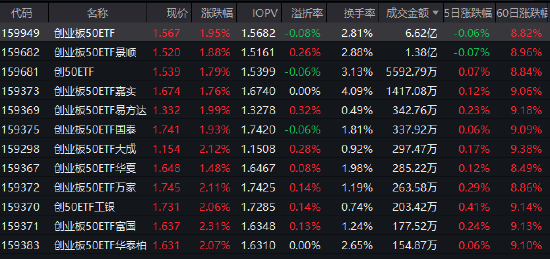
创业板50ETF(159949)半日成交6.62亿领跑!人形机器人引爆节后科技行情,机构看好三大主线!
Xin Lang Cai Jing· 2026-02-24 04:18
Market Performance - On February 24, the market opened high but retreated before rebounding, with all three major indices rising over 1% by midday. The ChiNext Index increased by 1.76%, and over 4,200 stocks in the market were in the green [1][6] - The ChiNext 50 ETF (159949) rose by 1.95% to 1.567 yuan, with a turnover rate of 2.81% and a trading volume of 662 million yuan, making it the largest in its category [1][6] Sector Trends - The humanoid robot industry gained significant attention due to its collective appearance during the Spring Festival Gala, enhancing market expectations for a post-holiday tech rally. Historical data from Huajin Securities indicates that technology growth sectors typically outperform in the first 5 to 10 trading days after the Spring Festival [1][8] - The top-performing sectors in the first 5 trading days after the Spring Festival over the past decade include computers (5 times), electronics (4 times), telecommunications (3 times), and media (3 times) [1][8] Investment Opportunities - Institutions are optimistic about three main lines: technology growth focusing on AI, robotics, and storage chips. Huachuang Securities believes that the technology sector is likely to lead the market due to concentrated industrial catalysts during the Spring Festival [3][8] - The ChiNext 50 ETF (159949) offers a convenient tool for long-term investors interested in China's technology growth sector, with a return of 36.48% over the past three years, outperforming its benchmark and ranking 440th among 1,636 similar products [3][8]