金融

Search documents
关键词:经贸交流合作
Xin Lang Cai Jing· 2026-01-25 20:19
热点话题:2025青海—澳门经贸交流合作推介会、第二届青海—香港招商引资推介会分别在澳门香港举 行 新闻事实:2025年2月21日,第二届青海——香港招商引资推介会在香港会展中心举行,聚焦清洁能 源、生态文旅、特色农牧等领域,现场签约项目总投资超120亿元。会上发布"青海绿色算力招商包""高 原特色农畜产品出口包",推动青港企业在绿电制氢、跨境电商等领域达成5项合作意向,香港中华总商 会、香港青海商会签署长期战略合作框架。10月28日,以"共享发展机遇,深化青澳合作"为主题的2025 青海——澳门经贸交流合作推介会在澳门举行,配套举办"青海家宴"品鉴活动,创新融合青海风味与葡 式烹饪技艺。现场重点拓展与葡语国家经贸合作,达成特色农产品出口、文旅资源互换等8项协议,搭 建起多元化对外合作平台。 事件意义:搭建青港产业精准对接平台,吸引香港资本参与青海"四地"建设。推动清洁能源、特色农牧 业等优势产业与香港金融、商贸资源深度融合,拓宽青海外向型经济发展路径。同时,借助澳门平台突 破传统外贸市场局限,拓宽青海对外合作空间与全球辐射范围。提升 "青字号" 产品在葡语国家及全球 市场的影响力,优化外贸市场多元化布局。深 ...
开年以来二手房销售改善、新房仍弱【国盛宏观|高频半月观】
Xin Lang Cai Jing· 2026-01-25 16:12
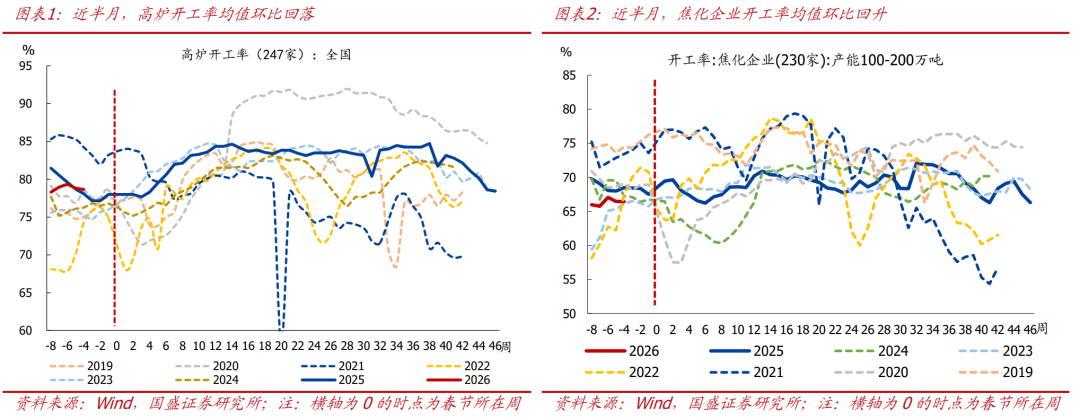
Core Conclusion - The recent high-frequency changes indicate three main trends: improvement in second-hand housing sales, continued weakness in new housing sales, and rising prices of major commodities [1][2]. Group 1: Supply - Upstream operating rates show divergence, with a slight recovery in coking and asphalt, while high furnace and cement dispatch rates have declined. The average operating rate of high furnaces decreased by 0.4 percentage points to 78.7% [3][18]. - In the downstream sector, the operating rate of automotive semi-steel tires increased by 6.9 percentage points to 74.0%, while the operating rate of polyester filament saw a seasonal decline [21]. Group 2: Demand - Second-hand housing sales continued to improve, while new housing sales remained weak. From January 1 to 23, the average transaction area of new homes in 30 major cities decreased by 55.1% month-on-month, with a year-on-year decline of 38.6% [5][34]. - In contrast, second-hand housing sales in 18 key cities remained stable, with a month-on-month increase of 22.5%, indicating a potential recovery [34]. Group 3: Prices - Most upstream commodity prices have risen, with Brent crude oil prices increasing by 5.4% month-on-month, while LME copper prices rose by 2.1% [7][38]. - The average price of rebar increased by 0.2% month-on-month, while cement prices fell by 1.7% [8][46]. Group 4: Inventory - Industrial metal inventories have increased, with steel and electrolytic aluminum inventories rising by 0.3% and 5.8%, respectively [10][54]. - The average coal inventory in coastal power plants decreased by 3.7% month-on-month, while U.S. crude oil and petroleum product inventories increased by 14.76 million barrels [10][52]. Group 5: Transportation and Logistics - Chinese export freight rates have rebounded, with the CCFI index rising by 1.2% month-on-month [13][61]. - The number of commercial flights increased by 2.6% month-on-month, while subway ridership in 10 key cities saw a slight decline [58]. Group 6: Liquidity - The central bank implemented a net liquidity injection of 10,423 billion yuan through OMO, with a focus on easing monetary conditions [15][65]. - The yield on 10-year government bonds decreased by 2.1 basis points, reflecting a broader trend of declining interest rates [67].

大江东|开局看上海②5万亿之城如何挑大梁、做尖兵?
Xin Lang Cai Jing· 2026-01-25 16:11
Core Insights - China's economy is entering a new phase with significant contributions from major cities and provinces, particularly Shanghai, which has achieved a GDP of 5 trillion yuan, marking its status as a leading economic hub [1][6]. Economic Performance - Shandong has become the third province in China to surpass a GDP of 10 trillion yuan, following Guangdong and Jiangsu [1]. - Beijing has joined the "5 trillion yuan city club," following Shanghai [1]. - Shanghai's GDP growth is projected at approximately 5.4% for 2025, exceeding the national average growth rate by 0.4 percentage points [1]. Industrial Contributions - Shanghai's three leading industries—artificial intelligence, integrated circuits, and biomedicine—saw an industrial output value increase of 9.6% year-on-year [6]. - The third sector's contribution to Shanghai's GDP is nearing 80%, with a growth rate of 6% [6]. - Shanghai's industrial strategic emerging industries grew by 6.5%, with the new energy sector growing by 12.9% [6]. Strategic Role - Shanghai serves as a critical hub for international resources, with foreign enterprises contributing about 25% of the city's GDP and one-third of its tax revenue [6]. - The city is a focal point for national strategies, including the Pudong New Area and the Lingang New Area, emphasizing its role in national economic leadership [6]. Research and Development - Shanghai's R&D expenditure as a percentage of GDP is around 4.5%, with significant contributions to high-quality development [7]. - The city has a strong output in scientific publications, with 30.6% of papers in top international journals published by Shanghai scientists [10]. Innovation and Transformation - Shanghai's approach to innovation is characterized by a seamless connection between R&D, pilot testing, and manufacturing, distinguishing it from other regions [11]. - The city has established a comprehensive system for cultivating smart factories, leading to significant digital transformation among small and medium enterprises [14]. Open Economy - Shanghai has been proactive in implementing institutional reforms, such as the registration system for the Sci-Tech Innovation Board, which has facilitated the listing of high-tech startups [15]. - The city has also pioneered cross-border service trade and knowledge protection initiatives, aligning with international standards [16][18]. Challenges and Future Directions - Shanghai faces challenges in balancing security and openness amid global uncertainties, including geopolitical tensions and economic decoupling [19]. - There is a need for enhanced collaboration between Shanghai and the broader Yangtze River Delta region to overcome administrative barriers and improve the integration of innovation and industrial chains [20].

海外策略周报:地缘风险叠加财报密集期,美股波动或放大-20260125
Ping An Securities· 2026-01-25 14:42
Core Insights - Geopolitical risks are affecting market sentiment, leading to increased volatility in US stocks, while commodities are rising. The MSCI global index fell by 0.07%, with US indices such as the S&P 500, Nasdaq, Dow Jones, and Russell 2000 experiencing slight declines of 0.4%, 0.1%, 0.5%, and 0.3% respectively [2][14][20] - The US PCE inflation for November 2025 showed a mild increase, aligning with expectations, while personal consumption expenditures remained robust despite a slight decline in income growth. The PCE and core PCE indices recorded a year-on-year increase of 2.8%, up by 0.1 percentage points from the previous month [2][3][4] - The US labor market shows limited layoffs, with initial unemployment claims indicating stability. The GDP growth for Q3 2025 was revised up to an annualized rate of 4.4%, the highest in two years, driven by strong exports and reduced inventory drag [2][3][6] Market Overview - The US stock market is entering a period of intensive earnings reports, which may lead to heightened short-term volatility. However, the overall outlook for the year remains positive for US equities, with potential influences from upcoming earnings on Hong Kong stocks as well [2][29] - In the bond market, the 10-year and 2-year US Treasury yields remained stable at 4.24% and 3.60% respectively, while the dollar index decreased by 1.88% to 97.5. Commodities such as gold and silver saw significant increases of 8.30% and 14.80% respectively [19][20] - The Hong Kong stock market is experiencing a lack of catalysts, resulting in a fluctuating pattern. The Hang Seng Index and Hang Seng Technology Index both saw a decline of 0.4% [2][29][33] Policy Developments - Recent policy actions by the Trump administration include the cancellation of tariff threats against the EU and a framework agreement regarding Greenland, which may involve military and resource-related agreements. This has implications for market sentiment and geopolitical stability [2][8] - The US Supreme Court appears unlikely to support President Trump's attempt to dismiss Federal Reserve Governor Lisa Cook, indicating potential stability in the Fed's independence [2][8] Sector Performance - In the US, the energy and materials sectors led gains, while healthcare and information technology sectors faced declines. Notably, lithium battery and social media concepts performed well, with respective increases of 9.2% and 6.0% [25][28] - In Hong Kong, the materials and energy sectors also showed strong performance, while the technology and healthcare sectors lagged. Concept indices such as smart TVs and gold jewelry saw significant gains [34][38]
挖掘经济潜能系列一:纵深推进全国统一大市场建设的方向、举措、效果推演
East Money Securities· 2026-01-25 13:30
Group 1: National Unified Market Construction - The construction of a national unified market has been elevated to a core economic strategy, emphasizing the need to eliminate market barriers and facilitate economic circulation[8] - The central economic work conference in 2025 highlighted the importance of deepening the construction of a unified market, marking a transition from framework establishment to systematic implementation[9] - The construction process has seen significant progress, with improvements in property rights protection, market access, fair competition, and social credit systems[9] Group 2: Key Areas and Policies - The modern service industry is expected to be a crucial driver in the unified market construction, with coastal regions likely to be the first to pilot reforms[1] - Tax incentives and government subsidies have been adjusted, primarily affecting key industries such as electronics, automotive, and pharmaceuticals, which may accelerate industry restructuring[1] - The establishment of a unified market will require reforms in the fiscal and tax systems, as well as optimization of local performance evaluation systems[1] Group 3: Economic Impact and Participation - The participation of different provinces in the unified market varies significantly, with coastal provinces showing higher engagement levels[1] - The share of external factors in total inputs is over 50% for resource-related and some high-tech manufacturing industries, indicating smoother domestic flow of factors[14] - Service industries show lower external factor input ratios, with public administration, accommodation, and comprehensive technical services at 7.23%, 11.54%, and 11.99% respectively, suggesting potential bottlenecks in factor circulation[14]
【每周经济观察】:法国制造业PMI升至近四年新高——海外周报第124期-20260125
Huachuang Securities· 2026-01-25 10:09
宏观研究 证 券 研 究 报 告 【每周经济观察】 法国制造业 PMI 升至近四年新高——海外 周报第 124 期 ❖ 核心观点: 1、重要数据回顾:①美国 1 月标普全球制造业 PMI 回升,第三季度实际 GDP 环比折年率终值为 4.4%,ADP 周度新增就业人数下滑。②日本 12 月出口增 速不及预期。③欧元区 1 月 ZEW 经济景气指数回升,1 月制造业 PMI 初值 回升,法国制造业 PMI 升至近四年新高的 51。 2、美国基本面高频:①景气上行的有:地产(房贷申请数量继续回升)、物价 (大宗价格回升、美国汽油零售价回升)、就业(续请失业金回落)。②景气下 行的有:WEI 指数(经济景气下行)、消费(红皮书商业零售同比边际回落)、 就业(初请失业金人数回升)。 3、美国流动性高频:①美国和欧元区金融条件收紧。②离岸美元流动性:日 元兑美元流动性改善,欧元兑美元流动性恶化。 ❖ 一、过去一周重要数据回顾 美国经济活动指数回落。1 月 17 日当周,美国 WEI 指数升至 2.34%,上周为 2.4 。 上周为-0.03%。 ❖ 三、需求 1、美国红皮书商业零售同比增速边际回落。1 月 16 日当周 ...
美联储决议+中美数据+科技巨头财报!全球市场进入“风暴眼”
Hua Er Jie Jian Wen· 2026-01-25 09:24
Economic Indicators - The U.S. durable goods orders for November are expected to show a month-on-month increase of 3%, a significant recovery from the previous decline of -2.2% [3] - China's industrial profits for December are anticipated to decline by 13.1% year-on-year, indicating ongoing pressure on profitability in the industrial sector [3][4] - The U.S. PCE inflation data for December will be released on January 29, providing insights into price pressures in the economy [9] Major Financial Events - The upcoming week is termed "Super Earnings Week," with major tech companies like Microsoft, Meta, Tesla, and Apple set to report earnings, shifting focus from traditional financial metrics to the efficiency of AI capital expenditures [6][10] - The Federal Reserve is expected to maintain interest rates during its meeting on January 30, with Chairman Powell's comments likely to clarify the outlook for future rate cuts [7][10] - The OPEC+ monthly meeting is scheduled for February 1, where oil production policies will be discussed [17] Corporate Earnings - Key tech giants such as Tesla, Microsoft, Meta, and Apple will report earnings, with a focus on AI-related capital expenditures and hardware cycle recovery [10][11] - Storage companies like SanDisk, Western Digital, and Seagate, along with South Korean firms Samsung and SK Hynix, will also report, with market attention on the impact of AI on storage pricing and profitability [10][11] Geopolitical Events - The U.S. Treasury Secretary is expected to announce the new Federal Reserve Chairperson candidate during the week of January 26, which could influence market sentiment [12] - The EU-India summit may announce a historic trade agreement, reflecting the EU's strategic pivot in response to U.S. trade policies [12] - Political tensions and geopolitical risks, including developments in Greenland and the potential for another U.S. government shutdown, are expected to create market uncertainty [12][13] Industry Conferences - The China Academy of Information and Communications Technology will hold a seminar on space computing power on January 26, focusing on the integration of space information and intelligent computing [16] - The European Parliament will host a fusion energy conference on January 27, discussing the EU's fusion strategy [17]



关于把握数字化智能化发展浪潮提升中央银行履职能力的若干思考|金融与科技
清华金融评论· 2026-01-25 09:20
文/中国人民银行科技司相关课题组 金融数字化、智能化背景下提升央行履职能力应以建设强大的中央银行为 目标,以数字央行建设为抓手,以运用数字化智能化手段提升央行履职能 力为主线,为建设具有高度适应性、竞争力、普惠性的中国特色现代金融 体系贡献科技力量。 金融信息化事业加速迈进数字化智能化新阶段 金融业是典型的技术密集型和创新驱动型行业。一部金融发展史,也是一部金融与科技不断融合创新的演进史。改革开放以来,随着信息技术持续迭代发 展,我国金融信息化事业已先后历经电子化、网络化阶段,为迈进数字化、智能化新阶段奠定坚实基础。金融电子化阶段,我国金融业主要依托电子计算 机、卫星通讯网络等技术,实现金融业务"从手工到电子、从单机到联网"的历史性突破,行业整体电子化、自动化水平显著提升。金融网络化阶段,我国 金融业运用互联网、移动通信、数据库等技术,将传统金融业务迁移至互联网和移动终端,推动金融数据集中和信息系统互联互通,支撑央行履职的国 库、支付、征信、反洗钱、会计核算等信息化基础设施体系逐步建立健全,金融服务和管理信息化水平实现全面跃升。 近年来,随着新一轮科技革命和产业变革深入发展,人工智能、大数据、云计算、区块链、 ...

金融赋能 共建支点!荆州市2026年金融早春行政银企对接会举行
Xin Lang Cai Jing· 2026-01-25 06:55
Group 1 - The meeting emphasized the importance of financial institutions supporting local enterprises to drive economic development in Jingzhou, highlighting the need for increased credit allocation and improved service quality [1][2] - The government, banks, and enterprises are viewed as a community of shared destiny, with a focus on creating a favorable financial ecosystem and enhancing cooperation among these entities [2] - A total of 16 financial institutions signed agreements with 17 enterprises, with a total credit amount of 260.54 billion yuan [3] Group 2 - The city’s development plan for 2026 includes significant projects and financing needs, with representatives from enterprises and financial institutions discussing specific financing requirements and financial products [3]
专家:政策呵护牛市,适度“降温”举措确有必要
Di Yi Cai Jing· 2026-01-25 06:48
Market Overview - The A-share market has continued its upward trend since the beginning of 2026, with the Shanghai Composite Index breaking through significant psychological levels [2][3] - As of January 22, 2026, the Shanghai Composite Index closed at 4136.16 points, reflecting a 0.33% increase, with a total trading volume of 3.12 trillion yuan [3] Policy Support - The current market rally is characterized by a cautious approach from policymakers, aiming to prevent both overheating and sharp declines in the market [2][6] - The effectiveness of policies has been highlighted, with a focus on maintaining a stable market environment through careful regulatory measures [5][6] Economic Impact - There is a belief that the stock market can stimulate economic growth, although the extent of this impact may be limited [9][10] - The economic growth forecast for 2026 suggests a "front low, back high" pattern, with improvements expected in the latter half of the year due to lower base effects and increased policy support [11] Monetary Policy - Recent monetary policies have been described as accommodative, but not as extensive as those implemented during previous market rallies [7][12] - The focus for 2026 is expected to be on fiscal policy, with structural monetary policies serving as supplementary measures [13]