电力设备及新能源

Search documents
沪指刷新逾10年新高!突破2025年11月14日阶段高点,脑机接口概念延续强势、智能驾驶概念表现活跃
Jin Rong Jie· 2026-01-06 01:56
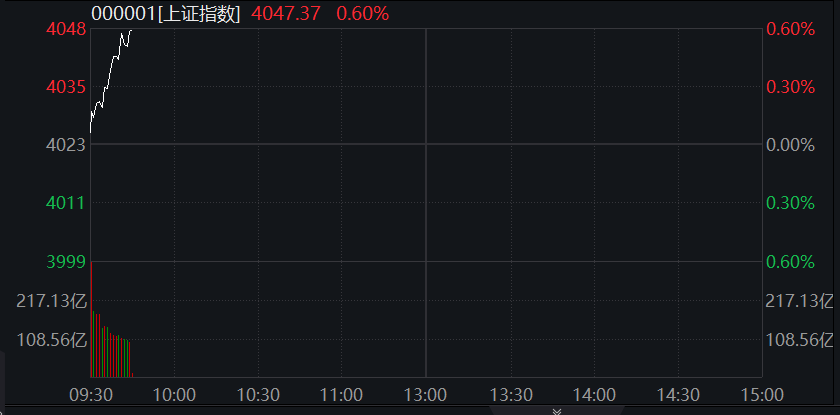
Market Performance - The Shanghai Composite Index surged after the opening, breaking the high point from November 14, 2025, and reaching the highest level since July 2015, closing at 4047.37 points, up 0.6% [1] - The Shenzhen Component Index rose by 0.69% to 13923.61 points, while the ChiNext Index increased by 0.46% to 3309.76 points, and the Sci-Tech 50 Index jumped 1.85% to 1429.42 points [1] - The total trading volume in the Shanghai and Shenzhen markets reached 567.525 billion yuan, with over 3500 stocks rising [1] Sector Highlights - The brain-computer interface sector continued to perform strongly, with several companies hitting the daily limit up, following a breakthrough in implant technology at Fudan University [3] - Semiconductor equipment stocks showed resilience, with companies like Jin Hai Tong hitting the daily limit up and others like Bei Fang Hua Chuang and Zhong Ke Fei Ce rising over 5%, reaching historical highs [3] - The solid-state battery concept saw significant gains, with Jin Long Yu hitting the daily limit up, as a Finnish company announced the launch of the world's first commercially viable all-solid-state battery [4] - The commercial aerospace sector experienced a rebound, with Lei Ke Defense achieving five consecutive limit-ups, following a capital increase announcement from China Aerospace Science and Technology Corporation [4] Institutional Insights - Huatai Securities expressed optimism about the spring market, suggesting a focus on growth sectors like electric equipment and renewable energy, as well as domestic demand improvement themes [5] - CITIC Securities noted that the cross-year market may exhibit characteristics of "growth leading and liquor accumulating," with a focus on sectors like snacks and dairy [5] - Huaxi Securities highlighted 2026 as a year of multiple positive factors, with a solid foundation for a bull market, driven by macro policies and improving corporate earnings [6] - Guojin Securities projected 2026 to be the year of recoverable commercial rockets, emphasizing the importance of cost reduction through recoverable technology in the aerospace sector [7] - Tianfeng Securities recommended focusing on cosmetics, gold jewelry, and duty-free sectors, which are expected to grow amid the recovery of high-end consumption [7]

A股指数涨跌不一:创业板指跌0.45%,商业航天、CPO等板块跌幅居前
Feng Huang Wang Cai Jing· 2026-01-06 01:36
Market Overview - The three major indices opened mixed, with the Shanghai Composite Index up 0.06% and the Shenzhen Component Index up 0.01%, while the ChiNext Index opened down 0.45% [1] - The human brain engineering and lithium mining sectors showed significant gains, while commercial aerospace and CPO sectors experienced declines [1] Index Performance - Shanghai Composite Index: 4026.02, up 0.06%, with 1018 gainers and 808 losers [2] - Shenzhen Component Index: 13830.30, up 0.01%, with 1318 gainers and 1066 losers [2] - ChiNext Index: 3279.81, down 0.45%, with 650 gainers and 552 losers [2] External Market - U.S. stock indices closed higher, with the Dow Jones reaching a record high, driven by strong financial stocks [3] - The Dow Jones increased by 594.79 points (1.23%) to 48977.18, the Nasdaq rose by 160.19 points (0.69%) to 23395.82, and the S&P 500 gained 43.58 points (0.64%) to 6902.05 [3] - Most Chinese concept stocks saw gains, with the Nasdaq Golden Dragon China Index up 0.49% [3] Institutional Insights - Huatai Securities anticipates a strengthening spring market, recommending investments in growth sectors such as electric equipment and renewable energy, as well as sectors related to domestic demand improvement [4] - CITIC Securities highlights a "growth first, liquor accumulation" trend in the cross-year market, with a focus on sectors like snacks and dairy that show clear growth potential [5] - Huaxi Securities predicts 2026 will be a significant year for the market, supported by favorable macro policies and improving corporate earnings [6] - Guojin Securities expects 2026 to be the year of recoverable commercial rockets, emphasizing the importance of cost reduction through recoverable technology [7][8] - Tianfeng Securities sees growth potential in cosmetics, gold jewelry, and duty-free sectors amid the recovery of high-end consumption [9]






华泰证券:春季行情预期或进一步强化 建议沿两条主线布局
Xin Lang Cai Jing· 2026-01-06 00:08
Core Viewpoint - The report from Huatai Securities is optimistic about the spring market, indicating a strengthening trend with most broad-based indices showing a rebound in scores and the Shanghai Composite Index entering a bullish zone [1] Group 1: Market Outlook - The macroeconomic environment suggests that the all-weather strategy in January is betting on growth exceeding expectations and increasing stock allocations [1] Group 2: Investment Recommendations - The report recommends two main investment themes: 1. Growth style, with a positive outlook on the electric equipment and new energy sectors [1] 2. Focus on the improvement of domestic demand in the context of the 14th Five-Year Plan, recommending sectors such as social services, real estate, home appliances, and beverages [1]
华泰证券:春季行情预期或进一步强化,建议沿两条主线布局
Sou Hu Cai Jing· 2026-01-05 23:59
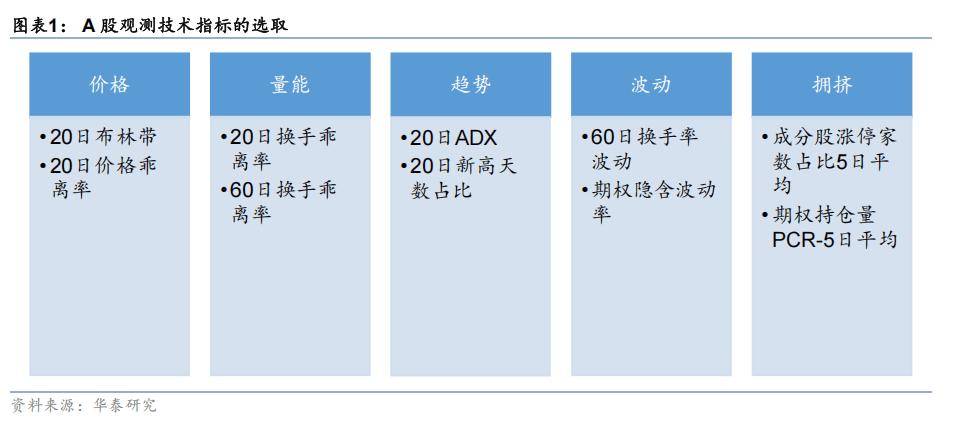
Core Viewpoint - The expectation for the spring market may further strengthen, with A-share indices showing signs of recovery and entering a bullish phase [2][3] Technical Analysis - The A-share technical scoring model indicates that most broad indices have seen a slight rebound in technical scores, with the Shanghai Composite Index surpassing the bullish threshold [3][10] - The model's performance for 2025 shows a timing return of 12.54%, while the overall return for the Wind All A index is 27.65%, resulting in an underperformance of -15.11% [10] Market Strategy - The macro strategy for January is focused on an optimistic growth outlook, with an increased allocation to equities [2][6] - Recommended investment themes include: - Growth style, particularly in the electric equipment and new energy sectors - Domestic demand improvement themes, focusing on consumer services, real estate, home appliances, and beverages [2][5] Style Timing Model - The style timing model has shifted from neutral to bearish on dividend style since December 22, 2025, favoring growth style instead [4][14] - The model indicates a preference for small-cap stocks, operating in a low crowding zone, which suggests a bullish outlook for small-cap stocks [20][23] Industry Rotation Model - The industry rotation model, which utilizes genetic programming techniques, has identified consumer services, electric equipment and new energy, real estate, home appliances, and beverages as favorable sectors [5][24] - The model achieved an absolute return of 40.34% in 2025, outperforming the industry equal-weight benchmark by 15.88 percentage points [24] All-Weather Strategy - The all-weather enhanced portfolio strategy for 2025 has yielded an absolute return of 13.86%, with a Sharpe ratio of 2.22 and a maximum drawdown of 2.67% [6][34] - The strategy has significantly over-allocated to the "growth exceeding expectations" quadrant and slightly to the "inflation below expectations" quadrant [34][35]
成长赛道喜迎2026“开门红”,深成长ETF大成(159906)活跃上行涨近3%,重仓股盐湖股份涨停,2025年业绩大幅预增
Xin Lang Cai Jing· 2026-01-05 05:15
深成长ETF大成(159906)紧密跟踪深证成长40指数,深证成长40指数反映深市成长风格突出的上市公司 的股价变化情况。 数据显示,截至2025年12月31日,深证成长40指数前十大权重股分别为新易盛、胜宏科技、宁德时代、 阳光电源、盐湖股份、沪电股份、思源电气、汇川技术、云铝股份、藏格矿业,前十大权重股合计占比 72.12%。 相关产品:深成长ETF大成(159906),场外联接(A类:090012;C类:019254)。 MACD金叉信号形成,这些股涨势不错! 有色板块成为最大亮点,盐湖股份强势涨停,凭借锂电池原材料核心优势领涨,该公司日前发布2025年 度业绩预告,预计实现归母净利润82.9亿元至88.9亿元,同比增长77.78%至90.65%。藏格矿业同步涨超 6%,印证顺周期反内卷赛道的高景气。 TMT科技股表现强势,胜宏科技上涨2.43%,汇川技术盘中涨幅一度达5%。兴业证券此前表示,避险 情绪缓解叠加三季报景气验证,市场对于科技成长景气主线的共识有望再一次凝聚。 新能源龙头稳健发力,宁德时代涨近2%。宁德时代1月4日晚间发布公告称,截至2025年12月31日,公 司通过深圳证券交易所股票交易系 ...

20cm速递|创业板50ETF国泰(159375)涨超1.3%,科技成长主线获政策与资金共振
Mei Ri Jing Ji Xin Wen· 2026-01-05 02:53
Group 1 - The core viewpoint is that the ChiNext 50 index, representing the technology growth sector, achieved a notable increase of 4.93% in December, indicating strong performance in the year-end market [1] - The main focus of the industry revolves around semiconductors, AI, and future industry hotspots, with government support for new smart glasses and smart home initiatives, as well as the launch of the National Venture Capital Guidance Fund targeting early-stage projects in integrated circuits and artificial intelligence [1] - The global technology stocks are experiencing a synchronized upward trend, with semiconductors and AI chips being the core of the market rally, driven by domestic policy support and valuation recovery in the technology sector [1] Group 2 - The ChiNext 50 ETF (159375) tracks the ChiNext 50 index (399673), which has a daily price fluctuation limit of 20%, and is composed of 50 stocks with high average trading volumes and good liquidity from the ChiNext market [1] - The constituent stocks of the ChiNext 50 index are primarily distributed across high-tech sectors such as power equipment and new energy, pharmaceuticals, and information technology, showcasing significant growth characteristics [1] - The medium to long-term outlook is positive for industrial metals and minor metals, with an upward price trend driven by global liquidity easing and emerging demands from AI and new energy sectors [1]
A股迎来2026年首个交易日!机构最新研判来了
Zhong Guo Zheng Quan Bao· 2026-01-04 22:55
明日,A股市场将迎来2026年首个交易日。元旦假期期间,港股迎来新年开门红,在美上市的中国资产 也有强势表现,一定程度上提振了市场对A股新年开门红的预期。 1月1日起房贷利率下调 自2026年1月1日起,存量住房公积金贷款利率下调25个基点。此外,由于2025年5年期以上LPR累计下 调10个基点,因此部分重定价日在1月1日的商贷利率也迎来下调。 2026年"国补"政策明确 近日,国家发展改革委、财政部印发《关于2026年实施大规模设备更新和消费品以旧换新政策的通 知》,明确2026年"两新"政策的支持范围、补贴标准和工作要求。通知称:继续实施汽车报废更新和汽 车置换更新补贴;继续实施家电以旧换新补贴,支持范围聚焦冰箱、洗衣机、电视、空调、电脑、热水 器等6类产品;同时,将数码产品购新补贴拓展为数码和智能产品购新补贴,支持范围包括手机、平 板、智能手表(手环)、智能眼镜和智能家居产品(含适老化家居产品)。 多型新火箭将首飞并挑战回收 2025年,我国在载人航天、深空探测、商业航天等领域完成多项突破,实现多个首次。在"十五五"开局 之年,中国航天的新蓝图正在展开。载人登月项目将展开多项试验,嫦娥七号将奔赴月球南 ...
机构论后市丨春季行情可能缓步启动;消费与成长有望成为两条主线
Di Yi Cai Jing· 2026-01-04 09:43
Group 1 - The A-share market is expected to experience a higher probability of upward fluctuations after the start of the year, driven by a low funding heat at the end of last year and a market sentiment that is eager for growth [2] - Key sectors for investment include materials, overseas computing power, and semiconductors, with a focus on high-quality real estate developers and industries related to travel services such as duty-free and aviation [2] - Mid-term preferences lean towards sectors with lower heat and concentration but increasing attention and catalysts, such as chemicals, engineering machinery, power equipment, and new energy [2] Group 2 - The spring market is likely to gradually start, with a favorable liquidity environment expected before the Spring Festival, although some volatility may occur in January [3] - Institutional funds, including insurance and private equity, are expected to have strong replenishment motivation, focusing on themes with strong industrial trends or multiple catalysts [3] - The spring market may require verification of economic data to confirm continued acceleration [3] Group 3 - Consumption and growth are anticipated to be the two main lines of the spring market, with a focus on sectors such as electronics, power equipment, non-ferrous metals, and automobiles in January [4] - If the market style leans towards growth, top-rated sectors include electronics, power equipment, communications, non-ferrous metals, automobiles, and defense [4] - In a defensive market style, top-rated sectors include non-bank financials, electronics, non-ferrous metals, power equipment, automobiles, and transportation [4] Group 4 - The mid-term trend remains upward, with a strong consensus on the dual mainline thinking of technology and cycles, focusing on assets in trend [5] - In the technology sector, priority should be given to AI computing power, energy storage, and storage chips, while in the cyclical sector, attention should be on directions that validate price increases [5] - Short-term participation should focus on industrial catalysts, with domestic emphasis on commercial aerospace and software innovation [5] Group 5 - The Hong Kong stock market is expected to remain active and trend upward due to multiple positive factors [6] - The technology sector is seen as a long-term investment mainline, benefiting from price increases and mergers and acquisitions [6] - The consumption sector is expected to benefit from policy support, with current valuations at relatively low levels, indicating significant long-term upside potential [6]
山西证券研究早观点-20251231
Shanxi Securities· 2025-12-31 01:02
Market Trends - The domestic market indices showed mixed performance, with the Shanghai Composite Index closing at 3,965.12, unchanged, while the Shenzhen Component Index rose by 0.49% to 13,604.07 [2] Industry Commentary - The solar power sector saw a significant increase in new installations, with a month-on-month growth of 75% in November, totaling 22.02 GW of new capacity [5][8] - The coal import data indicates a continued upward trend in import prices, with November's average price reaching $73 per ton, despite a year-on-year decrease in import volume [11][13] Company Insights - The report highlights the company "Hengdong Light" as a national-level "specialized and innovative" small giant in the optical communication field, focusing on passive optical devices [15][17] - Hengdong Light's revenue is projected to grow rapidly from 475 million yuan in 2022 to 1.315 billion yuan in 2024, with net profit expected to increase significantly during the same period [17][18] Investment Recommendations - The report suggests focusing on companies in the photovoltaic sector, including Aiko Solar and Longi Green Energy, as well as those involved in energy storage and market-oriented electricity [12] - The investment outlook for Hengdong Light is positive due to its competitive advantages and strong growth potential in the optical communication market [17][18]
1月十大金股推荐
Ping An Securities· 2025-12-29 11:53
Group 1: Market Outlook - The equity market is expected to continue its upward trend due to clear domestic policy, strong economic growth momentum, and relatively loose market liquidity[3] - Investors are advised to actively position for the spring market, focusing on sectors with improving performance and benefiting from policies[3] Group 2: Recommended Stocks - BeiGene (688235.SH): Global sales of its core product, Zanubrutinib, reached $2.78 billion in the first three quarters of 2025, a year-on-year increase of 53.2%[4] - Beijing Junzheng (300223.SZ): The storage cycle is on the rise, and the company is expected to benefit from the L3 autonomous driving market[11] - Haiguang Information (688041.SH): The company is a leading domestic computing power provider, with revenue maintaining rapid growth in the first three quarters of 2025[18] - Daotong Technology (688208.SH): The company has seen rapid revenue growth and is advancing its AI strategy[26] - Penghui Energy (300438.SZ): The company ranks among the top three globally in household storage cell shipments in the first three quarters of 2025[32] - Goldwind Technology (002202.SZ): The gross margin for wind turbine and component business reached 7.97% in the first half of 2025, showing significant improvement[39] - Chifeng Gold (600988.SH): The company is expected to benefit from rising gold prices and increased production from new mining projects[46] - Luoyang Molybdenum (603993.SH): The company is positioned to benefit from rising copper prices and increased production[52] - Huaxin Cement (600801.SH): The company reported a 120.7% year-on-year increase in net profit attributable to shareholders in Q3 2025[57] - China Pacific Insurance (601601.SH): The company has maintained a high dividend yield, exceeding 3% since 2018[65]