债券

Search documents
中国再抛118亿美债,全球抢着卖,美元霸权真要变?
Sou Hu Cai Jing· 2025-12-22 16:25
加拿大激烈出手,原因里有经济自救的成分,也有对美国产生的不满和应对政策冲击的一股本能,抛售给全球市场投下大石。 同一时间,特朗普重新掌舵白宫后就在搞动作,公开要求更换美联储主席,并且强烈暗示要大幅度降息,时间点极为敏感。 中国再抛118亿美债,全球抛售、特朗普换将,美元霸权危矣?这话题得来得猛,也得看清来龙去脉,先把关键点抛出来——中国减持美债118亿美元、加拿 大单月卖出567亿美元、特朗普上台后急着换美联储主席并催促降息,这些事放一起,像是压在一盘棋上的三颗子同时掉了,后面有更猛的细节,别急着走 开。 2022年起,中国的外汇配置开始转向,美元资产比重慢慢降下来,到了2025年再次减持118亿美元,把持仓推向2008年以来的新低。 中国这波减持不是一时兴起,而是长期调整的延续,外储从高位慢慢"瘦身",同时连续13个月买金,这阵势像是在给账本做防护。 到了2025年,加拿大在一个月内抛售567亿美元美债,这数目在历史上都算惊人的,非常规操作把市场嚇了一跳。 资金流动上,曾经把美元国债当避风港的国家和机构,现在开始寻求分散,黄金等替代品成了很多人的新选择。 加拿大的单月巨量抛售在市场上起到了催化剂的作用,说明 ...


短期震荡或是主题
Datong Securities· 2025-12-22 11:32
Core Insights - The overall market is experiencing a period of sustained volatility as it approaches the holiday season, with the equity market showing insufficient upward momentum and trading volume significantly below 20 trillion [2][9] - Investor sentiment is cautious, influenced by a policy vacuum at year-end and increased risk aversion due to the holiday season, leading to a lack of upward movement in the market [3][10] - Despite the short-term volatility, the market remains supported at relatively high levels, indicating resilience and a potential for upward movement in the medium to long term, especially with favorable policies and strong corporate earnings expected [3][12] Equity Market Summary - The A-share market continues to maintain high-level fluctuations, with trading volumes remaining weak and investor caution increasing [3][10] - The year-end policy vacuum and external market conditions, such as the transition in the U.S. Federal Reserve leadership and the easing of the Russia-Ukraine conflict, contribute to a subdued market environment [3][10] - In the medium to long term, the market has significant upward potential, particularly with the "14th Five-Year Plan" beginning and a supportive monetary environment [3][12] - A "barbell strategy" is recommended for equity allocation, focusing on both offensive positions in sectors like communication, semiconductors, and innovative pharmaceuticals, and defensive positions in consumer sectors to enhance returns [3][13] Bond Market Summary - The bond market continues to exhibit a volatile trend, closely following the equity market, indicating a lack of independent movement [4][35] - Without significant positive developments, the bond market is expected to remain weak in upward momentum, making it difficult to achieve independent performance [5][35] Commodity Market Summary - The commodity market is also experiencing volatility, with precious metals, particularly gold, showing a strong upward trend while other commodities remain subdued [6][40] - Gold prices are expected to continue rising in the medium to long term, supported by both investment and safe-haven demand, potentially leading precious metals to develop an independent trend [6][40] - It is advised to maintain positions in gold as part of the commodity investment strategy [6][41]
这玩意儿机构都在买,却不是你的投资机会
虎嗅APP· 2025-12-22 11:08
Core Viewpoint - The article discusses the current state of the long-term bond market, particularly focusing on the performance and investment potential of ultra-long government bonds, highlighting the challenges and opportunities present in this segment [4][11]. Group 1: Ultra-Long Government Bonds - Ultra-long government bonds are defined as those with maturities of 20 years or more, primarily held by institutions like insurance companies and pension funds [5]. - The 30-year government bond ETF (511090) saw a significant increase of 23.21% in 2024, but has recently experienced a decline of approximately 4% from early November to December 8, with yields rising from 2.136% to 2.265% [7][9]. - The yield spread between the 30-year and 10-year government bonds has widened to about 41 basis points, indicating a divergence in performance [9]. Group 2: Market Dynamics and Influences - The decline in ultra-long bonds is attributed to several factors, including credit events in the real estate sector affecting market sentiment, leading to a reduction in duration by investors [17]. - Central bank operations and changes in policy expectations have also contributed to the volatility in the ultra-long bond market, with recent net bond purchases signaling uncertainty about future rate movements [19]. - Global trends, such as rising long-term interest rates in other markets, have further pressured China's ultra-long bond yields, making institutions more cautious [19][20]. Group 3: Investment Strategy and Outlook - The article suggests that the current environment presents a mismatch between market expectations and reality, with the 30-year bond yield having risen back above 2.2% due to slower-than-expected easing measures [21][22]. - Investors are advised to adopt a cautious approach, focusing on key policy signals and liquidity conditions, rather than aggressively pursuing directional bets [22][23]. - A specific yield level of 2.35% for the 30-year bond is highlighted as a potential entry point for investors looking to gradually accumulate positions [24].
国债与企业债风险差异有哪些?
Sou Hu Cai Jing· 2025-12-22 09:13
Core Insights - The article discusses the significant differences between government bonds and corporate bonds, focusing on their risk characteristics and investment attributes [1][2][3] Group 1: Credit Risk - Government bonds are issued by the central government and backed by national credit, resulting in a very low credit risk level [1] - Corporate bonds are issued by domestic companies and their credit risk is closely tied to the financial health and profitability of the issuing company, leading to a higher overall credit risk compared to government bonds [1] Group 2: Default Risk - Government bonds have the highest stability in terms of repayment, supported by stable cash flows from taxes and bond issuance, making default almost impossible [2] - Corporate bonds depend on the operational performance and cash flow of the issuing company, which can lead to potential defaults if the company faces financial difficulties [2] Group 3: Liquidity Risk - Government bonds typically have larger issuance sizes and are actively traded across various platforms, providing strong asset liquidity [2] - Corporate bonds' liquidity is influenced by factors such as issuance size and credit rating, with many corporate bonds having lower trading activity, especially those from smaller companies [2] Group 4: Market Risk - Both government and corporate bonds are sensitive to market interest rate changes, but their sensitivity differs due to variations in coupon rates and maturity structures [2] - Government bonds generally have lower coupon rates and a higher proportion of long-term bonds, making them more sensitive to rising interest rates compared to corporate bonds [2] Group 5: Policy Environment - Government bonds are influenced by macroeconomic policies, but such adjustments do not affect their repayment safety [3] - Corporate bonds are more susceptible to industry-specific policies and regulations, which can increase credit and market risks for the issuing companies [3]
减持美债创新低,中美关系正在重新定价,中国不再给美国兜底了
Sou Hu Cai Jing· 2025-12-22 09:01
这个数字,有一个很明确的含义。它已经是2008年全球金融危机以来的最低水平。 最近,美国财政部公布了一组数据,引发了不少关注。数据显示,今年10月,中国继续减持美国国债, 单月减持规模达到118亿美元。减持之后,中国持有的美国国债规模,降至6887亿美元。 如果把时间拉长来看,这个变化并不突然。中国对美债的减持,已经持续了很多年。从高峰时期超过 1.3万亿美元,一路下降到现在不到6900亿美元,这是一个方向非常清晰的过程,而不是短期操作。 这组数据放在全球范围内一起看,更有意思。10月份,海外投资者对美债的总体持仓,是下降的。但在 中国减持的同时,日本和英国却选择了加仓。 日本当月的美债持仓,增加到大约1.2万亿美元,创下近两年来的新高。英国的持仓,也上升到8779亿 美元。这种对比,本身就很说明问题。 这并不是简单的"谁看好、谁不看好"。而是不同国家,在不同位置上,做出了不同选择。 而美国这边,其实也已经开始感受到变化。美债的买家结构,正在发生变化。美联储在缩表,美国国内 资金承接能力有限,越来越多的压力,需要通过海外资金来消化。 不过,需要注意的是,中国的减持方式非常克制。中国并没有一次性抛售,也没有制造 ...

加拿大反水,狂抛567亿美债,美国梦碎,中国持仓一夜回到17年前
Sou Hu Cai Jing· 2025-12-22 08:18
编辑:W 美国的铁杆盟友突然反水,万万没想到加拿大竟然是背后捅刀的那个,在美国国债家里如此大的情况下,抛售500多亿美债和要了美国的命没什么区别。 主要不光光是加拿大在抛售美债,中国的短抛就没停过,这一次的抛售更是将持仓数回到了17年前,美国人真的要傻眼了。 加拿大为什么在这个时候选择反水?抛售美债对美国有什么样的影响? 加拿大已经被逼急了 仔细看看整个2025年,你会发现加拿大这一年的操作完全就是反复无常,而且还有点鱼死网破的感觉,4月份先是大幅抛售,5月份为了稳住局面又不得不买 回来600多亿,结果到了10月份,还是选择了再次重拳出击。 这种"惊心动魄"的资金大挪移背后是加拿大对这个邻居积压已久的愤怒,道理其实很直白,那个在贸易桌上步步紧逼、动不动就挥舞关税大棒威胁邻居的美 国,终于逼得加拿大不得不祭出金融反制的手段。 既然你在贸易领域卡我的脖子,那我就把美债当作谈判桌上的筹码,在这个你最缺钱、最脆弱的时刻,釜底抽薪。 中国的稳步策略 相较于加拿大的"掀桌子",中国的动作就是一种深谋远虑后的撤退,同样是在2025年10月,中国再次减持了118亿美元的美债,将持仓总额压低到了6887亿 美元,如今中国对美债 ...
债券研究周报:年末债市还有哪些好策略?-20251222
Guohai Securities· 2025-12-22 08:04
Group 1 - The report analyzes the recent trends in the bond market, highlighting a general strategy of reducing duration and increasing leverage as year-end approaches [6][11] - As of December 19, the leverage ratio in the interbank bond market increased by 0.23 percentage points to 107.68%, indicating a notable rise in leverage [11][22] - The median duration of medium to long-term bond funds decreased to 2.68 years, down by 0.07 years compared to December 15 [11][38] Group 2 - The report suggests focusing on short to medium-term credit bonds due to a favorable funding environment and large banks purchasing short-term bonds [12] - There is a notable trend of non-bank institutions, such as asset management and trust companies, significantly buying 5-year subordinated bonds and perpetual bonds, indicating a compression opportunity in spreads [12][13] - Caution is advised regarding 30-year government bonds, as there has been significant selling pressure from joint-stock banks, and the report maintains a cautious stance on this segment [13] Group 3 - Key interest rates and spreads have shown changes, with the 1-year government bond yield decreasing by 3.25 basis points to 1.35% and the 10-year yield down by 1.80 basis points to 1.83% [14] - The report notes that the yield spread between the 30-year and 10-year government bonds decreased by 3.60 basis points to 39.44 basis points [14] - The report tracks the changes in government bond yield spreads, indicating fluctuations in the 3-year to 1-year and 5-year to 3-year spreads [16] Group 4 - The interbank pledged repo balance rose by 0.38 trillion yuan to 12.80 trillion yuan as of December 19 [19] - The average transaction amount for pledged repos from December 15 to 19 was 8.48 trillion yuan, with overnight transactions accounting for 90% of the total [26] - The report highlights the net funding outflow from banks, with a total net outflow of 5.09 trillion yuan as of December 19 [28] Group 5 - The median duration of interest rate bond funds was reported at 3.74 years, down by 0.03 years from December 15, while credit bond funds had a median duration of 2.43 years, also down by 0.09 years [43] - The report provides insights into the borrowing balance of 10-year government bonds, indicating fluctuations in borrowing activity [48]
利率债周报:债市延续暖意,收益率曲线陡峭化下移-20251222
Dong Fang Jin Cheng· 2025-12-22 07:39
Report Summary 1. Report Industry Investment Rating No information provided. 2. Core View of the Report - Last week, the bond market continued to show warmth, with the yield curve shifting downward in a steepening manner. The bond market first declined and then rose, remaining generally strong, and long - term bond yields continued to fall. Short - term interest rates also decreased, with a larger decline in short - term bond yields than long - term ones. This week (the week of December 22), the bond market is expected to fluctuate weakly. The unchanged LPR quote on Monday may drive institutions to realize floating profits, bringing adjustment pressure. However, supported by factors such as central bank bond - buying, loose liquidity, and funds' year - end scale - boosting demands, the long - end bond yields are expected to be "capped" and fluctuate slightly. Before the end of the year, the bond market is mainly driven by institutional behavior, and the 10 - year Treasury yield is expected to oscillate within the range of 1.83% - 1.88% [3]. 3. Summary by Relevant Catalogs 3.1 Last Week's Market Review 3.1.1 Secondary Market - The bond market was generally warm last week, and long - term bond yields continued to fall. The 10 - year Treasury futures main contract rose 0.14% cumulatively. The 10 - year Treasury yield decreased by 0.88bp, and the 1 - year Treasury yield decreased by 3.32bp compared with the previous Friday, with the term spread continuing to widen [4]. - On December 15 (Monday), the bond market continued to adjust. The yields of major inter - bank interest - rate bonds mostly rose, and Treasury futures contracts closed down across the board. The 10 - year main contract fell 0.12%, and the 30 - year main contract fell 0.99%, hitting a new closing low since November 18, 2024 [4]. - On December 16 (Tuesday), the bond market recovered slightly. The yields of major inter - bank interest - rate bonds generally declined, and the 10 - year Treasury yield decreased by 0.30bp. The performance of Treasury futures contracts at different maturities was divergent, with the 10 - year main contract rising 0.05% [4]. - On December 17 (Wednesday), the bond market continued to recover. The yields of major inter - bank interest - rate bonds generally declined, and the 10 - year Treasury yield decreased by 1.18bp. Treasury futures contracts closed up across the board, with the 10 - year main contract rising 0.10% [4]. - On December 18 (Thursday), short - term bonds continued to recover, but long - term bonds were weak. The yields of major inter - bank interest - rate bonds mostly declined, but the 10 - year Treasury yield rose 0.16bp. Most Treasury futures contracts closed up, with the 10 - year main contract remaining flat [4]. - On December 19 (Friday), the bond market continued its upward trend. The yields of major inter - bank interest - rate bonds generally declined, and the 10 - year Treasury yield decreased by 0.48bp. Treasury futures contracts closed up across the board, with the 10 - year main contract rising 0.10% [4]. 3.1.2 Primary Market - Last week, 35 interest - rate bonds were issued, a decrease of 62 compared with the previous week. The issuance volume was 376.1 billion yuan, a significant decrease of 919.8 billion yuan, and the net financing amount was 20.9 billion yuan, a decrease of 374.4 billion yuan. The issuance and net financing of Treasury bonds, policy - bank bonds, and local government bonds all decreased compared with the previous week [10]. - The subscription demand for interest - rate bonds was generally acceptable. Four Treasury bonds were issued with an average subscription multiple of 2.82 times; seven policy - bank bonds were issued with an average subscription multiple of 3.92 times; 24 local government bonds were issued with an average subscription multiple of 19.28 times [11]. 3.2 Last Week's Important Events - The macro data in November continued the downward trend. The year - on - year actual growth rate of industrial added value above designated size in November was 4.8% (previous value: 4.9%); the cumulative year - on - year actual growth rate in the first 11 months was 6.0% (2024 full - year cumulative year - on - year: 5.8%). The year - on - year growth rate of total retail sales of consumer goods in November was 1.3% (previous value: 2.9%); the cumulative year - on - year growth rate in the first 11 months was 4.0% (2024 full - year cumulative year - on - year: 3.5%). The cumulative year - on - year decline in national fixed - asset investment from January to November 2025 was 2.6% (previous value: a decline of 1.7%, 2024 full - year cumulative year - on - year growth: 3.2%) [12]. - The slight decline in industrial added - value growth in November was mainly due to the weakening of the pulling effect of domestic - demand - promoting policies, weak domestic consumption and investment momentum, and subsequent pressure on demand, which was transmitted to industrial production. The significant decline in the year - on - year growth rate of total retail sales of consumer goods in November was mainly due to the weakening of the subsidy policy for trading in the old for the new, the expansion of the decline in commercial housing sales, the pre - positioning of some consumption demand in October due to the early "Double Eleven" promotion, and factors such as fluctuations in the external economic and trade environment and the accelerating decline in domestic housing prices, which continuously suppressed residents' consumption confidence and willingness. The cumulative year - on - year negative growth in fixed - asset investment from January to November continued for three months and the decline was expanding, mainly because the three major investment sectors of infrastructure, manufacturing, and real estate all slowed down. After excluding price factors, the actual fixed - asset investment from January to November maintained positive growth, indicating that investment still played a positive role in promoting economic growth [12]. 3.3 Real - Economy Observation - Most high - frequency data on the production side declined last week. The blast - furnace operating rate, petroleum asphalt plant operating rate, semi - steel tire operating rate, and daily average pig iron output all decreased to varying degrees. On the demand side, the BDI index continued to decline, while the China Container Freight Index (CCFI) continued to rise. The sales area of commercial housing in 30 large and medium - sized cities rebounded significantly. In terms of prices, the pork price rose slightly overall, while most commodity prices declined, including copper and oil prices, while the rebar price increased [13]. 3.4 Last Week's Liquidity Observation - The central bank's open - market operations had a net capital injection of 109 billion yuan last week. The R007 rose, and DR007 declined. The issuance rate of inter - bank certificates of deposit of joint - stock banks fluctuated upward, the national and stock direct - discount rates at all maturities continued to rise, the trading volume of pledged repurchase continued to increase, and the inter - bank market leverage ratio continued to rise [26][27].
华东政法大学李文莉:上海推动自贸离岸债发展,有利于推进人民币国际化进程
Xin Lang Cai Jing· 2025-12-22 07:25
Core Viewpoint - The 22nd China International Financial Forum held in Shanghai focuses on building an intelligent financial ecosystem in the digital economy era [1][5] Group 1: Development of Offshore Bonds - Shanghai's advantages in promoting free trade offshore bonds include the formation of a market, evidenced by over 130 billion yuan in offshore bond issuance [3][7] - The integration of FT accounts with offshore bonds, initiated in 2014, has been successfully replicated in other regions like Tianjin, Guangdong, and Shenzhen since 2019 [3][7] Group 2: Significance of Offshore Bonds - Promotes the opening of financial markets by aligning offshore bonds with international rules, facilitating global financial resource aggregation [4][7] - Advances the internationalization of the Renminbi by encouraging the issuance of offshore bonds denominated in Renminbi, meeting global investors' demand for Renminbi assets [4][7] - Supports the construction of a new development pattern characterized by dual circulation, leveraging the free trade zone to connect domestic and international markets [4][7] Group 3: Financial Security and Stability - The Central Clearing Company plays a crucial role in the issuance, registration, custody, clearing, and valuation of offshore bonds, enhancing financial security [8] - The option to designate the Shanghai Financial Court as an arbitration institution helps mitigate jurisdictional risks [8] - This framework allows for better control over the innovation practices of financial market openness, contributing to national financial security and stability [8]

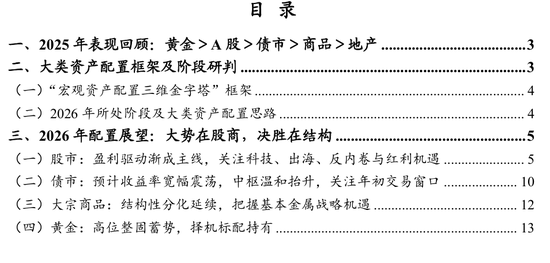
财信证券:2026年度宏观策略展望 破局谋新,迈向新平衡
Xin Lang Cai Jing· 2025-12-22 07:14
Group 1 - In 2025, major asset performance showed significant differentiation driven by three forces: financial cycle downturn, global order restructuring, and deepening industrial revolution. Gold prices surged over 60%, A-shares entered a structural bull market, while the bond market faced fluctuations and real estate prices continued to adjust [1][75]. Group 2 - The macro asset allocation framework for 2026 indicates a complex transition period. The strategic layer suggests maintaining a defensive stance due to the ongoing financial cycle downturn. The tactical layer anticipates a combination of economic recovery and financial easing, providing opportunities in commodities and equities [2][76]. Group 3 - The outlook for 2026 suggests that the stock market may experience a profit-driven rally supported by improved economic fundamentals and ample liquidity. Key focus areas include technology sectors like AI and semiconductors, high-quality export sectors, and renewable energy benefiting from anti-involution policies [3][77]. Group 4 - The bond market is expected to see a wide range of fluctuations with a moderate upward trend in yields, projected to be between 1.6% and 2.1%. The key factors influencing this include a rebound in PPI and alleviation of the "asset shortage" issue, with potential trading opportunities arising from small rate cuts early in the year [3][43][77]. Group 5 - In the commodities market, structural differentiation is expected to continue, with basic metals like copper and aluminum benefiting from global fiscal expansion and liquidity easing. Traditional energy sources like oil may perform relatively poorly due to the financial cycle downturn and supply pressures [3][59][77]. Group 6 - Gold is anticipated to enter a phase of high-level consolidation, with long-term support from weakened dollar credit and central bank gold purchases. However, short-term volatility may arise from price corrections and geopolitical factors [3][68][77].