军工

Search documents
2025年指数投资回忆录:锚点里的价值碎片
Sou Hu Cai Jing· 2025-12-25 01:13
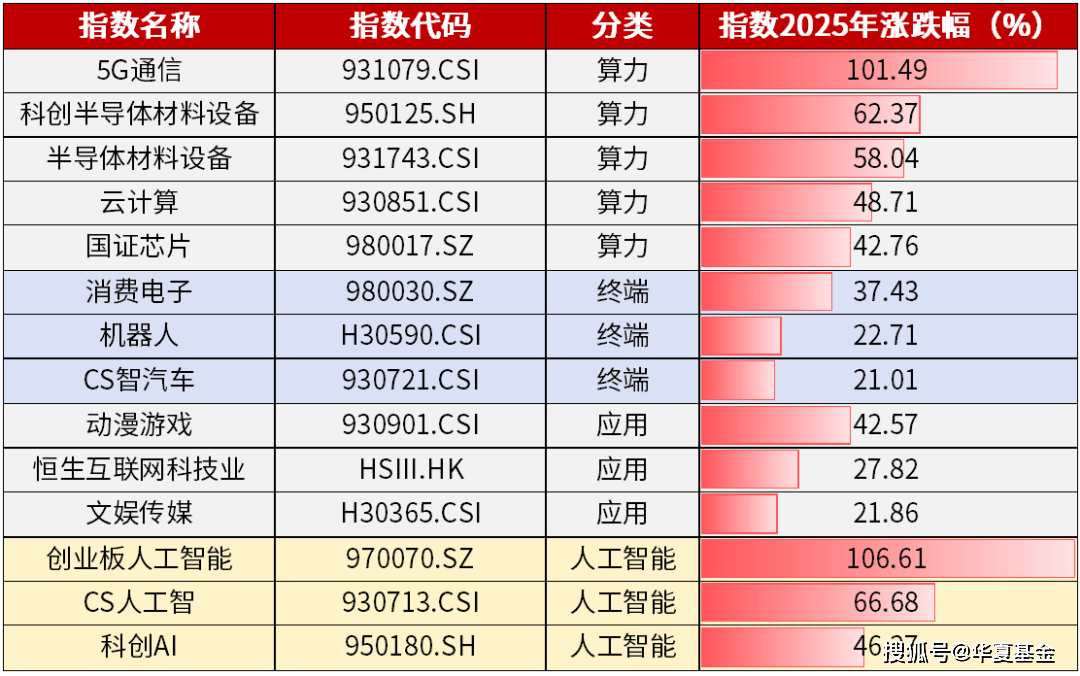
Core Insights - 2025 is recognized as a significant year for assets, with a shift in investment strategies focusing on industry trends, valuation restructuring, and global pricing power [1] - Understanding indices is crucial for grasping market consensus during specific periods, making it an essential skill for investors [1] Group 1: Seasonal Highlights - Spring marked a technological revaluation led by AI breakthroughs, reshaping market narratives around Chinese technology [2] - The AI and technology-related indices saw substantial annual gains, with the 5G communication index increasing by 101.49% and the AI-focused indices also performing strongly [3][6] - The introduction of new products related to the Sci-Tech Innovation Board simplified access to technology investments for the general public [4] Group 2: Mid-Year Developments - Mid-year saw a focus on dividend strategies, with low-volatility dividend indices gaining recognition for their stability and reliability [7] - The market acknowledged the value of dividends that do not rely on macroeconomic acceleration, with various categories of dividend assets being tailored to meet different investor needs [7] Group 3: Autumn Trends - Autumn brought renewed focus on fundamentals as US-China tariff negotiations began, with the AI industry and traditional sectors showing improved profitability [8] - The A-share market experienced significant trading volumes, with daily transactions exceeding 30 trillion, marking a ten-year high [8] Group 4: Year-End Reflections - By year-end, the Shanghai Composite Index briefly surpassed 4000 points, but concerns over AI sector bubbles and fluctuating monetary policy led to increased market volatility [9] - The A500 core index emerged as a balanced investment option, appealing to investors seeking stability amid market fluctuations [9] Group 5: Investment Trends - Industry-specific ETFs became the most attractive investment area, driven by technology and cyclical sectors, particularly in AI, semiconductors, and resource stocks [14] - The Hong Kong stock market attracted investor interest due to its differentiated value propositions, suggesting a strategy of gradual investment in undervalued assets [15] - Gold prices surged over 70% during the year, highlighting the importance of rational asset allocation in gold investments [16] - Broad-based indices like the CSI A500 and CSI 300 delivered solid returns, emphasizing the effectiveness of a balanced investment strategy [17] Group 6: Bond Market Insights - The bond ETF market saw significant growth, reflecting a strong demand for stable, low-risk assets despite the diminishing tax advantages of government bonds [18] Group 7: Future Outlook - The consensus around indices indicates a collective understanding of market dynamics, with ETFs experiencing rapid growth [19] - The narrative around AI technology is expected to continue evolving, with potential applications across various industries anticipated in 2026 [22] - The Hong Kong market presents promising opportunities, particularly in technology, consumer goods, and high-dividend stocks [22] - A diversified and balanced asset allocation strategy is projected to become increasingly important in the face of market uncertainties [23]

浙商证券浙商早知道-20251225
ZHESHANG SECURITIES· 2025-12-24 23:30
Market Overview - On December 24, the Shanghai Composite Index rose by 0.53%, the CSI 300 increased by 0.29%, the STAR 50 climbed by 0.9%, the CSI 1000 went up by 1.54%, the ChiNext Index gained 0.77%, and the Hang Seng Index rose by 0.17% [4] - The best-performing sectors on December 24 were defense and military industry (+2.88%), electronics (+2.12%), building materials (+1.72%), light industry manufacturing (+1.69%), and machinery equipment (+1.49%). The worst-performing sectors were agriculture, forestry, animal husbandry, and fishery (-0.85%), coal (-0.7%), food and beverage (-0.36%), banking (-0.3%), and media (+0.01%) [4] - The total trading volume for the entire A-share market on December 24 was 1,897.242 billion yuan, with a net outflow of 1.175 billion Hong Kong dollars from southbound funds [4] Key Insights Non-Bank Financial Sector - The non-bank sector is expected to see a rebound in 2026, offering both high probability and favorable odds [5] - Market expectations for the non-bank sector are low due to the high base in 2025 [5] - Factors driving this outlook include a long-term "slow bull" market in equities and optimization of the liability side [5] Industry Rotation Strategy - The top five industry indices from the 2025 Annual Industry Scoring Table yielded a cumulative return of 44.8% as of December 23, 2025, outperforming the CSI 300 by 22.2%, with positive excess returns in 11 out of 12 months [6][7] - In a bull market, focusing on industry fundamentals is deemed more important than trading comparisons, with a strategy of identifying and holding onto sectors with strong economic logic being favored over rotation trading [6][7] - Key sectors to watch in 2026 include cyclical and technology sectors, closely aligned with top-level policy themes such as technological self-reliance, domestic demand, and anti-involution [6][7] Automotive Parts Industry - The automotive lightweight trend presents significant opportunities for substituting steel with plastics, as modified plastics are lighter and stronger, making them ideal materials for automotive lightweighting [8] - The increase in the usage of modified plastics serves as a catalyst for this trend [8] - Risks include rising raw material costs and the potential for new material substitution [8]
12/24财经夜宵:得知基金净值排名及选基策略,赶紧告知大家
Sou Hu Cai Jing· 2025-12-24 16:00
Core Insights - The article provides an overview of the latest net asset value (NAV) rankings of various funds, highlighting the top-performing and bottom-performing funds in the market [1] Fund Performance Summary Top 10 Funds by NAV Growth - The top-performing funds as of December 24 include: 1. Yongying High-end Equipment Intelligent Mixed Fund A (NAV: 1.2025, Growth: 7.17%) 2. Yongying High-end Equipment Intelligent Mixed Fund B (NAV: 1.2191, Growth: 7.16%) 3. Fangzheng Fubon Core Advantage Mixed Fund A (NAV: 1.1716, Growth: 5.55%) 4. Fangzheng Fubon Core Advantage Mixed Fund B (NAV: 1.1566, Growth: 5.55%) 5. Qianhai Kaiyuan Ocean Mixed Fund (NAV: 1.9630, Growth: 5.31%) 6. Jinxin Economic Preferred Mixed Fund B (NAV: 1.2725, Growth: 5.08%) 7. Jinxin Economic Preferred Mixed Fund A (NAV: 1.2835, Growth: 5.08%) 8. Great Wall Jiujia Innovation Growth Mixed Fund B (NAV: 2.3167, Growth: 5.04%) 9. Great Wall Jiujia Innovation Growth Mixed Fund A (NAV: 2.7690, Growth: 5.04%) 10. Huian Value Blue Chip Mixed Fund B (NAV: 0.7328, Growth: 4.81%) [2] Bottom 10 Funds by NAV Growth - The bottom-performing funds as of December 24 include: 1. Guotai Zhongzheng Livestock Breeding ETF Link Fund C (NAV: 0.7702, Decline: -1.29%) 2. Guotai Zhongzheng Livestock Breeding ETF Link Fund E (NAV: 0.7784, Decline: -1.29%) 3.招商中证畜牧养殖ETF联接A (NAV: 0.8785, Decline: -1.29%) 4. Guotai Zhongzheng Livestock Breeding ETF Link Fund A (NAV: 0.7806, Decline: -1.29%) 5. 招商中证畜牧养殖ETF联接C (NAV: 0.8649, Decline: -1.29%) 6. 华夏中证农业主题ETF发起联接A (NAV: 0.8521, Decline: -1.10%) 7. 华夏中证农业主题ETF发起联接C (NAV: 0.8436, Decline: -1.10%) 8. 华夏中证农业主题ETF发起联接D (NAV: 0.8436, Decline: -1.10%) 9. 西部利得新兴产业混合C (NAV: 1.8644, Decline: -1.09%) 10. 西部利得新兴产业混合A (NAV: 1.9057, Decline: -1.08%) [3] Market Overview - The Shanghai Composite Index showed a horizontal fluctuation with a slight rebound, closing with a small gain. The ChiNext Index exhibited a similar pattern. The total trading volume reached 1.89 trillion yuan, with a gain-loss ratio of 4128:1137 among individual stocks, and a limit-up-limit-down ratio of 86:6 [5] - Leading sectors included aviation, components, paper, chemical fiber, communication equipment, industrial machinery, and building materials, all with gains exceeding 2%. Notable concepts with gains over 3% included commercial aerospace, large aircraft, satellite navigation, carbon fiber, 6G concepts, and military information technology [5]
【公告全知道】6G+商业航天+PCB+无人机+低空经济+军工!公司产品助力“神舟十九号载人飞船”发射成功
财联社· 2025-12-24 15:17
Group 1 - The article highlights significant announcements related to the stock market, including "suspensions and resumption of trading, share buybacks, investment wins, acquisitions, earnings reports, unlocks, and high transfers" [1] - Important announcements are marked in red to assist investors in identifying investment hotspots and preventing various black swan events [1] - The article mentions a company whose products supported the successful launch of the "Shenzhou 19 manned spacecraft," focusing on sectors like 6G, commercial aerospace, PCB, drones, low-altitude economy, and military industry [1] Group 2 - Another company has established a 6G research institute, emphasizing its involvement in sectors such as 6G, computing power, data centers, low-altitude economy, and artificial intelligence [1] - A military and aerospace company has signed contracts worth over 250 million yuan for a series of aircraft fuselage products, indicating strong growth in the military and aviation engine sectors [1]

74吨稀土背后的较量?美国这次为何不敢硬刚到底
Sou Hu Cai Jing· 2025-12-24 14:56
Group 1 - The core argument revolves around the strategic psychological warfare between the U.S. and China, particularly regarding rare earth exports, with China reducing its exports to the U.S. by 74 tons in November, a decrease of 11% from 656 tons to 582 tons, while increasing exports to other markets by 13% [1][3] - China's approach to rare earth exports is likened to a modern oil weapon, demonstrating a calculated strategy that avoids complete supply cuts while still exerting pressure on the U.S. military and high-tech industries, which are heavily reliant on these materials [5][7] - The timing of U.S. military sales to Taiwan and subsequent comments from Senator Rubio indicate a strategic dilemma for the U.S., revealing fears of China's potential response in reducing rare earth supplies, thus highlighting the power dynamics at play [7][9] Group 2 - The uncertainty surrounding China's rare earth export policies creates significant psychological pressure on the U.S., as the reduction in exports serves as a reminder of China's control over critical supply chains, particularly in the context of advanced weapon production and electric vehicle industries [9][11] - The implications of China's rare earth strategy suggest that the U.S. may face a prolonged dependency on Chinese supplies, with estimates indicating that establishing alternative sources could take 8 to 10 years, thereby reinforcing China's leverage in negotiations and geopolitical maneuvers [5][9]

12月24日盘后播报:高弹性板块涨幅居前,贵金属涨势如虹
Mei Ri Jing Ji Xin Wen· 2025-12-24 12:01
Market Performance - A-shares showed strong performance today, with the Shanghai Composite Index rising by 0.53% to 3940.95 points, the Shenzhen Component Index increasing by 0.88%, and the ChiNext Index up by 0.77% [1] - The total trading volume in the Shanghai and Shenzhen markets was 1.88 trillion yuan, a decrease of 19.6 billion yuan compared to the previous trading day [1] - High-volatility sectors such as military, consumer electronics, photovoltaic, and telecommunications performed well, while sectors like aquaculture, coal, and dividend stocks lagged behind [1] Investment Outlook - The long-term outlook for the equity market remains optimistic, driven by policies aimed at "expanding domestic demand," which includes support for income-driven demand, reasonable investment returns, and financial demand constrained by capital and debt [2] - The current bottleneck in the A-share market is attributed to the K-shaped economic recovery, with high-growth sectors like AI and export chains facing uncertainty, while low-growth sectors such as consumption and real estate may require policy support to recover [2] - The trade surplus has exceeded 1.2 trillion USD, indicating strong competitiveness in Chinese manufacturing, but rising protectionism poses risks to export growth [2] Sector Recommendations - Investors are advised to focus on sectors with more certainty, such as those related to power infrastructure, including mining ETFs, non-ferrous metal ETFs, and grid ETFs [3] - The economic structure remains unchanged, but if risks in AI and related fields materialize, cash flow ETFs may present significant value [3] - Precious metals are experiencing a strong upward trend, with gold prices surpassing 4500 USD per ounce for the first time, driven by geopolitical risks, supply shortages, and strong investment demand [3]
ETF日报:资金正源源不断地流入黄金ETF,今年除5月外,全球黄金ETF的总持仓量每个月都在上升
Xin Lang Cai Jing· 2025-12-24 11:49
Market Overview - A-shares experienced a rebound with the Shanghai Composite Index recording six consecutive days of gains, closing up 0.53% at 3940.95 points, while the Shenzhen Component Index rose 0.88% and the ChiNext Index increased by 0.77% [1][15] - The total trading volume in the Shanghai and Shenzhen markets was 1.88 trillion yuan, a decrease of 19.6 billion yuan from the previous trading day [1][15] - High-volatility sectors such as military, consumer electronics, photovoltaic, and communication performed well, while sectors like aquaculture, coal, and dividend stocks lagged behind [1][15] Investment Strategy - The current market environment suggests a neutral to strong risk appetite, with a recommendation for "balanced allocation" as a more prudent investment strategy due to the increasing difficulty in accurately betting on a single sector [1][15] - The China Securities A500 Index is highlighted as a new core broad-based index that aligns with market demands for balanced sector exposure [1][15] Future Outlook - The market is expected to continue its oscillating structure, with 2026 being a critical year for cross-year layout as it marks the beginning of the "14th Five-Year Plan" [2][16] - Structural opportunities are anticipated to arise from policy guidance and industry prosperity, with a focus on the China Securities A500 ETF (159338) as a popular choice among investors [2][16] Sector Analysis - The China Securities A500 Index offers comprehensive and balanced coverage across various industries, reflecting the performance of representative listed companies [2][16] - The index has reduced its weight in traditional sectors like non-bank financials and food and beverage by approximately 10%, reallocating to emerging industries, enhancing its growth characteristics [2][16] - The index includes 97% of the leading companies across various sectors, combining traditional giants with high-growth potential "hidden champions" [2][16] Precious Metals - Gold, silver, and platinum prices have surged to historical highs due to geopolitical risks, ongoing supply shortages, and strong investment demand [5][19] - The price of gold has surpassed $4500 per ounce for the first time, while platinum futures have exceeded $2300 per ounce [5][19] - The strong performance of gold is attributed to factors such as the recent interest rate cuts, higher-than-expected unemployment rates, and lower-than-expected CPI, which have raised expectations for further rate cuts [20] Cash Flow ETFs - The cash flow ETF (159399) has completed its quarterly adjustment, significantly increasing the weight of the communication sector while enhancing the allocation to electronics, retail, steel, and automotive industries [23][24] - The index adjustment has resulted in a more balanced industry distribution, with a slight increase in the free cash flow rate of constituent stocks [23][24] - Compared to other cash flow indices, the FTSE cash flow index is characterized by its focus on large and mid-cap stocks, providing a better risk-return profile [24][26]
美国的MAGA梦能实现吗?回溯美国制造业百年变迁
虎嗅APP· 2025-12-24 10:17
Group 1 - The article discusses the historical significance of American manufacturing as a backbone of national strength and social structure, highlighting the decline of stable job opportunities for the middle class due to the loss of manufacturing jobs [4][5]. - It raises critical questions about whether the U.S. can bring back some manufacturing capabilities and if the service sector can fill the gap left by manufacturing in providing stable, middle-class jobs [5][36]. Group 2 - The formation of American manufacturing civilization was characterized by the ability of companies to integrate resources across states and industries, supported by government initiatives that set clear demand through public works and military procurement [7][8]. - The post-war period saw significant contributions from education and population structure, with the GI Bill expanding access to higher education and vocational training, while infrastructure projects like the Interstate Highway Act fueled domestic demand [11][12]. Group 3 - The decline of American manufacturing is attributed to three main forces: rising institutional friction, globalization pushing manufacturing to low-cost regions, and the concentration of wealth among high-skilled workers due to technological and financial trends [22][24][25]. - Institutional friction has led to a preference for less risky projects, making it harder for manufacturing to thrive in the U.S. as the approval processes become longer and more complex [24][26]. Group 4 - The article emphasizes that while nominal GDP share of manufacturing has decreased, the actual output has remained stable, indicating that manufacturing has not disappeared but rather shifted in its role within the economy [30][34]. - Employment in manufacturing peaked in June 1979 at 19.6 million and has since declined to approximately 12.8 million by June 2019, reflecting a significant drop in its share of total employment [35][68]. Group 5 - The service sector's ability to absorb displaced manufacturing jobs is questioned, as it struggles to provide sufficient, well-paying jobs with clear career advancement paths, particularly in a high-cost living environment [36][39]. - The article outlines that the service sector is characterized by a "dumbbell structure," where high-end jobs require significant education and skills, while low-end jobs offer low wages and instability, making it difficult to support a middle-class lifestyle [39][40]. Group 6 - The discussion on re-industrialization in the U.S. highlights the need for a dual approach: ensuring national security in critical industries while also addressing the social structure to allow ordinary people to share in economic growth [44][46]. - The article suggests that a realistic path forward involves selective return of manufacturing capabilities, focusing on key industries while also investing in infrastructure, energy transition, and skill development to create stable job opportunities [49][51]. Group 7 - The challenges of re-establishing manufacturing in the U.S. are not solely financial; they also include regulatory hurdles, skill shortages, supply chain density, and overall cost structures that complicate the return of manufacturing jobs [53][54][55]. - The article argues that simple policies like tariffs and subsidies are insufficient to address the complex structural issues facing American manufacturing and that a more nuanced approach is necessary [56][58]. Group 8 - The article concludes that if manufacturing cannot recreate a robust middle class, the U.S. must explore a combination of industries to provide dignified work for ordinary people, including infrastructure, energy transition, and restructured service sectors [60][61]. - It emphasizes that the ultimate goal is to restore a social structure where ordinary people can achieve dignity through work, rather than merely focusing on the number of manufacturing jobs [62][63].

年末资金不“猫冬”,借道宽基谋开局
Xin Lang Cai Jing· 2025-12-24 07:56
12月,中证A500ETF成了当红的投资标的。 12月22日,中证A500ETF(159338)净流入超过44亿份。12月23日,资金持续流入中证A500ETF (159338)22.86亿元。 临近年末,宽基ETF连续净流入。这既反映"聪明钱"、长钱与机构资金加仓路径,也契合年末风格再均 衡与来年景气线索分散化的资产配置需求。 为什么年底资金格外青睐中证A500ETF? 一大原因是,跟踪指数的质地适合布局跨年行情。 中证A500ETF(159338)跟踪的是中证A500指数,该指数从A股市场各行业龙头中筛选样本,采用行业 均衡选样方法,兼具市值代表性和行业分布均衡性。指数成分股集中体现"新质生产力"特征,通过价值 与成长风格的双重配置,全面反映A股核心资产的整体表现。 中证A500采用"规模+流动性+行业均衡+ESG"筛选,行业分布尽可能贴近市场整体,权重更分散于电 子、电力设备、医药、军工等"新质生产力"方向,相对降低金融、主要消费等传统权重集中度,兼顾中 大盘稳定性与中小盘成长弹性。 也就是说中证A500ETF在行业与市值分布上更贴近全A,而相比传统宽基显著超配"新质生产力"相关行 业,同时降低单一权重 ...
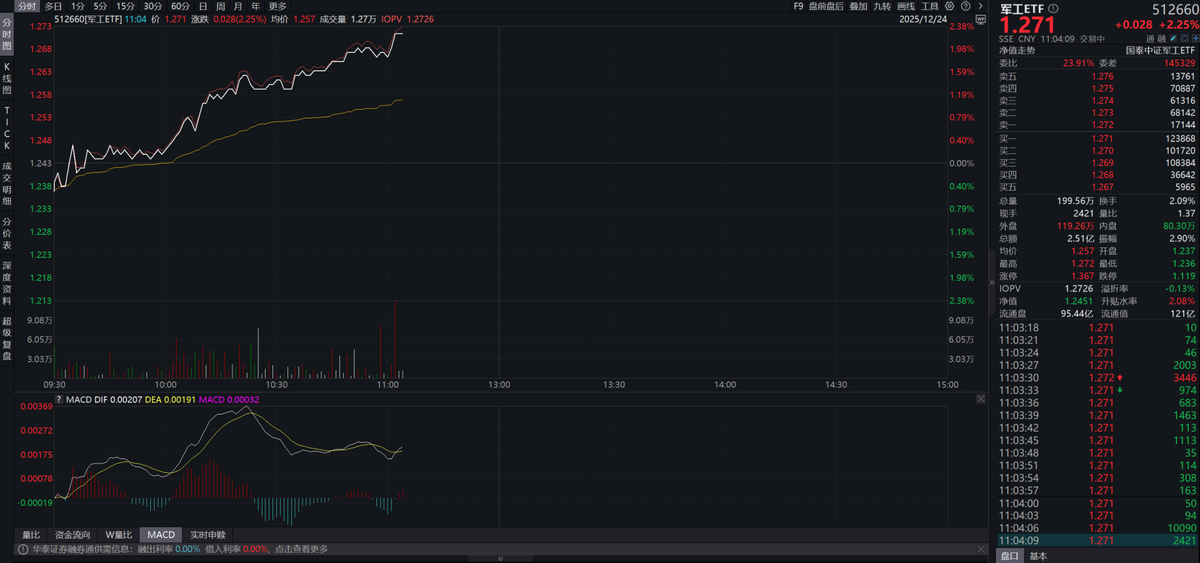
低轨卫星加速发展,军工ETF(512660)涨超2%
Mei Ri Jing Ji Xin Wen· 2025-12-24 07:52
Group 1 - The low Earth orbit (LEO) satellite communication is entering a critical phase of large-scale deployment and commercialization, boosting the fundamentals of the military industry, with the military ETF (512660) rising over 2% [1] - The acceleration of satellite development is driven by the global digitalization process, existing blind spots in terrestrial communication networks, and emerging application scenarios such as low-altitude economy, ocean communication, emergency rescue, and IoT wide-area connectivity [3] - LEO satellites are becoming a core pillar for building the next-generation integrated information infrastructure due to their unique advantages of low latency, high bandwidth, wide coverage, and low dependence on ground stations [3] Group 2 - Enhanced on-board processing (OBP) capabilities allow satellites to have stronger data routing and computing functions, reducing reliance on ground stations, while mature phased array antenna technology significantly improves user terminal performance and portability [4] - The widespread use of reusable launch vehicles alleviates launch bottlenecks, leading to a continuous decrease in the cost of transmitting per bit, establishing an economic foundation for large-scale user access [4] - Policies supporting the construction of LEO satellite constellations have been included in several national strategies, with clear growth paths created for various segments of the industry chain [4] Group 3 - The alleviation of capacity bottlenecks in the industry chain is expected to benefit the manufacturing sector, with ground equipment revenue projected to account for the highest share of global satellite industry revenue in 2024 [7] - As OBP technology is realized, the dependence of constellations on ground stations is expected to decrease, indirectly compressing satellite operating costs and increasing the revenue share of satellite manufacturing and services [7] - There is anticipated growth in demand for consumer broadband terminals, IoT terminals, and specialized communication devices for industries, providing unprecedented market opportunities for domestic companies with core hardware R&D and large-scale delivery capabilities [7] Group 4 - The military ETF (512660) covers the entire military industry chain, ranking first among similar products, and reflects the overall performance of representative listed companies in the defense and military sectors [9][12] - The military industry is expected to enter a new growth cycle during the 14th Five-Year Plan period, with increased demand for new-generation main battle equipment and new operational capabilities, leading to a sustained boom until 2027 [9] - The military industry is transitioning to a high-quality development phase, with improvements expected on both supply and demand sides, and foreign trade in military products becoming a cornerstone of growth [9]