
造船

Search documents
建信期货焦炭焦煤日评-20250603
Jian Xin Qi Huo· 2025-06-03 11:41
Report Information - Report Type: Coking Coal and Coke Daily Review [1] - Date: June 3, 2025 [2] - Research Team: Black Metal Research Team [3] - Researchers: Zhai Hepan, Nie Jiayi, Feng Zeren [3] 1. Market Conditions 1.1 Futures Market - On May 30, the main contract J2509 of coking coal futures hit a new low since January 2017 for the September contract, with the decline narrowing. The main contract JM2509 of coking coal futures saw an enlarged decline, hitting a new low since July 2016 for the September contract [5]. - J2509: The previous closing price was 1332 yuan/ton, opening at 1333 yuan/ton, with a high of 1334.5 yuan/ton, a low of 1295.5 yuan/ton, and a closing price of 1308 yuan/ton, down 2.13%. The trading volume was 31,257 lots, and the open interest was 56,074 lots, a decrease of 358 lots, with a capital outflow of 0.36 billion yuan [5]. - JM2509: The previous closing price was 759 yuan/ton, opening at 757 yuan/ton, with a high of 759.5 yuan/ton, a low of 726 yuan/ton, and a closing price of 726 yuan/ton, down 5.28%. The trading volume was 875,062 lots, and the open interest was 552,525 lots, an increase of 12,197 lots, with a capital outflow of 1.08 billion yuan [5]. 1.2 Spot Market - On May 30, the ex - warehouse price index of quasi - first - grade metallurgical coke at Rizhao Port, Qingdao Port, and Tianjin Port was 1340 yuan/ton, with no change. The price in Tangshan was 1270 yuan/ton, also unchanged [8]. - The aggregated price of low - sulfur primary coking coal in Tangshan was 1275 yuan/ton, unchanged; in Lvliang, it was 1150 yuan/ton, down 50 yuan/ton; in Linfen, it was 1200 yuan/ton, unchanged; in Handan, it was 1220 yuan/ton, unchanged; in Heze, it was 1320 yuan/ton, unchanged; in Pingdingshan, it was 1460 yuan/ton, unchanged [8]. 2. Technical Analysis - On May 30, the daily KDJ indicators of the coking coal 2509 contract showed a divergent trend, with the J and K values turning up and the D value continuing to decline, showing a potential golden cross. The daily KDJ indicators of the coking coal 2509 contract continued to diverge downward. The daily MACD green bars of the coking coal 2509 contract continued to expand slightly, while those of the coking coal 2509 contract expanded further [8]. 3. Outlook 3.1 Coking Coal - In the past 5 weeks, the coking coal production of independent coking plants has slightly declined after hovering near the highest level since early August last year. The coking coal production of steel mills has also slightly declined compared to late April. In the past 6 weeks, the coking coal inventory at ports has significantly decreased, but the de - stocking speed of steel mills is slow, and the inventory of coking plants has started to accumulate, adding new downward pressure on coking coal prices. The profit per ton of coking coal has been in the red for 2 consecutive weeks, mainly due to two rounds of price cuts for coking coal in mid - and late May, hitting a new low in recent years [10]. 3.2 Coking Coal - From January to April, the year - on - year growth of imports turned negative, but the absolute value of imports remained high, and the overall loose supply pattern was difficult to reverse. The raw coal inventory of coal washing plants first increased and then decreased, and the clean coal inventory rose again to a relatively high level. In the past 6 weeks, the inventory of independent coking plants has significantly decreased, and the port inventory has also returned to the normal level before early August last year, but the steel mill inventory has increased steadily. With steel mills still having relatively sufficient inventory, if coking plants also adopt a de - stocking strategy, coking coal prices are likely to fall rather than rise [10]. 3.3 Overall - Although the weak market for coking coal and coke futures continues, and there may still be new lows in early June, positive factors in the fundamentals and news are accumulating. Attention should be paid to whether a turnaround in the market can occur around early June due to changes in tariff policies and the recovery of confidence in the steel market [10]. 4. Industry News - On May 29, the General Office of the Communist Party of China Central Committee and the General Office of the State Council issued an opinion on improving the market - based allocation system for resource and environmental factors, aiming to improve the carbon market coverage and other aspects by 2027 [11]. - The third - round and fourth - batch of central ecological and environmental protection inspections were launched, targeting 5 provinces and 3 central enterprises [11]. - Zhang Guoqing emphasized safety production at the launch ceremony of the 2025 National "Safety Production Month" [12]. - Sansteel Minguang's production, capacity replacement, fuel procurement, and sales situation were introduced, and it believed that relevant production - restriction policies were reasonable and necessary [12]. - Shanxi Coking Coal International Energy will focus on its main business in 2025 and optimize resource allocation [12]. - Shaanxi Energy's profit decline in the first quarter was due to lower power generation and coal sales prices [12]. - As of May 30, the coal inventory at Qinhuangdao Port was 6.75 million tons, showing different changes compared to the previous week, month, and year [13]. - Yitai B - share completed the tender offer for ST Xinchao's controlling stake [13]. - Tongbao Energy will manage its coal inventory according to market conditions [13]. - From January to April 2025, China's shipbuilding industry maintained its leading position globally, and the industry's boom cycle is expected to continue [13]. - The US Federal Circuit Court of Appeals temporarily suspended the ruling against Trump's tariff measures [14]. - The OECD report pointed out that planned capacity expansion may exacerbate global steel over - capacity [14]. - Clean energy accounted for an increasing proportion of US power generation in March and April [14]. - Turkey's coal imports in April 2025 increased year - on - year and month - on - month [14]. - Bayan Resources' coal sales volume in the first quarter of this year increased significantly, but the average selling price was lower than expected [14]. 5. Data Overview - The report provides various data charts, including the spot price index of metallurgical coke, the aggregated price of primary coking coal, the production and capacity utilization of coking plants and steel mills, the daily average pig iron production, the inventory of coking coal and coke at ports, steel mills, and coking plants, the profit per ton of coking coal, the production and operating rate of coal washing plants, the raw coal and clean coal inventory of coal washing plants, and the basis between spot and futures contracts [16][17][22]
突发!美国宣布关税豁免延长
Sou Hu Cai Jing· 2025-06-03 01:39
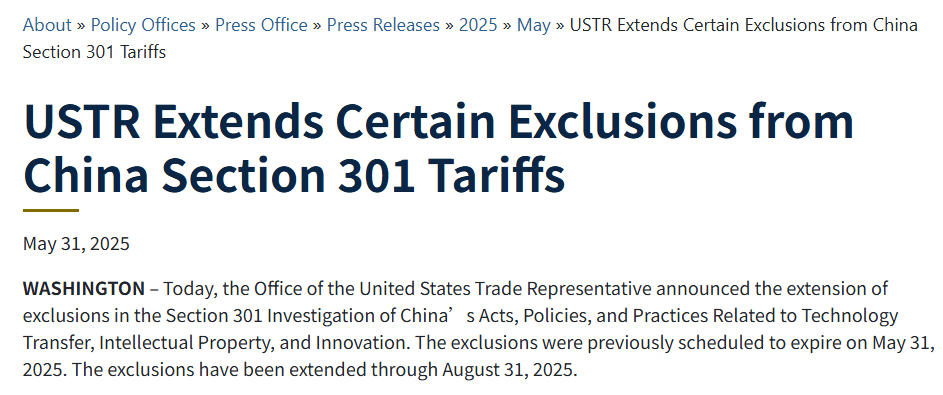
Core Points - The U.S. Trade Representative's Office announced an extension of the tariff exemption period for certain products related to China's technology transfer, intellectual property, and innovation practices from May 31, 2025, to August 31, 2025 [1][3] Group 1: Tariff Exemption Extension - The extension of the tariff exemption is based on public feedback received by December 29, 2023, and ongoing evaluations during the four-year review process [3] - A total of 164 items from Attachment A and 14 items from Attachment B will have their exemptions extended for an additional three months [3] - The exemption applies to products listed in Attachments A and B, including chemical materials, electronic components, medical supplies, solar manufacturing equipment, and wafer handling equipment [4] Group 2: Historical Context and Economic Impact - Historical data indicates that during the Trump administration, four rounds of "301 tariffs" were imposed on China, with the first three rounds having a 25% increase and the fourth round at 7.5% [3] - The average weighted tariff rate on Chinese imports was 19.3% at the beginning of 2020, but is projected to decrease to 10.7% by the end of 2024 due to changes in export proportions and product categories [3] - The U.S. has faced criticism for its unilateral and protectionist measures, which have been deemed to disrupt international trade order and supply chain stability [4] Group 3: New Investigations and Responses - On April 17, the U.S. Trade Representative's Office initiated a 301 investigation into China's maritime, logistics, and shipbuilding industries, which has been met with strong opposition from China [5] - China's Ministry of Commerce criticized the U.S. for misrepresenting normal trade activities as threats to national security and for blaming its own industrial issues on China [5] - The Chinese government has urged the U.S. to respect facts and multilateral rules, calling for a return to a rules-based multilateral trading system [5]

心智观察所:14年的博弈,中国造船是如何取代韩国霸主地位的
Guan Cha Zhe Wang· 2025-06-02 01:12
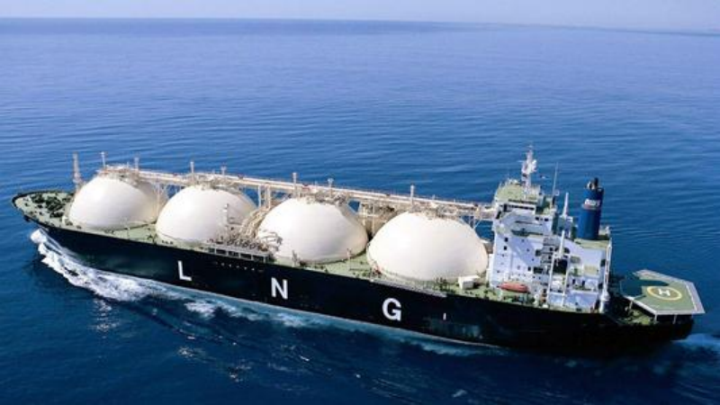
Core Viewpoint - The article highlights China's dominance in the global shipbuilding industry, achieving a 74.7% share of new ship orders in 2024, effectively ending South Korea's 20-year reign as the leader in this sector [1][4]. Group 1: Historical Context - The shipbuilding industry has historically seen shifts in dominance among major nations, with the UK, Japan, and South Korea each holding the crown at different times [1][3]. - In 2000, South Korea surpassed Japan with a 40% market share, while China held only 4% at that time [3]. Group 2: Recent Developments - By 2024, China led in three key metrics: completion volume (55.1%), order backlog (61.4%), and new orders (74.7%), while South Korea's shares were significantly lower at 25.6%, 24.1%, and 17% respectively [4]. - China's new orders reached 87.11 million deadweight tons (DWT), a 51.7% year-on-year increase, while South Korea's new orders were only 10.98 million compensated gross tons (CGT) [4]. Group 3: Competitive Advantages - China's shipbuilding success is attributed to its scale, technology, and integrated supply chain, allowing for greater efficiency compared to South Korea's fragmented approach [6][7]. - The China State Shipbuilding Corporation (CSSC) has consolidated its shipyards to create a closed-loop system from design to construction, enhancing operational efficiency [6]. Group 4: Technological Advancements - China has made significant strides in high-end ship types, including LNG carriers, where it captured 48% of the global orders in 2024, closely trailing South Korea's 50% [8]. - The successful delivery of China's first self-developed large cruise ship, "Aida Magic City," demonstrates a shift from low-end manufacturing to high-end intelligent manufacturing [8]. Group 5: Green Technology Leadership - China leads in green shipbuilding, with green vessel orders rising from 8.2% in 2016 to 41% in 2024, capturing over 70% of global green ship orders [8][9]. - Innovations include the world's first LNG-powered ultra-large crude carrier and the largest dual-fuel powered car carrier, showcasing China's advancements in green technology [9][11].
中国反制后,3名美上将罕见承认美国已受阻,美国局势还在恶化
Sou Hu Cai Jing· 2025-05-31 11:06
Group 1: U.S.-China Relations and Military Dynamics - The U.S. military leadership acknowledges that U.S. global strategy is significantly hindered by China's counteractions, indicating a shift in the balance of power [1][11] - The U.S. has implemented strict export controls on high-end chips to China, aiming to isolate China's high-tech industry and prevent its self-sufficiency in this critical sector [3][4] - China has responded to U.S. tariffs with equivalent countermeasures, leading to increased inflation in the U.S. due to reliance on Chinese low-end products [3][6] Group 2: Resource Dependency and Military Production - The U.S. military's dependency on Chinese rare earth elements is highlighted, with over 80% of its military supply chain reliant on these materials, which are crucial for advanced weaponry [6][9] - The U.S. military's production capabilities are under threat due to potential restrictions on rare earth exports from China, which could lead to material shortages and production halts [6][10] - The U.S. has proposed unrealistic solutions to its rare earth challenges, such as acquiring territories for resource access, which are impractical and violate international law [6][10] Group 3: Technological and Industrial Competitiveness - China's shipbuilding capacity is reported to be 200 times greater than that of the U.S., showcasing a significant gap in military production capabilities [7][9] - The U.S. Navy's shipbuilding projects are lagging, with significant delays in the construction of new vessels compared to China's rapid production timelines [7][9] - The U.S. military leadership expresses deep concern over China's advancements in both traditional and emerging military capabilities, indicating a loss of competitive edge [9][10] Group 4: Strategic Misjudgments and Future Directions - The U.S. has historically underestimated China's potential and resilience, leading to misguided policies that have exacerbated its current strategic challenges [10][11] - The U.S. military's resource allocation issues and inefficient budget usage contribute to its declining military effectiveness [10][11] - A call for the U.S. to abandon its hegemonic mindset and seek cooperative relations with China is emphasized as a necessary step for future stability [11]

智通港股解盘 | 计划不如变化形势依然复杂 石药集团(01093)BD合作再传捷报
Zhi Tong Cai Jing· 2025-05-30 13:21
Market Overview - The Hong Kong stock market experienced a gap down of 1.2% due to unexpected developments in the trade war, despite initial optimism about tariff negotiations [1] - The U.S. Court of Appeals temporarily suspended a lower court's ruling that prohibited the enforcement of several tariff orders from the Trump administration, providing a temporary reprieve for the administration [1][2] Trade Policy Developments - The Trump administration is considering a two-step strategy to ensure the continuation of its tariff policies, potentially utilizing a rarely invoked clause from the Trade Act of 1974 to impose tariffs of up to 15% for 150 days [2] - U.S. Treasury Secretary indicated that trade negotiations between the U.S. and China are currently stalled, requiring direct involvement from both countries' leaders to reach an agreement [2] Industry Responses - In response to the U.S. trade actions, China announced export controls on seven categories of rare earth materials, which are critical for various industries including automotive and aerospace [3] - The Chinese rare earth sector is expected to see movements in related stocks, such as China Rare Earth (00769) and Jinhui Rare Earth (06680) [3] Pharmaceutical Sector Highlights - The pharmaceutical company CSPC Pharmaceutical Group (01093) announced three potential BD collaborations with a total transaction value nearing $5 billion, with one deal expected to be signed next month [4] - The stock of CSPC Pharmaceutical rose over 6%, reaching a new high for the year, reflecting the growing competitiveness of Chinese innovative drug companies in the global market [4] Shipbuilding Industry Performance - The Chinese shipbuilding industry demonstrated strong resilience, with completion and new order volumes for the first four months of the year reaching 15.32 million deadweight tons and 30.69 million deadweight tons, respectively, maintaining a global market share of 49.9% and 67.6% [8] - Many shipbuilding companies report full order books, with some orders extending to 2029, indicating a sustained positive outlook for the industry [8] Individual Company Insights - China Shipbuilding Defense (00317) reported a significant increase in revenue and net profit for Q1, with net profit growing by 1099.85% year-on-year, driven by increased ship product revenue and improved production efficiency [10] - The company has a robust order backlog, with new orders in Q1 amounting to RMB 12.502 billion, which is 71.64% of its annual target, indicating strong future cash flow and operational performance [10]
新华财经晚报:三部门印发通知加大国有企业技能人才薪酬分配激励
Xin Hua Cai Jing· 2025-05-30 10:00
Domestic News - The Ministry of Human Resources and Social Security, the Ministry of Finance, and the State-owned Assets Supervision and Administration Commission issued a notice to enhance the salary distribution incentives for skilled talents in state-owned enterprises, emphasizing a dual linkage between position salary and job value, as well as skill level [1][3] - The total import and export value of automotive goods in China for January to April 2025 reached $81.88 billion, a year-on-year decrease of 5.2%. In April 2025 alone, the total was $23.09 billion, with imports at $3.7 billion and exports at $19.39 billion [2][3] - The China Communications Industry Association reported that in April 2025, the domestic smartphone shipment reached 25.04 million units, a year-on-year increase of 4.0%, with 5G smartphones accounting for 79.4% of the total [2][3] Financial Market Developments - The Shanghai Stock Exchange and the China Securities Index Co., Ltd. will officially launch the SSE 580 Index on June 16, 2025, which will reflect the overall performance of 580 smaller-cap stocks in the Shanghai market [4] - Ping An Asset Management has received approval to establish Hengyi Holding (Shenzhen) Private Fund Management Co., with a registered capital of 300 million yuan, aimed at issuing a private securities investment fund with an initial scale of 30 billion yuan [5] International News - The Eurozone's broad money supply (M3) annual growth rate increased to 3.9% in April 2025, surpassing the previous month's revised figure of 3.7% [6] - The U.S. trade friction index for March was reported at 126, indicating a high level of global trade tensions, with the monetary value of trade friction measures increasing by 26.1% year-on-year and 152.3% month-on-month [3]
造船企业订单饱满 有企业订单已排至2029年
news flash· 2025-05-30 06:51
Group 1 - The core viewpoint of the article highlights the strong market resilience and competitiveness of China's shipbuilding industry, which continues to maintain the largest share of new orders globally despite complex global trade conditions [1] - From January to April, China's shipbuilding industry secured new orders that accounted for the largest market share in the world [1] - Many shipbuilding companies have a full order book, with production schedules extending several years into the future, with some companies' orders reaching as far as the first half of 2029 [1] Group 2 - Dalian COSCO KHI Ship Engineering Co., Ltd. is currently constructing large 16,000 TEU container ships and six dual-fuel LNG large crude oil carriers [1] - The company has reported that both of its docks are fully booked with orders extending into 2029 [1]
5.29犀牛财经早报:公募今年新发规模已超4000亿元 哪吒汽车债转股失败
Xi Niu Cai Jing· 2025-05-30 02:20
Group 1 - Public funds have launched over 400 billion yuan in new funds this year, with 515 new funds established and a total issuance scale of 406.08 billion yuan as of May 29 [1] - Nearly 70% of A-share companies plan to distribute cash dividends, with 2,546 companies reporting a year-on-year increase in net profit [1] - Over 170 billion yuan of long-term insurance capital is accelerating into the market, indicating a growing demand for equity asset allocation [1] Group 2 - Jim Rogers has sold all his U.S. stocks and holds significant cash, expressing concerns about a potential crisis in the market [2] - Michael Burry has nearly liquidated his U.S. stock portfolio, retaining only Estée Lauder [2] - The emergence of AI agents is accelerating across various sectors, with expectations for a significant breakthrough by 2025, despite current challenges in development [2] Group 3 - In April, the net profit of 150 futures companies in China declined both year-on-year and month-on-month, with total revenue of 3.073 billion yuan and net profit of 785 million yuan [3] - The global smartphone shipment growth forecast for 2025 has been significantly reduced to 0.6% due to economic uncertainties and declining consumer spending [4] - China's shipbuilding industry continues to lead globally, with new orders accounting for a significant market share [4] Group 4 - Alibaba has open-sourced its innovative autonomous search AI agent, WebAgent, which can autonomously search and analyze information [5] - Nvidia's CEO plans to sell up to 6 million shares of the company, indicating potential changes in executive holdings [5] - Yushun Technology has changed its name to Hangzhou Yushun Technology Co., Ltd., sparking speculation about a potential IPO [5] Group 5 - Yongkun Gold has faced significant redemption issues, leading to investor complaints and legal actions, undermining its investment promises [6] - Rongda Hezhong plans to raise up to 220.8 million HKD through an IPO in Hong Kong [6] Group 6 - *ST Jinguang is facing mandatory delisting due to continuous false reporting in its annual reports, with trading suspended [8] - *ST Longyu's chairman has resigned due to personal reasons, with interim leadership established [8] Group 7 - Neta Auto's debt-to-equity swap plan has failed, leading to demands from investors for the removal of its CEO [9] - U.S. stock indices experienced slight gains, with mixed performance among major companies [9]


英媒:印度与美贸易谈判,对核心农产品高额关税态度坚决
Huan Qiu Shi Bao· 2025-05-29 22:47
Core Insights - A US trade team is expected to visit India next month for trade negotiations, with a potential temporary trade agreement by June 25 [1] - India is proposing significant tariff reductions in certain areas while seeking to maintain high tariffs on sensitive agricultural products like grains and dairy [1][2] - The negotiations are still in early stages and may become complicated due to opposition from affected industries [2] Group 1: Trade Negotiations - India has indicated a flexible stance on tariffs for less sensitive agricultural products like almonds and may reduce import duties on oil and gas by 2.5% to 3% [1] - The Indian trade representatives are firm on retaining high tariffs on core agricultural products such as wheat, rice, corn, and dairy [1] - Current tariffs imposed by India include 70%-80% on US rice and 30%-60% on US dairy products [1] Group 2: International Context - India has a history of protecting its dairy industry, being the largest milk producer globally, and has pushed for similar protections in recent trade agreements [2] - Other countries like South Korea and Japan are also engaged in tariff negotiations with the US, focusing on sectors like steel, aluminum, and automobiles [2] - The US has shown a cautious approach towards reviewing tariff measures, particularly in the automotive sector, while being receptive to cooperation in shipbuilding with Japan [2]

韩国:2025年总统选举前的阿尔法策略思路及政策影响
Goldman Sachs· 2025-05-29 06:00
Political Landscape - The emergency presidential election in South Korea is scheduled for June 3, 2025, following political uncertainty due to the declaration of martial law and the impeachment of President Yoon Suk-yeol[6]. - Recent polls indicate that opposition candidates are leading, reflecting a favorable trend for the opposition party amid high public support for changing the current government[7][8]. Economic Policy Outlook - Key economic policy platforms focus on improving corporate governance and addressing the "Korea discount," with retail investors representing nearly 30% of the population[19]. - Major candidates propose four main categories of capital market policies: corporate governance reform, tax incentives, enhanced accessibility for capital markets, and establishing a fair market order[20]. Market Projections - The KOSPI 12-month target has been raised to 2900, indicating a 9% upside potential, driven by the elimination of political risks and advancements in capital market reforms[3][64]. - The potential reclassification of South Korea's MSCI status could attract approximately $20-30 billion in foreign investment, improving market accessibility[48][51]. Corporate Governance Reforms - Both leading candidates emphasize the importance of corporate governance reforms, which could play a crucial role in narrowing the Korea discount[22][23]. - Despite previous efforts, the valuation of the Korean stock market remains significantly discounted compared to regional and global peers, with a price-to-book ratio discount of 48% compared to developed markets[28]. Tax Incentives - Proposed reforms include changes to dividend and inheritance tax policies to encourage higher dividend payouts, which previously saw significant increases when similar policies were implemented in 2014[37][40]. - The inheritance tax reform aims to address undervaluation issues of listed company stocks, particularly for those with a price-to-book ratio below 0.8[38]. Market Order and Transparency - Candidates commit to strengthening penalties for illegal trading practices, such as insider trading, to enhance protection for minority shareholders and improve market transparency[52][53]. - The overall number of unfair trading cases has decreased, but there has been a rise in cases related to interest disclosures in 2024[53]. Sector-Specific Policies - Both candidates support strategic industries such as AI, renewable energy, and defense, with commitments to establish investment funds and incentives for domestic production[59][60]. - The focus on enhancing the competitiveness of the shipbuilding industry and advancing defense technology is also highlighted in their platforms[60].