
交通运输

Search documents
中俄免签新政助推跨境出行 东宁打造全链条“保姆式”服务
Zhong Guo Xin Wen Wang· 2025-12-03 06:06
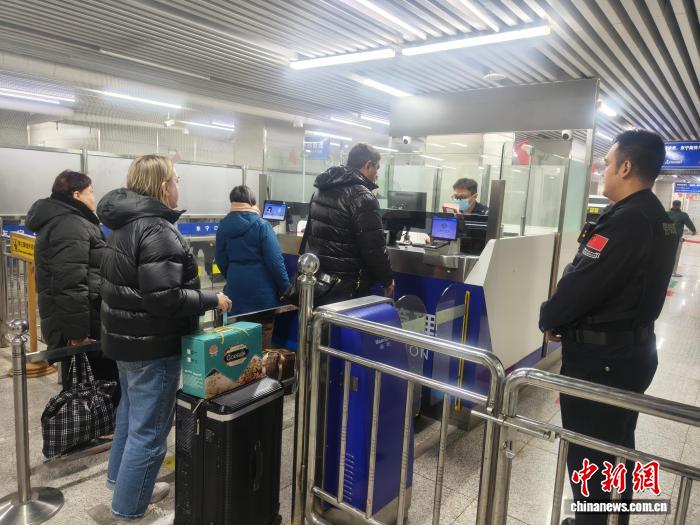
Core Viewpoint - The implementation of the visa-free policy between China and Russia is revitalizing cross-border travel, with Dongning City enhancing its services to create a comprehensive travel experience for visitors [1][2]. Group 1: Policy Impact - The visa-free policy for Chinese passport holders has been officially implemented, injecting new momentum into personnel exchanges and economic and cultural interactions between China and Russia [2]. - Dongning Port, as the closest land port to Vladivostok, has become a significant channel for Sino-Russian exchanges since its opening in 1990 [2]. Group 2: Service Enhancements - Dongning City has optimized its entry and exit services by setting up clear signage and providing dedicated personnel to assist travelers, resulting in a smooth and efficient crossing experience [2]. - The city has introduced a "7 days × 12 hours without lunch break + flexible extended customs clearance" model to meet cross-border travel demands [3]. - A "fast-track passport replacement green channel" has been established, along with electronic verification process improvements and Russian translation equipment, significantly reducing customs clearance times [3]. Group 3: Transportation and Tourism - Dongning City has launched bilingual shuttle services from the port to key urban areas, established transportation service desks, and created one-stop service packages that include accommodation and transportation [3]. - The city is promoting unique tourism routes such as border-themed tours and leisure picking, while also enhancing shopping experiences through the establishment of display and sales centers [3]. - Cultural events like Sino-Russian art evenings and calligraphy exhibitions are planned to enrich cross-border consumption scenarios [3]. Group 4: Future Development - Dongning officials aim to further improve the "port-scenery-business circle" travel loop, ensuring that the benefits of the visa-free policy are fully realized for open development [5]. - The city is poised to become a vital active node in the Northeast Asia economic corridor as the visa-free policy continues to be implemented [5].

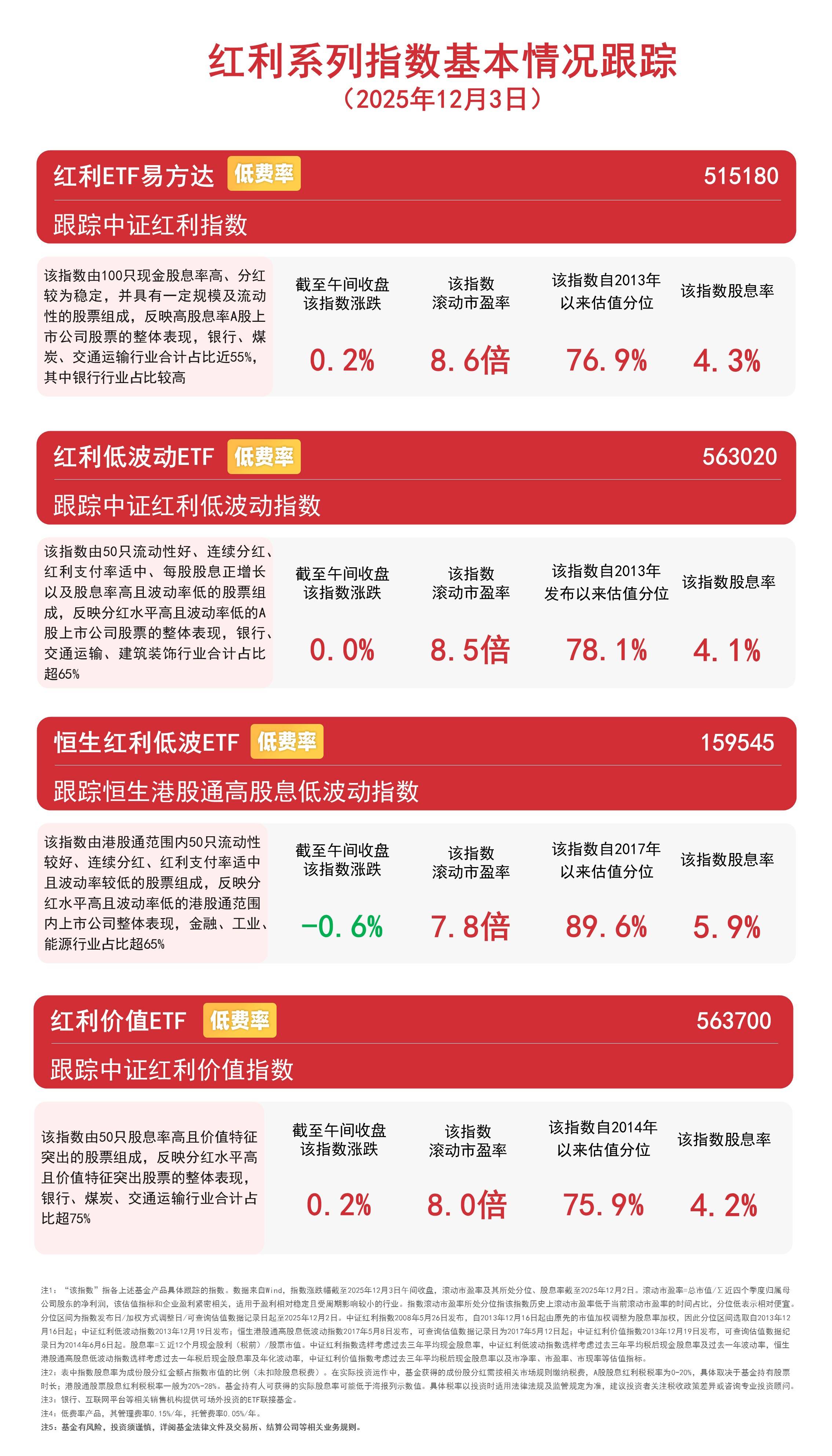
红利板块震荡分化,资金持续加仓,恒生红利低波ETF(159545)半日净申购超1亿份
Sou Hu Cai Jing· 2025-12-03 05:15
Group 1 - The core viewpoint of the news highlights the performance of dividend-related indices, with the CSI Dividend Value Index and CSI Dividend Index both rising by 0.2%, while the Hang Seng High Dividend Low Volatility Index decreased by 0.6% [1][6] - E Fund is noted as the only fund company offering low fee rates for all dividend ETFs, with management fees set at 0.15% per year for various products, facilitating low-cost investment in high-dividend assets [1][5] - The CSI Dividend Index comprises 50 stocks characterized by good liquidity, continuous dividends, moderate payout ratios, positive growth in dividends per share, and low volatility, with banking, transportation, and construction industries accounting for over 65% of the index [4] Group 2 - The Hang Seng High Dividend Low Volatility Index consists of 50 stocks within the Hong Kong stock market that exhibit good liquidity, continuous dividends, moderate payout ratios, and low volatility, with financial, industrial, and energy sectors making up over 65% of the index [6] - The Hang Seng Low Dividend ETF (159545) has seen a net subscription exceeding 100 million units in the first half of the day [1]
南京明确未来3—5年城市工作重点
Nan Jing Ri Bao· 2025-12-03 02:16
Core Insights - Nanjing is focusing on high-quality urban development and enhancing its urban capabilities through various infrastructure projects and spatial planning initiatives [2][3][4] Group 1: Urban Development Initiatives - Nanjing will accelerate the construction of key projects such as the third phase of Lukou International Airport and the Ningxuanhuang Railway to enhance transportation hubs [2][3] - The city aims to optimize urban layout and promote development along the Yangtze River, while also advancing the approval and implementation of the Nanjing Urban Circle Land Space Planning [2][3] - The city plans to create a one-hour commuting circle and a one-day living circle by developing suburban railways and enhancing connectivity within the urban area [2][3] Group 2: Quality of Life Improvements - Nanjing will implement a series of actions to improve urban quality, including enhancing public spaces, transportation order, and waste management [5] - The city aims to create vibrant urban centers by focusing on pedestrian networks, public services, and cultural experiences in key districts [4][5] - The city will also promote the construction of 29 proposed projects to enhance public space quality and create a vibrant center ecosystem [4] Group 3: Innovation and Economic Development - Nanjing is developing a spatial strategy to enhance industrial strength and innovation, with plans to release over 120 square kilometers of new construction land during the 14th Five-Year Plan [6] - The city will support the establishment of innovation hubs and collaborative spaces between universities and enterprises to drive economic growth [6] - Jiangbei New Area will focus on building a "Smart Manufacturing Corridor" to strengthen the regional industrial innovation capacity [6]
爱沙尼亚2025年第三季度经济同比增长0.9%
Shang Wu Bu Wang Zhan· 2025-12-02 17:21
Economic Overview - Estonia's GDP reached €10.49 billion in Q3 2025, showing a year-on-year growth of 0.9% and remaining stable quarter-on-quarter [1] - Private consumption decreased by 0.6% year-on-year, while government consumption increased by 3.4%, marking the fastest growth since Q2 2024 [1] - Overall investment fell by 0.7% year-on-year, with government investment rising by 8.8% and corporate investment declining significantly by 27.3% [1] - Household investment in housing grew by 12.1% year-on-year [1] Trade Performance - External trade continued to grow, with goods and services exports increasing by 5.7% year-on-year and imports rising by 5.6% [1] - Net exports achieved positive growth for the second consecutive quarter [1] Sector Performance - The energy sector experienced the highest value-added growth at 21.5% year-on-year [1] - Manufacturing sector value-added grew by 7.9% year-on-year [1] - The real estate sector saw a value-added increase of 4.4% year-on-year [1] - The accommodation and food services sector faced the largest decline in value-added, down by 8.8% year-on-year [1] - Transportation sector value-added decreased by 6.9% year-on-year [1] - Wholesale and retail trade sector value-added also fell by 6.9% year-on-year [1] - Health and social work sector value-added declined by 4.5% year-on-year [1]
A股公告精选 | 10天7板梦天家居(603216.SH):如股价进一步异常上涨 或申请停牌核查
智通财经网· 2025-12-02 12:43
Group 1 - Tianpu Co., Ltd. has completed the stock suspension review and will resume trading on December 3, 2025, after a significant price increase of 451.8% from August 22 to November 27, indicating potential trading risks [1] - Daoming Optics announced that it does not have any AI mobile phone-related business despite recent media discussions, and its stock experienced abnormal trading fluctuations with a cumulative price deviation exceeding 20% [2] - Jiangbolong plans to raise no more than 3.7 billion yuan for high-end storage research and industrialization projects related to AI and semiconductor storage control chips [3] Group 2 - Daimai Co., Ltd. received an insurance compensation of 14.7 million USD for a fire incident, which will be recorded as non-recurring income in the 2025 financial statements [4] - Meng Tian Home has seen its stock price deviate over 100% in the last 10 trading days, and may apply for a suspension review if the price continues to rise abnormally [5] - Daming City announced that 10.13% of shares held by its controlling shareholder are subject to judicial freezing and marking, but this will not adversely affect the company's operations or governance [6] Group 3 - Guomai Culture reported an investment loss of approximately 40 million yuan from a film project, which is expected to impact its 2024 audited net profit by over 10% [7] - Pingtan Development's stock price has increased significantly over three consecutive trading days, raising concerns about irrational speculation despite no major changes in its fundamentals [8] - Xiamen Tungsten plans to invest 942 million yuan in the second phase of its motor industrial park, which is expected to be completed by September 2029 [9] Group 4 - Shunhao Co., Ltd. experienced abnormal stock trading with a cumulative price deviation exceeding 20%, while its investment in a project has uncertain outcomes [10] - Haowei Group's controlling shareholder plans to donate 2.48% of the company's shares to a university foundation [11] - Yutong Bus reported production and sales growth in November 2025, with production increasing by 11.21% year-on-year [12] Group 5 - Tianfu Communication's executives plan to reduce their holdings by a total of 47,500 shares due to personal financial needs [13] - Jixin Technology's secretary plans to reduce holdings by up to 22,764 shares [15] - New Tonglian's major shareholder has reduced its holdings, affecting the equity structure but not violating any commitments [16] Group 6 - Axin Security announced that several shareholders plan to collectively reduce their holdings by up to 1.75% [17] - Gaohua Technology's shareholders plan to reduce their holdings, with specific amounts and percentages outlined [18] - Weisheng Information won three electricity project contracts totaling 65.32 million yuan, which will positively impact its performance [19] - Design Institute recently won 17 projects with a total bid amount of approximately 251 million yuan [20]


两融周报|融资净买入额超过113亿元
Xin Lang Cai Jing· 2025-12-02 11:44
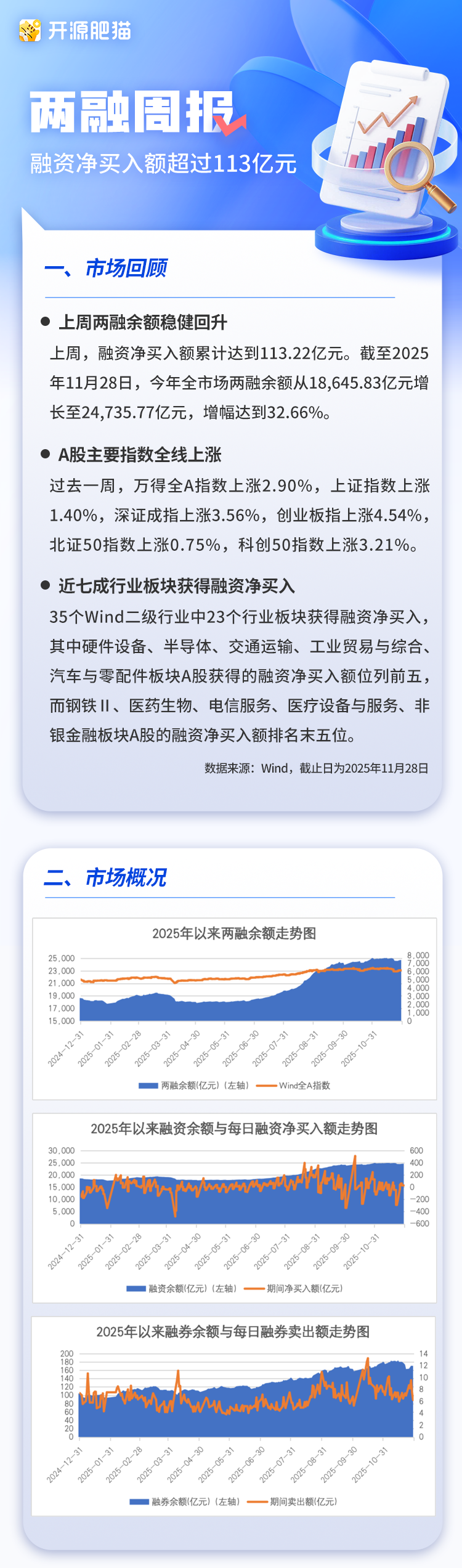
Core Viewpoint - The automotive and parts sector in A-shares has seen significant net buying in financing, ranking among the top five, while sectors such as steel II, pharmaceuticals, telecommunications services, medical devices, and non-bank financials have ranked among the bottom five in net buying [24]. Market Overview - As of November 28, 2025, the financing net buying amounts for various sectors have shown a clear disparity, with 23 out of 35 Wind secondary industry sectors experiencing net buying [24][25]. - The major indices in A-shares have all risen, with the Wind All A Index increasing by 2.90%, the Shanghai Composite Index by 1.40%, the Shenzhen Component Index by 3.56%, the ChiNext Index by 4.54%, the North 50 Index by 0.75%, and the Sci-Tech 50 Index by 3.21% [23]. Financing Net Buying Rankings - The top five sectors for net buying in the past week include: - Industrial Trade and Comprehensive: 94.90 billion - Semiconductor: 33.84 billion - Automotive and Parts: 7.81 billion - Hardware Equipment: 6.82 billion - Transportation: 6.57 billion [31] - The bottom five sectors for net buying in the past week include: - Medical Devices and Services: -1.31 billion - Steel II: -1.99 billion - Pharmaceuticals: -3.89 billion - Telecommunications Services: -4.90 billion - Non-Bank Financials: -24.50 billion [32]. Financing Balance Rankings - The top five sectors by financing balance are: - Hardware Equipment: 3,446.36 billion - Non-Bank Financials: 1,827.97 billion - Semiconductors: 1,800.99 billion - Electrical Equipment: 1,791.24 billion - Software Services: 1,500.74 billion [33].
12.2犀牛财经晚报:六大行全面停售5年期大额存单 11月A股新开户数238万户
Xi Niu Cai Jing· 2025-12-02 10:24
Group 1: Banking and Financial Products - Major banks in China have stopped offering 5-year large-denomination time deposits, with only shorter-term products available [1] - The 3-year large-denomination time deposit rate is 1.55%, while the 1-year and 2-year rates are both 1.20% [1] - In November 2025, A-share new account openings reached 2.38 million, a 3% increase from October, with a total of 24.84 million new accounts opened in the year, reflecting a year-on-year growth of 7.95% [1] Group 2: Investment and Market Trends - The bond fund "Huachen Future Stable Income" experienced a significant net value decline, with a cumulative drop of 6.81% over three trading days due to market conditions affecting certain bonds [2] - The gaming console market is expected to see a 4.4% decrease in shipment volume in 2026 due to rising storage chip prices impacting overall product costs [2] Group 3: Corporate Developments - Nestlé is reportedly considering selling its Blue Bottle Coffee chain, with the expected valuation likely to be below $700 million [4] - Lenovo's ISG division in Shanghai has reportedly undergone mass layoffs affecting hundreds of employees [5] - Huijin Tong announced the resignation of its general manager Zhang Chunhui, with Jin Zhijian appointed as the new general manager [6] - ST Zhongqingbao's vice president Qin Ping has resigned for personal reasons [7] - Guomai Culture reported an estimated loss of approximately 40 million yuan from its investment in the film "The Stars of the Three Kingdoms" [8] - Yutong Bus announced a sales increase of 8.62% year-on-year in November, with total sales for the first 11 months up by 6.14% [9] - Huakang Clean won a bid for a purification system project worth 176 million yuan, which represents 10.29% of its expected revenue for 2024 [10] - Plai Ke plans to acquire a 4.04% stake in Zhongpu Biological for 17.51 million yuan, which will give it control over the company [11] Group 4: Market Performance - Guangzhou Port expects a 14.7% year-on-year increase in container throughput for November, with a total of 2.399 million TEUs [13] - The Design Institute announced winning 17 projects with a total value of approximately 278 million yuan [14] - Weisheng Information reported winning projects worth 65.32 million yuan in November, accounting for 2.38% of its expected revenue for 2024 [15] - The market saw fluctuations with the ChiNext index dropping by 0.69%, while the Fujian sector showed strong performance [16]
中观高频景气图谱:上游企稳回升,中游分化修复
Guoxin Securities· 2025-12-02 09:56
Group 1 - The overall performance of upstream resource products remains low, but internal structure continues to differentiate, with coal industry stability and slight price increases in thermal coal [4] - The manufacturing sector shows an overall recovery, with notable performance in machinery and equipment, while the automotive industry is experiencing marginal improvements [4] - Downstream consumption sectors exhibit varied recovery dynamics, with significant improvements in social services and entertainment, while the real estate sector shows signs of marginal recovery [4] Group 2 - The banking system maintains ample liquidity, with stable growth in M2 and social financing, indicating marginal improvements in the funding environment [4] - The transportation sector shows continued differentiation, with significant growth in port container throughput, while comprehensive freight rates face slight pressure due to geopolitical and supply-demand factors [4] - The environmental sector is experiencing a recovery in performance, with improved air quality rates and sustained high levels of related infrastructure investment [4] Group 3 - The chemical industry is under pressure, with prices of PVC and methanol continuing to decline, while the performance of the basic chemical sector is closely linked to fuel oil and methanol futures prices [5][10] - The steel industry shows a correlation between excess returns and various operational metrics, including iron ore operating rates and steel production inventories [21][25] - The non-ferrous metals sector maintains relative stability, with slight increases in copper and aluminum prices, and its performance is linked to the LME base metals index [27][32] Group 4 - The construction materials sector is facing weak demand, with cement and glass prices remaining in negative territory, and its performance is correlated with cement price indices [38][39] - The coal industry shows a correlation between excess returns and thermal coal closing prices, indicating a relationship with market dynamics [39][43] - The oil and petrochemical sector continues to experience weak performance, with expanding year-on-year declines in gasoline and natural gas prices [44] Group 5 - The electric equipment sector's performance is linked to the prices of photovoltaic components and polysilicon, indicating a recovery phase [46][52] - The automotive sector shows a correlation between excess returns and tire operating rates, with daily average sales of passenger vehicles also being a significant indicator [54][60] - The machinery sector's performance is associated with the BPI and machinery price indices, reflecting its recovery trajectory [61][62] Group 6 - The retail sector's performance is linked to the Yiwu order price index, indicating a recovery in trade activities [89] - The agricultural sector shows a correlation between excess returns and the food price index, with specific attention to the dynamics of vegetable prices and pig feed ratios [92][93] - The food and beverage sector's performance is associated with various agricultural product price indices, reflecting market trends [94][98]
12月2日主题复盘 | 福建板块再度爆发,航天持续活跃,房地产迎资金关注
Xuan Gu Bao· 2025-12-02 08:32
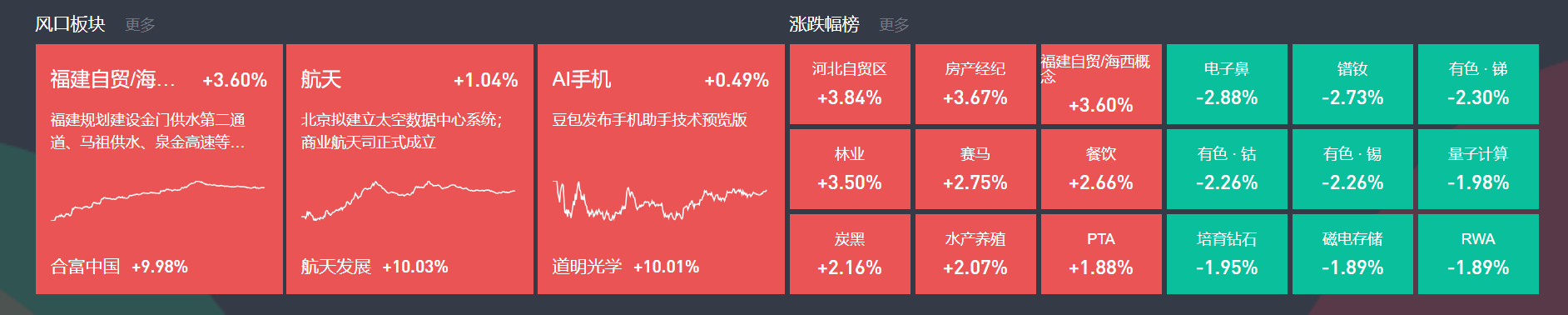
Market Overview - The market experienced a day of volatility with all three major indices declining. Local stocks in Fujian surged, with companies like Fujian Expressway and Pingtan Development hitting the daily limit. The pharmaceutical sector also saw gains, with stocks like Renmin Tongtai and Haiwang Biological reaching the limit. The consumer sector was active, with stocks such as Maoye Commercial and Huifa Food also hitting the limit. Conversely, the consumer electronics sector fell, with Yunzuka Technology hitting the limit down, and the lithium battery sector adjusted, with Shida Shenghua dropping over 7% [1] Hot Topics Fujian Free Trade Zone - The Fujian Free Trade Zone concept saw a significant rise, with stocks like Hefuchina and Pingtan Development hitting the limit again. Hai Xin Food achieved a five-day limit increase, and several other stocks also reached the limit. The catalyst for this surge includes the recent formulation of policies by Fujian Province to implement the Central Government's directives on cross-strait integration development, comprising 12 measures across three areas. Additionally, major projects such as the second water supply channel to Kinmen and the Quanjin Expressway have been approved for planning and construction [4][13] Aerospace Sector - The aerospace sector remained active, with Tongyu Communications achieving a four-day limit increase, and companies like Aerospace Development, Leike Defense, and Shunhao Co. also seeing three-day limit increases. Analysts predict that with a clear policy framework, commercial aerospace will enter a phase of high-frequency launches starting in 2026. From 2027, the proportion of reusable rockets is expected to rise annually, with projections indicating that by 2030, the market size for China's rocket launches could exceed 110 billion yuan [6][8][14] Real Estate Sector - The real estate sector showed strength, with stocks like Dream Home, Shilian Hang, and Haolaike hitting the limit. The China Securities Regulatory Commission announced the pilot program for commercial real estate investment trusts (REITs), which is expected to enhance asset liquidity and promote value reassessment for related enterprises. Recent policies in various regions are also being developed to support the sale of existing homes, indicating a shift towards new development models in real estate [9][11][10]
让互利共赢纽带更结实(开放谈)
Ren Min Ri Bao Hai Wai Ban· 2025-12-01 22:11
Group 1 - China's outbound direct investment continues to grow steadily, solidifying its position as a major investor globally, despite a decline in global cross-border direct investment [1] - Chinese enterprises are distributed across 190 countries, with nearly half of the top 20 investment destinations in 2024 being developed countries [1] - Investment in countries participating in the Belt and Road Initiative reached 234.15 billion RMB in the first ten months of 2025, a year-on-year increase of 22.3% [1] Group 2 - The manufacturing sector saw its highest investment flow in 2024, increasing by 45.3% compared to 2020 [1] - The service industry, characterized by light assets, has flourished, with investments in logistics, R&D, business, and finance growing, extending the investment value chain [2] - In 2024, outbound investments contributed to $211 billion in goods exports, 1.2 times that of 2020 [2] Group 3 - Chinese outbound investments have improved infrastructure in host countries, enhancing employment and tax revenues, and accelerating their green and digital transformation [2] - In 2024, Chinese enterprises paid a total of $82.1 billion in various taxes to host countries, employing 5.021 million people, with 3.304 million being local employees [2] - The focus on localization in investment strategies is emphasized, aiming to enhance sustainable development capabilities in host countries [3]