机械

Search documents
金融工程月报:券商金股 2025 年 10 月投资月报-20251009
Guoxin Securities· 2025-10-09 08:29
Quantitative Models and Construction Methods 1. **Model Name**: Securities Firms' Golden Stock Performance Enhancement Portfolio - **Model Construction Idea**: The model aims to optimize the selection of stocks from the securities firms' golden stock pool to outperform the benchmark, which is the median of equity-biased hybrid fund indices. The model leverages a multi-factor approach to select stocks with high alpha potential while controlling for deviations in individual stocks and style factors from the golden stock pool [39][43]. - **Model Construction Process**: - The securities firms' golden stock pool is used as the stock selection universe and constraint benchmark. - A multi-factor model is applied to further optimize the selection of stocks from the pool. - The portfolio is constructed by controlling the deviation of individual stocks and style factors from the golden stock pool. - The industry allocation is based on the distribution of all public funds [43]. - **Model Evaluation**: The model demonstrates strong alpha generation potential and consistently outperforms the equity-biased hybrid fund index. It reflects the research strength of securities firms and their ability to capture market trends effectively [43]. --- Model Backtesting Results 1. **Securities Firms' Golden Stock Performance Enhancement Portfolio** - **Absolute Return (Monthly)**: -0.55% (2025/09/01 - 2025/09/30) [42] - **Excess Return (Monthly)**: -3.50% relative to equity-biased hybrid fund index (2025/09/01 - 2025/09/30) [42] - **Absolute Return (Year-to-Date)**: 33.26% (2025/01/02 - 2025/09/30) [42] - **Excess Return (Year-to-Date)**: 1.19% relative to equity-biased hybrid fund index (2025/01/02 - 2025/09/30) [42] - **Ranking in Active Equity Funds (Year-to-Date)**: 43.07% percentile (1494/3469) [42] - **Historical Performance (2018-2025)**: - Annualized Return: 19.34% - Annualized Excess Return: 14.38% relative to equity-biased hybrid fund index - Consistently ranked in the top 30% of active equity funds each year [44][47] --- Quantitative Factors and Construction Methods 1. **Factor Name**: Intraday Return - **Factor Construction Idea**: Measures the return generated within a single trading day to capture short-term price movements [27][28]. - **Factor Evaluation**: Demonstrated strong performance in the most recent month [27][28]. 2. **Factor Name**: BP (Book-to-Price Ratio) - **Factor Construction Idea**: Reflects the valuation of a stock by comparing its book value to its market price [27][28]. - **Factor Evaluation**: Performed well in the most recent month but underperformed year-to-date [27][28]. 3. **Factor Name**: Volatility - **Factor Construction Idea**: Measures the degree of variation in a stock's price over a specific period, capturing risk and uncertainty [27][28]. - **Factor Evaluation**: Showed strong performance in the most recent month but underperformed year-to-date [27][28]. 4. **Factor Name**: Total Market Capitalization - **Factor Construction Idea**: Represents the total market value of a company's outstanding shares, often used to gauge company size [27][28]. - **Factor Evaluation**: Underperformed in the most recent month but performed well year-to-date [27][28]. 5. **Factor Name**: SUE (Standardized Unexpected Earnings) - **Factor Construction Idea**: Measures the deviation of actual earnings from expected earnings, standardized by the standard deviation of past earnings surprises [27][28]. - **Factor Evaluation**: Underperformed in the most recent month [27][28]. 6. **Factor Name**: Single-Quarter Earnings Surprise - **Factor Construction Idea**: Captures the magnitude of earnings surprises in a single quarter [27][28]. - **Factor Evaluation**: Underperformed in the most recent month but performed well year-to-date [27][28]. 7. **Factor Name**: Single-Quarter Revenue Growth - **Factor Construction Idea**: Measures the growth in revenue over a single quarter, reflecting a company's sales performance [27][28]. - **Factor Evaluation**: Performed well year-to-date [27][28]. 8. **Factor Name**: Analyst Net Upward Revision - **Factor Construction Idea**: Tracks the net number of upward revisions in analysts' earnings estimates for a stock [27][28]. - **Factor Evaluation**: Performed well year-to-date [27][28]. 9. **Factor Name**: Expected Dividend Yield - **Factor Construction Idea**: Represents the expected annual dividend payments as a percentage of the stock price [27][28]. - **Factor Evaluation**: Underperformed year-to-date [27][28]. --- Factors' Backtesting Results 1. **Intraday Return Factor** - **Recent Month Performance**: Strong [27][28] - **Year-to-Date Performance**: Not specified [27][28] 2. **BP Factor** - **Recent Month Performance**: Strong [27][28] - **Year-to-Date Performance**: Weak [27][28] 3. **Volatility Factor** - **Recent Month Performance**: Strong [27][28] - **Year-to-Date Performance**: Weak [27][28] 4. **Total Market Capitalization Factor** - **Recent Month Performance**: Weak [27][28] - **Year-to-Date Performance**: Strong [27][28] 5. **SUE Factor** - **Recent Month Performance**: Weak [27][28] - **Year-to-Date Performance**: Not specified [27][28] 6. **Single-Quarter Earnings Surprise Factor** - **Recent Month Performance**: Weak [27][28] - **Year-to-Date Performance**: Strong [27][28] 7. **Single-Quarter Revenue Growth Factor** - **Recent Month Performance**: Not specified [27][28] - **Year-to-Date Performance**: Strong [27][28] 8. **Analyst Net Upward Revision Factor** - **Recent Month Performance**: Not specified [27][28] - **Year-to-Date Performance**: Strong [27][28] 9. **Expected Dividend Yield Factor** - **Recent Month Performance**: Not specified [27][28] - **Year-to-Date Performance**: Weak [27][28]


【国信金工】券商金股10月投资月报
量化藏经阁· 2025-10-09 07:08
Group 1 - The core viewpoint of the article emphasizes the performance and characteristics of the "brokerage golden stocks" pool, highlighting significant monthly and annual returns compared to benchmarks like the mixed equity fund index and the CSI 300 index [1][8][35] - In September 2025, the top-performing stocks included Jiangbolong, Xiechuang Data, and Jingzhida, with monthly increases of 86.50%, 81.70%, and 71.73% respectively [4][5] - The top three brokerages by monthly returns were Huazheng Securities, Hualong Securities, and Fangzheng Securities, with returns of 17.45%, 15.17%, and 14.38% respectively, outperforming the mixed equity fund index and the CSI 300 index [7][9] Group 2 - The "brokerage golden stocks" pool is characterized by a strong alpha extraction ability, reflecting both top-down industry allocation and bottom-up stock selection capabilities [3][32] - As of October 9, 2025, 42 brokerages had released their golden stocks for the month, resulting in a total of 304 unique A-shares after deduplication [22] - The sectors with the highest allocation in the golden stocks pool were Electronics (16.11%), Machinery (9.13%), and Non-ferrous Metals (8.17%) [29] Group 3 - The performance of the brokerage golden stock performance enhancement portfolio showed an absolute return of -0.55% for the month ending September 30, 2025, and a year-to-date return of 33.26% [35] - The portfolio's relative performance against the mixed equity fund index was -3.50% for the month and +1.19% year-to-date [35] - The portfolio ranked in the 43.07 percentile among active equity funds this year, indicating a competitive performance [35] Group 4 - The article discusses the factors influencing stock selection within the golden stocks pool, noting that recent performance indicators such as daily return rates and volatility have been strong, while total market capitalization and quarterly surprise performance have lagged [21][19] - The article also highlights the importance of analyst recommendations, noting that stocks with fewer prior recommendations tend to gain more market attention once included in the golden stocks pool [25][30]


中原证券晨会聚焦-20251009
Zhongyuan Securities· 2025-10-09 00:47
Core Insights - The report highlights a positive outlook for the gaming sector driven by strong performance, favorable policies, and AI advancements, with the gaming sub-sector showing significant growth potential [22][24] - The basic chemical industry has shown slight revenue and profit growth in the first half of 2025, indicating a bottoming recovery trend, with total revenue reaching 13,004.67 billion and net profit at 770.50 billion, reflecting year-on-year increases of 4.70% and 0.40% respectively [15][16] - The photovoltaic industry is experiencing a significant decline in new installation demand, with a 55.29% year-on-year drop in new photovoltaic capacity added in August 2025, while the overall effective capacity is expected to decrease due to stricter energy consumption standards [18][19][20] Domestic Market Performance - The Shanghai Composite Index closed at 3,882.78 with a slight increase of 0.52%, while the Shenzhen Component Index rose by 0.35% to 13,526.51 [3] - The A-share market is characterized by a mixed performance across various sectors, with aerospace and automotive industries leading the gains, while gaming and internet services lagged [7][10] Industry Analysis - The report indicates that the manufacturing PMI for September was at 49.8%, showing a slight increase, while the non-manufacturing PMI was at 50.0%, indicating stable economic activity [4][7] - The basic chemical sector's profitability is stabilizing, with a gross margin of 17.97% and a net margin of 6.16% in Q2 2025, reflecting a recovery from previous declines [16][17] Investment Recommendations - The report suggests focusing on high-growth sectors such as gaming, chemicals, and renewable energy, particularly in light of favorable government policies and market conditions [22][24][10] - For the photovoltaic sector, it is recommended to monitor leading companies in the supply chain, especially those involved in energy-efficient technologies and materials [21][19] Macro Strategy - The report emphasizes the importance of maintaining a supportive policy environment to bolster economic recovery, with ongoing measures to promote consumption and stabilize the real estate market [10][7] - The overall sentiment in the capital markets remains positive, with foreign investment continuing to flow into domestic stocks and bonds, indicating confidence in Chinese assets [10][7]

金融制造行业10月投资观点及金股推荐-20251008
Changjiang Securities· 2025-10-08 14:49
Investment Rating - The report maintains a "Buy" rating for several key stocks in the financial and manufacturing sectors, including Yuexiu Property, New China Life Insurance, Nanjing Bank, and others [13][18][19][25][35][42]. Core Insights - The report highlights a recovery in industrial profits, with August showing a significant year-on-year profit growth of 20.4%, although revenue growth remains modest at 1.9% [10]. - The real estate sector is under pressure, but there is potential for policy easing to create trading opportunities, particularly for quality developers with low inventory [11]. - Non-bank financials are expected to maintain high growth in Q3, driven by market enthusiasm and performance of leading stocks [14]. - The banking sector is viewed positively, especially for quality city commercial banks, which are expected to offer stable dividends and growth [17]. - The new energy sector is identified as having established a bottom, with a focus on technological advancements and market demand recovery [20]. - The machinery sector is transitioning from traditional industries to growth segments, with a focus on companies with dual growth curves [27]. - The military industry is seen as promising, with investment opportunities in military trade, internal equipment, and civilian conversion [33]. - The light industry is expected to benefit from new consumption trends and overseas growth, with an emphasis on high dividend and low valuation stocks [36]. - The environmental sector presents various investment opportunities across absolute returns, growth, and aggressive strategies [43]. Summary by Sections Macro Overview - The report emphasizes the resilience of demand in Q4, with industrial profit growth driven by state-owned enterprise investment returns [10]. Real Estate - The report notes increasing downward pressure on housing prices in core cities, but anticipates potential policy support for quality developers [11][12]. Non-Bank Financials - The sector is expected to continue its high growth trend, with a focus on leading stocks and insurance companies benefiting from improved return on equity [14][16]. Banking - Quality city commercial banks are highlighted as attractive investments due to their stable earnings and dividend yields [17][18][19]. New Energy - The report identifies a stable outlook for the new energy sector, particularly in solar and storage technologies, with a focus on leading companies [20][23][25][26]. Machinery - The machinery sector is transitioning to growth areas, with recommendations for companies that show strong growth potential [27][30][31]. Military - Investment opportunities are identified in military trade and technology, with a focus on companies leading in military aircraft and related technologies [33][34]. Light Industry - The report highlights growth potential in new consumption and overseas markets, with a focus on companies with strong operational capabilities [36][38][39]. Environmental - The environmental sector is seen as having multiple investment opportunities, particularly in waste management and water services [43][44][50].
招商证券:市场保持震荡上行且低斜率走势 建议关注高景气持续及困境反转方向
智通财经网· 2025-10-08 13:26
Market Outlook - The market is expected to continue the upward trend observed in September, maintaining a low-slope oscillating movement in October, with a high probability of an upward trend due to the low base effect from last year and anticipated earnings growth in most industries [1][2] - The upcoming Fourth Plenary Session and the introduction of the 15th Five-Year Plan are expected to influence market expectations and trading directions, maintaining a high risk appetite in October [2] Industry Recommendations - Key sectors to focus on include non-ferrous metals, power equipment, machinery, automotive, electronics, and media, particularly those with sustained high prosperity and potential for turnaround [1][3][7] - Specific recommendations include industrial metals, precious metals, photovoltaic equipment, batteries, automation equipment, passenger vehicles, semiconductor, consumer electronics, and gaming [3][7] Investment Style and Fund Flows - The market is leaning towards a large-cap style in October, with growth expected to continue to outperform, and a more balanced industry style [3] - There is a positive outlook for net inflows of incremental funds in October, driven by financing funds and continued interest in industry and thematic ETFs [4][5] Economic and Liquidity Conditions - The macro liquidity environment is expected to remain stable, with the central bank maintaining a supportive monetary policy, which is crucial for market stability [4] - The overall funding supply is improving, with a notable increase in the issuance of equity funds and a shift from net redemptions to net subscriptions in ETFs [5] Earnings and Sector Performance - The third-quarter earnings report is anticipated to show significant growth in sectors such as high-end manufacturing, AI industry chain, and essential consumer goods, driven by low base effects and policy support [6][7] - The sectors with the highest expected earnings growth include mid-to-high-end manufacturing, AI-related industries, and certain resource products [6]

新一轮十大行业稳增长方案发布,有哪些新亮点?
Di Yi Cai Jing· 2025-10-08 12:58
Core Viewpoint - The new round of growth stabilization plans for ten key industries aims to enhance quality supply capabilities and optimize the development environment, significantly impacting the stability of the industrial economy [1][2]. Group 1: Industry Overview - The ten key industries include steel, non-ferrous metals, petrochemicals, chemicals, building materials, machinery, automotive, power equipment, light industry, and electronic information manufacturing, collectively accounting for about 70% of the industrial output above a designated size [1]. - The new plans focus on both supply and demand sides, emphasizing coordinated efforts to stimulate industry growth and address structural challenges [1][3]. Group 2: Quantitative Goals - Specific growth targets have been set for various industries, such as a 5% annual increase in value-added for petrochemical and non-ferrous metal industries by 2025-2026 [2]. - The automotive industry aims for approximately 32.3 million vehicle sales in 2025, a year-on-year increase of about 3%, with new energy vehicle sales projected at around 15.5 million, reflecting a 20% growth [2]. Group 3: Policy Focus - The current stabilization policies shift from "quantity growth" to a focus on "quality and efficiency," prioritizing structural optimization and long-term high-quality development [3]. - The plans emphasize expanding demand and optimizing supply, with specific initiatives in the power equipment sector to enhance international market participation and domestic consumption [4]. Group 4: Industry Challenges and Solutions - The petrochemical industry faces intensified competition in basic organic raw materials and insufficient supply of high-end fine chemicals, prompting support for key product development and innovation centers [5]. - The machinery sector is tasked with enhancing innovation capabilities and supply chain resilience, focusing on the development of smart equipment and quality brand building [5]. Group 5: Competition Regulation - A notable aspect of the new plans is the emphasis on strengthening industry governance and regulating competitive order, particularly in the steel and non-ferrous metals sectors [6][7]. - The steel industry will implement precise capacity and output controls, while the non-ferrous metals sector will focus on avoiding redundant low-level construction and promoting self-regulation [6][7].
国庆海内外十件大事——策略周聚焦
Huachuang Securities· 2025-10-08 12:14
Global Macro Overview - Global equity markets experienced a rally, benefiting from expectations of interest rate cuts by the Federal Reserve. Major indices such as the S&P 500, Dow Jones, and Nasdaq rose by 0.4%, 0.4%, and 0.6% respectively from October 1-7. European indices also saw gains, with the FTSE 100, DAX, and CAC40 increasing by 1.4%, 2.1%, and 1.0% respectively. Asian markets outperformed, with the Nikkei 225 up 6.7% and the KOSPI up 3.6% [2][9][12] - Precious metals surged, with COMEX gold rising by 3.1% and reaching over $4000 per ounce on October 8. This increase was supported by a backdrop of a U.S. government shutdown and weak employment data, which heightened expectations for Fed rate cuts. In contrast, WTI and Brent crude oil prices fell by 1.0% and 2.3% respectively, primarily due to OPEC+ considering increased production [2][12][14] - Bitcoin futures on CME rose by 6.55% during the same period, reaching a peak of $125,689 on October 5, surpassing the previous record set on August 14. This increase was part of a broader rally in risk assets [3][16] Domestic Economic Insights - Domestic travel saw a significant increase, with cross-regional movement reaching 2.14 billion trips from October 1-7, a 6.9% increase year-on-year. The number of flights executed during this period was 118,000, averaging 16,800 flights per day, marking a five-year high [5][26][33] - However, urban public transport in major cities showed a decline, with daily subway ridership in first-tier cities averaging 26.65 million, lower than the previous two years. The film market also underperformed during the National Day holiday, with box office revenue of 1.73 billion yuan, only slightly above 2022's figures [5][27][32] Stock Market Performance - The A-share market has shown strong performance this year, with the Shanghai Composite Index up 16% and the CSI 300 Index up 18%. Small-cap growth stocks have outperformed, with the ChiNext Index and the STAR Market both rising by 51% [9][37][39] - The market has seen significant excess returns from public funds, with the CSI Equity Fund Index up 32%, outperforming the Shanghai Composite Index by 16.4 percentage points. Approximately 75% of actively managed equity funds have outperformed the Shanghai Composite Index [37][42] - There has been a notable increase in share reductions since July, particularly in the TMT, machinery, and power equipment sectors. The total reduction in shares from July to September reached 1.22 billion yuan, with electronics and machinery being the most affected sectors [10][43][45]
A股2025年10月观点及配置建议:攻势不改,新高在望-20251008
CMS· 2025-10-08 08:33
Group 1 - The market is expected to continue the upward trend observed in September, maintaining a low-slope oscillation, with the current phase identified as the second stage of a bull market, driven by continuous inflow of incremental capital [2][3][25] - Key sectors to focus on include AI computing and applications, semiconductor self-sufficiency, solid-state batteries, commercial aerospace, and controllable nuclear fusion, along with "anti-involution" related directions [3][17][25] - The upcoming Fourth Plenary Session and the anticipated 15th Five-Year Plan are expected to influence market expectations and trading directions, with a high probability of maintaining a favorable risk appetite in October [3][22][25] Group 2 - The industry configuration strategy suggests a focus on high-growth sectors, particularly in large-cap styles, with recommendations for indices such as CSI 300, ChiNext 50, and 300 Quality Growth [4][20][21] - Recommended industries include non-ferrous metals (industrial metals, precious metals, minor metals), power equipment (photovoltaic equipment, batteries, wind power equipment), machinery (automation equipment), automotive (passenger cars, auto parts), electronics (semiconductors, consumer electronics), and media (gaming) [4][20][21] - The liquidity outlook indicates continued net inflow of incremental capital, with a strong emphasis on the role of public and private funds, as well as industry and thematic ETFs [5][7][24] Group 3 - The third-quarter earnings reports are expected to show a rebound in profitability across most industries due to a low base from the previous year, reinforcing market confidence [19][23][26] - High-growth areas anticipated for improvement include mid-to-high-end manufacturing, AI industry chain, and resource sectors benefiting from price increases [8][33][36] - The report highlights the importance of monitoring the performance of sectors such as electronic devices, power equipment, and machinery, which are expected to show significant growth [8][33][36]
WTO:AI商品提振全球贸易,今年北美进口将萎缩
Di Yi Cai Jing Zi Xun· 2025-10-07 13:40
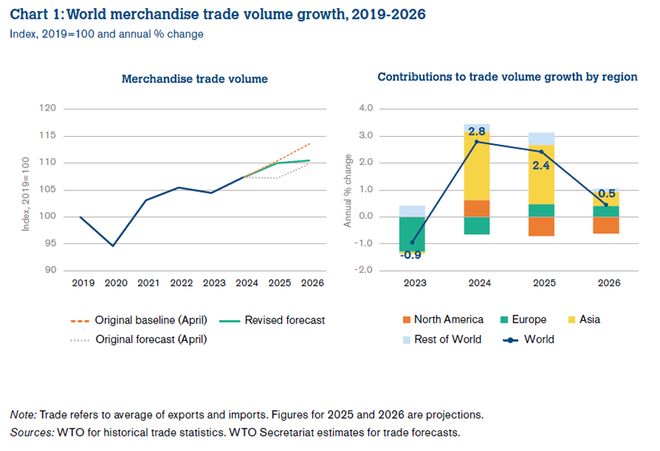
Core Insights - The WTO has revised its global trade growth forecast for 2025 upwards to 2.4%, driven by increased spending on AI-related products, a surge in North American imports before tariff hikes, and strong trade growth in other regions [1][5] - However, the forecast for 2026 has been significantly downgraded to 0.5%, indicating potential challenges ahead [1][5] Group 1: Trade Growth Drivers - In the first half of 2025, global merchandise trade volume is expected to grow by 4.9% year-on-year, with a 6% increase in current dollar terms following a 2% growth in 2024 [4] - Key drivers of this growth include early North American imports, favorable macroeconomic conditions such as deflation and supportive fiscal policies, and robust growth in emerging markets [4] - AI-related products, including semiconductors, servers, and telecommunications equipment, contributed nearly half of the overall trade growth, with a year-on-year value increase of 20% [4] Group 2: Trade Forecast Adjustments - The WTO anticipates that global merchandise trade growth will slow from 2.8% in 2024 to 2.4% in 2025 and further to 0.5% in 2026, reflecting the impact of higher tariffs and trade policy uncertainties [5] - The GDP growth forecast for 2025 is set at 2.7%, with a slight decrease to 2.6% in 2026 [5] - The WTO emphasizes that the main downside risks to this forecast include the spread of trade restrictions and policy uncertainties across more economies and sectors [5] Group 3: Regional Trade Performance - Asia and Africa are expected to achieve the fastest export growth in 2025, while North America is projected to experience a decline [6] - By 2026, export performance in North America and Europe is expected to improve, although all regions are anticipated to see a decline in import performance [6] Group 4: Impact on Services Trade - The WTO has downgraded its forecast for global commercial services trade due to indirect impacts from tariffs, with transportation and tourism sectors expected to see reduced growth rates [7] - The expected growth rate for transportation services in 2025 is 2.5%, down from 4.5% in 2024, while tourism is projected to grow by 3.1%, a decrease from 11% the previous year [7] - Digital services are expected to show slightly stronger growth, with a forecast of 6.1% compared to 5.7% in 2024 [7]
A股创历史新高,投资热潮再起,财富机遇全面爆发
Sou Hu Cai Jing· 2025-10-06 20:01
又有新纪录!——A股的2025年9月,像一场意外暴雨砸在地上,溅起泥点,也砸碎不少人的幻想,数据在屏幕上跳舞,交易大厅的屏气凝神,和手机 屏幕背后的碎碎念,交织成一张巨网。 有人说:"今年的9月,A股疯了",有人却在微信群里喊,"不就是成交额创个新高吗,历史每年都在刷"。但今年的9月,沪深北三市合计成交53.2万 亿,记录簿翻了又翻,前一次月成交股数还能追溯到去年11月,3.3万亿股,这个月只差一点点就追上了,这种"只差一点点",有时候比直接超越更让 人焦虑。 有朋友问我,"是不是整个市场都涨?"其实不是,大盘指数只涨了零点几个点,北证50还跌了2.9%,一边天高云淡,一边泥里打滚,谁也说不清哪个 更真实。深证成指也只有29%出头的涨幅,上证指数12.73%,远没到疯狂的地步,但创业板、科创那头的热血数据,很容易让人误以为"全民皆牛"。 9月刚收官那天,我蹲在中关村地铁口,听到一群年轻人讨论,"创业板涨疯了,三季度直接翻了一倍多,谁信啊",另一人插嘴,"你炒了没?"前者摇 头,"没,怕得很"。三季度创业板涨幅50.40%,科创50也快50%,数据就摆在那里,像考卷分数,不认可也得接着看。 "行业都涨吗?"我查 ...