
煤化工

Search documents
光大期货煤化工商品日报-20250918
Guang Da Qi Huo· 2025-09-18 08:14
光大期货煤化工商品日报 光大期货煤化工商品日报(2025 年 9 月 18 日) 一、研究观点 请务必阅读正文之后的免责条款部分 EVERBRIGHT FUTURES 1 光大期货煤化工商品日报 二、市场信息 尿素 1、郑商所数据:9 月 17 日尿素期货仓单 8268 张,较上一交易日-11 张,有效预报 49 张。 2、隆众数据:9 月 17 日尿素行业日产 19.56 万吨,较上一工作日增加 0.35 万吨(修正:上一 工作日日产为 19.21 万吨);较去年同期增加 0.10 万吨;行业开工率 83.59%,较去年同期 87.26% 下降 3.67 个百分点。 3、9 月 17 日国内各地区小颗粒尿素现货价格(隆众;元/吨):山东 1650,持平;河南 1660, 持平;河北 1680,持平;安徽 1660,持平;江苏 1650,持平;山西 1530,-10。 4、隆众数据:截至 9 月 17 日尿素企业库存 116.53 万吨,较上周+3.26 万吨,+2.88%。 纯碱 & 玻璃 | 品种 | 点评 | 观点 | | --- | --- | --- | | 尿素 | 周三尿素期货价格偏弱震荡,主力 ...
华谊集团跌2.04%,成交额1.23亿元,主力资金净流出627.57万元
Xin Lang Cai Jing· 2025-09-18 06:07
Company Overview - Shanghai Huayi Group Co., Ltd. is located at 809 Changde Road, Jing'an District, Shanghai, established on August 5, 1992, and listed on December 4, 1992. The company's main business involves the research, production, and sales of tires, energy chemicals, fine chemicals, and chemical services [2]. Business Segmentation - The revenue composition of Huayi Group includes: Fine Chemicals 19.84%, Tire Manufacturing 12.51%, Fine Chemicals: Propylene and downstream products 12.20%, Tire Manufacturing: Full steel radial tires 10.97%, Energy Chemicals 8.71%, Chemical Services 6.50%, and other segments contributing smaller percentages [2]. Financial Performance - As of June 30, Huayi Group reported a total revenue of 24.192 billion yuan for the first half of 2025, representing a year-on-year growth of 6.81%. The net profit attributable to shareholders was 488 million yuan, reflecting a year-on-year increase of 17.93% [3]. Shareholder Information - As of June 30, the number of shareholders for Huayi Group was 58,000, a decrease of 4.67% from the previous period. The average circulating shares per person remained at 0 shares [3]. Dividend Distribution - Huayi Group has cumulatively distributed 4.298 billion yuan in dividends since its A-share listing, with 1.064 billion yuan distributed over the past three years [4]. Institutional Holdings - As of June 30, 2025, the top ten circulating shareholders included Hong Kong Central Clearing Limited, holding 10.6497 million shares (a decrease of 5.2555 million shares), and the China Securities Shanghai State-owned Enterprise ETF, holding 8.6198 million shares (a decrease of 1.0099 million shares). The Southern China Securities 1000 ETF entered as a new shareholder with 6.9902 million shares [4]. Stock Performance - On September 18, Huayi Group's stock price decreased by 2.04%, trading at 8.64 yuan per share with a total market capitalization of 18.341 billion yuan. The stock has increased by 26.69% year-to-date, with a slight decline of 1.59% over the last five trading days [1].

中辉能化观点-20250918
Zhong Hui Qi Huo· 2025-09-18 02:59
1. Report Industry Investment Ratings - **Cautiously Bearish**: Crude oil, LPG, asphalt [1][4] - **Bearish Rebound**: L, PP, PVC, glass, soda ash [1][4] - **Cautiously Bullish**: PX, PTA, ethylene glycol, urea, natural gas [1][3][4] - **Bullish**: Methanol [3] 2. Core Views of the Report - Geopolitical risks are released, and the Fed's interest - rate cut is confirmed. Oil prices return to fundamental pricing. There are different supply - demand situations and price trends for various energy and chemical products [1]. - For most products, the macro - environment, including OPEC+ production policies, Fed interest - rate decisions, and geopolitical conflicts, has a significant impact on prices. At the same time, the supply - demand relationship of each product itself also determines its price trend [1][3]. 3. Summaries According to Related Catalogs Crude Oil - **Market Performance**: Overnight international oil prices declined. WTI dropped 1.86%, Brent fell 1.48%, and SC rose 1.28%. The latest WTI主力 was at $63.32/barrel, Brent主力 at $67.46/barrel, and SC主力 at 499.8 yuan/barrel [5]. - **Basic Logic**: The ongoing Russia - Ukraine conflict and unexpected inventory drawdown in the US provide short - term support for oil prices, but there is a long - term supply surplus, with prices likely to fall to around $60 [6]. - **Fundamentals**: As of the week ending September 12, US crude net imports decreased by 3.1 million barrels/day to 415,000 barrels/day, and exports increased by 2.5 million barrels/day to 5.3 million barrels/day. EIA data showed a 9.3 - million - barrel decrease in US commercial crude inventories to 415.36 million barrels [7]. - **Strategy Recommendation**: Hold short positions. Pay attention to the range of [495 - 505] for SC [8]. LPG - **Market Performance**: On September 16, the PG main contract closed at 4,494 yuan/ton, a 0.42% decline. Spot prices in Shandong, East China, and South China were 4,540 (+10) yuan/ton, 4,499 (- 5) yuan/ton, and 4,550 (+10) yuan/ton respectively [10]. - **Basic Logic**: The cost - end crude oil has a supply surplus and may decline further. The demand side has weakened due to falling chemical profits. As of September 17, the number of warehouse receipts remained unchanged at 13,002 lots [11]. - **Strategy Recommendation**: Hold short positions. Focus on the range of [4400 - 4500] for PG [12]. L - **Market Performance**: The L2601 contract closed at 7,169 yuan/ton (- 40). The North China Ningmei price was 7,100 yuan/ton (- 30), and the number of warehouse receipts was 12,525 lots (+523) [16]. - **Basic Logic**: Market sentiment has improved. The short - term supply - demand contradiction is not prominent, gradually shifting to a situation of strong supply and demand. Production is expected to increase next week, and the demand side is supported by the approaching peak season for shed films [17]. - **Strategy Recommendation**: Buy on dips. Pay attention to the range of [7200 - 7350] for L [17]. PP - **Market Performance**: The PP2601 closed at 6,939 yuan/ton. The East China wire - drawing market price was 6,847 yuan/ton, and the basis was - 92 yuan/ton [21]. - **Basic Logic**: Cost support has improved. The recent increase in the PP parking ratio and the decline in the wire - drawing production ratio are expected to ease supply pressure. Downstream demand is entering the peak season [22]. - **Strategy Recommendation**: Buy on dips as supply pressure eases. Focus on the range of [6900 - 7050] for PP [22]. PVC - **Market Performance**: The V2601 closed at 4,847 yuan/ton. The Changzhou spot price was 4,650 yuan/ton, and the 01 basis was - 197 yuan/ton [26]. - **Basic Logic**: Market sentiment has improved, and the price has rebounded from a low level. Fundamentally, supply is strong and demand is weak, with large - sample social inventories accumulating for 12 consecutive weeks. There are more maintenance plans this week, and exports may weaken [27]. - **Strategy Recommendation**: Buy on dips supported by low valuations. Pay attention to the range of [4900 - 5050] for V [27]. PX - **Market Performance**: On September 12, the PX spot price was 6,864 (+7) yuan/ton, and the PX11 contract closed at 6,712 (- 66) yuan/ton. The PX11 - 12 month - spread was 24 (- 10) yuan/ton, and the East China basis was 85.7 (- 1.2) yuan/ton [30]. - **Basic Logic**: Supply - side domestic and overseas device changes are not significant. Demand has improved, with PTA device operating loads rising. The supply - demand is in a tight balance, and inventories are still relatively high. Macro factors include OPEC+ production increases and a high probability of Fed interest - rate cuts [31]. - **Strategy Recommendation**: Build long positions on dips in intraday trading and gradually close short positions. Focus on the range of [6750 - 6860] for PX511 [32]. PTA - **Market Performance**: On September 12, the PTA East China price was 4,565 (- 55) yuan/ton, and the TA01 closed at 4,648 (- 40) yuan/ton. The TA11 - 1 month - spread was - 18 (- 4) yuan/ton, and the East China basis was - 83 (- 15) yuan/ton [34]. - **Basic Logic**: PTA processing fees are low. Supply pressure increases due to the resumption of previously maintained devices and new device投产 expectations. There is an expectation of a "Golden September and Silver October" consumption peak season, and demand is slightly better. The supply - demand is in a tight balance in September and is expected to be loose in the fourth quarter [35]. - **Strategy Recommendation**: Close short positions. Look for opportunities to expand PTA processing fees and build long positions on dips in intraday trading [3]. Ethylene Glycol - **Market Performance**: On September 12, the ethylene glycol spot price in East China was 4,378 (- 44) yuan/ton, and the EG01 closed at 4,319 (- 31) yuan/ton. The EG10 - 1 month - spread was 34 (+21) yuan/ton, and the East China basis was 106 (- 14) yuan/ton [38]. - **Basic Logic**: Domestic devices have slightly reduced their loads, and overseas devices have not changed much. Arrivals and imports are relatively low. There is an expectation of a consumption peak season, and demand is improving. Inventories are low, providing support for prices. The market is trading on new device投产 expectations [39]. - **Strategy Recommendation**: Gradually close short positions and hold a light - position wait - and - see attitude. Focus on the range of [4270 - 4310] for EG01 [40]. Methanol - **Market Performance**: On September 12, the methanol spot price in East China was 2,317 (- 8) yuan/ton, and the main 01 contract closed at 2,379 (- 8) yuan/ton. The East China basis was - 65 yuan/ton, and the port basis was - 99 (+3) yuan/ton [42]. - **Basic Logic**: Methanol device maintenance has increased, and the operating load has declined slightly. Overseas device loads are still high, and imports are high, resulting in relatively large supply - side pressure. Demand has stopped falling, and cost support has stabilized [43]. - **Strategy Recommendation**: Do not short firmly. Look for opportunities to build long positions on dips for the 01 contract. Focus on the range of [2350 - 2380] for MA01 [45]. Urea - **Core View**: Cautiously bullish. Short - term supply is tight, but it is expected to be loose. Domestic demand is weak, while exports are good. The domestic fundamentals are still relatively loose, but there are upper and lower limits under certain policies [3]. - **Strategy Recommendation**: The urea futures price is under pressure in the short - term. Look for opportunities to build long positions on dips for the 01 contract in the medium - to - long - term [3]. Natural Gas - **Core View**: Cautiously bullish. Geopolitical factors drive up energy prices, and the temperature is getting cooler, increasing combustion demand and gas storage for winter [4]. Asphalt - **Core View**: Cautiously bearish. Although the cost - end crude oil rebounds due to geopolitical disturbances, the supply is in surplus, and the overall supply - demand is loose, with high valuations [4]. - **Strategy Recommendation**: Hold short positions [4]. Glass - **Core View**: Bearish rebound. Market sentiment has improved, and enterprise inventories have decreased. New production lines have been ignited, increasing daily melting volume, but terminal demand is still weak [4]. - **Strategy Recommendation**: Short - term bullish due to improved market sentiment [4]. Soda Ash - **Core View**: Bearish rebound. Market sentiment has improved, and enterprise inventories have decreased for three consecutive weeks. Demand is mostly rigid, and supply pressure is expected to ease due to upcoming device maintenance [4]. - **Strategy Recommendation**: Short - term bullish with a slight improvement in demand, but bearish in the medium - to - long - term [4].
鲁西化工涨2.42%,成交额1.13亿元,主力资金净流入1005.97万元
Xin Lang Cai Jing· 2025-09-18 02:21
Company Overview - LUXI Chemical Group Co., Ltd. is located in the Chemical New Materials Industrial Park of Liaocheng High-tech Zone, Shandong, established on June 11, 1998, and listed on August 7, 1998 [1] - The company's main business involves chemical new materials, basic chemicals, and other products, with revenue composition as follows: chemical new materials 66.07%, basic chemicals 20.11%, fertilizers 12.06%, and other products 1.76% [1] Stock Performance - As of September 18, LUXI Chemical's stock price increased by 2.42% to 14.41 CNY per share, with a trading volume of 113 million CNY and a turnover rate of 0.42%, resulting in a total market capitalization of 27.441 billion CNY [1] - Year-to-date, the stock price has risen by 27.07%, with a recent 5-day decline of 0.62%, a 20-day increase of 11.02%, and a 60-day increase of 40.18% [1] Financial Performance - For the first half of 2025, LUXI Chemical reported a revenue of 14.739 billion CNY, representing a year-on-year growth of 4.98%, while the net profit attributable to shareholders decreased by 34.81% to 763 million CNY [2] - The company has distributed a total of 9.885 billion CNY in dividends since its A-share listing, with 2.167 billion CNY distributed over the past three years [3] Shareholder Structure - As of June 30, 2025, the number of shareholders increased to 101,000, up by 9.83%, while the average circulating shares per person decreased by 8.95% to 18,860 shares [2] - Notable institutional shareholders include Southern CSI 500 ETF, holding 16.9804 million shares (an increase of 2.3522 million shares), and Hong Kong Central Clearing Limited, holding 16.6184 million shares (a decrease of 2.9461 million shares) [3]

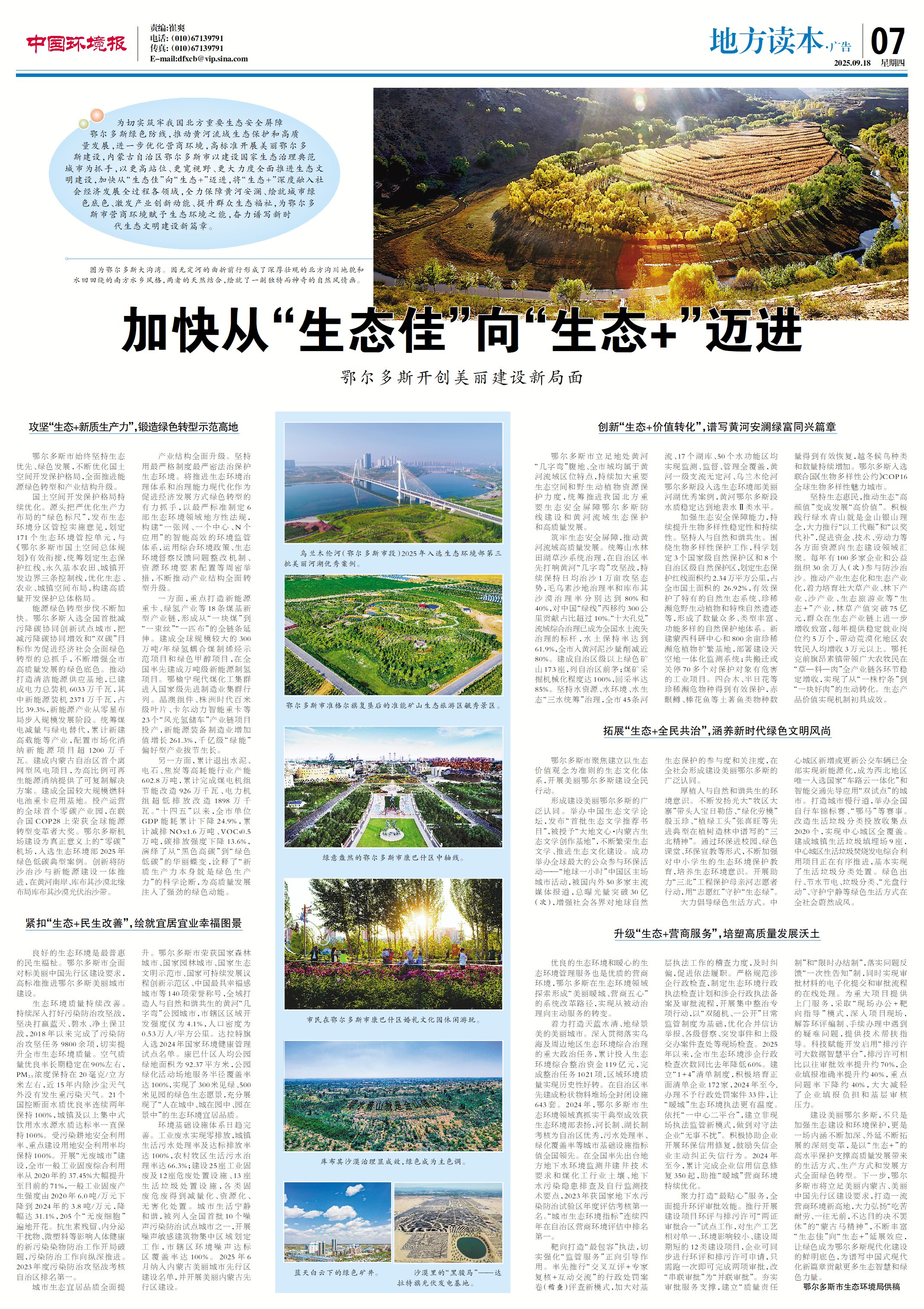
加快从“生态佳”向“生态+”迈进——鄂尔多斯开创美丽建设新局面
Zhong Guo Huan Jing Bao· 2025-09-18 01:15
Core Viewpoint - The article emphasizes the commitment of Ordos City in Inner Mongolia to ecological civilization construction, aiming to enhance the ecological environment while promoting high-quality economic development and improving the business environment [1][14]. Group 1: Ecological Protection and Development - Ordos City is focused on building a national model for ecological governance, integrating "ecology+" into all aspects of social and economic development to ensure the safety of the Yellow River and enhance urban green spaces [1][14]. - The city has implemented a comprehensive ecological protection strategy, including the establishment of 171 ecological environment control units and the optimization of land use through ecological protection red lines and agricultural land boundaries [4][16]. Group 2: Energy Transition and Industrial Upgrading - Ordos has accelerated its green energy transition, becoming one of the first cities in China to implement pollution reduction and carbon reduction initiatives, with a total installed power capacity of 60.33 million kilowatts, of which renewable energy accounts for 39.3% [17][19]. - The city is developing 18 new coal-based industrial chains, including large-scale green hydrogen projects, and has seen a 261.3% increase in the added value of the new energy equipment manufacturing industry [5][18]. Group 3: Environmental Quality Improvement - Since 2018, Ordos has completed over 9,800 pollution prevention tasks, maintaining an air quality good rate of around 90% and achieving a 100% compliance rate for drinking water sources [12][21]. - The city has made significant progress in waste management, with the comprehensive utilization rate of industrial solid waste increasing from 37.45% in 2020 to 71% currently [12][21]. Group 4: Social and Economic Benefits - The ecological improvements have translated into enhanced living conditions, with Ordos being recognized as a national forest city and a city with high happiness levels, reflecting the integration of ecological and social benefits [22][24]. - The city promotes ecological industries, providing stable employment opportunities and increasing income for local residents, with an annual increase of over 30,000 yuan per person in desertification-affected areas [28][29]. Group 5: Governance and Community Engagement - Ordos is enhancing its ecological governance framework, focusing on community involvement in ecological protection and promoting a culture of environmental awareness through various initiatives [29][30]. - The city has adopted a proactive approach to environmental management, reducing administrative burdens on businesses and improving the efficiency of environmental assessments and approvals [31][34].


华鲁恒升20250917
2025-09-17 14:59
Summary of the Conference Call for Hualu Hengsheng Industry Overview - The coal chemical industry is facing challenges of capacity expansion and weak demand, leading to inventory accumulation and price declines, resulting in poor overall profitability [2][5] - New capacity pressure in products like urea is significant, necessitating attention to potential adjustments in macro policies regarding capacity control [2][5] - The acetic acid market benefits from strong downstream PTA and EVA export demand, with future development dependent on changes in overseas demand and external factors like US interest rate cuts [2][8] - The DMF industry operates at low utilization rates, with no new capacity expected, and leading companies are likely to shift production towards more profitable products like dimethylamine [2][9] - The oxalic acid market is performing well, driven by recovery in traditional sectors and increased demand from new energy and electronics industries [2][10] Key Points on Hualu Hengsheng - Hualu Hengsheng, as a leading enterprise, benefits from a diversified downstream product portfolio and may gain from anti-involution policies [2][6] - In the urea sector, if supply is constrained while demand remains strong, the supply-demand relationship will improve [2][6] - The company maintains stable profits despite industry losses, with a focus on cost reduction and efficiency improvements [2][8][16] - Hualu Hengsheng's cash flow is robust, and its valuation is at historical lows, providing potential for excess returns during PPI upturns [3][16] - The company is undergoing upgrades to its synthesis platform and expanding its Jingzhou base, which will enhance its bottom-line profits [3][16][18] Market Dynamics - The coal chemical industry is currently in a phase of poor profitability, with many products struggling to maintain margins [5][15] - Urea production is expected to see an increase of 10 million tons by 2026, while domestic demand is around 70 million tons, indicating significant supply pressure [5] - The acetic acid market is at the bottom of the cycle but has good demand, particularly from exports [8] - The DMF industry is characterized by low operating rates and a lack of new capacity, leading to a micro-profit environment [9] - The oxalic acid market is optimistic, with expected double-digit growth driven by new energy and electronic sectors [10][11] Future Outlook - The coal chemical industry is expected to approach the end of its capacity expansion phase by early 2026, with potential turning points in late 2026 or 2027 [3][12] - Hualu Hengsheng's bottom-line profit is projected to reach approximately 4 billion yuan by the end of 2026 or early 2027, bolstered by ongoing capacity expansions and efficiency improvements [19] - The overall investment value in the coal chemical sector is currently low, but with clear bottom prices and profits, there is potential for recovery as external conditions improve [22]

光大期货煤化工商品日报-20250917
Guang Da Qi Huo· 2025-09-17 07:18
光大期货煤化工商品日报 光大期货煤化工商品日报(2025 年 9 月 17 日) 一、研究观点 | 品种 | 点评 | 观点 | | --- | --- | --- | | 尿素 | 周二尿素期货价格震荡偏强运行,主力01合约收盘价1686元/吨,日环比涨0.42%。 | 偏强 | | | 现货市场多数探涨,昨日主流地区市场价格上调10~20元/吨不等,山东、河南地区 | | | | 市场价格分别为1650元/吨、1660元/吨,日环比分别涨10元/吨、20元/吨。基本面来 | | | | 看,尿素供应继续回升,昨日行业日产量19.20万吨,日环比增0.08万吨。价格上涨 | | | | 后对需求形成压制,现货市场成交氛围有所下降。昨日主流地区产销率降至5%~40% | | | | 区间,个别地区仍维持100%以上,区域间分化明显扩大。宏观情绪及商品市场情绪 | | | | 积极给尿素期货市场提供支撑,且煤炭期价走强、国际市场及印度招标方面后续或 | | | | 仍有题材发酵可能。预计短期尿素期货价格仍能保持坚挺运行状态,但由于供需暂 | | | | 无明显扭转,尿素期价上方压制也较多,不建议过分看涨。关注尿 ...
一块煤如何裂变多条链——新疆哈密市现代煤化工产业发展调查
Jing Ji Ri Bao· 2025-09-17 06:24
Core Viewpoint - Hami City is transforming its traditional energy structure by leveraging its coal resources to develop a modern coal chemical industry, aiming for high-value utilization and low-carbon development while ensuring energy security under the "dual carbon" goals [1][2]. Group 1: Coal Resource Utilization - Hami City is advancing the "coal-to-chemical" industry layout, transitioning from traditional energy output to modern coal chemical production, creating multiple industrial chains from coal [2][3]. - The city has established various industrial chains, including "coal-methanol-carboxylic acid, formaldehyde, polypropylene" and "coal-coke oil-fuel oil" [2]. - Hami's coal chemical industry added value increased by 17.9% year-on-year in the first half of the year [1]. Group 2: Technological Innovation and Projects - Hami is introducing significant projects, such as the world's first second-generation technology for direct coal liquefaction, expected to produce 4 million tons of oil annually by 2027 [3]. - The city is also developing a 1 million tons per year acetic acid project, which is the first of its kind in Xinjiang [4][5]. - Hami's coal-to-chemical projects are designed to maximize resource utilization and reduce environmental impact through advanced technologies [6][7]. Group 3: Circular Economy and Resource Efficiency - Hami is implementing a zero-discharge wastewater treatment project, achieving 100% recycling of industrial wastewater [6]. - The city is focusing on the circular utilization of coal resources, with projects like the 400,000 tons of ethylene glycol from waste gas, maximizing the use of low-value resources [7]. - The comprehensive energy conversion rate of coal processing in Hami exceeds 85%, indicating high efficiency in resource utilization [8]. Group 4: Coupling Development with Renewable Energy - Hami is exploring the coupling of traditional coal energy with renewable energy, with 67.8% of its installed power capacity coming from renewable sources [12]. - New coal chemical projects must source at least 50% of their electricity from green energy, significantly reducing production costs and carbon emissions [12]. - The integration of green hydrogen into coal chemical processes is being promoted, with companies planning to use wind and solar energy to produce hydrogen for chemical production [13][14]. Group 5: Talent and Research Development - Hami is establishing a research institute focused on the clean and efficient utilization of high-oil coal resources, enhancing its research capabilities [11]. - The city is also developing a vocational school to train skilled workers in the energy and chemical sectors, aligning education with industry needs [11]. - Collaborative efforts with universities and research institutions aim to foster innovation in coal chemical technologies [10].
一块煤如何裂变多条链
Jing Ji Ri Bao· 2025-09-17 03:35
Core Viewpoint - Hami City is transforming its traditional energy structure by developing a modern coal chemical industry, leveraging its abundant coal resources to achieve high-value utilization and contribute to national energy security under the "dual carbon" goals [2][3]. Group 1: Coal Resource Utilization - Hami City has a coal resource prediction of approximately 570.8 billion tons, accounting for one-third of Xinjiang's and one-eighth of China's total coal resources [2]. - The city is focusing on clean and efficient coal utilization, with the coal chemical industry’s added value increasing by 17.9% year-on-year in the first half of the year [2][3]. - Hami has established multiple industrial chains, including coal-to-methanol, coal-to-fuel oil, and coal-to-gas, with products such as methanol, liquefied natural gas, and ethylene glycol [3][4]. Group 2: Technological Innovation and Projects - Hami is introducing significant projects, such as the first global coal-to-oil project using second-generation technology, expected to produce 4 million tons of oil annually by 2027 [4]. - The city is also developing a 1 million tons per year acetic acid project, which is the first of its kind in Xinjiang, aimed at alleviating the shortage of acetic acid in the northwest region [6]. - Hami is implementing a zero discharge project for industrial wastewater, achieving a 100% recycling rate for wastewater in the industrial park [7]. Group 3: Circular Economy and Resource Efficiency - Hami is promoting a circular economy by maximizing the utilization of by-products from coal processing, such as the innovative use of waste gas to produce ethylene glycol [9]. - The city is also focusing on the efficient use of coal resources, with plans for a project that can process over 10 million tons of coal annually [5][8]. - The comprehensive utilization of coal resources is expected to significantly enhance economic benefits, with potential returns being several times that of raw coal [10]. Group 4: Coupling Development with Renewable Energy - Hami is exploring the integration of traditional energy and renewable energy, with 67.8% of its installed power capacity coming from renewable sources [14]. - New coal chemical projects are required to source at least 50% of their electricity from green energy, which can reduce production costs and carbon emissions [14]. - The city is also developing a green hydrogen industry, utilizing wind and solar energy to produce hydrogen for coal chemical processes [15]. Group 5: Talent and Research Development - Hami is establishing a research institute focused on the clean and efficient utilization of high-oil coal, collaborating with universities and research institutions [12]. - The city is also investing in vocational training for skilled workers in the energy and chemical sectors to meet the industry's growing demands [13]. - Hami aims to become a significant hub for energy technology innovation, fostering collaboration between experts and enterprises [12].
继续维持港口弱内地强的格局
Hua Tai Qi Huo· 2025-09-17 02:35
Report Summary 1. Report Industry Investment Rating No information provided. 2. Core Viewpoints - The pattern of stronger inland than ports in the methanol market continues. The port inventory pressure remains high, but after the restart of the downstream MTO Xingxing, the port basis has slightly bottomed out and rebounded, and the port inventory accumulation rate may slow down. However, the arrival pressure is still large, and the subsequent changes mainly depend on when the Iranian winter inspection plan is announced. [2] - The lowest point of coal - based methanol production in the inland has passed, but it will not return to a high level until the second half of the month. The inventory of inland methanol factories is still low, and overall, the inland is stronger than the ports. The window for ports to flow back to the inland is an important variable supporting the lower limit of port prices. [3] 3. Summary by Relevant Catalogs I. Methanol Basis & Inter - period Structure - The report presents multiple figures related to methanol basis and inter - period spreads, including the basis between methanol in different regions (such as Taicang, Lunan, Inner Mongolia North Line, etc.) and the main futures contract, as well as the spreads between different methanol futures contracts (e.g., MA2601 - MA2605). [7][11][22] II. Methanol Production Profit, MTO Profit, Import Profit - Figures show the production profit of Inner Mongolia coal - based methanol, the MTO profit in East China, and the import spread between Taicang methanol and CFR China, as well as price differences between CFR Southeast Asia, FOB US Gulf, FOB Rotterdam and CFR China. [26][31] III. Methanol Production and Inventory - The port total inventory of methanol is 1,550,330 tons (+122,675 tons), with the inventory in Jiangsu ports at 804,000 tons (+44,000 tons), Zhejiang ports at 285,500 tons (+43,200 tons), and Guangdong ports at 274,000 tons (+7,000 tons). The downstream MTO开工率 is 81.57% (-3.15%). The inland factory inventory is 342,560 tons (-4,523 tons), and the northwest factory inventory is 221,300 tons (-3,700 tons). [1][2] IV. Regional Price Differences - The report lists various regional price differences, such as the difference between Lubei and Northwest, Taicang and Inner Mongolia, etc. For example, the Lubei - Northwest - 280 spread is - 23 yuan/ton (+0), and the Taicang - Inner Mongolia - 550 spread is - 385 yuan/ton (-8). [2] V. Traditional Downstream Profits - Figures show the production profits of traditional downstream products such as Shandong formaldehyde, Jiangsu acetic acid, Shandong MTBE isomerization etherification, and Henan dimethyl ether. [52][56] 4. Strategies - Unilateral: None. - Inter - period: Go long on the spread of MA2601 - MA2605 when it is low. - Cross - variety: Shorten the spread of PP01 - 3MA01 when it is high. [4]