
航空航天

Search documents
六大经济部委释放2026关键信号
2 1 Shi Ji Jing Ji Bao Dao· 2026-01-13 23:16
Core Viewpoint - The Chinese government is focusing on stabilizing economic growth, expanding domestic demand, supporting technological innovation, and stabilizing the real estate and stock markets as it prepares for the economic goals of 2026, the first year of the 14th Five-Year Plan [1][2]. Economic Policy Initiatives - Various ministries are implementing proactive macroeconomic policies, including enhancing economic monitoring, improving policy tools, and ensuring effective fiscal and monetary policy coordination [2]. - The fiscal policy for 2026 will be more active, with an expanded fiscal spending plan and optimized government bond tools to enhance local financial capabilities [2][3]. - The People's Bank of China will maintain a moderately loose monetary policy, focusing on high-quality economic development and reasonable price recovery, with expectations of a 25-50 basis point reduction in the reserve requirement ratio [2][3]. GDP and Fiscal Projections - The GDP growth target for 2026 is expected to remain around 5%, with a fiscal deficit rate holding steady at 4% and an increase in special bonds to 4.8 trillion yuan [3][4]. - The broad deficit scale is projected to rise from 11.86 trillion yuan in 2025 to approximately 12.45 trillion yuan in 2026, corresponding to a broad deficit rate increase from 8.4% to 8.5% [3]. Consumer and Investment Stimulus - The government aims to boost consumption through practical measures, including optimizing the trade-in policy for consumer goods and expanding service consumption [5][6]. - Investment will be supported through various government funding initiatives, including the issuance of special bonds and increased central budget investments [5][6]. Real Estate and Stock Market Stability - Policies will focus on stabilizing the real estate market through targeted measures, including optimizing housing purchase policies and promoting the use of existing housing for social needs [12]. - The central bank will work on mitigating financial risks in key areas and enhancing market confidence through specific monetary policy tools [13]. Emerging Industry Development - There is a strong emphasis on fostering new and emerging industries, including integrated circuits, new materials, and artificial intelligence, with significant investments planned in these sectors [8][9]. - The establishment of the National Venture Capital Guiding Fund aims to attract substantial investment in high-tech fields, with an expected total investment scale exceeding one trillion yuan [9]. Innovation-Driven Growth - The focus for 2026 will be on building an innovation-driven growth model, enhancing the modern industrial system, and promoting technological self-reliance [10].
法国经济逐步回暖
Sou Hu Cai Jing· 2026-01-13 23:05
Economic Growth Outlook - France's economic growth is projected to be 0.9% in 2025 and 1% in 2026, with a notable acceleration in GDP growth of 0.5% quarter-on-quarter in Q3 2025, indicating enhanced economic momentum [1] - The recovery in the French economy is attributed to multiple factors, including improved economic momentum in the second half of 2025, stabilization in investment, and better-than-expected industrial recovery [1] Sector Performance - The aerospace sector's easing supply constraints contributed to a 1.3% quarter-on-quarter increase in manufacturing output, while manufacturing exports rose by 4.8% and corporate investments increased by 0.8% [1] - The monthly business survey by the Bank of France indicates continued improvement in economic activity, particularly in the industrial sector, with key indicators remaining above long-term averages for six consecutive months [2] Inflation and Consumer Power - As of November 2025, France's inflation rate increased by 0.9% year-on-year, remaining relatively low within the Eurozone, which supports consumer purchasing power and provides a predictable environment for businesses [1] - The stability in industrial sales prices and a slight increase in service prices were noted, with 8% of industrial firms reporting significant supply difficulties and 16% facing recruitment challenges, both showing a decrease from previous levels [2] Structural Challenges - Despite improved growth prospects, France's economy faces structural pressures, with public debt reaching €348.22 billion, accounting for 117.4% of GDP, and a projected fiscal deficit of 5.5% of GDP for 2025, significantly above the EU's 3% limit [3] - The French parliament has not yet formally approved the 2026 budget, leading the government to propose a "special law" to continue taxation and borrowing, which is crucial for maintaining normal operations of state institutions [3]
隔夜美股 | 风险资产走势分化 三大指数微跌 比特币突破9.5万美元关口
Zhi Tong Cai Jing· 2026-01-13 22:37
Economic Indicators - The U.S. December core Consumer Price Index (CPI) increased by 0.2% month-over-month and 2.6% year-over-year, both lower than market expectations by 0.1 percentage points, indicating a potential cooling of inflation [1] - The overall CPI figures met market expectations, suggesting that price increases are moving towards the Federal Reserve's 2% target, although levels remain elevated [1] - Housing costs, a key factor in inflation, rose by 0.4% month-over-month and 3.2% year-over-year, contributing significantly to the CPI increase [1] Stock Market Performance - The Dow Jones Industrial Average fell by 398.21 points, or 0.80%, closing at 49,191.99 points; the Nasdaq decreased by 24.03 points, or 0.10%, to 23,709.87 points; and the S&P 500 dropped by 13.56 points, or 0.19%, to 6,963.71 points [2] - Notable stock movements included Morgan Stanley (JPM) down over 4%, Intel (INTC) up 7.3%, and Google (GOOG) up 1% [2] Cryptocurrency Market - Bitcoin surged over 4.5%, surpassing the $95,000 mark, while Ethereum rose over 7% to $3,332.95 [3] - Related stocks such as MicroStrategy (MSTR) increased by over 6.6%, Coinbase (COIN) by 4%, and Robinhood (HOOD) by over 2.3% [3] Commodity Prices - Spot gold slightly decreased by 0.22%, priced at $4,586.62 [4] - Crude oil prices saw an increase, with light crude oil futures for February rising by $1.65 to $61.15 per barrel (up 2.77%) and Brent crude for March increasing by $1.60 to $65.47 per barrel (up 2.51%) [4] Government Actions - The U.S. government is seeking to seize more oil tankers related to Venezuelan oil trade, with recent actions including the seizure of five vessels [5] - The government has filed multiple civil forfeiture lawsuits to provide legal grounds for seizing oil cargo and vessels involved in the trade [5] Federal Reserve Insights - Federal Reserve official Musalem indicated that inflation risks are easing, suggesting no further rate cuts are necessary at this time [9] - He expressed optimism that inflation will trend towards the Fed's 2% target later this year, supported by recent inflation data [9] Corporate Developments - Boeing reported a total of 1,175 aircraft orders for 2025, surpassing Airbus's 1,000 orders, marking a recovery from a seven-year decline [10] - Boeing's deliveries totaled 600 aircraft for the year, with December alone accounting for 63 deliveries, the highest monthly total [10] - Meta Platforms is in discussions to double the production of Ray-Ban AI glasses to 20 million units by the end of 2026, with potential for further increases based on demand [11]

法国经济逐步回暖 二〇二五年经济增速预计为百分之零点九
Ren Min Ri Bao· 2026-01-13 22:16
Economic Growth Outlook - France's economic growth is projected to be 0.9% in 2025 and 1% in 2026, with a notable acceleration in GDP growth of 0.5% quarter-on-quarter in Q3 2025 compared to Q2 [1] - The recovery in the French economy is attributed to multiple factors, including improved economic momentum in the second half of 2025, stabilization in investment, and better-than-expected industrial recovery [1] Sector Performance - The aerospace sector's easing supply constraints contributed to a 1.3% quarter-on-quarter increase in manufacturing output, while manufacturing exports rose by 4.8% and corporate investments increased by 0.8% [1] - A monthly business survey by the Bank of France indicated continued improvement in economic activity, particularly in the industrial sector, with key industries like computers, electronics, and optics driving growth [2] Inflation and Consumer Prices - France's inflation rate rose by 0.9% year-on-year in November 2025, remaining relatively low within the Eurozone, which helps stabilize consumer purchasing power expectations [1] - The stability in industrial sales prices and a slight increase in service prices were noted, with 8% of industrial firms reporting significant supply difficulties and 16% facing recruitment challenges, both showing a decrease from previous levels [2] Structural Challenges - Despite improved growth prospects, France's economy faces structural pressures, with public debt reaching €348.22 billion, accounting for 117.4% of GDP, and a projected fiscal deficit of 5.5% of GDP for 2025, significantly above the EU's 3% limit [3] - The French parliament has not yet formally approved the 2026 budget, leading the government to propose a "special law" to continue tax collection and borrowing, which is crucial for maintaining normal operations of state institutions [3]
六大部委释放四大关键信号 这些产业要飞
2 1 Shi Ji Jing Ji Bao Dao· 2026-01-13 15:42
Core Viewpoint - The Chinese government is focusing on stabilizing economic growth and expanding domestic demand in 2026, marking the beginning of the "14th Five-Year Plan" period, with key policies aimed at supporting technological innovation and stabilizing the real estate and stock markets [1] Group 1: Economic Policy Signals - Key ministries, including the National Development and Reform Commission, Ministry of Finance, and others, have released four major policy signals for 2026: stabilizing growth, expanding domestic demand, supporting technological innovation, and stabilizing the real estate and stock markets [1] - The year 2026 is seen as crucial for achieving a good start to the "14th Five-Year Plan" [1] Group 2: Investment in Emerging Industries - The National Venture Capital Guidance Fund is set to officially operate by December 26, 2025, with an expected investment scale exceeding 1 trillion yuan, focusing on "hard technology" sectors such as integrated circuits, quantum technology, biomedicine, brain-computer interfaces, and aerospace [1] - The Ministry of Industry and Information Technology plans to implement actions to develop and strengthen emerging industries, targeting key areas like integrated circuits, new displays, new materials, aerospace, low-altitude economy, and biomedicine [1] Group 3: Artificial Intelligence Initiatives - The Beijing Municipal Development and Reform Commission has announced an action plan for building an artificial intelligence innovation hub, aiming to add over 10 listed companies and more than 20 unicorns in the AI sector within two years [1]
六大部委释放四大关键信号,这些产业要飞
21世纪经济报道· 2026-01-13 13:35
Core Viewpoint - The article emphasizes the proactive measures taken by various Chinese government departments to ensure stable economic growth in 2026, marking the beginning of the "14th Five-Year Plan" period. Key policies focus on stabilizing growth, expanding domestic demand, supporting technological innovation, and maintaining stability in the real estate and stock markets [1][3]. Group 1: Economic Policy Measures - The National Development and Reform Commission (NDRC) and other ministries are implementing policies to strengthen economic monitoring, improve policy tools, and manage expectations to ensure a smooth start to 2026 [3]. - The fiscal policy for 2026 will be more proactive, with an expanded fiscal spending plan and optimized government bond tools to enhance financial efficiency [3]. - The People's Bank of China (PBOC) will continue a moderately loose monetary policy, focusing on high-quality economic development and reasonable price recovery, while maintaining liquidity and promoting balanced credit growth [3][4]. Group 2: GDP and Fiscal Projections - The GDP growth target for 2026 is expected to remain around 5%, with a fiscal deficit rate holding steady at 4% and an increase in special bonds to 4.8 trillion yuan [4]. - The broad deficit scale is projected to rise from 11.86 trillion yuan in 2025 to approximately 12.45 trillion yuan in 2026, with a corresponding increase in the broad deficit rate from 8.4% to 8.5% [4]. Group 3: Consumer and Investment Stimulus - The NDRC emphasizes the need for practical measures to boost consumption, including optimizing the trade-in policy for consumer goods and enhancing service consumption [7]. - Investment strategies will focus on stabilizing and increasing effective investment, particularly in new infrastructure and technology sectors, with significant government funding allocated for major projects [8][9]. Group 4: Emerging Industries Development - The Ministry of Industry and Information Technology aims to enhance technological innovation capabilities and support the growth of emerging industries such as integrated circuits, new materials, and biomedicine [11][12]. - The establishment of the National Venture Capital Guiding Fund, with an initial investment of 100 billion yuan, aims to attract further investment in key technology sectors [12]. Group 5: Real Estate and Stock Market Stability - The housing and urban-rural development meeting outlines strategies to stabilize the real estate market through targeted policies, including optimizing housing purchase restrictions and supporting demand for housing [15]. - The PBOC is focused on mitigating financial risks in key areas and has established mechanisms to provide liquidity support to non-bank institutions, enhancing market stability [16][17].


最后4分钟,突然拉升!
Zhong Guo Zheng Quan Bao· 2026-01-13 12:47
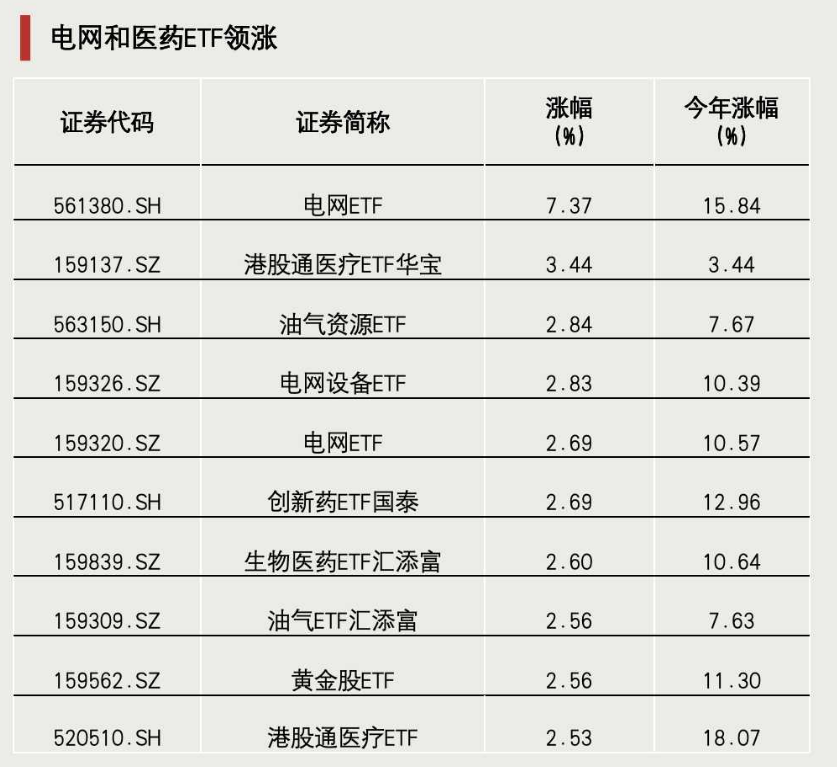
Market Overview - On January 13, A-shares experienced a collective pullback, with the ChiNext Index dropping nearly 2% and over 900 out of 1300 ETFs declining [1] - Despite the overall market downturn, ETFs focused on defensive sectors such as electric grid, oil and gas, gold, and pharmaceuticals saw gains, with several products rising over 2% [1] ETF Performance - The Electric Grid ETF (561380) led the market with a 7.37% increase, experiencing a significant surge in the last four minutes before closing [2][4] - The AI-focused ETF Morgan (588420), which had performed well previously, saw a sharp decline of over 11% today, marking the largest drop in the market [2][7] Fund Flows - The overall net inflow into the ETF market was approximately 1.157 billion yuan, a significant decrease from the 16.4 billion yuan net inflow on January 9 [3][9] - The Media ETF (512980) attracted the highest net inflow of 2.327 billion yuan, contributing to a total of over 3 billion yuan in net inflows this year [3][10] Sector Analysis - ETFs targeting the electric grid, oil and gas, and gold sectors showed resilience, with all ETFs in these categories posting gains [4][5] - The Medical ETF focusing on Hong Kong stocks and innovative drugs also performed well, with the Hong Kong Medical ETF (159137) rising by 3.44% [5][6] Notable Declines - Several ETFs in the AI and aerospace sectors faced significant declines, with nine out of the top ten ETFs by drop percentage being aerospace-related [7] - The AI ETF Morgan experienced a drastic increase in turnover rate, indicating high trading activity amid its price drop [7] Non-Equity ETF Trends - Non-equity ETFs, including money market and bond funds, faced substantial net outflows, with some experiencing over 10 billion yuan in outflows this year [11][12] Industry Insights - The aviation sector is viewed as having significant long-term growth potential, supported by policy backing and industry acceleration [13] - The semiconductor sector is experiencing short-term volatility but is expected to maintain a positive long-term outlook due to strong demand and supportive policies [13] ETF Market Milestone - Huaxia Fund became the first public fund company in China to have an ETF management scale surpassing 1 trillion yuan, reaching 1.016424 trillion yuan as of January 12 [14]
六大经济部委释放2026关键转向:两大市场要稳,这些产业要飞
2 1 Shi Ji Jing Ji Bao Dao· 2026-01-13 12:47
Core Viewpoint - The Chinese government is focusing on stabilizing economic growth and expanding domestic demand in 2026, which marks the beginning of the "14th Five-Year Plan" period, with key policies aimed at supporting technology innovation, stabilizing the real estate and stock markets, and promoting consumption and investment [1][2]. Economic Policy Initiatives - Various ministries are implementing proactive macroeconomic policies, including enhancing economic monitoring, improving policy tools, and ensuring smooth policy transitions between 2025 and 2026 [2]. - The fiscal policy for 2026 will be more active, with an expanded fiscal spending plan, optimized government bond tools, and improved transfer payment efficiency to enhance local financial autonomy [2]. - The People's Bank of China will maintain a moderately loose monetary policy, focusing on high-quality economic development and reasonable price recovery, with expectations of a 25-50 basis point reduction in the reserve requirement ratio [3][4]. Consumption and Investment Promotion - The government aims to boost consumption through practical measures, including optimizing the trade-in policy for consumer goods and enhancing service consumption [7]. - Investment will be stabilized through government funding, including the issuance of new local government special bonds and increased central budget investments [8]. - A total of approximately 295 billion yuan has been allocated for early 2026 projects, with significant infrastructure projects approved, totaling over 400 billion yuan [8]. Real Estate and Stock Market Stability - The focus for 2026 will be on stabilizing the real estate market through targeted policies, including inventory reduction and optimizing supply [12]. - Recent adjustments in housing policies in major cities aim to support both rigid and improved housing demand, with expectations of further easing measures [12]. - The central bank is also working on mechanisms to mitigate financial risks in key areas, ensuring stability in capital markets [13]. Emerging Industries Development - The government is prioritizing the enhancement of technological innovation capabilities in industries, with a focus on sectors such as integrated circuits, new materials, and aerospace [10][11]. - A new venture capital fund has been established to support investments in "hard technology" sectors, with an expected investment scale exceeding one trillion yuan [10]. Overall Economic Growth Projections - GDP growth for 2026 is projected to be around 5%, with a broadening fiscal deficit and an increase in special bonds to support economic activities [3][4]. - The emphasis will be on combining short-term policies with long-term structural reforms to enhance domestic demand and economic resilience [9].
【环球财经】空客2025年交付793架商用飞机,预计超过波音
Xin Hua Cai Jing· 2026-01-13 11:02
不过,商用飞机交付4%的增幅仍低于空客最初目标。去年12月,由于旗舰产品A320机型的机身面板质 量问题,该公司将全年商用飞机交付目标从820架下调至790架。根据12日公布的数据,空客2025年 A320机型共交付607架,占总量的76.5%。 数据还显示,空客2025年共获得1000架商用飞机的新订单,去除被取消的订单,净订单量为889架。得 益于此,空客2025年底订单积压量创历史新高,达到8754架,其中宽体客机订单积压量为1124架。 新华财经巴黎1月13日电(记者李文昕)欧洲飞机制造商空中客车公司12日宣布,该公司2025年共交付 793架商用飞机,同比增长4%。这一数量预计将超过其美国竞争对手波音公司。截至去年11月底,波音 的商用飞机交付量为537架,分析人士预测,其全年商用飞机交付量将达到600架左右。 (文章来源:新华财经) ...

顺义:“十五五”期间,守好汽车产业这一基本盘
Xin Jing Bao· 2026-01-13 09:55
Core Insights - Shunyi District is focusing on the transformation and upgrading of town-level industrial parks, aiming to create a batch of characteristic industrial parks centered around five high-end manufacturing sectors during the 14th Five-Year Plan period [1] Group 1: High-End Manufacturing Development - Shunyi has established a "5+4" industrial system, achieving significant progress in key industries [1] - In the new energy smart vehicle sector, the launch of the Li Auto i series has been stable, with Beijing Hyundai's exports increasing by 45% year-on-year, and the production value of BAIC off-road vehicles rising by 110% [1] - The third-generation semiconductor sector is expected to grow by 18% by 2025, marking the highest growth rate in three years, with notable projects like Zhanxin Electronics and Qichip Micro being introduced [1] - In the aerospace sector, 14 key projects with a total investment of 9.9 billion yuan are progressing, including the completion of the Beijing Aircraft Engine Maintenance project [1] - The intelligent equipment sector has 24 key projects in reserve, with significant projects like Tianma Zhikong's high-pressure efficient plunger pump and the Green Smart Industrial Park under construction [1] - In the biopharmaceutical sector, key projects such as Hanmi Phase II and New Jietek are advancing, with the Airport Biopharmaceutical Park hosting 112 enterprises and the medical device industrial park in Nancai Town accelerating construction, expected to achieve an output value of 11.3 billion yuan for the year [1] Group 2: Industrial Ecosystem and Collaboration - The Beijing-Tianjin-Hebei Intelligent Connected New Energy Vehicle Technology Ecological Port is a key project for Shunyi, with construction and investment promotion progressing simultaneously [2] - The core component manufacturing plant and R&D service center have completed their main structures, with 105 quality projects in areas like steer-by-wire and air suspension being reserved [2] - Shunyi District aims to strengthen its automotive industry base by providing comprehensive service support for key enterprises like Li Auto, Mercedes-Benz, Hyundai, and BAIC off-road vehicles [2] - The district is focusing on enhancing the quality and quantity of key industries such as third-generation semiconductors, aerospace, biopharmaceuticals, and intelligent equipment, aiming to create a multi-point support industrial development pattern [2] - Shunyi will leverage city and district-level funds and policies to attract investments in popular sectors like new energy vehicles, biopharmaceuticals, intelligent equipment, and integrated circuits, promoting industrial chain and capital investment [2]
