光伏设备

Search documents
昱能科技跌0.98%,成交额1.64亿元,近5日主力净流入-3046.72万
Xin Lang Cai Jing· 2026-01-09 07:40
Core Viewpoint - The company, YN Technology, focuses on the photovoltaic power generation sector, particularly in the development, production, and sales of component-level power electronic devices for distributed photovoltaic power generation systems [2][4]. Group 1: Company Overview - YN Technology specializes in the research, production, and sales of component-level power electronic devices for distributed photovoltaic power generation systems, including micro-inverters, smart control disconnectors, and energy communication and monitoring systems [2][4]. - The company was established on March 24, 2010, and went public on June 8, 2022. Its main business revenue composition includes micro-inverters and energy communication products (54.95%), commercial energy storage systems (29.14%), smart control disconnectors (8.94%), and others (3.89%) [8]. Group 2: Financial Performance - For the period from January to September 2025, YN Technology achieved a revenue of 943 million yuan, a year-on-year decrease of 38.48%, and a net profit attributable to shareholders of 66.48 million yuan, down 55.52% year-on-year [9]. - The company has distributed a total of 349 million yuan in dividends since its A-share listing [9]. Group 3: Market Position and Trends - As of January 9, the company's stock price decreased by 0.98%, with a trading volume of 164 million yuan and a turnover rate of 1.92%, resulting in a total market capitalization of 8.486 billion yuan [1]. - The company benefits from the depreciation of the RMB, with overseas revenue accounting for 66.03% of total revenue [4]. Group 4: Product Development and Projects - YN Technology has completed the product layout for energy storage products, including portable mobile storage, household storage, and commercial energy storage systems, with the single-phase household energy storage series entering mass production and being sold in Europe and the United States [2][3]. - The company's distributed photovoltaic power station business has achieved a grid-connected capacity of over 60 MW, including benchmark projects like the 25 MW photovoltaic power station at Nanjing International Expo Center and the 6.45 MW power station at Yangzhou Hisense Rongsheng [3].

光伏设备板块局部走弱,弘元绿能跌停
2 1 Shi Ji Jing Ji Bao Dao· 2026-01-09 06:21
Group 1 - The photovoltaic equipment sector is experiencing localized weakness, with significant declines in stock prices [1] - Hongyuan Green Energy has hit the daily limit down, while Daqo Energy has dropped over 6% [1] - Other companies such as Aotwei, Tongwei Co., and JinkoSolar are also seeing declines in their stock prices [1]


高测股份股价跌5.03%,华富基金旗下1只基金位居十大流通股东,持有920万股浮亏损失644万元
Xin Lang Cai Jing· 2026-01-09 05:52
Group 1 - The core point of the news is that Gaoce Co., Ltd. experienced a decline of 5.03% in its stock price, reaching 13.21 yuan per share, with a trading volume of 888 million yuan and a turnover rate of 7.76%, resulting in a total market capitalization of 10.975 billion yuan [1] - Gaoce Co., Ltd. is based in Qingdao, Shandong Province, and was established on October 20, 2006. It was listed on August 7, 2020. The company's main business involves the research, production, and sales of cutting equipment and consumables for hard and brittle materials [1] - The revenue composition of Gaoce Co., Ltd. includes: 48.98% from silicon wafer and cutting processing services, 23.42% from photovoltaic cutting consumables, 9.14% from other cutting equipment and consumables, 8.91% from other waste income, 7.45% from photovoltaic cutting equipment, 2.08% from services and others, and 0.02% from rental income [1] Group 2 - Among the top ten circulating shareholders of Gaoce Co., Ltd., a fund under Huafu Fund ranks first. The Huafu Technology Momentum Mixed A Fund (007713) entered the top ten circulating shareholders in the third quarter, holding 9.2 million shares, which accounts for 1.11% of the circulating shares. The estimated floating loss today is approximately 6.44 million yuan [2] - The Huafu Technology Momentum Mixed A Fund (007713) was established on November 6, 2019, with a latest scale of 1 billion yuan. Since the beginning of the year, it has incurred a loss of 0.25%, ranking 8688 out of 8827 in its category. Over the past year, it has achieved a return of 108.8%, ranking 109 out of 8084 in its category, and has a cumulative return of 101.33% since inception [2]

晶澳科技跌2.07%,成交额4.28亿元,主力资金净流出5329.34万元
Xin Lang Cai Jing· 2026-01-09 03:37
Core Viewpoint - JinkoSolar Technology Co., Ltd. has experienced a decline in stock price and significant financial losses in recent periods, indicating potential challenges in the solar energy sector [1][2]. Financial Performance - As of September 30, 2025, JinkoSolar reported a revenue of 36.809 billion yuan, a year-on-year decrease of 32.27% [2]. - The company recorded a net profit attributable to shareholders of -3.553 billion yuan, reflecting a year-on-year decrease of 633.54% [2]. Stock Market Activity - On January 9, JinkoSolar's stock price fell by 2.07%, trading at 11.85 yuan per share with a total market capitalization of 39.22 billion yuan [1]. - The stock has seen a year-to-date increase of 3.49%, with a 4.87% rise over the past 20 days, but a significant decline of 17.13% over the last 60 days [1]. Shareholder Information - The number of shareholders decreased by 17.24% to 147,800, while the average number of circulating shares per person increased by 20.84% to 22,370 shares [2]. - Major shareholders include Hong Kong Central Clearing Limited, holding 214 million shares, and other institutional investors with varying changes in their holdings [3]. Dividend History - JinkoSolar has distributed a total of 3.055 billion yuan in dividends since its A-share listing, with 2.415 billion yuan distributed over the last three years [3]. Business Overview - JinkoSolar, established on October 20, 2000, specializes in the research, production, and sales of silicon wafers, solar cells, and solar modules, as well as the development and operation of solar power plants [1]. - The company's main revenue sources are solar modules (91.10%), other businesses (5.85%), and solar power plant operations (3.05%) [1]. Industry Classification - JinkoSolar is classified under the power equipment sector, specifically in photovoltaic equipment and solar cell modules [1]. - The company is associated with concepts such as monocrystalline silicon, BIPV, TOPCon cells, Xiong'an New Area, and HJT cells [1].

晶科能源跌2.03%,成交额6.51亿元,主力资金净流出1.16亿元
Xin Lang Cai Jing· 2026-01-09 03:35
Core Viewpoint - JinkoSolar's stock has experienced fluctuations, with a recent decline of 2.03%, while the company faces significant revenue and profit challenges in the current fiscal year [1][2]. Financial Performance - As of September 30, 2025, JinkoSolar reported a revenue of 47.986 billion yuan, a year-on-year decrease of 33.14% [2]. - The company recorded a net profit attributable to shareholders of -3.92 billion yuan, reflecting a substantial year-on-year decline of 422.67% [2]. Stock Market Activity - JinkoSolar's stock price is currently at 6.26 yuan per share, with a market capitalization of 626.33 billion yuan [1]. - The stock has seen a year-to-date increase of 10.99%, with a 10.99% rise over the last five trading days, a 15.50% increase over the last 20 days, and a 6.64% increase over the last 60 days [1]. Shareholder Information - The number of shareholders increased to 77,300, a rise of 4.14% compared to the previous period [2]. - The average circulating shares per person decreased by 3.97% to 129,456 shares [2]. Dividend Distribution - JinkoSolar has distributed a total of 3.355 billion yuan in dividends since its A-share listing, with 3.125 billion yuan distributed over the past three years [3]. Institutional Holdings - As of September 30, 2025, Hong Kong Central Clearing Limited is the second-largest circulating shareholder, holding 306 million shares, a decrease of 132 million shares from the previous period [3]. - E Fund's SSE STAR 50 ETF and Huaxia's SSE STAR 50 Component ETF are among the top ten circulating shareholders, with significant reductions in their holdings [3].
TCL中环跌2.09%,成交额5.65亿元,主力资金净流出1.11亿元
Xin Lang Cai Jing· 2026-01-09 03:31
Core Viewpoint - TCL Zhonghuan's stock price has shown fluctuations, with a recent decline of 2.09% and a total market capitalization of 36.024 billion yuan, indicating a mixed performance in the market [1]. Financial Performance - For the period from January to September 2025, TCL Zhonghuan reported a revenue of 21.572 billion yuan, reflecting a year-on-year decrease of 4.48%. However, the net profit attributable to shareholders was -5.777 billion yuan, which represents a year-on-year increase of 4.70% [2]. Shareholder Information - As of November 30, 2025, the number of shareholders for TCL Zhonghuan reached 254,000, an increase of 4.25% from the previous period. The average circulating shares per person decreased by 4.08% to 15,905 shares [2]. Dividend Distribution - Since its A-share listing, TCL Zhonghuan has distributed a total of 2.338 billion yuan in dividends, with 1.373 billion yuan distributed over the past three years [3]. Institutional Holdings - As of September 30, 2025, the second-largest circulating shareholder is Hong Kong Central Clearing Limited, holding 119 million shares, an increase of 6.3283 million shares from the previous period. Other notable institutional shareholders include Huatai-PB CSI 300 ETF and E Fund CSI 300 ETF, both of which have seen a decrease in their holdings [3].

光伏设备再度走高,钧达股份2连板
Mei Ri Jing Ji Xin Wen· 2026-01-09 02:17
Group 1 - The photovoltaic equipment sector has seen a significant rise, with JunDa Co., Ltd. achieving a consecutive two-day increase in stock price [1] - LianSheng Technology experienced a surge of over 15% in its stock price [1] - Dongfang Risen's stock price increased by more than 10% [1] Group 2 - Other companies such as JinBo Co., Maiwei Co., Dier Laser, LianCheng CNC, and HaiYou New Materials also saw stock price increases [1]

上能电气涨2.02%,成交额3.45亿元,主力资金净流入1119.57万元
Xin Lang Cai Jing· 2026-01-09 02:07
Core Viewpoint - The stock of Shangneng Electric has shown significant growth, with a year-to-date increase of 18.29%, indicating strong market performance and investor interest [1]. Group 1: Stock Performance - As of January 9, Shangneng Electric's stock price rose by 2.02% to 40.48 CNY per share, with a trading volume of 3.45 billion CNY and a turnover rate of 2.24%, resulting in a total market capitalization of 20.416 billion CNY [1]. - The stock has experienced an 18.29% increase in price this year, with a 26.26% rise over the past 60 days [1]. Group 2: Financial Performance - For the period from January to September 2025, Shangneng Electric reported a revenue of 3.565 billion CNY, reflecting a year-on-year growth of 16.15%, and a net profit attributable to shareholders of 311 million CNY, which is a 2.99% increase compared to the previous year [2]. - The company has distributed a total of 130 million CNY in dividends since its A-share listing, with 102 million CNY distributed over the past three years [3]. Group 3: Shareholder Information - As of September 30, 2025, the number of shareholders for Shangneng Electric increased to 75,800, a rise of 62.40% from the previous period, while the average number of circulating shares per person decreased by 14.03% to 5,054 shares [2]. - Among the top ten circulating shareholders, Hong Kong Central Clearing Limited holds 8.6206 million shares, an increase of 5.4105 million shares from the previous period [3].
固德威目标价涨幅超49% 三花智控评级被调低丨券商评级观察
2 1 Shi Ji Jing Ji Bao Dao· 2026-01-09 01:23
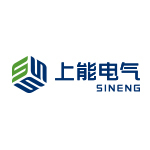
Core Insights - On January 8, 2023, brokerage firms provided target prices for listed companies, with notable increases for GCL-Poly Energy, Haiguang Information, and China Pacific Insurance, showing target price increases of 49.60%, 40.27%, and 29.61% respectively, across the photovoltaic equipment, semiconductor, and insurance industries [1][2]. Group 1: Target Price Increases - GCL-Poly Energy (688390) received a target price of 111.00 yuan, reflecting a 49.60% increase from the latest closing price [2]. - Haiguang Information (688041) has a target price of 339.00 yuan, indicating a 40.27% increase [2]. - China Pacific Insurance (601601) has a target price of 60.85 yuan, showing a 29.61% increase [2]. Group 2: Brokerage Recommendations - On January 8, 30 listed companies received brokerage recommendations, with Jinggong Steel Structure, Helen Zhe, and China Chemical each receiving one recommendation [2]. - One company, Allwinner Technology (300458), had its rating upgraded from "Hold" to "Buy" by Zhongyou Securities [3]. Group 3: Rating Downgrades - Two companies experienced rating downgrades: Haixia Co. (002320) was downgraded from "Buy" to "Hold" by Tianfeng Securities, and Sanhua Intelligent Control (002050) was downgraded from "Buy" to "Hold" by Northeast Securities [4]. Group 4: First-Time Coverage - Seven companies received first-time coverage on January 8, including Jieli Rigging (002342) rated "Hold" by Northeast Securities, and Shenchi Electromechanical (603109) rated "Buy" by CITIC Securities [5]. - Other companies receiving first-time ratings include Chenguang Co. (603899) with a "Recommended" rating, and Jinhua New Materials (920015) with a "Hold" rating [5].





固德威目标价涨幅超49%,三花智控评级被调低丨券商评级观察
2 1 Shi Ji Jing Ji Bao Dao· 2026-01-09 01:20
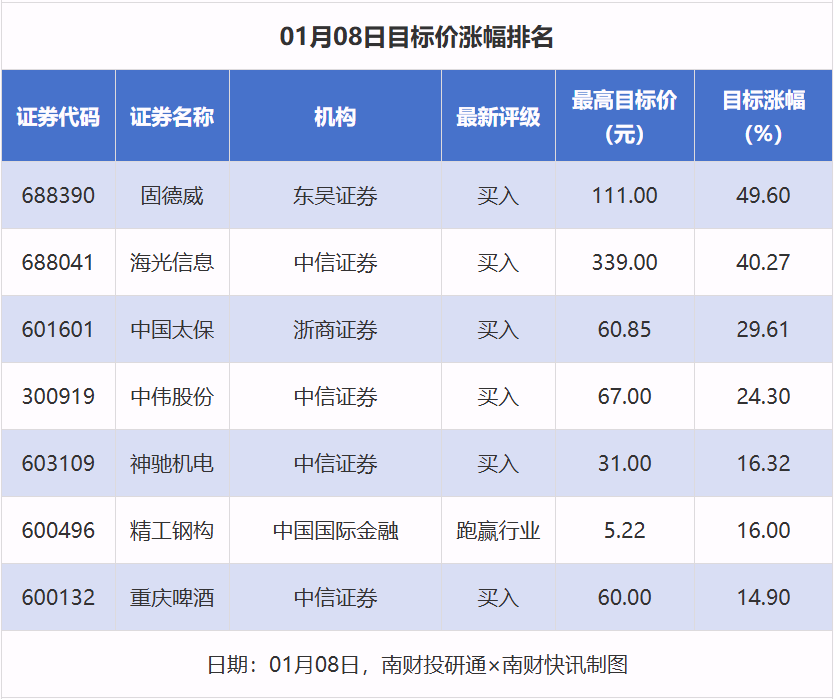
Core Viewpoint - On January 8, 2023, brokerage firms provided target prices for listed companies, with notable increases in target prices for companies in the photovoltaic equipment, semiconductor, and insurance industries, specifically GCL-Poly Energy, Haiguang Information, and China Pacific Insurance, with target price increases of 49.60%, 40.27%, and 29.61% respectively [1][2]. Group 1: Target Price Increases - GCL-Poly Energy (688390) received a target price of 111.00 yuan, reflecting a target price increase of 49.60% from Dongwu Securities [2]. - Haiguang Information (688041) has a target price of 339.00 yuan, with a target price increase of 40.27% from CITIC Securities [2]. - China Pacific Insurance (601601) has a target price of 60.85 yuan, showing a target price increase of 29.61% from Zheshang Securities [2]. Group 2: Brokerage Recommendations - On January 8, 30 listed companies received brokerage recommendations, with Jinggong Steel Structure, Helen Zhe, and China Chemical each receiving one recommendation [2]. - One company, Allwinner Technology (300458), had its rating upgraded from "Hold" to "Buy" by Zhongyou Securities [3]. Group 3: Rating Downgrades - Two companies experienced rating downgrades: Haixia Co., Ltd. (002320) had its rating lowered from "Buy" to "Hold" by Tianfeng Securities, and Sanhua Intelligent Control (002050) had its rating lowered from "Buy" to "Hold" by Northeast Securities [4]. Group 4: First Coverage - Seven companies received initial coverage on January 8, including Jieli Rigging (002342) rated "Hold" by Northeast Securities, Shenchi Electromechanical (603109) rated "Buy" by CITIC Securities, and Chenguang Co., Ltd. (603899) rated "Recommended" by Ping An Securities [5].