
服务业

Search documents
【环球财经】重压之下 美国劳动力市场流失逾120万移民
Xin Hua She· 2025-09-02 07:45
Core Insights - The analysis by the Pew Research Center indicates that over 1.2 million immigrants have left the U.S. labor market from January to July this year, influenced by the immigration policies of the Trump administration [1][3] - Immigrants constitute approximately 20% of the U.S. labor force, with significant contributions in agriculture (45%), construction (30%), and services (24%) [3][4] Labor Market Impact - The cessation of large-scale immigration has had a "huge impact" on job creation capabilities in the U.S., with immigrants typically contributing to at least 50% of employment growth [4] - Enforcement actions against immigrants have led to disruptions in various sectors, particularly agriculture and construction, causing delays in crop harvesting and job losses [4][7] Sector-Specific Effects - The construction industry has seen job losses in nearly half of U.S. metropolitan areas, with the Riverside-San Bernardino-Ontario area losing 7,200 jobs and the Los Angeles-Long Beach-Glendale area losing 6,200 jobs [7] - The healthcare sector is also likely to be affected, as approximately 43% of home care workers are immigrants, raising concerns about staffing shortages in hospitals and nursing homes [7]


【环球财经】日经225指数上涨0.29%
Xin Hua Cai Jing· 2025-09-02 07:45
Market Performance - The Tokyo stock market experienced a rebound on September 2, with the Nikkei 225 index rising by 0.29% and the Tokyo Stock Exchange Price Index increasing by 0.61% [1][2] - The Nikkei index closed at 42,310.49 points, up by 121.70 points, while the Tokyo Stock Exchange index finished at 3,081.88 points, gaining 18.69 points [2] Sector Analysis - Most of the 33 industry sectors on the Tokyo Stock Exchange saw gains, with wholesale, marine transportation, and securities and commodity futures trading sectors leading the increases [2] - Conversely, the machinery, other products, and service sectors experienced slight declines [2] Investor Behavior - Investors maintained a cautious stance towards semiconductor-related stocks, with companies like Advantest and SoftBank Group showing weak stock performance [1] - Institutional investors actively purchased stocks from general trading companies, shipping, and steel sectors, which had recently seen lower stock prices [1]
8月PMI点评:需求偏弱VS生产增强
Great Wall Securities· 2025-09-02 06:45
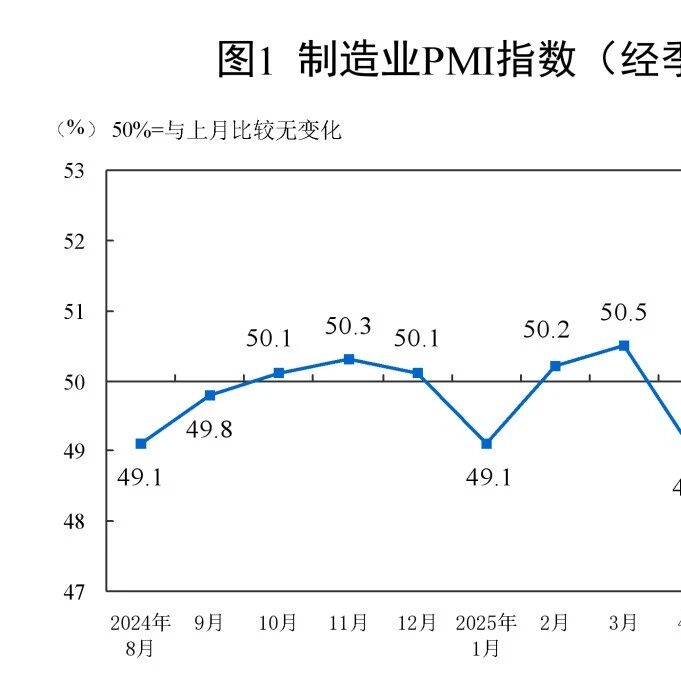
Group 1: Manufacturing Sector Insights - In August 2025, the manufacturing PMI increased by 0.1 percentage points to 49.4%, remaining below the expansion threshold, with a growth rate slightly lower than the average of 0.2% from 2016 to 2019[1] - The new orders index rose by 0.1 percentage points to 49.5%, contributing 0.03 percentage points to the PMI change[5] - The production index increased by 0.3 percentage points to 50.8%, marking the fourth consecutive month above the critical point[5] Group 2: Non-Manufacturing Sector Insights - The non-manufacturing PMI rose by 0.2 percentage points to 50.3%, indicating expansion, with the services index increasing by 0.5 percentage points to 50.5%[1] - The construction index fell by 1.5 percentage points to 49.1%, dropping into the contraction zone due to adverse weather conditions[1] - The business activity expectation index for services rose to 57.0%, indicating optimism among service sector enterprises[18] Group 3: Employment and Labor Market - The manufacturing employment index decreased by 0.1 percentage points to 47.9%, indicating a decline in employment conditions in the manufacturing sector[1] - The non-manufacturing employment index remained at 45.6%, with the services employment index dropping by 0.5 percentage points to 45.9%[23] - The construction employment index increased by 2.7 percentage points to 43.6%, supported by ongoing major infrastructure projects[23] Group 4: Risks and Economic Outlook - Risks include potential underperformance of domestic macroeconomic policies, delayed data extraction, and concentrated credit events[26] - The overall market demand remains weak, with external demand pressures still significant, indicating that the economic recovery foundation needs to be solidified[5]
【数据发布】2025年8月中国采购经理指数运行情况
中汽协会数据· 2025-09-02 03:03
Group 1: Manufacturing PMI Overview - In August, the Manufacturing Purchasing Managers' Index (PMI) was 49.4%, an increase of 0.1 percentage points from the previous month, indicating a slight improvement in manufacturing activity [1] - Large enterprises had a PMI of 50.8%, up 0.5 percentage points, while medium and small enterprises had PMIs of 48.9% and 46.6%, respectively, indicating a decline for medium and small enterprises [3] - The production index was 50.8%, up 0.3 percentage points, suggesting accelerated manufacturing production expansion [4] Group 2: Manufacturing Sub-indices - The new orders index was 49.5%, indicating a slight improvement in market demand, although still below the critical point [4] - The raw materials inventory index was 48.0%, showing a narrowing decline in inventory levels [4] - The employment index was 47.9%, indicating a slight decrease in employment levels within manufacturing [4] - The supplier delivery time index was 50.5%, reflecting faster delivery times from suppliers [5] Group 3: Non-Manufacturing PMI Overview - In August, the Non-Manufacturing Business Activity Index was 50.3%, an increase of 0.2 percentage points, indicating continued expansion in the non-manufacturing sector [9] - The construction industry index was 49.1%, down 1.5 percentage points, while the services industry index was 50.5%, up 0.5 percentage points [12] Group 4: Non-Manufacturing Sub-indices - The new orders index for non-manufacturing was 46.6%, showing improvement but still below the critical point [14] - The input price index was 50.3%, indicating stable input prices for non-manufacturing activities [14] - The sales price index was 48.6%, suggesting a narrowing decline in sales prices [14] - The employment index for non-manufacturing was 45.6%, indicating weak employment conditions [14] Group 5: Business Activity Expectations - The business activity expectation index was 56.2%, indicating optimism among non-manufacturing enterprises regarding market prospects [15] Group 6: Comprehensive PMI Overview - The comprehensive PMI output index was 50.5%, an increase of 0.3 percentage points, indicating an overall acceleration in production and business activities [21]
开源证券:8月制造业PMI略弱于季节性 关注服务消费增量政策
智通财经网· 2025-09-02 01:36
Group 1 - The manufacturing sector shows marginal recovery in supply and demand, with PMI production rising by 0.3 percentage points to 50.8% [2] - The "anti-involution" policy is driving a rebound in commodity prices, with August PPI expected to narrow its year-on-year decline to -2.8% [2] - The BCI index for private enterprises has dropped to 46.9%, indicating ongoing operational pressures for small and medium-sized enterprises [2] Group 2 - Infrastructure investment is likely to continue slowing down, but the launch of 500 billion yuan in policy financial tools may stimulate total investment by approximately 400 billion yuan in Q4 [3] - The service sector has shown slight improvement, with the capital market's strength boosting service PMI above 70.0% for two consecutive months [3] Group 3 - Q4 policies are expected to be timely enhanced, focusing on expanding service consumption, with nationwide service consumption vouchers estimated to be between 300-500 billion yuan [4] - Shanghai plans to allocate over 40 billion yuan for consumption upgrades from September to December 2024, suggesting a national scale of approximately 375 billion yuan for service consumption vouchers [4]
美国7月PCE未改降息预期,国内8月制造业弱修复
Tong Guan Jin Yuan Qi Huo· 2025-09-01 11:13
Report Summary 1. Report Industry Investment Rating No relevant information provided. 2. Core Views - Overseas: In July, US personal consumption expenditure showed resilience with a 0.5% month - on - month increase and a 0.3% real growth. PCE inflation remained at 2.6% year - on - year, while core PCE rose to 2.9%, highlighting core inflation pressure. The market's probability of a 25BP Fed rate cut in September remained at 87%. Trump's attempt to fire Fed理事Cook led to a legal battle. The dollar index fluctuated, US bond yields declined, gold prices rose, and stocks, copper, and crude oil all increased. This week, focus on US August non - farm payrolls, ISM manufacturing data, and Fed personnel issues [2]. - Domestic: In August, the manufacturing PMI slightly increased to 49.4 but remained in the contraction range. New orders and new export orders were weak, and the "anti - involution" policy pushed up price indices, alleviating deflation pressure. The non - manufacturing PMI rose to 50.3, with the service industry PMI reaching a yearly high. A - shares fluctuated, and the bond market was weak. As the domestic important node approaches, market divergence is expected to increase, and the window for peak stock market risk appetite may be approaching. This week, focus on the SCO Summit [2]. 3. Section Summaries Overseas Macro - 7 - month US PCE: Overall in line with expectations, with energy and food items falling, core goods cooling, and core services warming. The market's probability of a September rate cut remained at around 87% [4][5]. Domestic Macro - August Manufacturing: The PMI slightly increased but was still in the contraction range. Supply and demand improved, "anti - involution" pushed up prices, and there was raw material restocking and finished - product destocking. The service industry's PMI rose to a yearly high, while the construction industry was at a low level [7][8]. Asset Performance - Equity: A - shares, Hong Kong stocks, and overseas stocks showed different trends. A - shares fluctuated, with the Shanghai Composite Index reaching a ten - year high, but the market's money - making effect was not strong [11]. - Bond: Domestic and overseas bond yields changed. In the domestic market, 10 - year and 30 - year bond yields were at 1.78% and 2.01% respectively, and in September, government bond issuance may pressure the bond market [2]. - Commodity: Different commodities had different price trends. Gold and silver prices rose, while crude oil prices showed a mixed performance [17]. - Foreign Exchange: The US dollar index and exchange rates of major currencies changed. The US dollar index fluctuated, and the US dollar weakened against the RMB [19]. High - Frequency Data - Domestic: Data on congestion, subway passenger volume, real estate transactions, and passenger car sales were presented, but no specific analysis was provided [21]. - Overseas: Data on retail sales, unemployment claims, and financial conditions were presented, but no specific analysis was provided [26]. This Week's Key Data and Events - A series of economic data from China, the eurozone, and the US will be released this week, including PMI, CPI, employment, and trade data [29].
8月PMI数据点评:“反内卷”政策或是制造业价格提振的主要因素
Bank of China Securities· 2025-09-01 11:08
Group 1: Manufacturing Sector Overview - In August, the manufacturing PMI index was 49.4%, a slight increase of 0.1 percentage points from July, indicating a marginal recovery within the contraction zone[3] - The new orders index rose to 49.5%, up 0.1 percentage points, while the new export orders index also increased by 0.1 percentage points to 47.2%[4] - The production index reached 50.8%, reflecting a 0.3 percentage point increase, indicating active manufacturing activities[4] Group 2: Price Trends and Influences - The main raw materials purchase price index and the factory price index increased by 1.8 and 0.8 percentage points respectively, marking three consecutive months of recovery[7] - The "anti-involution" policy has significantly boosted the factory price index in the midstream equipment manufacturing sector, with indices rising above the threshold line[2] - However, demand weakness may hinder overall performance in the manufacturing supply chain, as evidenced by a decline in new orders in the electrical machinery and general equipment manufacturing sectors[2] Group 3: Non-Manufacturing Sector Insights - The non-manufacturing PMI index rose to 50.3%, a 0.2 percentage point increase, remaining in the expansion zone[9] - The new orders index for the non-manufacturing sector was 46.6%, up 0.9 percentage points, indicating some improvement in demand[9] - The construction sector's PMI fell to 49.1%, a decrease of 1.5 percentage points, indicating a contraction in construction activity[13]
8月制造业供需回暖但失衡仍存,关注价格修复的持续性
China Post Securities· 2025-09-01 10:42
Group 1: Manufacturing Sector Insights - The manufacturing PMI for August is at 49.4%, showing a marginal improvement of 0.1 percentage points from the previous month, but still below the expansion threshold[11] - The production index for manufacturing PMI is at 50.8%, indicating a recovery in production, while the new orders index is at 49.5%, reflecting weak demand[15] - The PPI is expected to show a marginal improvement in year-on-year growth, driven by the "anti-involution" policy, which aims to rectify disorderly competition in certain industries[27] Group 2: Employment and Small Enterprises - The Chinese Business Condition Index (BCI) for August is at 47.88, down 0.81 from July, indicating a decline in the operational conditions of small enterprises[17] - The continued decline in small enterprises may disrupt the employment market, affecting residents' income expectations and consumer recovery[28] - The disparity in recovery between large/mid-sized enterprises and small enterprises suggests a cautious outlook for overall economic recovery[28] Group 3: Non-Manufacturing Sector Performance - The non-manufacturing business activity index is at 50.3%, reflecting a slight recovery in expansion momentum, particularly in the service sector[21] - The construction sector's PMI is at 49.1%, indicating a contraction due to adverse weather conditions and slowing real estate sales[23] - The service sector's PMI is at 50.5%, with high activity levels in capital market services and transportation, benefiting from a recovering equity market[24] Group 4: Economic Outlook and Risks - Future economic recovery hinges on the sustainability of price recovery; if prices stabilize, it could lead to improved corporate revenues and profits[29] - Risks include geopolitical tensions and the potential ineffectiveness of policy measures, which could hinder economic recovery[5]
8月PMI数据解读:8月制造业PMI小幅回升
Guoxin Securities Co., Ltd· 2025-09-01 10:35
Manufacturing Sector Insights - August Manufacturing PMI stands at 49.4%, a slight increase of 0.1 percentage points from July, remaining below the critical line for five consecutive months, indicating a continued decline in manufacturing sentiment[2] - Production Index at 50.8%, up 0.3 percentage points from July, suggests accelerated manufacturing production expansion[3] - New Orders Index at 49.5%, up 0.1 percentage points from July, indicates a slight improvement in market demand[3] - Raw Material Inventory Index at 48.0%, up 0.3 percentage points from July, shows a narrowing decline in major raw material inventory[3] - Employment Index at 47.9%, down 0.1 percentage points from July, reflects a slight decrease in employment sentiment within manufacturing[3] Non-Manufacturing Sector Insights - August Non-Manufacturing Business Activity Index at 50.3%, up 0.2 percentage points from July, continues to indicate expansion in the non-manufacturing sector[5] - Construction Business Activity Index at 49.1%, down 1.5 percentage points from July, shows a decline in construction activity[9] - Service Sector Business Activity Index at 50.5%, up 0.5 percentage points from July, indicates growth in service activities[9] - New Orders Index for Non-Manufacturing at 46.6%, up 0.9 percentage points from July, suggests improved market demand in non-manufacturing[9] - Business Activity Expectation Index at 56.2%, up 0.4 percentage points from July, indicates optimism among non-manufacturing enterprises regarding market prospects[10]
万业企业:三林万业累计质押6656万股股份
Mei Ri Jing Ji Xin Wen· 2025-09-01 10:29
Group 1 - The second largest shareholder of Wanye Enterprise, Sanlin Wanye (Shanghai) Enterprise Group, holds approximately 70.35 million shares, accounting for 7.56% of the total share capital [1] - As of the announcement date, Sanlin Wanye has pledged 66.56 million shares, which represents 94.62% of its total holdings and 7.15% of the company's total share capital [1] - The revenue composition for Wanye Enterprise for the year 2024 is as follows: real estate accounts for 48.34%, manufacturing for 41.44%, services for 8.72%, and other businesses for 1.49% [1] Group 2 - The current market capitalization of Wanye Enterprise is 15 billion yuan [1]
