
证券业

Search documents
透过利率传导看“存款搬家”本质
Jing Ji Ri Bao· 2025-10-21 22:00
Core Insights - The recent increase in household deposits and non-bank financial institution deposits indicates a shift in asset allocation behavior among residents, reflecting a response to changes in asset return rates [1][2] Group 1: Deposit Trends - In the first three quarters of this year, RMB deposits increased by 22.71 trillion yuan, with household deposits rising by 12.73 trillion yuan and non-bank financial institution deposits increasing by 4.81 trillion yuan [1] - The growth rate of household deposits has slowed compared to previous highs, while non-bank deposits continue to grow rapidly [1][2] Group 2: Historical Context - The phenomenon of "deposit migration" is not new and has been a regular occurrence in the development of financial markets over the past 20 years, with various asset types attracting funds at different times [2] - The rapid growth of non-bank financial institution deposits is linked to the increased regularization of non-bank deposits and the holding of interbank certificates of deposit [2] Group 3: Impact of Interest Rates - Changes in interest rates act as a guiding mechanism for fund flows, with "deposit migration" resulting from relative changes in yields across different financial markets [2] - As expectations for bond and stock yields rise, individuals tend to increase their holdings in these assets, leading to a corresponding reduction in other asset allocations [2] Group 4: Economic Implications - Active asset reallocation based on yield comparisons can optimize resource allocation and support high-quality economic development [3] - The movement of funds into capital markets through various channels can provide direct financing support to the real economy, reflecting an increase in wealth management awareness among investors [3] Group 5: Challenges and Recommendations - Despite the benefits of diversified asset allocation, challenges such as information asymmetry, uneven investor education levels, and the need for improved market systems still exist [3] - Continuous investor education, diversification of financial product offerings, and enhanced market regulation are essential to maintain fair and transparent markets and protect investor rights [3]
避险情绪深化下,海外债的拉久期策略
GUOTAI HAITONG SECURITIES· 2025-10-21 11:13
Group 1 - The report highlights a deepening global credit risk differentiation, with France's sovereign rating downgraded to A+ and increasing default pressure on US corporations, suggesting a focus on extending duration and upgrading ratings in investment strategies [1][6][29] - The global bond market is driven by three main themes: monetary policy outlook, structural changes in sovereign debt, and international financial system reforms [6][8] - The report indicates that emerging market bonds are showing significant differentiation, with major markets enhancing resilience through dollar and local currency issuance, while frontier markets face sustainability pressures [6][8] Group 2 - The report notes that the US Treasury yield curve has shifted to a bull steepening shape, with the 10-year yield dropping to 4.011% and the 2-year yield declining even more significantly [8][9] - European sovereign bond yields have also seen substantial declines, with the UK 10-year yield plummeting by 25.83 basis points and Germany's 10-year yield falling by 14 basis points [9][10] - The credit market is showing a clear differentiation, with investment-grade corporate bonds performing strongly and high-yield bonds under pressure, as evidenced by the G-spread narrowing for investment-grade bonds while widening for high-yield bonds [11][28] Group 3 - The report emphasizes the need for defensive and structural opportunities in current investment strategies, recommending a moderate extension of duration and an overweight in investment-grade bonds [6][11] - The report suggests increasing allocations to emerging market dollar bonds while avoiding frontier market foreign currency debt, highlighting the resilience of major emerging markets [6][11] - The report also points out the narrowing of the offshore RMB bond yield spread, indicating improved liquidity and demand for RMB assets [15][24]
「数据看盘」机构、一线游资活跃度连续两日下降 IC期指空头大幅加仓
Sou Hu Cai Jing· 2025-10-21 10:06
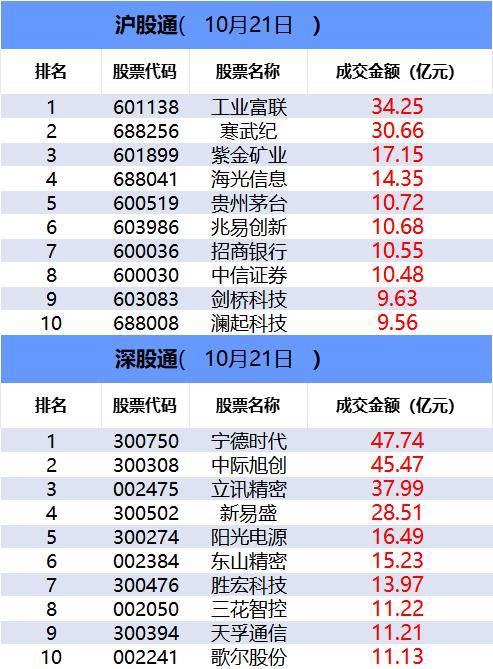
Group 1: Stock Market Overview - The total trading amount for Shanghai Stock Connect today was 120.83 billion, while Shenzhen Stock Connect totaled 126.04 billion [1] - The top traded stocks in Shanghai included Industrial Fulian with 3.43 billion, followed by Zhenzheng Ji with 3.07 billion, and Sanfa Cai with 1.72 billion [2] - In Shenzhen, the leading stock was Ningde Times with 4.77 billion, followed by Zhongji Xuchuang with 4.55 billion, and Luxshare Precision with 3.80 billion [3] Group 2: Sector Performance - The sectors showing the highest gains included cultivated diamonds, engineering machinery, and CPO, while coal and other sectors experienced declines [4] - The electronic sector led with a net inflow of 11.63 billion, followed by communication with 5.89 billion, and machinery equipment with 3.74 billion [5] - The banking sector had the highest net outflow at -1.84 billion, followed by coal mining at -1.50 billion, and non-ferrous metals at -1.39 billion [6][7] Group 3: Individual Stock Activity - Industrial Fulian saw the highest net inflow among individual stocks [8] - The stock with the largest net outflow was Citic Securities [9] Group 4: ETF Trading - The top ten ETFs by trading amount included Hong Kong Securities ETF with 22.55 billion, Gold ETF with 9.47 billion, and Hong Kong Innovative Drug ETF with 6.15 billion [10] - The ETF with the highest growth compared to the previous trading day was the Breeding ETF, which increased by 231.87% [10] Group 5: Futures Market - In the futures market, all four major index contracts (IH, IF, IC, IM) saw both long and short positions increase, with IC contract showing a significant increase in short positions [11] Group 6: Institutional Activity - Institutional activity showed a decrease, with Bluefeng Biochemical receiving 43.34 million from three institutions [13] - The stock with the largest institutional sell-off was Huile Ecology, which saw a sell-off of 179 million from two institutions [14] Group 7: Retail and Quantitative Trading - Retail trading activity decreased, with significant purchases in Shanhe Intelligent totaling 110 million from two retail investors [15] - Quantitative trading was active, with Source Technology receiving 292 million from a quantitative seat [16]






【招银研究|固收产品月报】债市趋于震荡,配置从中短债开始(2025年10月)
招商银行研究· 2025-10-21 09:22
Core Viewpoint - The article discusses the recent performance and outlook of fixed income products, highlighting a recovery in the bond market and the varying performance of different types of fixed income investments amid changing economic conditions and market sentiment [1][2]. Summary by Sections Fixed Income Product Performance - In the past month, the bond market has shown signs of recovery, with net values of fixed income products increasing. The leading performers include rights-embedded fixed income products, followed by short-duration assets like interbank certificates of deposit and short-term bond funds [3][10]. - As of October 17, the monthly returns for various products were as follows: rights-embedded bond funds at 0.21% (previously 0.54%), high-grade interbank certificates at 0.15% (previously 0.13%), short-term bond funds at 0.12% (previously 0.05%), and medium to long-term bond funds at 0.12% (previously -0.07%) [3][8]. Bond Market Review - The bond market experienced a phase of warming, with short-duration bonds outperforming long-duration ones. The yield curve initially steepened before flattening, influenced by factors such as the escalation of the US-China trade conflict and a weak economic backdrop [10][11]. - Key observations include: - The one-year government bond yield rose by 5 basis points to 1.44%, while the ten-year yield fell by 1 basis point to 1.83% [16][20]. - The average rates for three-month and one-year AAA interbank certificates increased slightly, indicating a stable liquidity environment [11][20]. Market Outlook - Short-term expectations suggest a stable interbank rate with potential for slight decreases, while medium-term projections indicate a continuation of a range-bound market for bonds, with a possible mild widening of yield spreads [1][32]. - The anticipated range for the ten-year government bond yield is between 1.6% and 2.0% [1][32]. Investment Strategies - For investors focused on liquidity management, maintaining cash-like products and considering stable low-volatility investments such as short-term bond funds is recommended. Long-term trends indicate a decline in cash product yields [39][42]. - For conservative investors, holding pure bond products while cautiously extending duration is advised, with a focus on high-grade long-duration bonds when yields exceed 1.8% [43][44]. - For more aggressive investors, a strategic allocation to fixed income plus products, including convertible bonds and equity assets, is suggested, leveraging the current favorable liquidity conditions [44][45].
螺丝钉指数地图来啦:指数到底如何分类|2025年10月
银行螺丝钉· 2025-10-21 07:58
Core Viewpoint - The article presents a comprehensive index map for investors, detailing various stock indices, their codes, selection rules, industry distribution, and average and median market capitalizations of constituent stocks, which will be regularly updated for easy reference [1][2]. Group 1: Types of Indices - The index map includes several categories of stock indices: broad-based indices, strategy indices, industry indices, thematic indices, and overseas indices [4][5]. Group 2: Broad-based Indices - Important broad-based indices in the A-share market include the CSI series such as the CSI 300, CSI 500, CSI 800, and the CSI All Share, which are selected based on the market capitalization of listed companies and cover a wide range of industries [9]. Group 3: Strategy Indices - Common strategy indices in the A-share market include: - CSI 300: Represents large-cap stocks - CSI 500: Represents mid-cap stocks - CSI 1000: Represents small-cap stocks - CSI 2000: Represents micro-cap stocks [11]. - Strategy indices enhance investment options and cater to diverse investor needs [13]. Group 4: Dividend and Value Indices - Dividend indices select stocks with high dividend yields, while value indices focus on stocks with low price-to-earnings and price-to-book ratios, as well as high dividend yields [12]. - Low volatility indices target stocks with lower price volatility, and fundamental indices select stocks based on revenue, cash flow, net assets, and dividend size [12][13].

企业盈利改善带动税收稳步回升 三季度销售收入增速达4.4%
Sou Hu Cai Jing· 2025-10-20 22:32
Group 1 - The implementation of a package of incremental policies since September 26 last year has led to a steady recovery in both invoice sales and tax revenue, indicating a positive trend in the economy [1] - The quarterly sales revenue growth for enterprises has shown a steady increase, with growth rates of 0.4%, 2.6%, 2.1%, 3.1%, and 4.4% from Q3 last year to Q3 this year [1] - Tax revenue has turned positive after seven months of negative growth, with continuous positive growth for eight months since February this year, showing an increasing cumulative growth rate [1] Group 2 - Tax revenue from the capital market services sector has increased by 56.8% year-on-year, with securities transaction stamp duty rising by 110.5%, reflecting active stock market trading [2] - The manufacturing sector's tax revenue has grown by 5.4% year-on-year, accounting for 31% of total tax revenue, with high-end manufacturing sectors like railway and aerospace showing significant growth [2] - The domestic value-added tax has increased by 3.2% year-on-year, indicating improved business operations, while corporate income tax has risen by 4.1%, reflecting better profitability in certain industries [2] Group 3 - The decline in tax revenue related to the real estate sector has narrowed, with a year-on-year decrease of 9.8%, indicating the effectiveness of policies aimed at stabilizing the real estate market [3] - The implementation of tax reduction policies has led to nearly 80 billion yuan in new tax cuts, significantly lowering transaction costs for residential housing [3] - The procurement of machinery and equipment by enterprises has increased by 9.7% year-on-year, with high-tech manufacturing showing an 11.8% growth, indicating a positive trend in capital investment [3]
LPR连续5个月“按兵不动” 降息窗口还需等待
Sou Hu Cai Jing· 2025-10-20 17:22
Core Viewpoint - The Loan Prime Rate (LPR) remains unchanged for the fifth consecutive month, with the 1-year and 5-year rates at 3.0% and 3.5% respectively, reflecting stable policy rates and bank margin pressures [1][2]. Monetary Policy and LPR Stability - The stability of the central bank's 7-day reverse repurchase rate at 1.40% has been a significant factor in maintaining the LPR [2]. - Bank net interest margins are under pressure, with the net interest margin for commercial banks dropping to 1.42% by the end of Q2 2025, a decrease of 10 basis points from the previous year [1][2]. Market Conditions and Future Expectations - There is an expectation for targeted LPR reductions by the end of the year to stimulate domestic demand and stabilize the real estate market [6]. - The central bank has indicated a commitment to maintaining adequate liquidity and supporting consumption and investment, especially in light of external economic pressures [4][6]. Economic Indicators - The average interest rate for new corporate loans in September was approximately 3.1%, down about 40 basis points year-on-year, while the average for new personal housing loans was also around 3.1%, down about 25 basis points [3]. External Influences - The potential for further easing of external constraints, particularly with the U.S. Federal Reserve's recent rate cuts, may provide a favorable environment for China's monetary policy adjustments [6][7].
山东省发展改革委发布民营经济高质量发展典型案例:为民营经济注入“金融活水”
Zhong Guo Fa Zhan Wang· 2025-10-20 06:34
Core Viewpoint - The financial system in the province is focused on implementing national financial policies to support the high-quality development of private enterprises, emphasizing service quality and efficiency [1] Group 1: Credit Resource Investment - Continuous increase in credit resources to support the growth of the private economy, with 59 financial institutions and over 2,200 teams serving 80,000 private enterprises, providing financing exceeding 400 billion yuan for 18,000 enterprises [2] - Support for weak links in the economy by extending financial services to individual businesses, resulting in 276,000 private enterprises having loans by the end of November, an increase of 19,000 since the beginning of the year [3] - Implementation of "Financial Direct to Grassroots Acceleration" actions to address issues like slow approvals and difficult renewals, facilitating financing for 1,303 projects totaling 307.687 billion yuan [4] Group 2: Capital Market Development - Utilizing domestic and international capital markets to promote the listing of private enterprises, with 5 new listed companies this year, bringing the total to 309, of which 62% are private enterprises [5] - Expanding direct financing channels through financial increment policies, with 16 private enterprises entering the investment project library of a newly established private equity fund totaling 50 billion yuan [6] - Strengthening regional equity markets by organizing financing roadshows and training, resulting in 160 new listed private enterprises this year, raising a total of 69.086 billion yuan [7] Group 3: Addressing Financing Challenges - Improving mechanisms for debt risk prevention and resolution, ensuring early identification and management of risks for private enterprises [8] - Enhancing support for private enterprises through government-backed financing guarantees, benefiting 234,900 small and micro enterprises and farmers [9] - Expanding the no-repayment renewal policy to all small and medium enterprises, with new no-repayment loans amounting to 280.103 billion yuan, a year-on-year increase of 13.49% [10] - Implementing digital financial initiatives to improve credit information access, providing data support to over 3.3 million private economic entities [11]

【华西大类资产】美欧日政策差异下的弱美元——2025Q4海外经济与资产展望
Sou Hu Cai Jing· 2025-10-20 00:20
Group 1: Economic Overview - The US economy is experiencing marginal slowdown, with both manufacturing and service sectors showing decreased activity, and the labor market showing signs of fatigue [1] - In Europe, the economy is stabilizing under the influence of continuous interest rate cuts, leading to increased credit growth for households and businesses, although structural issues and energy bottlenecks persist [1] - Japan's economy remains relatively stable with rising household income and improved consumer confidence, but faces new challenges from US tariffs and yen appreciation impacting manufacturing and exports [1] Group 2: Asset Outlook - US Treasury yields are expected to decline towards 3.5% as the Federal Reserve continues to cut rates, with European bond yields also expected to decrease due to easing inflation pressures [2] - The US dollar is anticipated to weaken due to the Federal Reserve's rate cuts and the differing monetary policy trajectories among the US, Eurozone, and Japan [2] - Short-term pressures on gold prices are noted due to increased margin requirements and prior price surges, while medium-term support remains strong from fiscal debt, monetary easing, and sovereign gold purchases [2]
长钱入市增强资本市场内在稳定性
Zheng Quan Ri Bao· 2025-10-19 22:53
Core Insights - The introduction of two monetary policy tools by the People's Bank of China has significantly enhanced the stability of the capital market over the past year, injecting thousands of billions into the market and boosting investor confidence [1][2][5]. Group 1: Monetary Policy Tools - The two monetary policy tools, namely stock repurchase and increase loan and swap convenience, were established with a total initial quota of 800 billion yuan, which has been effectively utilized to stabilize the market [1][4]. - The swap convenience has provided liquidity support to financial institutions without expanding the base currency supply, with a total of 1,050 billion yuan injected through two operations [3][5]. - The stock repurchase and increase loan has seen nearly 700 listed companies disclosing plans to use loans, with a total loan cap exceeding 3,300 billion yuan [1][4]. Group 2: Market Impact - The implementation of these tools has led to a reduction in A-share volatility, with the Shanghai Composite Index rising by 17.73% over the past year and its annualized volatility decreasing by 4.62 percentage points [6][5]. - The tools have played a crucial role in stabilizing market expectations and preventing excessive fluctuations, particularly during periods of external shocks [5][6]. - The measures have also facilitated a shift in market sentiment towards a more optimistic outlook, encouraging companies to repurchase shares and institutions to increase equity allocations [6][7]. Group 3: Future Directions - There is a push for the normalization of these monetary policy tools to establish a stable balance mechanism in the capital market, which would provide ongoing support and enhance investor confidence [7][8]. - Recommendations include expanding the coverage of the tools to include more financial institutions and optimizing policy designs to improve flexibility and responsiveness [8]. - Strengthening regulatory oversight on the use of these tools is essential to protect the interests of small investors and maintain market integrity [8].