
铜产业

Search documents
铜产业链周度报告-20260104
Guo Tai Jun An Qi Huo· 2026-01-04 08:44
1. Report Industry Investment Rating No information provided. 2. Core Viewpoints of the Report - Copper lacks obvious driving forces, with prices oscillating at high levels, and the idea of buying on dips remains unchanged. The strength analysis is neutral, with a price range of 96,000 - 105,000 yuan/ton, and the COMEX - LME price spread has fallen back to around $100/ton [3]. - Macro - and fundamental factors lack obvious driving forces for price movement. Geopolitical turmoil globally may intensify risk - aversion sentiment. In the short - term, the domestic spot driving logic is weak, while the overseas spot logic remains strong. Long - term fundamentals still support copper prices, with a significant drop in China's imported copper concentrate long - term TC in 2026 and a strong long - term consumption recovery expectation [7]. - In terms of trading strategies, the short - term upward driving force for prices is not strong, but the idea of buying copper on dips remains unchanged due to the long - term positive fundamentals. For spread trading, the COMEX - LME spread has weakened, and it is advisable to reduce positions in the LME - SHFE positive spread trading when opportunities arise. Also, be cautious with the internal - external reverse spread as the current spot export profit margin has narrowed [7]. 3. Summary by Relevant Catalogs 3.1 Trading End - Volatility: The volatilities of LME, SHFE, INE, and COMEX copper have expanded. The LME copper price volatility is around 16%, up from the previous week, and the SHFE copper volatility is around 19%, slightly up from the previous week [12]. - Term Spread: The term structure of SHFE copper has strengthened marginally, and the LME copper spot premium has expanded. The SHFE 01 - 02 spread was 560 yuan/ton on December 31, higher than - 120 yuan/ton on December 26. The LME 0 - 3 premium was $38.60/ton on January 2, 2026, higher than $19.69/ton on December 24, 2025. The COMEX copper near - end C - structure has expanded [17][19]. - Position: SHFE and LME copper positions have decreased, while INE copper positions have increased. SHFE copper positions have decreased by 37,000 lots to 617,700 lots [20]. - Capital and Industry Positions: LME commercial short net positions have increased. LME commercial short net positions increased from 76,400 lots on December 19 to 77,500 lots on December 24; CFTC non - commercial long net positions increased from 64,800 lots on December 16 to 67,100 lots on December 23 [26]. - Spot Premium: The domestic copper spot discount has narrowed, and the Yangshan Port copper premium has declined. The domestic copper spot premium narrowed from a discount of 340 yuan/ton on December 26 to a discount of 190 yuan/ton on December 31. The Yangshan Port copper premium fell from $55/ton on December 26 to $51/ton on December 31 [31]. - Inventory: The global total copper inventory has increased, with a significant increase in domestic social inventory. The global total copper inventory increased from 853,000 tons on December 25 to 905,500 tons on January 1, 2026. Domestic social inventory increased from 193,600 tons on December 25 to 238,900 tons on January 1, 2026 [37]. - Position - to - Inventory Ratio: The LME copper position - to - inventory ratio has oscillated, and the SHFE copper position - to - inventory ratio is at a historically low level for the same period [38]. 3.2 Supply End - Copper Concentrate: Imports have increased year - on - year, and processing fees have remained weak. In November 2025, China's imports of copper ore and concentrates were 2.5262 million tons, a month - on - month increase of 3.05% and a year - on - year increase of 12.55%. Port inventory decreased from 680,000 tons on December 19 to 670,000 tons on December 26 [43]. - Recycled Copper: Imports have increased year - on - year, and domestic production has increased significantly year - on - year. In November, recycled copper imports were 208,100 tons, a year - on - year increase of 19.94%. In September, domestic recycled copper production was 97,700 tons, a year - on - year increase of 17.85% [44]. - Crude Copper: Imports have increased month - on - month, and processing fees have rebounded. In November, crude copper imports were 58,300 tons, a month - on - month increase of 5.60%. In December, the southern processing fee was 1,500 yuan/ton, and the import processing fee was $95/ton [52]. - Refined Copper: Production has increased year - on - year, imports have decreased, and the loss in copper spot imports has narrowed. In November, refined copper production was 1.1031 million tons, a year - on - year increase of 9.75%. The loss in copper spot imports narrowed from 1,900.19 yuan/ton on December 24 to 1,083.72 yuan/ton on December 31 [55]. 3.3 Demand End - Capacity Utilization Rate: In November, the capacity utilization rate of copper product enterprises increased month - on - month. The capacity utilization rates of copper tubes and copper plates, strips, and foils rebounded in November but remained at historically low levels. In the week of December 25, the capacity utilization rate of wire and cable production decreased marginally [59]. - Profit: The copper rod processing fee is at a historically low level for the same period, and the copper tube processing fee has rebounded. As of December 31, the processing fee for copper rods used in the power industry in East China was 240 yuan/ton, higher than 110 yuan/ton on December 26. The 10 - day moving average of the processing fee for R410A - specific copper tubes was 5,343 yuan/ton on December 31, higher than 5,274 yuan/ton on December 26 [64]. - Raw Material Inventory: The raw material inventory of wire and cable enterprises has remained at a low level. In November, the raw material inventory of copper rod enterprises was at a slightly lower - than - neutral position for the same period in history, and the raw material inventory of copper tubes was at a historically low level. The weekly raw material inventory of wire and cable has continued to decline [65]. - Finished - Product Inventory: The finished - product inventory of copper rods is at a high level, and the finished - product inventory of wire and cable has increased. In November, the finished - product inventory of copper rods was at a historically high level for the same period, and the finished - product inventory of copper tubes was at a relatively low level for the same period. The weekly finished - product inventory of wire and cable has increased [68]. 3.4 Consumption End - Apparent Consumption: Apparent consumption is good, and power grid investment remains an important support. From January to October, the cumulative actual copper consumption was 13.2983 million tons, a year - on - year increase of 8.36%, and the apparent consumption was 13.4169 million tons, a year - on - year increase of 7.00%. Power grid investment increased by 5.90% year - on - year from January to November [76]. - Air - Conditioner and New - Energy Vehicle Production: In November, the domestic air - conditioner production was 10.577 million units, a year - on - year decrease of 35.70%, and the domestic new - energy vehicle production was 1.88 million units, a year - on - year increase of 20.05% [77].
智利11月铜产量同比下降7.18%
Wen Hua Cai Jing· 2026-01-01 11:55
Group 1 - Chile's copper production in November decreased by 7.18% year-on-year, totaling 451,815 tons [2] - Chile is the world's largest copper producer, highlighting its significant role in the global copper market [2] - The manufacturing output in Chile also fell by 1.3% year-on-year in November [2] Group 2 - China's copper industry faces three major challenges: increasing dependence on foreign upstream resources, overcapacity in the midstream processing sector, and suppressed downstream demand due to high copper prices [2] - To assist the industry in navigating these challenges, Shanghai Nonferrous Metals Network collaborated with copper industry chain enterprises to compile a bilingual version of the "2026 China Copper Industry Chain Distribution Map" [2]

迎接繁荣的起点-1月如何布局
2025-12-31 16:02
Summary of Key Points from Conference Call Records Industry Overview - The conference call discusses the potential for a prosperous economic environment in China, driven by the Federal Reserve's interest rate cuts and potential quantitative easing (QE), which will facilitate the return of cross-border capital to China and improve cash flow in the real economy [3][5]. - Key industries highlighted for investment opportunities include non-ferrous metals, new consumption, and high-end manufacturing [4][6]. Company Insights Zijin Mining - Zijin Mining, the world's third-largest copper mining company, is expected to benefit from rising copper prices and increased production, with projected revenues reaching 80 billion by 2026 and a market capitalization of 1.6 trillion [10]. - The company is seen as a top investment choice due to its strong growth prospects and the favorable market conditions for copper [10]. Huafeng Aluminum - Huafeng Aluminum is recognized for its solid quality and cautious capacity expansion, with a return on equity (ROE) of 20%-25% and a compound growth rate of over 15%. The current valuation is considered low, making it a potential investment target [11]. - The company is expected to benefit from new product launches and applications, with a projected doubling of capacity after the completion of its Chongqing expansion [11]. Huayou Cobalt - Huayou Cobalt's primary profit source is nickel, with expectations of profit doubling within three years, potentially within two years if nickel prices rise. The company is positioned well in the market due to concentrated supply dynamics [13][15]. - The nickel market is dominated by a few large players, with significant influence from Indonesian government policies, which are expected to drive prices higher [14]. Dongfang Electric - Dongfang Electric is positioned to benefit from increased global power investments, particularly in North America, where demand for gas turbines is rising due to AI-driven electricity needs. The company has secured overseas orders for its 750 gas turbine [16][17]. Guotai Junan Securities - Guotai Junan is expected to fully realize integration effects by 2026, with a leading customer base and significant cost reduction potential through business integration. The company reported a revenue of 46 billion and a net profit of 22.1 billion in the first three quarters of 2023, showing substantial growth [2][22]. - The current valuation is considered low compared to peers, indicating potential investment value [22]. Market Trends and Predictions - The A-share market is anticipated to reach new highs in 2026, with increased volatility. Non-ferrous metals, new consumption, and high-end manufacturing sectors are expected to perform well due to macroeconomic improvements [6]. - The copper and aluminum markets are projected to see price increases due to tight supply and stable demand over the next two to three years [9]. Additional Insights - The impact of U.S. Federal Reserve policies on the Chinese market is significant, with recent interest rate cuts reversing capital outflows and improving the economic environment [5]. - The agricultural sector is expected to benefit from rising prices in phosphate and potash resources due to supply-demand mismatches, with companies like Dongfang Iron Tower making strategic moves in this area [18]. Conclusion - The conference call highlights a positive outlook for several industries and companies in China, driven by macroeconomic factors and strategic positioning within their respective markets. Investors are encouraged to consider these opportunities as the economic landscape evolves.



开盘涨超1000%!A股,又见证历史
Zhong Guo Ji Jin Bao· 2025-12-31 03:20
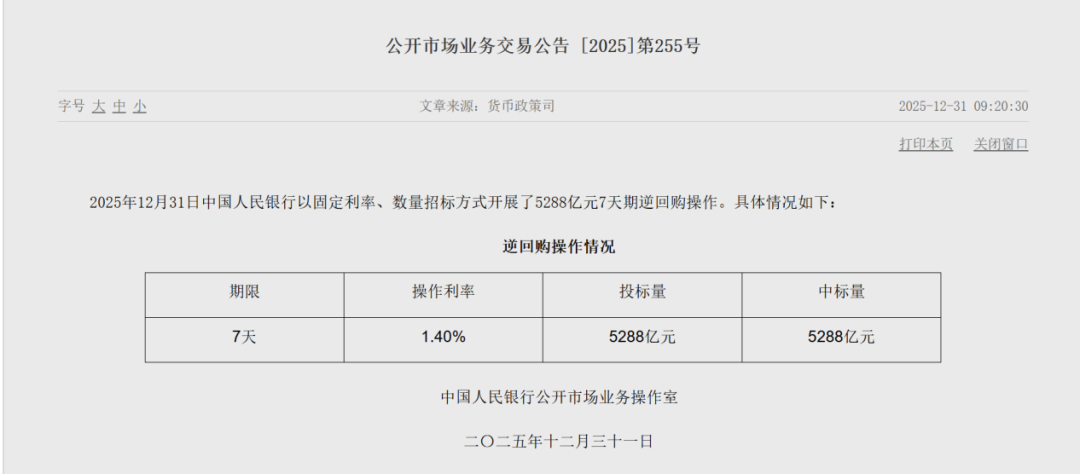
Monetary Policy - On December 31, the People's Bank of China conducted a 7-day reverse repurchase operation of 528.8 billion CNY at a fixed rate of 1.40%, with a net injection of 502.8 billion CNY after accounting for 26 billion CNY maturing reverse repos [1] Stock Market Performance - The A-share market opened slightly higher on December 31, with the Shanghai Composite Index up by 0.1%, the Shenzhen Component Index up by 0.13%, and the ChiNext Index up by 0.22% [2] - The precious metals sector showed overall gains, while sectors such as agriculture, retail, and oil and petrochemicals underperformed [2] Metals Sector - The non-ferrous metals sector saw a rise on December 31, with active trading in industrial metals, copper, cobalt, and nickel stocks. Jiangxi Copper reached its daily limit, with other stocks like Shengxin Lithium Energy and Zijin Mining also experiencing gains [3][6] Individual Stock Highlights - Jiangxi Copper's stock reached a peak of 55.28 CNY, with a trading volume of 584,500 hands and a market capitalization of 191.32 billion CNY [4] - Jiamai Packaging achieved an 11-day consecutive limit-up, trading at 13.04 CNY per share [7][10] - The stock of Hengtong Light surged by 1007.95% upon its debut on the Beijing Stock Exchange, opening at 350 CNY per share [11][13] Company Announcements - Jiamai Packaging announced that its main business had not undergone significant changes, and there are no plans for major asset restructuring in the near future [10] - Hengtong Light, established in 2011, focuses on passive optical device products and has a client base that includes major companies like Google, Amazon, and Microsoft [11][14]



《有色》日报-20251231
Guang Fa Qi Huo· 2025-12-31 01:32
Report Industry Investment Ratings No relevant content provided. Core Views of the Report Tin Industry - The resumption of tin mines in Myanmar is expected to accelerate, with a steady increase in imports in November and a significant increase in Indonesia's exports in November. The trading volume of the exchange in December also remained at a relatively high level. - In the demand aspect, tin solder enterprises in South China showed certain resilience, while those in East China were more obviously affected. - The market sentiment has fluctuated greatly recently, and the tin price has fluctuated sharply. It is recommended to be cautious in operation and pay attention to the macro and supply - side recovery [2]. Aluminum Industry - For alumina, the policy of encouraging mergers and reorganizations is more of an emotional drive, and it is difficult to reverse the supply - demand fundamentals in the short term. The price is expected to fluctuate widely around the industry cash cost line. - For electrolytic aluminum, the market is dominated by the game between strong macro - expectations and weak fundamentals. It is expected to maintain a wide - range high - level shock in the short term. It is recommended that pre - existing long positions be closed at high prices [4]. Aluminum Alloy Industry - The casting aluminum alloy followed the upward trend of aluminum prices and the market trading became light. The cost is strongly supported, but the demand is weak. The price of ADC12 is expected to continue to fluctuate in a high - level range in the short term [5]. Zinc Industry - The domestic zinc ore supply is tight, but the opening of the zinc ore import window may ease the short - term supply pressure. The increase in refined zinc production is limited, while the demand side is better, and the social inventory is continuously decreasing. - In the future, the price is expected to be mainly volatile, and attention should be paid to changes in import profit and loss, TC inflection points, and refined zinc inventories [7]. Copper Industry - The medium - and long - term fundamentals of copper are still good, but in the short term, the previous sharp rise in prices has suppressed real demand. The price is expected to enter a shock adjustment stage, and attention should be paid to the support level [10]. Industrial Silicon Industry - The supply and demand of industrial silicon are both stable with a slight decline, and the expectation of production reduction is further heating up. It is expected that the price will fluctuate at a low level, and attention should be paid to the intensity of production reduction [13]. Polysilicon Industry - The polysilicon futures further reduced positions and rebounded. The upstream hopes to drive the price increase of the entire industrial chain by raising prices, but the terminal demand is weak. It is recommended to wait and see, pay attention to the production reduction situation and price adjustment acceptance [14]. Nickel Industry - The Indonesian government's plan to cut nickel production has driven up market sentiment, but the actual implementation remains to be seen. The short - term reality is still weak, and the medium - term fundamentals are loose, which restricts the upward space of prices [15]. Stainless Steel Industry - The stainless - steel market was driven by raw material nickel, and the market sentiment improved. The supply pressure has eased slightly, but the demand in the off - season is still insufficient. It is expected to maintain a strong shock adjustment in the short term [18]. Lithium Carbonate Industry - The lithium carbonate market has a large amplitude. The short - term supply is expected to increase slightly, and the downstream demand maintains a certain resilience. The price is supported by fundamentals, but the new driving force is limited. The market is affected by market sentiment, and the disk is expected to maintain a wide - range shock before the New Year's Day [20]. Summary by Relevant Catalogs Tin Industry Spot Price and Basis - SMM 1 tin decreased by 5.82% to 323,500 yuan/ton, and SMM 1 tin premium decreased by 12.50% to 350 yuan/ton. - LME 0 - 3 premium decreased by 26.92% to 95.00 dollars/ton [2]. Internal - External Price Ratio and Import Profit and Loss - The import loss decreased by 7.19% to - 13,988.79 yuan/ton, and the Shanghai - London ratio remained at 7.87 [2]. Monthly Spread - The spread of 2601 - 2602 increased by 70.73%, and the spread of 2602 - 2603 decreased by 18.06% [2]. Fundamental Data - In November, the import of tin ore increased by 29.81%, the output of refined tin decreased by 0.81%, the import volume of refined tin increased by 127.19%, and the export volume increased by 31.62%. - The average operating rate of SMM refined tin decreased by 0.76%, and the operating rate of SMM solder enterprises increased by 0.96% [2]. Inventory Changes - SHEF inventory increased by 4.72%, social inventory increased by 2.02%, SHEF warehouse receipts decreased by 1.68%, and LME inventory increased by 3.60% [2]. Aluminum Industry Price and Spread - SMM A00 aluminum decreased by 1.38% to 22,180 yuan/ton, and the premium remained unchanged. - The prices of alumina in various regions remained unchanged [4]. Ratio and Profit and Loss - The import loss of electrolytic aluminum decreased by 34.3 yuan/ton, and the import loss of alumina decreased by 1.1 yuan/ton. The Shanghai - London ratio was 7.57 [4]. Monthly Spread - The spread of AL 2601 - 2602 decreased by 10.0 yuan/ton, and the spread of AL 2602 - 2603 remained unchanged [4]. Fundamental Data - In November, the output of alumina decreased by 4.44%, the domestic output of electrolytic aluminum decreased by 2.82%, and the overseas output decreased by 3.50%. - The import volume of electrolytic aluminum decreased by 40.83%, and the export volume increased by 116.23%. - The operating rates of various aluminum products decreased to varying degrees, and the inventory of various types increased to varying degrees [4]. Aluminum Alloy Industry Price and Spread - The prices of various types of SMM ADC12 decreased by 0.45%. - The refined - scrap price differences of various types of aluminum increased to varying degrees [5]. Monthly Spread - The spread of 2601 - 2602 increased by 5.0 yuan/ton, and the spread of 2602 - 2603 increased by 25.0 yuan/ton [5]. Fundamental Data - In November, the output of recycled aluminum alloy ingots increased by 5.74%, the output of primary aluminum alloy ingots increased by 5.84%, and the output of scrap aluminum increased by 11.45%. - The import volume of unwrought aluminum alloy ingots decreased by 4.19%, and the export volume decreased by 0.97%. - The operating rates of recycled and primary aluminum alloys increased to varying degrees, and the social inventory of recycled aluminum alloy ingots decreased by 2.06% [5]. Zinc Industry Price and Spread - SMM 0 zinc ingot decreased by 0.60% to 23,300 yuan/ton, and the premium decreased by 10.00 yuan/ton [7]. Ratio and Profit and Loss - The import loss decreased by 175.63 yuan/ton, and the Shanghai - London ratio increased to 7.47 [7]. Monthly Spread - The spread of 2601 - 2602 increased by 10.00 yuan/ton, and the spread of 2602 - 2603 decreased by 10.00 yuan/ton [7]. Fundamental Data - In November, the output of refined zinc decreased by 3.56%, the import volume decreased by 3.22%, and the export volume increased by 402.59%. - The operating rates of galvanizing, die - casting zinc alloy, and zinc oxide increased to varying degrees. - The seven - region social inventory of zinc ingots decreased by 10.12%, and the LME inventory decreased by 0.21% [7]. Copper Industry Price and Spread - SMM 1 electrolytic copper decreased by 3.10% to 97,620 yuan/ton, and the premium increased by 90.00 yuan/ton. - The refined - scrap price difference decreased by 33.11% [10]. Fundamental Data - In November, the output of electrolytic copper increased by 1.05%, and the import volume decreased by 3.90%. - The operating rates of electrolytic copper rod and recycled copper rod decreased, and the domestic social inventory increased by 27.55% [10]. Industrial Silicon Industry Spot Price and Basis - The prices of various types of industrial silicon remained unchanged, and the basis of some types changed to varying degrees [13]. Monthly Spread - The spreads of some contracts changed to varying degrees, such as the spread of 2601 - 2602 decreased by 16.67% [13]. Fundamental Data - In November, the national output of industrial silicon decreased by 11.17%, and the outputs of Yunnan and Sichuan decreased significantly. - The output of organic silicon DMC increased by 3.82%, and the output of polysilicon decreased by 14.48%. - The export volume of industrial silicon increased by 21.78% [13]. Inventory Changes - The Xinjiang factory inventory increased by 2.33%, the social inventory increased by 0.36%, and the warehouse receipt inventory increased by 5.09% [13]. Polysilicon Industry Spot Price and Basis - The average prices of N - type polysilicon remained unchanged, and the N - type material basis increased by 37.45% [14]. Futures Price and Monthly Spread - The main contract decreased by 4.16%, and the spreads of some contracts changed to varying degrees [14]. Fundamental Data - The weekly output of silicon wafers decreased by 3.19%, and the monthly output decreased by 10.35%. - The monthly output of polysilicon decreased by 14.48%, the import volume decreased by 27.05%, and the export volume increased by 108.68% [14]. Inventory Changes - The polysilicon inventory increased by 3.41%, and the silicon wafer inventory increased by 0.88% [14]. Nickel Industry Price and Spread - SMM 1 electrolytic nickel increased by 0.65% to 132,550 yuan/ton, and 1 Jinchuan nickel increased by 0.55% to 136,150 yuan/ton. - LME 0 - 3 decreased by 14.82% to - 170 dollars/ton [15]. Cost - The cost of producing electrowon nickel from integrated MHP increased by 0.19%, and the cost from integrated high - grade nickel matte decreased by 3.60% [15]. Monthly Spread - The spread of 2602 - 2603 increased by 40 yuan/ton, and the spread of 2604 - 2605 increased by 100 yuan/ton [15]. Supply - Demand and Inventory - The output of refined nickel in China decreased by 9.38%, and the import volume decreased by 65.66%. - SHFE inventory decreased by 1.82%, social inventory decreased by 1.43%, and SHFE warehouse receipts decreased by 1.85% [15]. Stainless Steel Industry Price and Spread - The prices of 304/2B stainless steel in Wuxi and Foshan increased by 0.77%. - The prices of some raw materials remained unchanged, and the price of 8 - 12% high - nickel pig iron increased by 0.27% [18]. Monthly Spread - The spreads of 2602 - 2603, 2603 - 2604, and 2604 - 2605 decreased to varying degrees [18]. Fundamental Data - In November, the output of 300 - series stainless steel in China decreased by 0.72%, and the output in Indonesia increased by 0.36%. - The import volume of stainless steel decreased by 9.68%, and the export volume increased by 13.18%. - The 300 - series social inventory decreased by 1.43%, and the SHFE warehouse receipts increased by 0.50% [18]. Lithium Carbonate Industry Price and Spread - The average price of SMM battery - grade lithium carbonate remained at 118,000 yuan/ton, and the price of SMM industrial - grade lithium carbonate remained unchanged. - The price of lithium concentrate decreased by 0.68% [20]. Monthly Spread - The spreads of 2601 - 2602, 2601 - 2603, and 2601 - 2605 decreased to varying degrees [20]. Fundamental Data - In November, the output of lithium carbonate increased by 4.04%, the demand increased by 5.11%, the import volume decreased by 7.64%, and the export volume increased by 208.75%. - The total inventory decreased by 23.36%, the downstream inventory decreased by 21.13%, and the smelter inventory decreased by 27.19% [20].
AI供应链博弈与库存“堰塞湖”隐忧——2026年铜价真的高枕无忧吗?
Xin Hua Cai Jing· 2025-12-30 13:42
Core Viewpoint - Copper prices have surged to historical highs due to supply constraints and increasing demand from emerging sectors like AI and renewable energy, while concerns about potential tariffs and inventory levels in the U.S. add complexity to the market dynamics [1][2][10]. Supply Dynamics - On December 3, 2023, copper prices reached $11,448.50 per ton, marking a new high since May 2021, driven by supply tightness exacerbated by the cancellation of warehouse receipts by major commodity traders like Mercuria [1]. - The global copper supply has been disrupted, with mining pressures affecting smelting operations, leading to a forecasted reduction in copper production capacity by over 10% for 2026 [1][2]. - U.S. copper inventories account for nearly 50% of global stocks, while the remaining regions hold less than half, indicating a potential depletion of copper outside the U.S. [2]. Demand Drivers - Structural growth in demand for copper is being fueled by sectors such as electric vehicles, renewable energy, and AI, with significant investments in AI infrastructure expected to drive copper consumption [2][4]. - The AI sector alone is projected to increase copper demand by 47,500 tons by 2026, significantly impacting the supply-demand balance in a market that typically has a shortfall of only 10-20 thousand tons annually [4]. Market Sentiment and Price Projections - Despite recent price fluctuations, the market remains optimistic about copper's long-term prospects, with forecasts suggesting prices could stabilize around $11,400 per ton in 2026 [5][12]. - Analysts warn that U.S. inventory levels may create a "dam" effect, potentially flooding the market if tariffs are lifted or delayed, which could lead to significant price volatility [10][11]. Infrastructure and Regulatory Challenges - The construction of AI data centers is facing delays due to bottlenecks in electrical grid access and supply chain issues for critical power equipment, which may slow down the anticipated demand growth for copper [6][7]. - In Europe, regulatory measures are being implemented to limit the expansion of data centers, further complicating the supply landscape for copper [8][9]. Alternative Materials and Recycling - High copper prices may accelerate the adoption of aluminum as a substitute, particularly in non-AI sectors, while advancements in recycling technology could increase the supply of recycled copper [12].

铜铝周报:沪铜触及10万关口-20251229
Bao Cheng Qi Huo· 2025-12-29 10:57
Report Investment Rating - The report does not mention any investment ratings for the industry. Core Views - **Copper**: Macro factors continue to drive up copper prices, but caution is needed for a potential high - level pullback before the New Year's Day holiday. Last week, copper prices accelerated their upward movement, with SHFE copper reaching the 100,000 - yuan mark and open interest rising to 660,000 contracts. The market liquidity recovered after the yen interest rate hike in late December, pushing up copper prices. However, the pressure on the mid - and downstream industries has been increasing, with the basis and calendar spreads weakening and the social inventory of electrolytic copper rising significantly. The benchmark processing fee for copper concentrate long - term contracts in 2026 is set at $0/ton, much lower than in 2025, which may lead to production cuts and intensify supply shortage expectations. The short - term upward momentum is strong, but the price is at a historical high, and there is a divergence between the domestic industrial pressure (high inventory, weak consumption) and the strong macro expectations. Also, with the approaching New Year's Day holiday, there may be an increasing willingness to close positions, so a high - level pullback risk should be watched out for [5][60]. - **Aluminum**: Macro factors are positive, while industrial factors are negative, leading to high - level oscillations in aluminum prices. Last week, aluminum prices fluctuated with a slight upward trend. The macro environment improved after the yen interest rate hike. On the industrial side, as aluminum prices rose, downstream hesitation increased, and the spot discount remained weak. The expectation of aluminum replacing copper in the home appliance sector provides support for long - term demand. The short - term rise in aluminum prices is largely driven by the strong performance of copper prices, and its own upward momentum is weak, with significant divergence between bulls and bears. Attention can be continuously paid to the support of the 5 - day moving average [6][60]. Summary by Directory 1. Macro Factors - After the yen interest rate hike, market liquidity recovered, the US dollar index showed a weak performance, and copper prices trended upward [10]. 2. Copper 2.1 Quantity and Price Trends - Last week, copper prices accelerated their upward movement, with SHFE copper reaching the 100,000 - yuan mark, and open interest rising to 660,000 contracts, indicating high short - term capital attention and a significant increase in volatility [5][16]. 2.2 Copper Ore Shortage - Last week, the port inventory of copper ore continued to recover from a low level and was approaching the same - period level of previous years. On December 26, Mysteel's port inventory of copper ore was 670,000 tons, a weekly decrease of 10,000 tons. The benchmark processing fee for copper concentrate long - term contracts in 2026 is set at $0/ton and $0 cents/pound, which lays a price support foundation for 2026 from the industrial perspective [25]. 2.3 Electrolytic Copper Inventory Accumulation - On December 25, Mysteel's social inventory of electrolytic copper was 202,200 tons, a weekly increase of 27,700 tons. On December 26, the combined inventory of COMEX and LME was 640,000 tons, a weekly increase of 17,400 tons. The continuous rise in copper prices has significantly suppressed downstream consumption, leading to an increase in inventory [27]. 2.4 Downstream Primary Processing - SMM expects the total output of the copper rod industry in December to decrease by 45,000 tons month - on - month to 1 million tons. In terms of operating rates, the operating rate of electrolytic copper rod enterprises was 65.07%, a month - on - month decrease of 1.58 percentage points and a year - on - year decrease of 7.53 percentage points. The operating rate of recycled copper rod enterprises was 19.61%, a month - on - month decrease of 4.23 percentage points and a year - on - year decrease of 16.73 percentage points [29]. 3. Aluminum 3.1 Quantity and Price Trends - Last week, aluminum prices fluctuated with a slight upward trend, and the volatility increased. The macro environment improved after the yen interest rate hike [6]. 3.2 Upstream Industrial Chain - On December 26, the port inventory of bauxite was 2.60207 billion tons, a decrease of 5.93 million tons from the previous week and an increase of 821.07 million tons compared with the same period in 2024. Last week, alumina prices rebounded significantly, driven by the macro improvement, and the profit of electrolytic aluminum plants shrank in the short term as the electrolytic aluminum price oscillated at a high level [45][46]. 3.3 Slowdown in Electrolytic Aluminum Inventory Reduction - On December 25, Mysteel's social inventory of electrolytic aluminum was 612,000 tons, an increase of 51,000 tons from the previous week. The overseas inventory of electrolytic aluminum was 527,500 tons, an increase of 1,400 tons from the previous week. The high - level operation of aluminum prices has suppressed downstream consumption, and the domestic inventory has increased significantly [50]. 3.4 Downstream Primary Processing - Last week, the processing fee of aluminum rods decreased significantly, reflecting the suppression of downstream demand by high aluminum prices. On December 25, the inventory of aluminum rods was 96,000 tons, a decrease of 4,700 tons from the previous week, indicating a decrease in downstream operating rates and the start of inventory consumption [55][57]. 4. Conclusion - **Copper**: The short - term upward momentum is strong, but the price is at a historical high, and there is a divergence between the domestic industrial pressure (high inventory, weak consumption) and the strong macro expectations. With the approaching New Year's Day holiday, a high - level pullback risk should be watched out for [5][60]. - **Aluminum**: The short - term rise is largely driven by the strong performance of copper prices, and its own upward momentum is weak, with significant divergence between bulls and bears. Attention can be continuously paid to the support of the 5 - day moving average [6][60].
有色金属周报:市场情绪向好,有色板块持续走强-20251229
Guo Mao Qi Huo· 2025-12-29 08:10
1. Report Industry Investment Rating - Not provided in the content 2. Core Viewpoints of the Report - The market sentiment is positive, and the non - ferrous metals sector continues to strengthen. The prices of various non - ferrous metals show different trends, and different metals have different investment outlooks based on macro factors, supply - demand relationships, and inventory changes. For copper, although the industrial side is weak recently, the macro sentiment is positive, and the copper price is expected to rise further. For zinc, the smelting cost center has moved up, and the zinc price is expected to strengthen in the short - term under the good macro sentiment. For nickel and stainless steel, the nickel price may run strongly in the short - term, and the stainless steel futures may fluctuate strongly in the short - term [9][87][195] 3. Summary by Directory 3.1 Non - ferrous Metal Price Monitoring - The report monitors the closing prices of various non - ferrous metals, including the US dollar index, exchange rate CNH, and various metal prices such as copper, aluminum, zinc, etc. Different metals have different daily, weekly, and annual price changes. For example, the US dollar index is at 98.0 with a daily increase of 0.13%, a weekly decrease of 0.69%, and an annual decrease of 9.63%. The price of Shanghai copper is 98,720 yuan/ton with a daily increase of 2.61%, a weekly increase of 5.95%, and an annual increase of 33.82% [6] 3.2 Copper (CU) - **Macro Factors**: Positive. The better - than - expected US economic data shows strong economic resilience, and the Japanese government's large - scale budget plan improves global liquidity. The Chinese central bank maintains the LPR unchanged, and there is still room for domestic interest rate cuts [9] - **Raw Material**: Positive. The spot processing fee of copper ore is slightly lower, the port inventory has slightly increased, and the long - term processing fee benchmark for 2026 has changed [9] - **Smelting**: Neutral. The profit of smelters using spot copper ore has decreased, while the profit of those using long - term contracts has also declined [9] - **Demand**: Negative. The high copper price has led to large - scale shutdowns of downstream enterprises, and the operating rate of refined copper rods has further declined [9] - **Inventory**: Negative. It is the domestic consumption off - season, and the global visible copper inventory has significantly increased [9] - **Investment View**: Bullish. Although the industrial side is weak, the macro sentiment is positive, and there is a continuous premium for US copper, so it is recommended to pay attention to low - buying opportunities [9] - **Trading Strategy**: Go long on a single - side basis when the price is low; no arbitrage strategy is recommended [9] 3.3 Zinc (ZN) - **Macro Factors**: Slightly positive. The central bank of China implements a moderately loose monetary policy, and the better - than - expected US GDP growth and other factors have boosted market sentiment [87] - **Raw Material**: Slightly positive. The domestic processing fee has been reduced, and the supply of domestic ores is still tight, but the short - term processing fee is expected to remain low and stable [87] - **Smelting**: Neutral. The smelting profit is inverted again, but the zinc ingot supply is expected to increase in January [87] - **Demand**: Slightly negative. Affected by environmental protection, holidays, and the off - season, the galvanizing operating rate is expected to be weak [87] - **Inventory**: Slightly negative. The social inventory has decreased, while the LME inventory has increased, and the price ratio has been adjusted [87] - **Investment View**: Bullish. The smelting cost center of zinc has moved up, and the zinc price is expected to strengthen in the short - term under the good macro sentiment [87] - **Trading Strategy**: Go long on a single - side basis; conduct long - short arbitrage between domestic and foreign markets [87] 3.4 Nickel - Stainless Steel (NI·SS) - **Macro Factors**: Slightly positive. The better - than - expected US GDP data and the decline of the US dollar index have boosted the non - ferrous metals sector. Attention is paid to the introduction of domestic growth - stabilizing policies [195] - **Raw Material**: Positive. Indonesia plans to reduce nickel ore production in 2026, and the nickel ore premium in Indonesia is firm. The import of nickel ore in the Philippines has decreased, and the domestic port inventory has decreased [195] - **Smelting**: Neutral. The production of pure nickel at the end of the year has slightly decreased, the price of nickel iron has slightly rebounded, and the production of nickel sulfate has remained stable [195] - **Demand**: Neutral. The demand for stainless steel is still weak, and the procurement demand for nickel sulfate in the new energy sector is expected to weaken [195] - **Inventory**: Slightly negative. The domestic inventory has slightly decreased but remains at a high level [195] - **Investment View**: Bullish. The nickel price may run strongly in the short - term, and the stainless steel futures may fluctuate strongly in the short - term. Attention should be paid to the changes in positions, macro news, and Indonesian policies [195] - **Trading Strategy**: Go long on a short - term and low - price basis; do not conduct arbitrage; enterprises can conduct short - selling hedging when the price is high [195]
宏观预期和供给担忧共振,做多注意节奏:铜年度报告
Guo Lian Qi Huo· 2025-12-29 02:13
1. Report Industry Investment Rating - Not provided in the content 2. Core Viewpoints of the Report - The macro - expectation is positive for copper as the Fed's rate - cut expectation boosts non - ferrous metals, domestic policy expectations are rising, and major overseas economies are implementing fiscal expansions. Fundamentally, global copper mine supply is restricted, and the growth rate of refined copper production is expected to slow down. Although the domestic demand growth rate may slow down, there will still be a supply - demand gap in the global copper market in 2026. Therefore, the Shanghai copper market is expected to continue an upward trend, and a long - position approach is recommended [3][4] 3. Summary According to the Directory 3.1 Macro - The US inflation is slowing down, the labor market is weakening, and the rate - cut expectation boosts non - ferrous metals. In November, the US CPI slowed to 2.7% year - on - year, the core CPI slowed to 2.6% year - on - year, and the unemployment rate rose to 4.6%. The Fed cut interest rates by 25 basis points in December, and launched a short - term Treasury purchase plan of about $40 billion per month [7][8] - In China, fixed - asset investment is slowing down, and policy expectations are rising. As of November 2025, the cumulative year - on - year growth of manufacturing investment was 1.9%, infrastructure investment (excluding power, heat, gas, and water production and supply) decreased by 1.1% year - on - year, and real estate development investment decreased by 15.9% year - on - year. The Central Economic Work Conference in December focused on stabilizing the real estate market, and the National Fiscal Work Conference stated that a more proactive fiscal policy would continue in 2026 [10][11] - Major overseas economies are implementing fiscal expansions. Germany will increase its federal debt issuance by about 20% in 2026, Japan will launch its largest - scale initial budget, and the US will have additional fiscal expenditures of about $480 billion in 2026. The PPI shows an upward trend, and attention should be paid to the start of the replenishment cycle [12][14] 3.2 Supply - The growth rate of global copper mine production is expected to be limited. In 2025, the growth rate of global copper mine production was adjusted down to 1.4% due to production cuts in some mines, and in 2026, it is expected to be 2.3% due to new and expanded production capacities in some countries [19][20] - In China, the supply of copper concentrates is in short supply, imports are increasing year - on - year, and port inventories are relatively low. From January to November 2025, copper ore and concentrate imports increased by 8.2% year - on - year, and as of mid - December 2025, port copper concentrate inventories decreased compared with the same period last year [22][23] - By - products improve the loss situation of smelters, and copper concentrate supply is tight, putting pressure on processing fees. In 2025, the TC of imported copper concentrates was in the negative range, and the long - term processing fee for copper concentrates in 2026 was set at 0 [25][26] - The growth rate of global refined copper production is expected to slow down in 2026. The growth rate is expected to slow down to 0.9% in 2026 due to limited copper concentrate supply. China's CSPT will cut the capacity load of mine - copper by more than 10% in 2026, affecting about 1 million tons of global refined copper supply [27][30] - The refined copper market shows a pattern of "strong overseas and weak domestic", with significant import inversion and a decline in net imports. From January to November 2025, China's refined copper imports decreased year - on - year, and exports increased year - on - year [32][33] 3.3 Demand - Driven by supply - capacity expansion and demand increase, China's copper product output increased. From January to November 2025, the cumulative output of copper products increased by 8.8% year - on - year [36][37] - The output of refined copper rods increased. New capacity, demand growth, and substitution effects contributed to the increase in output in 2025. The output of recycled copper rods decreased, driving some demand to refined copper rods [38][39] - The output of copper strips slightly decreased, while the output of copper foils increased significantly. The demand for copper strips is expected to be differentiated, and the demand for copper foils is driven by energy - storage and new - energy vehicle consumption [40][41] - The output of copper tubes was affected by air - conditioner production scheduling, with a significant year - on - year decline in the fourth quarter. From January to November 2025, the cumulative output of copper tubes decreased by 0.3% year - on - year [43][44] - Real - estate demand dragged down the performance of copper rods. From January to November 2025, the cumulative output of copper rods decreased by 1.4% year - on - year [46][47] - The demand for power - grid construction increased significantly, while the growth rate of power - source investment slowed down. In 2025, the cumulative power - grid investment increased by 7.17% year - on - year, and in 2026, it is expected to continue to grow [48][50] - The growth of the global photovoltaic market is expected to slow down in 2026. In 2025, the new photovoltaic installed capacity in China increased significantly, but in 2026, the growth rate will slow down due to policy adjustments, grid - absorption pressure, etc. [51][53] - The global wind - power industry is expected to remain prosperous in 2026. In 2025, the new installed capacity of wind - power in China increased significantly, and from 2026 - 2028, the average annual growth rate of onshore and offshore wind - power is expected to be high [54][55] - The domestic real - estate market is expected to be stabilized. The Central Economic Work Conference in December focused on stabilizing the real - estate market, and in 2025, the decline in real - estate indicators narrowed [56][58] - The growth rate of home - appliance consumption is expected to slow down in 2026. Although there is still policy support in 2026, the growth rate will slow down both domestically and overseas [60][61] - The production and sales of new - energy vehicles in China continued to grow significantly in 2025. In 2026, the growth rate will slow down due to the change in vehicle - purchase tax policy [63][68] 3.4 Inventory - Global copper inventory shows obvious regional differentiation. High prices will suppress demand in the short term, leading to an increase in social inventory. As of mid - December 2025, domestic electrolytic copper and bonded - area electrolytic copper inventories increased compared with the same period last year [71][72] - There is a concern about a short squeeze in the LME copper market. In 2026, there will be a supply - demand gap in the global copper market. The growth rate of global refined copper production will slow down to 0.9% in 2026, and the demand growth rate will slow down to 2.1%, resulting in a supply - demand gap of 150,000 tons [73][74]
《有色》日报-20251229
Guang Fa Qi Huo· 2025-12-29 02:04
1. Report Industry Investment Ratings No information about industry investment ratings is provided in the reports. 2. Core Views of the Reports Tin Industry - The market sentiment is overly high recently, and there is a risk of a decline. Attention should be paid to the macro - situation and the supply - side recovery [2]. Aluminum Alloy Industry - The strong cost and weak demand make the price of ADC12 have limited upward and downward space. It is expected to continue to fluctuate in a high - level range in the short term, with the main contract reference range of 20800 - 21800 yuan/ton [4]. Aluminum Industry - For alumina, the policy is more sentiment - driven and difficult to reverse the supply - demand fundamentals in the short term. The price is expected to fluctuate widely around the industry cash cost line. It is recommended to wait and see, with the main contract reference range of 2650 - 2950 yuan/ton. For electrolytic aluminum, the market is dominated by the game between strong macro - expectations and weak fundamentals. The price is expected to remain in a high - level wide - range fluctuation in the short term, with the main contract reference range of 21800 - 22800 yuan/ton [5]. Zinc Industry - The short - term zinc price is expected to fluctuate. The support comes from the tight domestic zinc ore supply and low zinc ingot inventory, while the pressure comes from the expected supply of imported ores. Attention should be paid to the import profit and loss, TC inflection point, and refined zinc inventory changes, with the main contract focusing on the 22850 - 22950 support [7]. Copper Industry - The medium - and long - term fundamentals of copper are good, but the short - term price is over - estimated to some extent. In a market with high speculative sentiment and risk preference, the price may remain strong in the short term. It is not advisable to short on the left side before the bullish logic reverses and the price shows a peak signal. Attention should be paid to overseas inventory changes and CL premium changes [10]. Lithium Carbonate Industry - The short - term supply is expected to increase slightly, and the downstream demand maintains a certain resilience. The destocking has slowed down. The price may remain strong in the short term under the support of capital sentiment, but attention should be paid to the risk of regulatory tightening and profit - taking adjustment of funds [14]. Nickel Industry - The expectation of increased nickel ore control in Indonesia drives the recent sentiment to strengthen, but the short - term reality is still weak, and the medium - term fundamentals are loose, which restricts the upward space of the price. The disk is expected to maintain a strong - side fluctuation in the short term, with the main contract reference range of 123000 - 130000 [15]. Stainless Steel Industry - The supply pressure has eased slightly, and the cost support of ore and ferronickel has strengthened, but the demand boost in the off - season is still insufficient. The short - term market sentiment is boosted, but the supply - demand game continues. It is expected to fluctuate and adjust in the short term, with the main contract reference range of 12500 - 13200 [17]. Industrial Silicon Industry - The supply and demand of industrial silicon are both stable with a downward trend, and the expectation of production reduction is further heating up. The price is expected to fluctuate at a low level, with the main price fluctuation range of 8000 - 9000 yuan/ton. Attention should be paid to the production reduction intensity [20]. Polysilicon Industry - The polysilicon price remains in a high - level shock. In January, under the background of weak demand, there is further production reduction pressure if supply - demand balance is to be achieved. It is recommended to wait and see, paying attention to the production reduction situation and price adjustment acceptance [21]. 3. Summaries According to Relevant Catalogs Tin Industry Price and Spread - SMM 1 tin price increased by 0.60%, SMM 1 tin premium increased by 900.00%, etc. The import profit and loss decreased by 13.49%, and the monthly spread of some contracts changed significantly [2]. Fundamental Data - In November, tin ore imports increased by 29.81%, SMM refined tin production decreased by 0.81%, etc. SHEF inventory increased by 4.72%, and social inventory increased by 2.02% [2]. Aluminum Alloy Industry Price and Spread - SMM aluminum alloy ADC12 price increased by 0.23%, and the refined - scrap price difference of some varieties changed. The monthly spread of some contracts also changed [4]. Fundamental Data - In November, the production of recycled aluminum alloy ingots increased by 5.74%, and the production of primary aluminum alloy ingots increased by 5.84%. The operating rate of recycled aluminum alloy increased by 6.93%, and the social inventory of recycled aluminum alloy decreased by 2.06% [4]. Aluminum Industry Price and Spread - SMM A00 aluminum price increased by 0.18%, and the prices of alumina in different regions decreased to varying degrees. The import profit and loss of electrolytic aluminum decreased by 44.9 yuan/ton, and the monthly spread of some contracts changed [5]. Fundamental Data - In November, alumina production decreased by 4.44%, domestic electrolytic aluminum production decreased by 2.82%, etc. The operating rate of some aluminum products decreased, and the social inventory of electrolytic aluminum increased by 6.75% [5]. Zinc Industry Price and Spread - SMM 0 zinc ingot price increased by 0.52%, the import profit and loss decreased by 177.63 yuan/ton, and the monthly spread of some contracts changed [7]. Fundamental Data - In November, refined zinc production decreased by 3.56%, refined zinc exports increased by 402.59%. The operating rates of galvanizing, die - casting zinc alloy, and zinc oxide increased, and the seven - place social inventory of zinc ingots decreased by 6.14% [7]. Copper Industry Price and Spread - SMM 1 electrolytic copper price increased by 3.14%, the refined - scrap price difference increased by 6.95%, the import profit and loss decreased by 129.00 yuan/ton, and the monthly spread of some contracts changed [10]. Fundamental Data - In November, electrolytic copper production increased by 1.05%, and imports decreased by 3.90%. The operating rates of electrolytic copper rod and recycled copper rod decreased, and the domestic social inventory increased by 16.77% [10]. Lithium Carbonate Industry Price and Spread - SMM battery - grade lithium carbonate average price increased by 6.67%, and the monthly spread of some contracts changed [14]. Fundamental Data - In November, lithium carbonate production increased by 3.35%, demand increased by 5.11%, imports decreased by 7.64%, and exports increased by 208.75%. The total inventory decreased by 23.36% [14]. Nickel Industry Price and Spread - SMM 1 electrolytic nickel price increased by 1.81%, the futures import profit and loss increased by 83.57%, and the monthly spread of some contracts changed [15]. Fundamental Data - In November, China's refined nickel production decreased by 9.38%, and imports decreased by 65.66%. SHFE inventory decreased by 1.82%, and social inventory decreased by 1.43% [15]. Stainless Steel Industry Price and Spread - The price of 304/2B (Wuxi Hongwang 2.0 coil) increased by 0.38%, and the monthly spread of some contracts changed [17]. Fundamental Data - In November, the production of 300 - series stainless steel crude steel in China decreased by 0.72%, and exports increased by 13.18%. The social inventory of 300 - series decreased by 1.43% [17]. Industrial Silicon Industry Price and Spread - The price of East China oxygen - containing SI5530 industrial silicon remained unchanged, and the monthly spread of some contracts changed [20]. Fundamental Data - In November, the national industrial silicon production decreased by 11.17%, the organic silicon DMC production increased by 3.82%, and the export volume increased by 21.78%. The Xinjiang inventory increased by 2.33%, and the social inventory increased by 0.36% [20]. Polysilicon Industry Price and Spread - The average price of N - type re - feed increased by 0.10%, and the monthly spread of some contracts changed significantly [21]. Fundamental Data - In November, polysilicon production decreased by 14.48%, imports decreased by 27.05%, and exports increased by 108.68%. The polysilicon inventory increased by 3.41%, and the silicon wafer inventory increased by 0.88% [21].