创新药

Search documents
2025量子科技多线领跑 AI赋能千行百业
Sou Hu Cai Jing· 2025-12-31 16:23
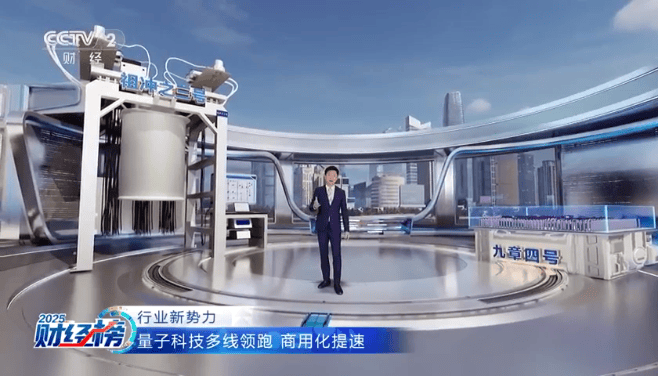
Group 1: Quantum Technology - In 2025, China's quantum technology commercialization is accelerating, showcasing vast application prospects [3] - China's "Zuchongzhi 3" superconducting quantum computer is reportedly 10 trillion times faster than the world's fastest supercomputer for specific tasks, while "Jiuzhang 4" can solve problems in microseconds that would take supercomputers 10^42 years [3] - Over 30 countries have released quantum strategy plans with total investments exceeding $35 billion, and the number of related companies has surpassed 800, with financing exceeding $14.5 billion in the past decade [3] Group 2: Artificial Intelligence - AI has evolved from a reactive model to a proactive service model, enabling autonomous operations in factories and personalized services in daily life [5] - The AI industry in China is projected to exceed 1.2 trillion yuan by 2025 and is expected to surpass 1.8 trillion yuan by 2028, with over 15% of work decisions globally anticipated to be made by AI agents by 2028 [5] Group 3: Smart Glasses - Smart glasses are emerging as the next mainstream interactive terminal, with significant advancements in battery life, optical display, and integration with AI models [7] - In the first half of the year, over 2.4 million smart glasses with camera functions were shipped globally, with China capturing a 35.5% market share, leading the world [7] - The Chinese smart glasses market is expected to grow at a compound annual growth rate of 55.6% from 2024 to 2029, the highest globally [7] Group 4: New Energy Storage - New energy storage technologies are ensuring the stability and affordability of green electricity, acting as "super charging stations" for cities [9] - By the end of September, China's new energy storage capacity reached 103 million kilowatts, accounting for over 40% of the global total, making it the world leader [9] Group 5: Innovative Pharmaceuticals - China's innovative pharmaceuticals are advancing in research, application, and international expansion, with a focus on cancer and rare diseases [11] - The number of innovative drugs in development accounts for approximately 30% of the global total, with a record number of approvals and 50 innovative drugs included in the national medical insurance directory [11] - Total licensing agreements for innovative drugs have surpassed $100 billion, demonstrating China's capability in original technology and global recognition [11]

A股医药板块的“火热”与“寒意”
Xin Lang Cai Jing· 2025-12-31 16:01
Core Viewpoint - The A-share pharmaceutical sector in 2025 exhibits structural differentiation, with innovative drugs and CXO sectors thriving due to overseas demand and business development, while traditional Chinese medicine, medical devices, and pharmaceutical commerce face performance pressures [3][20]. Summary by Category Overall Market Performance - The A-share pharmaceutical and biotechnology sector saw an overall increase of 25.64% from January 1 to December 30, 2025, despite a slight decline in revenue and a stabilization in profits, with total revenue of 18,544.52 billion yuan, down 1.42% year-on-year, and net profit of 1,407.32 billion yuan, down 1.65% year-on-year [4][21]. Innovative Drug Sector - The innovative drug sector was a standout performer in 2025, with the chemical pharmaceutical segment rising by 32.58% and the medical services segment by 32.91% [4][21]. - Companies like BeiGene (百济神州) reported significant growth, achieving revenue of 27.595 billion yuan, a 44.2% increase year-on-year, surpassing the total revenue of 27.21 billion yuan for 2024 [4][22]. Business Development (BD) Trends - The business development landscape for innovative drug companies is evolving, with significant partnerships such as the 11.4 billion USD deal between Innovent Biologics and Takeda, and a 12.5 billion USD collaboration between Hengrui Medicine and GlaxoSmithKline [5][22][24]. - The total value of business development transactions reached approximately 94.158 billion USD in the first three quarters of 2025, significantly exceeding the total for 2024 [25]. CXO Sector Performance - The CXO sector, driven by the demand for innovative drug research, achieved a 32.91% increase in 2025, with total revenue of 1,365.72 billion yuan, up 3.63% year-on-year, and net profit of 209.12 billion yuan, up 36.47% year-on-year [10][27]. - Leading companies like WuXi AppTec (药明康德) and Kanglong Chemical (康龙化成) returned to growth, with WuXi AppTec reporting a revenue increase of 18.61% and net profit growth of 84.84% [28][31]. Traditional Chinese Medicine and Medical Devices - The traditional Chinese medicine sector experienced a modest increase of 6.75% in 2025, with total revenue of 2,590.69 billion yuan, down 4.33% year-on-year, and net profit of 294.99 billion yuan, down 1.53% year-on-year [36]. - The medical device sector reported a revenue of 1,792.10 billion yuan, down 2.24% year-on-year, with notable performance differences among sub-sectors, where companies like Mindray Medical (迈瑞医疗) showed strong overseas revenue growth [33][34].



亿立舒国内外累计发货超50万支 亿帆医药国内销售里程碑条款望触发
Quan Jing Wang· 2025-12-31 13:26
Core Viewpoint - Yifan Pharmaceutical (002019) is experiencing significant growth in its core innovative drug, Yilishu, with a notable increase in both domestic and international shipments, indicating a strong market presence and potential for future performance enhancement [1][2][5] Group 1: Product Performance - Yilishu's cumulative shipment volume in domestic and international markets has exceeded 500,000 units, with a year-on-year growth rate of over 80% [1] - The product has achieved a terminal price of $4,600 per unit in the U.S. market, with shipments surpassing 46,000 units, showcasing the effectiveness of the company's international expansion strategy [1] - Another innovative drug, Yinikang, has also shown impressive performance, with a cumulative shipment volume growth exceeding 200% year-on-year [1][3] Group 2: Regulatory and Clinical Advancements - Yilishu has received significant endorsements from authoritative guidelines, being included as a top recommendation in multiple international cancer treatment guidelines [2] - The drug's clinical study, Guard-02, has been selected for presentation at the prestigious ESMO annual meeting, further solidifying its position in the oncology support treatment market [2] Group 3: Research and Development Progress - The company has multiple innovative products in its pipeline, including the approval of N-3C01 injection for clinical trials targeting advanced solid tumors and non-muscle invasive bladder cancer [3] - The company is also advancing its clinical trials for various other products, including a compound for treating advanced recurrent platinum-resistant ovarian cancer [3] Group 4: Globalization and Business Development - In 2025, the global business development (BD) center was established to enhance the company's capabilities in product transactions, cross-border negotiations, and market expansion [4] - The BD center aims to create a unique business model that integrates both inbound and outbound strategies, focusing on localizing multinational products and promoting domestic innovative drugs globally [4] Group 5: Industry Outlook - The innovative drug sector is viewed as a promising area for growth within the pharmaceutical industry, supported by favorable policies and a global commercialization trend [5] - As Yifan Pharmaceutical's innovative pipeline matures, the company's growth potential and long-term investment value are expected to become more pronounced, offering investors both certainty and growth opportunities [5]

【年终盘点】港股收官!恒指全年飙升28%,有色领跑涨幅榜
Sou Hu Cai Jing· 2025-12-31 12:40
Group 1 - The Hong Kong stock market experienced a strong performance in 2025, with the Hang Seng Index rising by 27.77% and the Hang Seng Tech Index increasing by 23.45% [2][4] - The trading volume in the Hong Kong market significantly increased compared to previous years, indicating heightened trading activity and a broad release of market profit potential [2] - The market's upward trend was driven by a clear rotation of sector leadership throughout the year, including AI technology, innovative pharmaceuticals, and the metals sector [4][6] Group 2 - The technology sector was a major contributor to market gains, with the Hang Seng Tech Index rising by 20.74% in Q1 2025, outperforming the Hang Seng Index's 15.25% increase during the same period [5] - Key drivers included investments in computing infrastructure, large model development, and AI applications, leading to significant valuation reassessments for companies like Alibaba [6] - The innovative pharmaceuticals sector gained momentum due to a surge in business development (BD) transactions, benefiting from improved global liquidity as the Federal Reserve began a rate-cutting cycle [6][7] Group 3 - The metals sector emerged as the strongest performer by year-end, with copper stocks rising by 261.85%, gold and precious metals by 197.85%, and other metals and minerals by 187.91% [9][10] - The rise in metal prices was attributed to multiple favorable factors, including the global trend of "de-dollarization," supply-demand imbalances, and domestic policies optimizing supply structures [9][11] - Notable individual stock performances included Zijin Mining rising by 162% and Shandong Gold increasing by over 183% [11] Group 4 - The overall strong performance of the Hong Kong stock market in 2025 was a result of a combination of valuation recovery, improved industry sentiment, and enhanced global liquidity [15][16] - Emerging industries such as AI, renewable energy, and innovative pharmaceuticals provided a wealth of high-growth investment opportunities, supporting long-term price increases [16] - Looking ahead to 2026, expectations remain positive for the Hong Kong market, with potential continued upward momentum driven by liquidity improvements and corporate profit recovery [16]

2025年十大牛股盘点!看看这一年你都错过了几个?
Jin Rong Jie· 2025-12-31 08:58
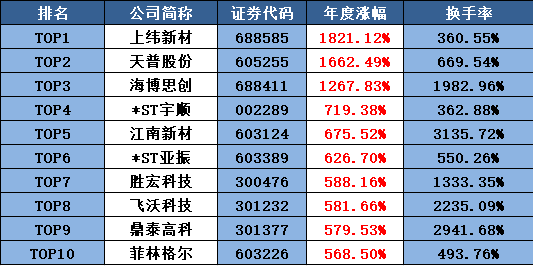
Core Viewpoint - The A-share market concluded 2025 with a historic breakthrough, characterized by "policy-driven, technology-led, and structural differentiation" trends, with a total market value exceeding 109 trillion yuan and annual trading volume surpassing 400 trillion yuan [1] Market Performance - The major indices of the A-share market all showed positive performance, with significant differentiation among them [1] - The ChiNext Index led with an annual increase of 49.57%, followed by the Sci-Tech 50 Index at 35.92%, the Shanghai Composite Index at 18.41%, and the Shenzhen Component Index at 29.87% [1] Sector Performance - Various sectors such as computing hardware, non-ferrous metals, banking, battery supply chain, innovative pharmaceuticals, commercial aerospace, and robotics contributed to the market's performance, with the Shanghai Composite Index briefly surpassing 4000 points [1] - A total of 4073 stocks in the market recorded positive annual growth, indicating a shift from "real estate-driven" to "innovation-driven" market dynamics [1] Top Performing Stocks - The top 10 stocks by annual growth rate (excluding new listings and the Beijing Stock Exchange) showcased significant price increases, reflecting market trends and speculative interests [1] - Notable performers included: - Top 1: Shangwei New Materials (688585) with a growth of 1821.12% and a turnover rate of 360.55% - Top 2: Tianpu Co., Ltd. (605255) with a growth of 1662.49% and a turnover rate of 669.54% - Top 3: Haibo Lichuang (688411) with a growth of 1267.83% and a turnover rate of 1982.96% [1]


ETF收评 | A股2025年涨超18%创10年新高,通信ETF、通信设备ETF全年涨120%
Ge Long Hui· 2025-12-31 07:57
Group 1 - The A-share market closed for 2025 with the Shanghai Composite Index rising by 0.09%, marking an 11-day winning streak and an annual increase of 18.41%, the highest in 10 years [1] - The Shenzhen Component Index fell by 0.58% but recorded an annual gain of 29.87%, while the ChiNext Index decreased by 1.23% with an impressive annual rise of 49.57% [1] - The STAR 50 Index saw an annual increase of 35.92%, and the North Exchange 50 Index rose by 38.8% for the year [1] Group 2 - Various sectors such as computing hardware, non-ferrous metals, banking, battery supply chain, innovative pharmaceuticals, commercial aerospace, and robotics contributed to the Shanghai Composite Index reaching above 4000 points during the year [1] - The CPO Index had the largest gain among concept indices, increasing over 180% cumulatively [1] - In the ETF market, the commercial aerospace sector continued its upward trend, with multiple satellite ETFs rising over 7%, while the low-altitude economy sector also performed well with gains of 4.6% [1] Group 3 - In terms of annual performance, AI hardware and non-ferrous themed ETFs showed remarkable results, with the Guotai Fund Communication ETF, the Fortune Fund Communication Equipment ETF, and the Guotai Fund Mining ETF rising by 125.81%, 121.37%, and 106.11% respectively [2] - The AI hardware sector experienced a pullback, with the Growth ETF and the Double Innovation ETF both declining by 2% [2] - The energy storage battery sector also faced a downturn, with the energy storage battery ETF dropping by 1.97% [2]
A股2025年收官:沪指11连阳全年收涨超18%,创业板指全年大涨49.57%
2 1 Shi Ji Jing Ji Bao Dao· 2025-12-31 07:25
Market Performance - The Shanghai Composite Index (沪指) closed the year with a 0.09% increase, marking an 11-day consecutive rise and an annual gain of 18.41%, the highest in 10 years [1][3] - The Shenzhen Component Index (深成指) decreased by 0.58% but recorded a yearly increase of 29.87% [1][3] - The ChiNext Index (创业板指) fell by 1.23% but achieved a significant annual increase of 49.57% [1][3] - The Sci-Tech 50 Index (科创50指数) rose by 35.92% over the year, while the Northern Stock Exchange 50 Index (北证50指数) increased by 38.8% [1][3] Sector Performance - Key sectors driving the market included computing hardware, non-ferrous metals, banking, battery supply chain, innovative pharmaceuticals, commercial aerospace, and robotics [1][3] Stock Highlights - The top three performing stocks for the year were: - Shangwei New Materials (上纬新材) with a staggering increase of 1821.41% - Tianpu Co., Ltd. (天普股份) with a rise of 1662.49% - N Hengdong Light (N蘅东光) with an increase of 878.16% [2][4] Future Outlook - Institutions generally hold a positive outlook for the A-share market in 2026, citing factors such as increased domestic and foreign capital inflow, corporate profit recovery, and enhanced policy support as key drivers for a "slow bull" market [2][4]

A股2025年收官:沪指11连阳 全年收涨超18% 创10年新高
Xin Lang Cai Jing· 2025-12-31 07:20
每经AI快讯,12月31日,A股2025年收官,截至收盘,沪指涨0.09%,录得11连阳,全年收涨18.41%, 创10年新高;深成指跌0.58%,全年收涨29.87%;创业板指跌1.23%,全年大涨49.57%。科创50指数全 年涨35.92%,北证50指数全年涨38.8%。纵观全年,算力硬件、有色金属、银行、电池产业链、创新 药、商业航天、机器人等多个板块轮动推动沪指一度站上4000点。同花顺问财数据显示,今年涨幅前三 个股分别为上纬新材、天普股份、N蘅东光。展望2026年,据新华财经,机构普遍对A股市场持积极预 期。多数机构认为,国内外增量资金入市、企业盈利修复、政策端加码等多重因素有望支撑A股市场后 续表现,2026年A股迈向"慢牛"。 责任编辑:石秀珍 SF183 每经AI快讯,12月31日,A股2025年收官,截至收盘,沪指涨0.09%,录得11连阳,全年收涨18.41%, 创10年新高;深成指跌0.58%,全年收涨29.87%;创业板指跌1.23%,全年大涨49.57%。科创50指数全 年涨35.92%,北证50指数全年涨38.8%。纵观全年,算力硬件、有色金属、银行、电池产业链、创新 药、商业 ...
从“年度创新力奖”看云顶新耀(01952.HK):以“双轮驱动”构建可持续创新体系
Ge Long Hui· 2025-12-31 06:10
Core Insights - CloudTop Innovations (01952.HK) received the "Annual Innovation Award" at the "Technology Empowerment · Capital Breakthrough" conference, highlighting a shift in the Chinese innovative pharmaceutical industry towards valuing sustainable value creation over merely chasing "star pipelines" [1] - The Chinese biopharmaceutical industry is transitioning from a phase of rapid growth focused on scale to a high-quality development phase emphasizing technological depth and commercial efficiency [1] - Capital is increasingly focused on companies that can integrate cutting-edge research with mature commercialization systems, establishing new benchmarks in the market [1] Company Strategy - CloudTop's "2030 Development Strategy" is centered on a dual-engine model of "Business Development (BD) cooperation + independent R&D," supported by its unique A2MS (Access, Medical, Market, Sales) commercialization platform [3][7] - The A2MS platform serves as the "value conversion hub" of the company's strategy, addressing core challenges in the commercialization of innovative drugs by streamlining the entire process from insurance access to patient management [3] Product Commercialization - The commercialization of the core product, NAI-Fu-Kang®, is a benchmark in the industry, achieving over 1 billion RMB in sales within its first commercial year, marking a significant milestone for chronic disease medications in China [4] - The company has also seen steady growth in sales for its antibiotic product, Yi-Jia®, with a 6% year-on-year increase in revenue for the first half of 2025, and a 37% increase in sales through targeted core hospitals [5] Future Outlook - CloudTop aims to expand its product portfolio to over 20 commercialized products by 2030, with projected revenues exceeding 15 billion RMB [8] - The company is also advancing its global strategy, focusing on a dual-engine growth model of "overseas licensing + commercialization" to accelerate internationalization [8] Market Recognition - The company's strategic direction has garnered confidence from both internal management and capital markets, with key executives increasing their shareholdings, signaling strong belief in the company's long-term value [9] - Investment firms have positively evaluated the company's growth logic, recognizing its integrated mRNA platform as a potential driver for transitioning from a commercialization entity to a technology-driven innovative enterprise [9] Industry Context - CloudTop's trajectory reflects a broader transformation in the Chinese innovative pharmaceutical landscape, emphasizing the importance of systematic platform capabilities that can continuously foster innovation and bring scientific breakthroughs to market [11] - The competitive landscape is shifting from broad strategic layouts to a focus on the depth of systemic capabilities, with companies like CloudTop positioned to lead and shape the next generation of treatment standards [11]
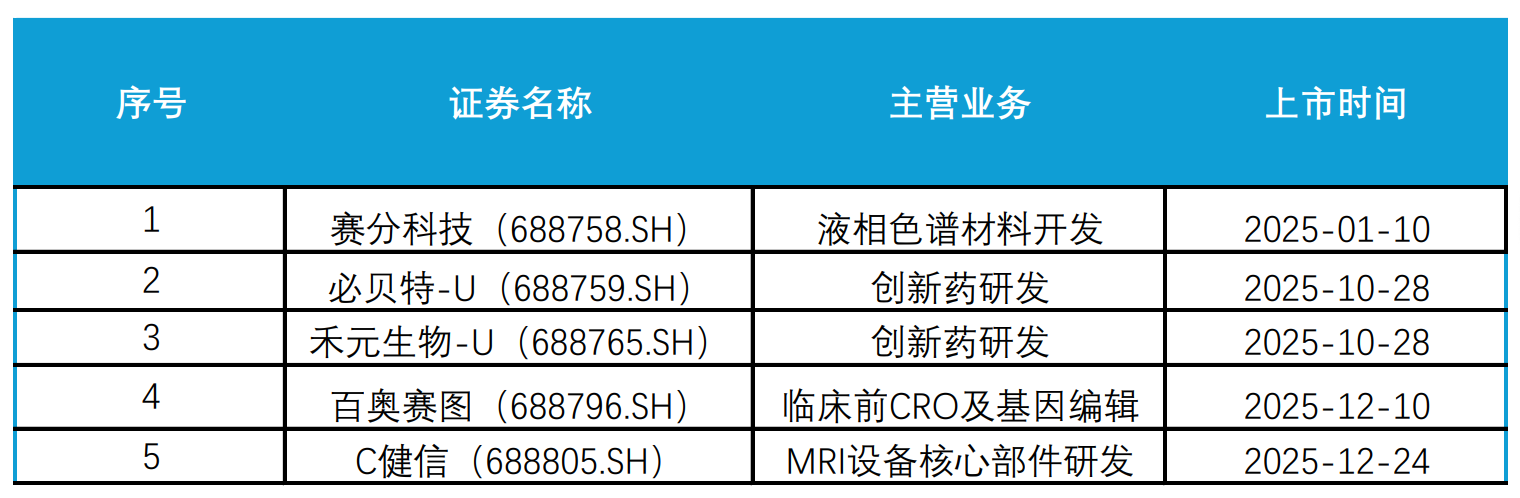
科创板医药2025:赛道分化显冷暖 支持“硬科技”仍然是主调⎜年终盘点
Xin Lang Cai Jing· 2025-12-31 05:25
Core Insights - The pharmaceutical sector of the Sci-Tech Innovation Board (STAR Market) has shown significant market narrative capabilities and has attracted more attention from the capital market in 2025 [1] - As of December 26, 2025, there were 118 listed companies in the STAR Market's pharmaceutical sector, with 98 companies experiencing stock price increases throughout the year [1] - The number of IPOs for biopharmaceutical companies on the STAR Market has decreased significantly, with only one company, Tianxing Medical, terminating its review in 2025, compared to over 10 in 2024 [2] Market Performance - The STAR Market's overall index has risen by 48.35% since its launch on January 20, 2025, outperforming major broad-based indices [5] - By December 26, 2025, 40 companies in the pharmaceutical sector had stock price increases exceeding 50%, with the top ten companies all surpassing a 100% increase compared to the previous year [6][7] New Listings and Policies - In 2025, five new biopharmaceutical companies were listed on the STAR Market, a significant increase from one in 2024 [2] - The introduction of the "1+6" policy measures by the China Securities Regulatory Commission (CSRC) on June 18, 2025, aimed to enhance the inclusivity of the STAR Market, particularly for unprofitable technology companies [2][3] Company Performance - The top-performing pharmaceutical companies in terms of stock price increase included Tianchen Medical, with a 226.84% rise, and others like Kangzhong Medical and SanSheng Guojian, which also saw significant gains [8] - Many of the companies with the highest stock price increases reported substantial revenue and net profit growth, indicating a strong correlation between financial performance and market valuation [8] Innovation Drug Sector - The innovation drug sector has emerged as a major highlight in 2025, with a total annual increase of 60.75%, driven by supportive policies and increasing market interest [9] - The total amount of business development (BD) transactions in the domestic innovation drug sector exceeded $130 billion in 2025, more than doubling from $64.08 billion in 2024 [10] Challenges in Other Sectors - The IVD (in vitro diagnostics), vaccine, and medical aesthetics sectors faced significant challenges, with many companies experiencing stock price declines and performance pressures [11] - The IVD sector, once considered a golden opportunity, is now facing a downturn due to various factors, including prolonged accounts receivable cycles and lower-than-expected demand [12] - The medical aesthetics industry is also under pressure, with both listed companies reporting declines in performance and stock prices due to increased competition and regulatory changes [13][14]