
证券业

Search documents
存款搬家引关注,权威人士回应
第一财经· 2025-10-15 10:44
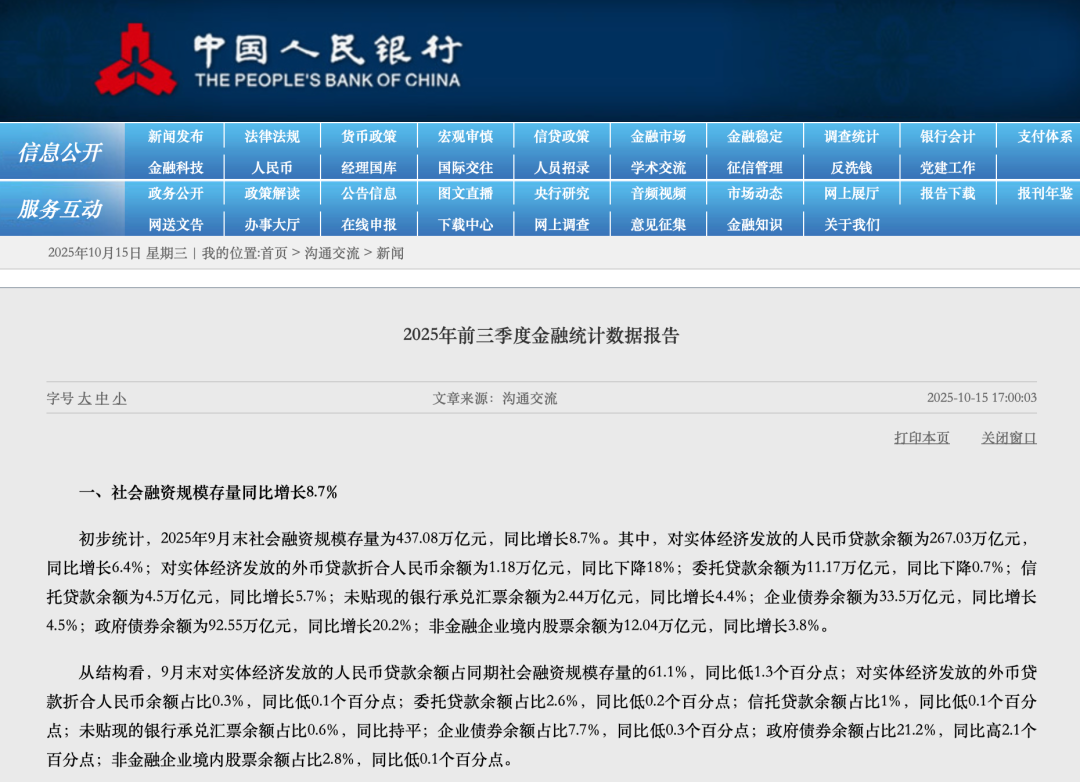
Core Viewpoint - The article discusses the phenomenon of "deposit migration," which is essentially a reallocation of residents' assets under the influence of interest rate mechanisms, as indicated by a market authority [3]. Group 1: Financial Statistics - In the first three quarters, the increase in RMB deposits reached 22.71 trillion yuan, with household deposits rising by 12.73 trillion yuan, non-financial enterprise deposits by 1.53 trillion yuan, fiscal deposits by 1.37 trillion yuan, and deposits from non-banking financial institutions by 4.81 trillion yuan [3]. - The growth rate of household deposits has slowed compared to previous highs, while non-bank deposits have maintained rapid growth [3]. Group 2: Deposit Migration - The term "deposit migration" refers to the phenomenon where residents convert their savings deposits in banks into other assets based on changes in asset return rates, reflecting a reallocation of their assets [3]. - Over the past 20 years, various asset types such as stocks, real estate, internet financial products, bank wealth management, and funds have served as destinations for the migration of household deposits, with these flows being dynamic and bidirectional based on market conditions [3]. Group 3: Market Dynamics - Experts suggest that deposit migration is a result of relative changes in yields across different financial markets rather than a cause. When expected yields on bonds and stocks rise, there is a tendency to increase holdings in these assets, leading to a corresponding reduction in other assets under budget constraints [4]. - Since 2023, the elasticity of the interest rate differential between deposit rates and other financial asset yields has increased, resulting in frequent occurrences of both "deposit migration" and "reflow" phenomena [4].


央行,最新发布!前三季度社融增量突破30万亿,M1攀升至7.2%,什么信号?
券商中国· 2025-10-15 10:17
Core Viewpoint - The People's Bank of China reported that the total social financing scale exceeded 30 trillion yuan in the first three quarters of the year, indicating a supportive monetary environment for economic recovery [1][3]. Financial Statistics - In the first three quarters, the total social financing increased by 4.42 trillion yuan compared to the same period last year, reaching 30.09 trillion yuan [1]. - The increase in RMB loans was 14.75 trillion yuan, while RMB deposits rose by 22.71 trillion yuan [1]. - As of the end of September, the year-on-year growth rate of social financing stock was 8.7%, up 0.7 percentage points from the previous year, and the M2 growth rate was 8.4%, up 1.5 percentage points [1]. Direct Financing Contribution - Government bonds and corporate bonds contributed over 40% of the new social financing, with net financing from government bonds at 11.46 trillion yuan, an increase of 4.28 trillion yuan year-on-year [3]. - Corporate bond financing also increased, with net financing reaching 1.57 trillion yuan, supported by favorable policies and low issuance rates [3]. - The share of RMB loans in the total social financing increment fell to 48%, indicating a shift towards more diversified financing channels [3]. Credit Growth and Structure - The growth rate of new RMB loans decreased to 6.6% by the end of September, but adjusted for local special bond replacements, the growth rate was approximately 7.7% [4]. - The balance of inclusive small and micro loans reached 36.09 trillion yuan, growing by 12.2%, while medium to long-term loans for manufacturing reached 15.02 trillion yuan, growing by 8.2% [5]. - The average interest rate for newly issued corporate loans was about 3.1%, down approximately 40 basis points year-on-year [5]. M1 Growth and Deposit Trends - The M1 growth rate reached 7.2% by the end of September, significantly up from the low of 0.1% earlier in the year [6]. - The narrowing gap between M1 and M2 reflects increased business activity and a recovery in personal consumption demand [6]. - The phenomenon of "deposit migration" indicates a reallocation of household assets in response to changing return rates across financial markets [7]. Economic Outlook - The monetary policy is expected to remain supportive of the real economy, with fiscal policies actively contributing to investment [7]. - The foundation for achieving the annual economic growth target of around 5% appears solid, supported by recent industry policy measures [7].

前三季度社融增量突破30万亿元,M1增速攀升至7.2%有何信号?
Zheng Quan Shi Bao· 2025-10-15 09:54
Group 1 - The core viewpoint of the article highlights the significant increase in social financing scale and the stability of credit growth in China during the first three quarters of the year, indicating a supportive monetary environment for economic recovery [1][8] - The total social financing scale reached 30.09 trillion yuan, an increase of 4.42 trillion yuan compared to the same period last year, with RMB loans increasing by 14.75 trillion yuan and RMB deposits by 22.71 trillion yuan [1][10] - The growth rates of social financing and broad money (M2) remained high, with social financing stock growth at 8.7% year-on-year and M2 growth at 8.4%, both higher than the previous year [1][12] Group 2 - In September, the narrow money (M1) growth rate rose significantly to 7.2%, reflecting increased activity in corporate operations and a recovery in personal investment and consumption demand [6][13] - The contribution of government and corporate bonds to new social financing exceeded 40%, with net financing from government bonds at 11.46 trillion yuan, up 4.28 trillion yuan year-on-year [8][10] - The structure of credit has been optimizing, with inclusive small and micro loans growing by 12.2% year-on-year and medium to long-term loans in the manufacturing sector increasing by 8.2% [10][11] Group 3 - The average interest rate for newly issued loans in September was approximately 3.1%, lower than the previous year, indicating a low-interest environment that may stimulate demand [11][12] - The phenomenon of "deposit migration" is observed, where residents are reallocating their assets based on changes in return rates, with total resident deposits increasing by 12.73 trillion yuan in the first three quarters [13][14] - Experts suggest that the monetary policy will continue to support the real economy, with fiscal policies also actively contributing to investment, aiming for a growth target of around 5% for the year [14]
存款搬家引关注,权威人士:系资产重新配置
Di Yi Cai Jing· 2025-10-15 09:53
Core Insights - The phenomenon of "deposit migration" is a result of relative changes in yields across different financial markets rather than a cause [1][2] - The People's Bank of China reported an increase of 22.71 trillion yuan in RMB deposits in the first three quarters, with household deposits rising by 12.73 trillion yuan [1] - The growth in non-bank financial institution deposits is attributed to the increased regularization of non-bank deposits and a rise in interbank certificates of deposit [1] Summary by Sections Deposit Growth - In the first three quarters, household deposits increased by 12.73 trillion yuan, non-financial enterprise deposits by 1.53 trillion yuan, fiscal deposits by 1.37 trillion yuan, and non-bank financial institution deposits by 4.81 trillion yuan [1] Market Dynamics - Recent months have seen a decline in the growth rate of household deposits, while non-bank deposits have maintained rapid growth [1] - The concept of "deposit migration" is described as a reallocation of assets by residents in response to changes in asset return rates, reflecting a dynamic two-way flow of funds among various asset types [1] Financial Asset Yield Changes - Experts indicate that "deposit migration" occurs when the yield differential between deposit rates and other financial asset returns increases, leading to a shift of funds from lower-yielding to higher-yielding assets [2] - Since the beginning of 2023, the elasticity of the yield differential between deposit rates and other financial assets has increased, resulting in frequent occurrences of "deposit migration" and "reflow" [2]
前三季度社融增量突破30万亿元 M1增速攀升至7.2%有何信号?
Zheng Quan Shi Bao Wang· 2025-10-15 09:40
Group 1 - The People's Bank of China reported that the total social financing scale exceeded 30 trillion yuan in the first three quarters of the year, reaching 30.09 trillion yuan, an increase of 4.42 trillion yuan compared to the same period last year [1] - The growth rates of social financing and broad money (M2) remained high, indicating that monetary finance continues to create a favorable environment for economic recovery [1] - The narrow money (M1) growth rate showed a significant rebound, reaching 7.2% by the end of September, reflecting increased business activity and consumer demand [1][6] Group 2 - The combination of government and corporate bonds contributed over 40% of the new social financing, with government bond net financing at 11.46 trillion yuan, an increase of 4.28 trillion yuan year-on-year [3] - The share of corporate bond financing also increased due to supportive policies and low issuance rates, with net financing reaching 1.57 trillion yuan [3] - The proportion of new social financing from RMB loans decreased to 48%, indicating a shift towards more diversified financing channels [3] Group 3 - Credit growth remained stable, with new RMB loans in September at approximately 1.29 trillion yuan, despite a decrease in growth rate to 6.6% [4] - The structure of loans continued to optimize, with inclusive small and micro loans growing by 12.2% year-on-year, and medium to long-term loans for manufacturing increasing by 8.2% [4] - The average interest rates for new loans remained low, with corporate loans at about 3.1%, down approximately 40 basis points year-on-year [4] Group 4 - The M1 growth rate's increase is attributed to the activation of both corporate and individual deposits, with a notable narrowing of the M1 and M2 "scissors difference" to 1.2 percentage points [6] - The concept of "deposit migration" reflects a reallocation of residents' assets based on changing return rates, with total resident deposits increasing by 12.73 trillion yuan in the first three quarters [7] - Experts suggest that the monetary policy will continue to support the real economy, with fiscal policies also actively contributing to investment [7]
中瑞金融领域合作:在全球变局中探索高质量联通之路
Di Yi Cai Jing· 2025-10-15 08:15
Group 1: Core Perspectives - The cooperation between China and Switzerland in capital markets, wealth management, and green finance is injecting new strategic momentum into bilateral relations [1] - The financial collaboration is becoming a key pillar for further development of China-Switzerland relations amid profound adjustments in the global economy and geopolitical landscape [1] Group 2: Capital Market Connectivity - Capital markets serve as the foundational area for China-Switzerland financial cooperation, with significant participation from Swiss enterprises and financial institutions in China's capital market [2] - The establishment of the Global Depositary Receipt (GDR) mechanism in 2022 marks a significant innovation in capital market cooperation, with 17 Chinese companies listed on the Swiss stock exchange [2] Group 3: Wealth Management - China's wealth management industry is experiencing rapid growth, with an asset management scale projected to reach RMB 150 trillion by 2024, ranking second globally [4] - The increasing demand for specialized and personalized wealth management services among China's high-net-worth individuals highlights the need for more comprehensive service models [5] Group 4: Sustainable Investment - Green finance and sustainable investment are emerging as forefront areas of cooperation, with China leading in green credit and bonds, and Switzerland excelling in responsible investment and ESG standards [6] - The anticipated funding requirement to achieve carbon peak by 2030 is expected to exceed RMB 25 trillion, indicating vast potential for green finance development [6] Group 5: Digital Finance - Digital finance is viewed as a "blue ocean" for cooperation, with China leading in mobile payments and financial technology, while Switzerland has unique advantages in blockchain and digital asset regulation [7] - A technical exchange mechanism has been established under the BIS Innovation Hub framework to explore digital finance development collaboratively [7] Group 6: Global Cooperation - The financial cooperation between China and Switzerland has both macro strategic significance and practical value, facilitating connections between enterprises and investors [8] - Financial institutions are evolving from mere intermediaries to bridges connecting capital, innovation, expertise, and opportunities [9]
央行月内二次开展买断式逆回购,4000亿中期流动性呵护资金面
2 1 Shi Ji Jing Ji Bao Dao· 2025-10-15 06:34
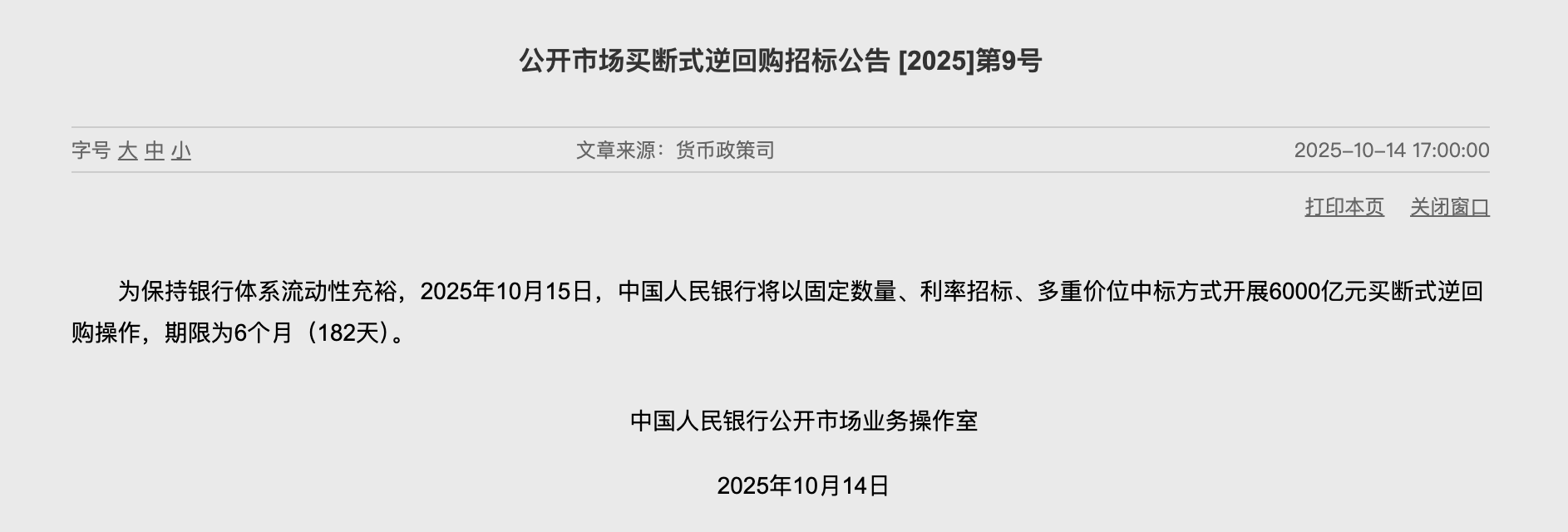
Core Viewpoint - The introduction of the buyout reverse repurchase agreement by the People's Bank of China (PBOC) in October 2024 enhances liquidity management and provides a longer-term funding support compared to traditional short-term operations [2][5]. Group 1: Buyout Reverse Repo Operations - The buyout reverse repo tool, launched in October 2024, allows the PBOC to lend funds by purchasing bonds from primary dealers, thereby injecting liquidity into the market [2]. - As of mid-October 2024, the PBOC has conducted multiple buyout reverse repo operations, making it a key component of mid-term liquidity management [2]. - The tool covers terms from 3 months to 1 year, filling a gap in the PBOC's liquidity management tools for mid to short-term periods [2]. Group 2: Recent Operations and Market Impact - In October 2024, the PBOC conducted its second buyout reverse repo operation, injecting 1.1 trillion yuan for a 3-month term, amidst upcoming maturities of previous operations [5]. - The combined increase of 400 billion yuan in buyout reverse repo operations in October aims to stabilize the liquidity environment, especially given the pressures from government bond issuances and other financial factors [5][6]. - Experts suggest that the PBOC's actions are crucial for maintaining a stable liquidity state in the banking system, especially in light of potential tightening pressures [7]. Group 3: Monetary Policy Tools and Strategies - The PBOC is diversifying its monetary policy tools, reducing reliance on medium-term lending facilities (MLF) and utilizing buyout reverse repos to manage liquidity more effectively [6][9]. - The recent operations are designed to support government bond issuances and encourage financial institutions to increase credit lending, reflecting a supportive monetary policy stance [7][8]. - The PBOC's strategy includes a mix of short-term and medium-term liquidity tools, ensuring a comprehensive approach to market liquidity management [9][10]. Group 4: Future Outlook - Analysts predict that the PBOC may resume government bond trading operations in the fourth quarter to inject long-term liquidity, aligning with growth stabilization policies [10]. - The PBOC's future monetary policy will be data-driven, focusing on macroeconomic conditions to guide adjustments in liquidity management [10][11]. - The ongoing use of structural monetary policy tools is expected to support key sectors such as technology innovation and small enterprises, enhancing overall economic stability [11].
连平:资本市场环境发生三大变化,对其长远发展保持信心
Di Yi Cai Jing· 2025-10-15 03:09
Group 1: Liquidity Environment - The liquidity environment in the capital market is expected to remain accommodative, influenced by changes in global monetary policies, particularly in major economies like the EU, Japan, and the US [2][3] - The US Federal Reserve has cut interest rates by a total of 100 basis points since the beginning of 2024, indicating a shift towards a more accommodative monetary policy due to economic slowdown and rising unemployment [2][3] - China's monetary policy has also shifted from "prudent" to "moderately accommodative," marking a significant change in approach to support economic growth [3][4] Group 2: Investment Trends - Investment demand is likely to shift towards the capital market as traditional channels like real estate and high-yield financial products have seen significant declines in attractiveness and returns [5][6] - The real estate market has been in a deep adjustment phase since the second half of 2021, leading to reduced investor confidence and a lower likelihood of high returns [5][6] - The yield on financial products has dropped significantly, with many previously high-yield options now offering around 2%, which fails to attract medium-risk investors, further driving them towards the capital market [6] Group 3: Central Bank Support - The central bank has introduced innovative tools to directly support the capital market, including liquidity swaps for financial institutions and special loans for stock buybacks by listed companies [7][8] - The central bank's actions are aimed at stabilizing market fluctuations and boosting investor confidence, especially during periods of significant market volatility [8][9] - The establishment of a market operation framework through the China Investment Corporation (CIC) is expected to play a crucial role in maintaining market stability and supporting the capital market's development [9]
资讯早间报-20251015
Guan Tong Qi Huo· 2025-10-15 02:26
地址:北京市朝阳区朝阳门外大街甲6号万通中心D座20层(100020) 总机:010-8535 6666 注:本报告资讯信息来源于万得资讯和金十数据,冠通研究整理编辑 本公司具备期货交易咨询业务资格,请务必阅读免责声明。 分析师:王静,执业资格证号 F0235424/Z0000771。 免责声明: 本报告中的信息均来源于公开资料,我公司对这些信息的准确性和完整性不作任何保证。报告中的内容和 意见仅供参考,并不构成对所述品种买卖的出价或征价。我公司及其雇员对使用本报告及其内容所引发的 任何直接或间接损失概不负责。本报告仅向特定客户传送,版权归冠通期货所有。未经我公司书面许可, 任何机构和个人均不得以任何形式翻版,复制,引用或转载。如引用、转载、刊发,须注明出处为冠通期 货股份有限公司。 资讯早间报 制作日期: 2025/10/15 隔夜夜盘市场走势 1. 国际贵金属期货收盘涨跌不一,COMEX 黄金期货涨 0.64%报 4159.60 美元/盎 司,COMEX 白银期货跌 0.17%报 50.35 美元/盎司。 2. 国际能源署发布看空预测,WTI 原油主力合约报 58.59 美元/桶;布伦特原油 主力合约跌 ...
金融业三维度同频共振 激活高质量发展新引擎
Zheng Quan Ri Bao· 2025-10-14 15:44
Core Insights - The financial industry in China has undergone significant transformation during the "14th Five-Year Plan" period, focusing on internal reforms, enhanced services to the real economy, and accelerated international openness [1] Group 1: Internal Reforms - The financial system reform has deepened, with improved top-level design and modernization of governance capabilities [2] - The establishment of the Central Financial Committee and the Central Financial Work Committee in 2023 has strengthened centralized leadership over financial work [2] - The financial regulatory framework has transitioned from "one bank and two commissions" to "one bank, one bureau, and one commission," enhancing regulatory efficiency and coordination [2][3] Group 2: Service to the Real Economy - The financial sector has significantly improved its service quality to the real economy, providing an additional 170 trillion yuan in funding through various means [4] - The annual growth rate of loans to technology-based SMEs, inclusive finance for small businesses, and green loans has exceeded 20% during the "14th Five-Year Plan" period [4][5] - The People's Bank of China has implemented structural monetary policy tools to ensure effective funding allocation to key areas such as inclusive finance and green development [5] Group 3: International Openness - The financial sector has made steady progress in high-level bilateral openness, enhancing its influence and participation in international financial governance [6] - As of July 2023, foreign institutions and individuals held over 10 trillion yuan in domestic stocks, bonds, and deposits, with panda bond issuance exceeding 1 trillion yuan [6] - The internationalization of the renminbi has advanced, with bilateral currency swap agreements signed with 32 countries, making the renminbi a major currency in global trade financing [6][7]