钢铁

Search documents
铁矿石库存周度数据-20260227
Guan Tong Qi Huo· 2026-02-27 04:47
下游盈利 港口总库存 日均疏港量 钢厂进口矿库存 钢厂进口矿日耗 到港量 内矿铁精粉产量 日均铁水产量 钢厂开工率 产能利用率 钢厂盈利率 本期 17091.96 298.48 9085.1 288.71 2152.4 37.34 233.28 80.22 87.45 39.83 1.50 上期 16946.32 351.19 10703.93 285.54 2418 38.81 230.49 80.13 86.41 38.53 4.50 周变动 145.64 -52.71 -1618.83 3.17 -265.60 -1.47 2.79 0.09 1.04 1.3 -3.00 粗粉 块矿 球团 精粉 贸易矿 巴西矿 澳大利亚矿 本期 13195.4 1964.57 364.73 1567.26 本期 11276.15 5329.1 8087.64 上期 13022.43 1950.58 380.76 1592.55 上期 11165.93 5423.87 7881.48 周变动 172.97 13.99 -16.03 -25.29 周变动 110.22 -94.77 206.16 注:数据来源于Wind,钢 ...
午评:沪指震荡微跌,半导体等板块走低,算力概念爆发
Sou Hu Cai Jing· 2026-02-27 04:18
Market Overview - The Shanghai Composite Index experienced a slight decline of 0.17%, closing at 4139.53 points, while the Shenzhen Component fell by 0.68% and the ChiNext Index dropped by 1.46% [1] - Over 2900 stocks in the A-share market were in the red, indicating a broad market weakness [1] - The total trading volume across the Shanghai, Shenzhen, and North markets reached approximately 1.6 trillion yuan [1] Sector Performance - Sectors such as paper, semiconductors, and building materials saw declines, while power, coal, non-ferrous metals, steel, and agriculture sectors experienced gains [1] - Emerging sectors like computing power, AI applications, and rare earth concepts showed active performance [1] Economic Outlook - Dongguan Securities highlighted that by 2026, macroeconomic policies will focus on the "14th Five-Year Plan" with an emphasis on fiscal and financial collaboration to expand domestic demand [1] - The coordinated efforts in monetary policy, fiscal policy, import-export regulation, and the real estate market aim to stabilize short-term growth while fostering long-term momentum [1] - The implementation of structural monetary policy tools and direct fiscal subsidies is expected to continuously release domestic demand potential, laying a solid foundation for qualitative and reasonable quantitative economic growth in the first year of the "14th Five-Year Plan" [1] Investment Recommendations - Key sectors to focus on include dividends, TMT (Technology, Media, and Telecommunications), and power equipment [1]
午评:创业板指半日跌1.46% 通信服务板块涨幅居前
Zhong Guo Jing Ji Wang· 2026-02-27 03:43
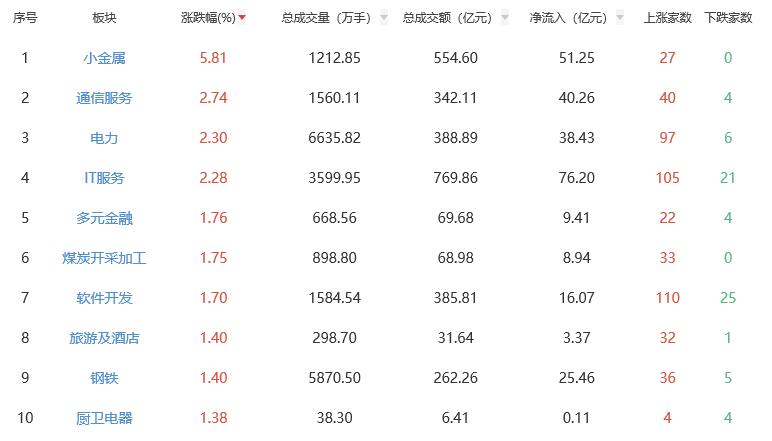
Core Viewpoint - The A-share market experienced a collective decline in the morning session, with all three major indices falling, indicating a bearish sentiment among investors [1]. Market Performance - The Shanghai Composite Index closed at 4139.53 points, down 0.17% - The Shenzhen Component Index closed at 14405.75 points, down 0.68% - The ChiNext Index closed at 3296.23 points, down 1.46% [1]. Sector Performance Top Gaining Sectors - Small Metals: Increased by 5.81%, with a total trading volume of 1,212.85 million hands and a net inflow of 51.25 billion - Communication Services: Increased by 2.74%, with a total trading volume of 1,560.11 million hands and a net inflow of 40.26 billion - Electric Power: Increased by 2.30%, with a total trading volume of 6,635.82 million hands and a net inflow of 38.43 billion [2]. Top Losing Sectors - Components: Decreased by 2.36%, with a total trading volume of 1,267.51 million hands and a net outflow of 50.17 billion - Electronic Chemicals: Decreased by 2.09%, with a total trading volume of 670.66 million hands and a net outflow of 18.45 billion - Paper: Decreased by 1.78%, with a total trading volume of 451.19 million hands and a net outflow of 4.41 billion [2].


银河期货每日早盘观察-20260227
Yin He Qi Huo· 2026-02-27 03:35
Report Industry Investment Rating No information provided in the content. Core Viewpoints of the Report - The report provides a comprehensive analysis of various futures markets, including financial derivatives, agricultural products, black metals, non - ferrous metals, shipping, carbon emissions, and energy chemicals. It assesses the current market situation, influencing factors, and provides corresponding trading strategies for each sector [18][25][56]. Summary by Related Catalogs Financial Derivatives Stock Index Futures - **Market Performance**: On Thursday, the stock index showed differentiation. The Shanghai 50 Index fell 0.65%, the CSI 300 Index fell 0.19%, the CSI 500 Index rose 0.35%, and the CSI 1000 Index rose 0.76%. The trading volume of the whole market was 2.556 trillion yuan. The stock index futures also showed differentiation, with the main contracts IH2603, IF2603, IC2603, and IM2603 having different changes in price and trading volume [19][20]. - **Investment Logic**: The market differentiation further increased. Technology stocks led the rise, while traditional large - cap stocks were weak. The stock index is expected to maintain an oscillating upward trend, with the CSI 500 and CSI 1000 Index remaining relatively strong [20]. - **Trading Strategy**: Unilateral trading should be oscillating and bullish, buying on dips; for arbitrage, conduct IM/IC long 2609 + short ETF cash - and - carry arbitrage; for options, use a bull spread strategy [21]. Treasury Bond Futures - **Market Performance**: On Thursday, treasury bond futures closed down across the board. The 30 - year main contract fell 0.53%, the 10 - year main contract fell 0.10%, the 5 - year main contract fell 0.08%, and the 2 - year main contract fell 0.03%. The yields of major - term treasury bonds in the inter - bank market generally increased [23]. - **Investment Logic**: The central bank net - withdrew 795 billion yuan of short - term liquidity, and the market capital was generally loose. In the short term, the bond market may fluctuate, but in the medium term, the report maintains an optimistic view on the bond market [23]. - **Trading Strategy**: Unilateral trading should adopt a neutral - to - bullish approach; for arbitrage, adopt a wait - and - see attitude [24]. Agricultural Products Protein Meal - **Market Performance**: CBOT soybean index rose 0.1% to 1158.75 cents per bushel, and CBOT soybean meal index fell 0.19% to 321.1 dollars per short ton [26]. - **Investment Logic**: Weather disturbances in the producing areas increased, and the export volume of Brazil increased. The domestic soybean import uncertainty increased, and the market was mainly oscillating [27]. - **Trading Strategy**: Unilateral trading should be mainly bearish; for arbitrage, expand the MRM spread; for options, use a short straddle strategy [27]. Sugar - **Market Performance**: The ICE US raw sugar main contract price oscillated, falling 0.02 (- 0.14%) to 13.96 cents per pound, and the London white sugar price oscillated slightly higher [29]. - **Investment Logic**: Internationally, the influence of Brazilian sugar decreased, and the focus shifted to the Northern Hemisphere. Domestically, the supply pressure was certain, but the price might rise slightly in the short term [31][32]. - **Trading Strategy**: Unilateral trading: the international sugar price is expected to maintain a low - level oscillation, and Zhengzhou sugar is expected to be slightly bullish in the short term; for arbitrage, adopt a wait - and - see attitude; for options, short put options in the short term [32]. Oilseeds and Oils - **Market Performance**: The overnight CBOT US soybean oil main price changed by 1.78% to 61.71 cents per pound, and the BMD Malaysian palm oil main price changed by 0.82% to 4038 ringgit per ton [33]. - **Investment Logic**: The production of Malaysian palm oil in February decreased, and the supply pressure of soybean oil might be postponed. The domestic oil inventory was at a neutral - to - high level, and the inventory might decrease after the festival [34]. - **Trading Strategy**: Unilateral trading: the short - term oil market will maintain an oscillation, with limited upside and downside space; for arbitrage, consider shorting p59 and y59 on rallies; for options, adopt a wait - and - see attitude [35]. Corn/Corn Starch - **Market Performance**: The CBOT corn futures rose, with the May 05 main contract rising 0.4% to 443.0 cents per bushel [36]. - **Investment Logic**: The US corn price was stable, and the domestic corn spot was stable in the short term but faced pressure in the long term. The 05 corn contract oscillated at a high level and might回调 after the festival [37]. - **Trading Strategy**: Unilateral trading: for the US 05 corn, buy on dips; for the domestic 05 corn, short on rallies with a light position; for arbitrage, widen the spread between 05 corn and starch on dips; for options, adopt a wait - and - see attitude [37]. Live Pigs - **Market Performance**: The live pig price was generally stable, with different price changes in different regions [38]. - **Investment Logic**: The overall supply pressure was still obvious, but the spot price might be supported in the short term, and the downward space of the futures price was limited [38]. - **Trading Strategy**: Unilateral trading: place a small number of long orders for the 05 live pig contract; for arbitrage, adopt a wait - and - see attitude; for options, use a short straddle strategy [39]. Peanuts - **Market Performance**: The national average price of peanut kernels was stable, and the prices of peanut oil and peanut meal also showed certain changes [41]. - **Investment Logic**: The peanut spot was stable, the import volume decreased, and the 05 peanut contract oscillated in a narrow range [42]. - **Trading Strategy**: Unilateral trading: trade long on dips for the 05 peanut contract with a light position; for arbitrage, adopt a wait - and - see attitude; for options, short the pk605 - P - 7700 option [42]. Eggs - **Market Performance**: The national mainstream egg price was stable, and the inventory and production of laying hens showed certain changes [43][45]. - **Investment Logic**: After the festival, it entered the off - season, and the overall capacity reduction slowed down. Consider shorting the June contract on rallies [46]. - **Trading Strategy**: Unilateral trading: consider shorting the June contract on rallies; for arbitrage, adopt a wait - and - see attitude; for options, adopt a wait - and - see attitude [46]. Apples - **Market Performance**: The national main - producing area apple cold - storage inventory decreased, and the price was stable [47][48]. - **Investment Logic**: The inventory decreased, and the demand was expected to improve. The cost of apple warehouse receipts was high, and the price of the May contract was expected to be bullish [49]. - **Trading Strategy**: Unilateral trading: expect the May contract price to oscillate bullishly, and place long orders on dips; for arbitrage, go long on the May contract and short on the October contract; for options, adopt a wait - and - see attitude [50]. Cotton - Cotton Yarn - **Market Performance**: The outer - market main contract fell, and the domestic cotton price was relatively strong [51]. - **Investment Logic**: The fundamentals were supported, and the global cotton supply - demand was expected to be tight. The signing situation improved, and the market was expected to rise [53]. - **Trading Strategy**: Unilateral trading: expect the US cotton to oscillate in the short term, and consider going long on dips for Zhengzhou cotton; for arbitrage, adopt a wait - and - see attitude; for options, adopt a wait - and - see attitude [53]. Black Metals Steel - **Market Performance**: The black market oscillated at night, and the steel price was under pressure [57]. - **Investment Logic**: The steel mills continued to overhaul, the inventory increased, the demand decreased, and the steel price was expected to oscillate before the Two Sessions and face pressure after the Two Sessions [57]. - **Trading Strategy**: Unilateral trading: maintain an oscillating trend; for arbitrage, short the coil - coal ratio on rallies and hold the short position of the coil - rebar spread; for options, adopt a wait - and - see attitude [58]. Coking Coal and Coke - **Market Performance**: The coking coal and coke market fluctuated greatly [59]. - **Investment Logic**: The supply of coking coal recovered, the demand was weak, and the price was expected to oscillate widely without a clear trend [60][61]. - **Trading Strategy**: Unilateral trading: the downward space is limited, do not short on dips, and try to go long on dips; for arbitrage, adopt a wait - and - see attitude; for options, adopt a wait - and - see attitude [62]. Iron Ore - **Market Performance**: The iron ore price oscillated at night [64]. - **Investment Logic**: The supply of iron ore was loose, the demand might decrease, and the price was expected to be weak [64]. - **Trading Strategy**: Unilateral trading: the price will be weak; for arbitrage, adopt a wait - and - see attitude; for options, adopt a wait - and - see attitude [65]. Ferroalloys - **Market Performance**: The silicon iron and manganese silicon prices were stable to slightly strong [66]. - **Investment Logic**: The supply and demand of silicon iron and manganese silicon had different changes, and the manganese ore price was affected by uncertain factors [66]. - **Trading Strategy**: Unilateral trading: hold long positions in silicon iron and partially take profits on long positions in manganese silicon; for arbitrage, adopt a wait - and - see attitude; for options, short out - of - the - money put options [68]. Non - Ferrous Metals Gold and Silver - **Market Performance**: London gold rose 0.39% to 5185.29 dollars per ounce, and London silver fell 1.01% to 88.3 dollars per ounce [70]. - **Investment Logic**: There were both bullish and bearish factors, and the market was expected to oscillate at a high level [71]. - **Trading Strategy**: Unilateral trading: hold long positions cautiously based on the 5 - day moving average; for arbitrage, adopt a wait - and - see attitude; for options, use a long out - of - the - money call option strategy or a bull call spread strategy [71][73]. Platinum and Palladium - **Market Performance**: The outer - market platinum and palladium oscillated widely [74]. - **Investment Logic**: The geopolitical and macro - economic situations supported the precious metals. Platinum was expected to be bullish in the short term, while palladium was in a surplus situation [74]. - **Trading Strategy**: Unilateral trading: go long on platinum on dips, and adopt a wait - and - see attitude for palladium and conduct band trading; for arbitrage, go long on platinum and short on palladium; for options, adopt a wait - and - see attitude [75]. Copper - **Market Performance**: The main contract of Shanghai copper 2604 closed at 102550, down 0.12% [77]. - **Investment Logic**: The macro - economic situation was favorable for copper consumption, but the inventory increase limited the upward momentum. In the long term, copper was expected to rise [78]. - **Trading Strategy**: Unilateral trading: the price will oscillate at a high level in the short term, and adopt a long - term low - buying strategy; for arbitrage, adopt a wait - and - see attitude; for options, buy out - of - the - money call options [78]. Alumina - **Market Performance**: The night - session alumina 2505 contract fell 101 yuan per ton to 2747 yuan per ton [79]. - **Investment Logic**: The spot price was supported, but the expectation of over - supply suppressed the price [80]. - **Trading Strategy**: Unilateral trading: the price will oscillate weakly [80]. Electrolytic Aluminum - **Market Performance**: The night - session Shanghai aluminum 2604 contract fell 80 yuan per ton to 23780 yuan per ton [82]. - **Investment Logic**: The global aluminum supply - demand was expected to be in short supply, but the domestic inventory was high. The price was expected to oscillate [85]. - **Trading Strategy**: Unilateral trading: the Shanghai aluminum price will oscillate; for arbitrage, the internal - external price difference will widen slightly; for options, adopt a wait - and - see attitude [85]. Cast Aluminum Alloy - **Market Performance**: The ADC12 aluminum alloy ingot spot price changed in different regions [86]. - **Investment Logic**: The supply and demand were weak, and the price was expected to oscillate with the aluminum price [86]. - **Trading Strategy**: Unilateral trading: the price will oscillate with the aluminum price; for arbitrage, adopt a wait - and - see attitude; for options, adopt a wait - and - see attitude [87]. Zinc - **Market Performance**: The overnight LME zinc market fell 0.61% to 3366.5 dollars per ton, and the Shanghai zinc 2604 fell 0.04% to 24570 yuan per ton [89]. - **Investment Logic**: The macro - economic situation and inventory changes affected the zinc price. The price was expected to be affected by market sentiment in the short term [90]. - **Trading Strategy**: Unilateral trading: buy on dips after the price stabilizes; for arbitrage, adopt a wait - and - see attitude; for options, adopt a wait - and - see attitude [90]. Lead - **Market Performance**: The overnight LME lead market fell 0.83% to 1979 dollars per ton, and the Shanghai lead 2604 contract rose 0.27% to 16800 yuan per ton [91]. - **Investment Logic**: The raw material supply, smelting, and consumption of lead had different situations, and the price was expected to oscillate in a range [94]. - **Trading Strategy**: Unilateral trading: the Shanghai lead price may oscillate bullishly in a range; for arbitrage, adopt a wait - and - see attitude; for options, short out - of - the - money put options [95]. Nickel - **Market Performance**: The overnight LME nickel price fell 315 to 17730 dollars per ton [97]. - **Investment Logic**: The supply - demand was recovering, and the price might rise if the Indonesian policy and demand were favorable [97]. - **Trading Strategy**: Unilateral trading: hold long positions at a low level; for arbitrage, adopt a wait - and - see attitude; for options, short out - of - the - money put options [98]. Stainless Steel - **Market Performance**: The stainless - steel inventory increased [99]. - **Investment Logic**: The inventory was high after the festival, but the cost was supported, and the price followed the nickel price [100]. - **Trading Strategy**: Unilateral trading: hold long positions at a low level; for arbitrage, adopt a wait - and - see attitude [100]. Industrial Silicon - **Market Performance**: The organic silicon开工率 decreased [101]. - **Investment Logic**: The demand was not improving significantly, and the market was worried about the impact of large - scale factory resumption on the fundamentals. The price was expected to oscillate weakly [101]. - **Trading Strategy**: Unilateral trading: the price will oscillate weakly; for arbitrage, no strategy provided; for options, no strategy provided [101]. Polysilicon - **Market Performance**: The US announced anti - subsidy tax on imported solar cells [102]. - **Investment Logic**: The policy affected the market, and the spot price was under pressure [102]. - **Trading Strategy**: Unilateral trading: the price will oscillate weakly; for arbitrage, no strategy provided; for options, no strategy provided [102]. Lithium Carbonate - **Market Performance**: Tesla China launched a low - interest loan policy, and some lithium - related companies had production changes [104]. - **Investment Logic**: The supply was blocked, the demand was good, and the price was likely to rise [105]. - **Trading Strategy**: Unilateral trading: hold long positions at a low level; for arbitrage, adopt a wait - and - see attitude; for options, short out - of - the - money call options for the 2604 contract to protect long - position profits [106][108]. Tin - **Market Performance**: The main contract of Shanghai tin 2604 rose 2.35% to 428000 yuan per ton [109]. - **Investment Logic**: The market was worried about the supply, and the price was expected to oscillate at a high level [109
午评:创业板指半日跌1.46%,稀有金属、算力租赁板块集体爆发
Xin Lang Cai Jing· 2026-02-27 03:33
Market Overview - The three major A-share indices collectively declined in the morning session, with the Shanghai Composite Index down 0.17%, the Shenzhen Component Index down 0.68%, and the ChiNext Index down 1.46% [1] - The total trading volume in the Shanghai, Shenzhen, and Beijing markets reached 15,966 billion yuan, a decrease of 532 billion yuan compared to the previous day [1] - Over 2,300 stocks in the market experienced gains [1] Sector Performance - Sectors with notable gains included small metals, computing power leasing, cloud computing, coal mining and processing, cross-border payments, steel, photovoltaic equipment, AI applications, and tourism and hotel industries [1] - Conversely, sectors that saw significant declines included paper making, PCB, CPO, storage chips, batteries, photolithography machines, and PET copper foil [1] Notable Stock Movements - Rare metals such as tungsten and rare earths surged due to price increases, with companies like Zhongtung High-tech, Zhangyuan Tungsten, and Zhong Rare Metals reaching historical highs [1] - The demand for cloud computing is reflected in the first-time surpassing of AI Token usage in China over the US, leading to a significant rise in the computing power leasing sector, with stocks like Yuntian Lifei and Chengdi Xiangjiang hitting the daily limit [1] - The space photovoltaic sector also performed well, with Jun Da Co. and Shuangliang Energy both reaching the daily limit [1] External Influences - Nvidia experienced its largest single-day drop since April 16 of last year, impacting the CPO and PCB sectors, with many computing hardware stocks like Xinyisheng, Zhongji Xuchuang, and Shenghong Technology declining over 5% [1]
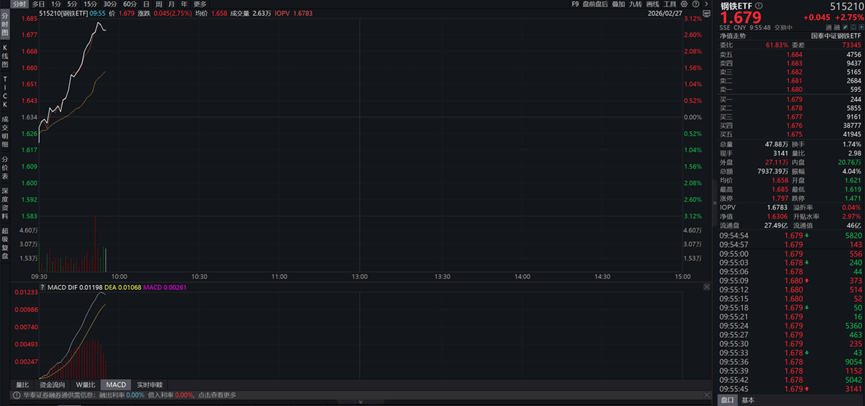
供需+政策利好共振,钢铁ETF(515210)大涨超2%
Sou Hu Cai Jing· 2026-02-27 03:33
Core Viewpoint - The steel sector is at a pivotal point driven by multiple resonating factors, with recent positive news catalyzing a significant rise in the only steel ETF (515210) by over 2% at the market open [1] Supply Side: Policy Framework and Capacity Management - The "anti-involution" initiative in the steel industry is gaining traction, with high-level meetings emphasizing the need to address "involutionary" competition and accelerate the exit of outdated capacity [4] - A clearer policy framework is emerging, with the central economic work conference proposing a unified national market and measures to tackle "involution" [4] - Steel companies will undergo a classification management system aimed at guiding resources towards leading firms, with policies expected to gradually take effect by 2026 [4] - The industry is witnessing increased concentration as smaller firms face survival pressures, benefiting larger companies with technological and cost advantages [4] Cost Side: Iron Ore Supply and Profit Distribution - The steel industry landscape is shifting as major iron ore projects come online, leading to a more relaxed supply-demand dynamic and a potential profit transfer from raw materials to finished products [5] - Current iron ore port inventories have reached 169 million tons, indicating a loosening supply situation [5] - The profit distribution within the steel supply chain is changing, with iron ore profits expected to decline, allowing for improved profitability in finished steel products [5] Inventory and Pricing: Low Inventory and Price Stabilization - This year's winter storage efforts have been weaker than in previous years, resulting in total inventory levels being at a near historical low, which reduces post-holiday destocking pressure [7] - Steel prices have stabilized at around 3200 yuan/ton, indicating a bottoming out after several quarters of decline, setting the stage for potential price increases if demand or supply catalysts emerge [7] Demand Side: Shift in Steel Demand Structure - By 2025, the demand structure in the steel industry is expected to undergo a historic shift, with manufacturing steel usage surpassing that of construction for the first time, becoming the core demand pillar [8] - The automotive sector is projected to see record production and sales, with new energy vehicles also contributing significantly to steel demand growth [8] - Emerging sectors such as energy and nuclear power are expected to drive additional demand, with significant investments planned in these areas [9] Investment Opportunity: Steel ETF (515210) - The steel ETF (515210) offers a diversified investment approach to capitalize on the "anti-involution" trend and the potential recovery in the steel sector [10] - The current valuation of the steel sector is considered to be at a medium-low level, with significant room for absolute returns as the market rebounds [10] - The ETF tracks leading companies in the industry, which are expected to benefit from improved profitability as raw material costs decrease [10]
人民币强势归来:升值逻辑、产业重构与投资新范式
Sou Hu Cai Jing· 2026-02-27 03:10
Core Viewpoint - The recent appreciation of the Renminbi (RMB) against the US dollar is driven by multiple factors, including a weakening dollar, asset revaluation, a surge in currency settlement, and policy guidance from the central bank [2][3]. Group 1: Drivers of RMB Appreciation - The primary external driver of the RMB's appreciation is the significant decline in the US dollar index, which fell approximately 9.7% in 2025 due to weak economic data and expectations of a more accommodative monetary policy from the Federal Reserve [3]. - Internal dynamics have shifted from an "Anything but China" strategy to an "AI & China" focus, with foreign capital reassessing the value of Chinese assets, leading to a noticeable trend of capital inflow [3][4]. - The peak period for currency settlement among export enterprises, particularly around the Chinese New Year, has led to a substantial sell-off of US dollars in favor of RMB, creating a positive feedback loop that amplifies the appreciation momentum [4]. - The central bank has maintained stability in the RMB through market-oriented measures rather than direct intervention, ensuring that the real effective exchange rate remains competitive for exports [4]. Group 2: Beneficiary Sectors of RMB Appreciation - Cost-compression industries, such as aviation and paper manufacturing, benefit significantly from RMB appreciation due to reduced costs associated with dollar-denominated debts and imported raw materials [5][6]. - Resource and commodity import sectors, including steel and petrochemicals, gain from enhanced global purchasing power, allowing them to stabilize profit margins amid fluctuating international prices [6][7]. - Financial and technology sectors are likely to see increased foreign investment, enhancing the relative return on RMB assets and boosting consumer purchasing power for cross-border consumption [7][8].

工业旅游受热捧生产线变成风景线
Zhong Guo Zhi Liang Xin Wen Wang· 2026-02-27 03:06
Core Insights - Industrial tourism transforms consumers from passive recipients to active participants in the production process, enhancing trust in traditional brands like Dong'e Ejiao [1][2] - The authenticity of industrial tourism, as opposed to curated theme parks, allows visitors to connect with real historical narratives and technological evolution [2][3] - Innovative repurposing of industrial sites into cultural landmarks attracts younger audiences and revitalizes industrial heritage [3][4] Group 1: Industrial Tourism Appeal - Industrial tourism offers immersive experiences that reveal the craftsmanship and technological beauty behind products, making "Chinese manufacturing" tangible [2][3] - Visitors can engage in hands-on activities, such as traditional brewing or production processes, fostering a deeper understanding of the products [2][3] Group 2: Cultural and Historical Significance - Industrial heritage sites serve as unique cultural capital, showcasing the evolution of cities and industries, as seen in examples like the Ruhr area in Germany and Ironbridge Gorge in the UK [2] - The transformation of industrial sites into tourist attractions reflects a growing confidence and openness in China's industrial sector, allowing for a deeper appreciation of manufacturing history [4] Group 3: Future of Industrial Tourism - As more industrial sites become accessible, industrial tourism is expected to inject cultural vitality into cities and provide the public with greater insights into industrial processes [4] - The dialogue between the public and industry through tourism helps demystify technology and fosters a sense of shared industrial heritage [3][4]
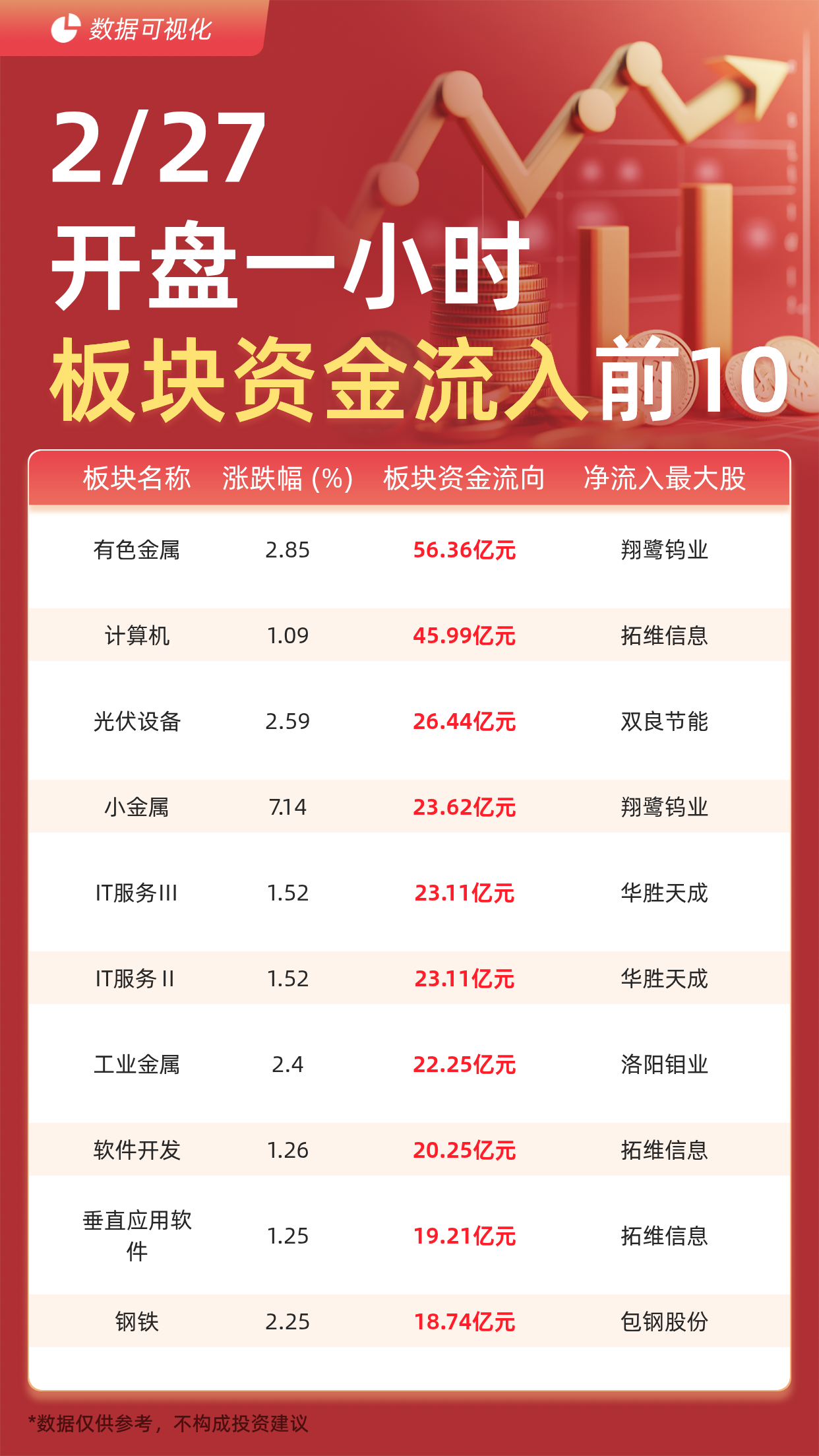
主力板块资金流入前10:有色金属流入56.36亿元、计算机流入45.99亿元
Jin Rong Jie· 2026-02-27 02:49
Group 1 - The main market experienced a net outflow of 19.84 billion yuan in principal funds as of February 27, one hour after the market opened [1] - The top ten sectors with inflows of principal funds included: Non-ferrous metals (5.64 billion yuan), Computers (4.60 billion yuan), Photovoltaic equipment (2.64 billion yuan), Minor metals (2.36 billion yuan), IT services III (2.31 billion yuan), IT services II (2.31 billion yuan), Industrial metals (2.23 billion yuan), Software development (2.02 billion yuan), Vertical application software (1.92 billion yuan), and Steel (1.87 billion yuan) [1] Group 2 - Specific companies benefiting from the inflow in industrial metals include Luoyang Molybdenum with 2.4% increase and 2.22 billion yuan [3] - In the software development sector, Tuo Wei Information saw an inflow of 2.26% with 2.02 billion yuan [3] - In the vertical application software sector, Tuo Wei Information also recorded a 2.25% increase with 1.92 billion yuan [3] - The steel sector, represented by Baogang Co., experienced a 2.25% increase with 1.87 billion yuan [3]



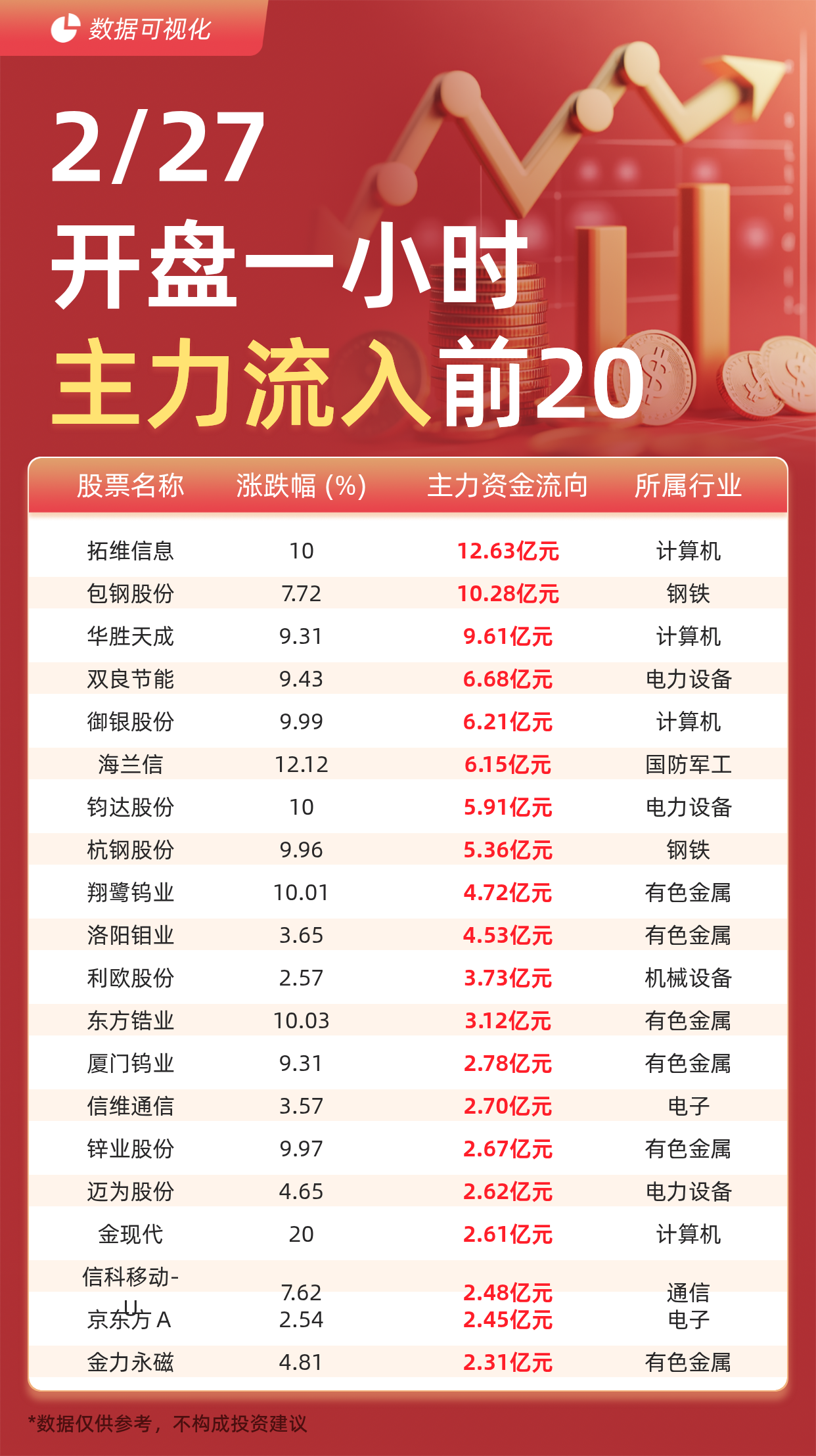
主力资金流入前20:拓维信息流入12.63亿元、包钢股份流入10.28亿元
Jin Rong Jie· 2026-02-27 02:49
Core Insights - The main focus of the news is on the significant inflow of capital into specific stocks, indicating strong investor interest and potential growth in these companies. Group 1: Stock Performance and Capital Inflow - Top stocks by capital inflow include: - Tuo Wei Information with 1.263 billion yuan and a 10% increase [1] - Baogang Co. with 1.028 billion yuan and a 7.72% increase [2] - Huasheng Tiancheng with 0.961 billion yuan and a 9.31% increase [2] - Shuangliang Energy with 0.668 billion yuan and a 9.43% increase [2] - Yuyin Co. with 0.621 billion yuan and a 9.99% increase [2] - Other notable stocks include: - Hailanxin with 0.615 billion yuan and a 12.12% increase [2] - Junda Co. with 0.591 billion yuan and a 10% increase [2] - Hangang Co. with 0.536 billion yuan and a 9.96% increase [2] - Xianglu Tungsten with 0.472 billion yuan and a 10.01% increase [2] - Luoyang Molybdenum with 0.453 billion yuan and a 3.65% increase [2] Group 2: Sector Analysis - The stocks are categorized into various sectors, including: - Computer sector: Tuo Wei Information, Huasheng Tiancheng, Yuyin Co., and Jinxi Modern [2][3] - Steel sector: Baogang Co. and Hangang Co. [2] - Power equipment sector: Shuangliang Energy, Junda Co., and Maiwei Co. [2][3] - Non-ferrous metals sector: Xianglu Tungsten, Luoyang Molybdenum, and Zinc Industry Co. [2][3] - Machinery equipment sector: Liou Co. [2] - Electronics sector: Xinwei Communication and BOE A [3]