
通信

Search documents
通信行业资金流入榜:中际旭创等13股净流入资金超亿元
Zheng Quan Shi Bao Wang· 2026-01-27 08:49
沪指1月27日上涨0.18%,申万所属行业中,今日上涨的有8个,涨幅居前的行业为电子、通信,涨幅分 别为2.27%、2.15%。通信行业位居今日涨幅榜第二。跌幅居前的行业为煤炭、农林牧渔,跌幅分别为 2.27%、1.95%。 资金面上看,两市主力资金全天净流出463.99亿元,今日有5个行业主力资金净流入,电子行业主力资 金净流入规模居首,该行业今日上涨2.27%,全天净流入资金89.01亿元,其次是通信行业,日涨幅为 2.15%,净流入资金为43.08亿元。 主力资金净流出的行业有26个,有色金属行业主力资金净流出规模居首,全天净流出资金145.23亿元, 其次是电力设备行业,净流出资金为113.67亿元,净流出资金较多的还有医药生物、基础化工、计算机 等行业。 通信行业今日上涨2.15%,全天主力资金净流入43.08亿元,该行业所属的个股共124只,今日上涨的有 72只,涨停的有4只;下跌的有51只,跌停的有1只。以资金流向数据进行统计,该行业资金净流入的个 股有41只,其中,净流入资金超亿元的有13只,净流入资金居首的是中际旭创,今日净流入资金17.59 亿元,紧随其后的是天孚通信、新易盛,净流入资金分 ...


博时市场点评1月27日:两市探底回升,成交出现缩量
Xin Lang Cai Jing· 2026-01-27 08:49
Market Overview - The three major indices in the A-share market rebounded after hitting a low, with total trading volume decreasing to less than 3 trillion yuan compared to the previous day [1][7] - The electronic sector led the gains among the Shenwan first-level industries [1] Economic Policy and Financial Stability - The People's Bank of China (PBOC) held a macro-prudential work meeting, emphasizing the need for proactive assessment of systemic financial risks and maintaining overall market stability as a key policy goal for the year [1][7] - The Ministry of Commerce announced plans to significantly develop service trade and implement policies to expand inbound consumption, aligning with earlier fiscal measures to stimulate domestic demand [1] Industrial Profit Trends - In December, profits of large-scale industrial enterprises turned from a 13.1% decline in November to a 5.3% increase, marking an 18.4 percentage point recovery [2][8] - For 2025, total profits of large-scale industrial enterprises reached 73,982 billion yuan, a 0.6% increase from the previous year, with manufacturing growing by 5.0% [2][8] Offshore RMB Market Development - The PBOC announced plans to support the development of the offshore RMB market in Hong Kong, increasing the funding arrangement scale from 100 billion yuan to 200 billion yuan [2][9] - This move is expected to enhance Hong Kong's role as a global offshore RMB business hub, attracting more international investors to hold and use RMB assets [9] Capital Market Opening - The China Securities Regulatory Commission (CSRC) announced the addition of 14 new futures and options products for domestic specific varieties, allowing participation from foreign traders [9] - This initiative is seen as a significant step towards deeper and higher-level institutional opening of the capital market, enhancing the depth and pricing power of the domestic futures market [9] Market Performance - As of January 27, the Shanghai Composite Index closed at 4,139.90 points, up 0.18%, while the Shenzhen Component Index and the ChiNext Index also saw slight increases [10][11] - The electronic, communication, and defense industries showed notable gains, while coal, agriculture, and steel sectors experienced declines [11] Trading Volume and Margin Data - The market's trading volume was recorded at 29,217.07 billion yuan, a decrease from the previous trading day, while the margin financing balance rose to 27,254.40 billion yuan [12]
一周观市|光大保德信基金:市场中期趋势或依然向好,继续看好科技成长板块
Xin Lang Cai Jing· 2026-01-27 08:13
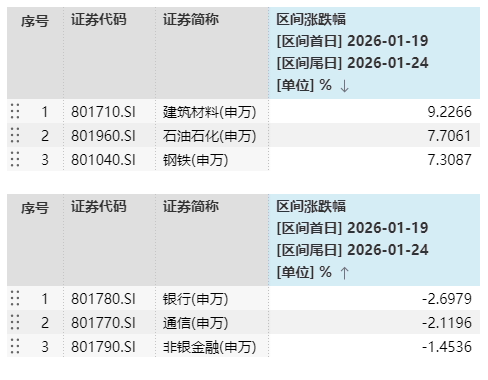
行业涨跌榜 | 库号 证券代码 | | 证券简称 | 区间涨跌幅 | | | --- | --- | --- | --- | --- | | | | | [区间首日] 2026-01-19 | | | | | | [区间尾日]2026-01-24 | | | | | | 单位 % ↑ | | | 1 | : 801780.SI | 银行(申万) | | -2.6979 | | 2 | 801770.SI | 通信(申万) | | -2.1196 | | 3 801790.SI | | 非银金融(申万) | | -1.4536 | 申万一级行业中,建筑材料、石油石化、钢铁涨幅靠前,银行、通信、非银金融、食品饮料跌幅靠前。 上周市场回顾 关键词:权益市场多数上涨 上周权益市场分化,上证指数上涨0.8%,深证指数上涨1.1%,沪深300下跌0.6%,创业板指下跌0.3%, 科创50上涨2.6%。 债市上涨,10年国债收益率收于1.83%左右,下行约1.3bp,7年国债收益下行2.2bp左右,1年国债收益 率上行约4.0bp,3年期中债企业债收益率下行约1.5bp。 | 成号 证券代码 | | 证券简称 | 区间涨跌 ...

粤开市场日报-20260127-20260127
Yuekai Securities· 2026-01-27 07:49
Market Overview - The A-share market showed mixed performance today, with the Shanghai Composite Index slightly up by 0.18% closing at 4139.9 points, and the Shenzhen Component Index up by 0.09% closing at 14329.91 points. The ChiNext Index increased by 0.71% to 3342.6 points, while the STAR 50 Index rose by 1.51% to 1555.98 points. Overall, there were 1928 stocks that rose and 3450 that fell, with a total trading volume of 28950 billion yuan, a decrease of 3532 billion yuan from the previous trading day [1][2]. Industry Performance - Among the Shenwan first-level industries, electronics, communications, defense and military industry, machinery equipment, and media sectors led the gains with increases of 2.27%, 2.15%, 1.65%, 0.64%, and 0.48% respectively. Conversely, the coal, agriculture, forestry, animal husbandry and fishery, steel, beauty care, and pharmaceutical biotechnology sectors experienced declines, with decreases of 2.27%, 1.95%, 1.34%, 1.22%, and 1.11% respectively [1][2]. Concept Sector Performance - The concept sectors that saw the highest gains today included cultivated diamonds, superhard materials, advanced packaging, optical chips, memory, analog chips, BC batteries, automotive chips, semiconductor silicon wafers, MCU chips, semiconductor selections, optical modules (CPO), wafer industry, and IGBT. In contrast, sectors such as cobalt mining, animal health selections, major infrastructure central enterprises, lithium battery anodes, and central enterprise coal experienced pullbacks [2].
今日59只个股涨停 主要集中在电子、有色金属等行业
Zheng Quan Shi Bao Wang· 2026-01-27 07:42
Choice统计显示,1月27日,沪深两市可交易A股中,上涨个股有1856只,下跌个股有3237只,平盘个 股有81只。不含当日上市新股,共有59只个股涨停,13只个股跌停。从所属行业来看,涨停个股主要集 中在电子、有色金属、机械设备、通信、国防军工等行业。 (文章来源:证券时报网) ...
20cm速递|科创创业ETF(588360)收涨超0.6%,科技创新与内需扩张的双轮驱动强化
Mei Ri Jing Ji Xin Wen· 2026-01-27 07:33
Core Viewpoint - The dual drivers of technological innovation and domestic demand expansion are strengthening, creating structural investment opportunities supported by continuous policy efforts [1] Group 1: Market Performance - The Science and Technology Innovation ETF (588360) rose over 0.6%, reflecting active performance in the technology innovation sector [1] - The Science and Technology Innovation 50 Index (931643), which the ETF tracks, includes 50 emerging industry companies with significant technological attributes, covering sectors such as electronics, power equipment, telecommunications, and biomedicine [1] Group 2: Investment Strategy - It is recommended to adopt a "technology innovation + dividend assets" barbell strategy to seize structural opportunities [1] - The strategic focus should align with the "14th Five-Year Plan" direction, emphasizing emerging industries like new energy, new materials, low-altitude economy, and aerospace, as well as future industries such as quantum technology and brain-computer interfaces [1]

ETF午评 | AI硬件板块走强,科创半导体ETF、科创半导体设备ETF涨3%
Ge Long Hui· 2026-01-27 06:12
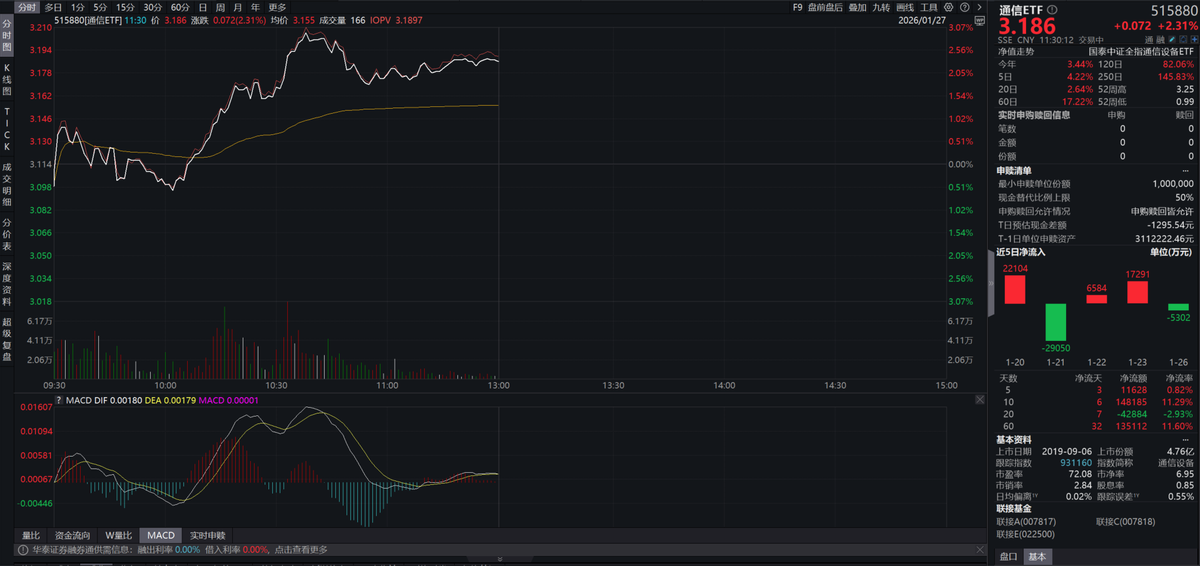
Market Overview - The three major A-share indices showed mixed performance in the morning session, with the Shanghai Composite Index up by 0.03%, the Shenzhen Component down by 0.37%, and the ChiNext Index up by 0.44% [1] - The North China 50 Index fell by 1.26%, and the total trading volume in the Shanghai, Shenzhen, and Beijing markets reached 1.89 trillion yuan, a decrease of 372.6 billion yuan compared to the previous day [1] - Over 4,400 stocks in the market experienced declines [1] Sector Performance - The computing power hardware industry chain strengthened, with CPO and memory sectors leading the gains [1] - Gold and semiconductor concept stocks also showed strength, while sectors such as consumer goods, lithium batteries, rare earth permanent magnets, innovative pharmaceuticals, and AI applications weakened [1] ETF Performance - In the ETF market, the semiconductor equipment sector saw significant gains, with the Huaxia Fund's Sci-Tech Semiconductor ETF, the Huatai-PB Fund's Sci-Tech Semiconductor Equipment ETF, and the Penghua Sci-Tech Semiconductor Equipment ETF all rising over 3% [1] - The CPO sector remained resilient, with the Guotai Fund's Communication ETF and the Fuguo Fund's Communication Equipment ETF increasing by 2.31% and 2.27%, respectively [1] - Conversely, the Guotai 2000 ETF from ICBC fell by 7%, and the vaccine sector declined, with the Vaccine ETF and the Fuguo Vaccine ETF both dropping by 5% [1] - The lithium battery sector faced a broad decline, with the Lithium Battery ETF and the Southern Battery ETF both down by 3% [1]
通信概念股走强,5G、通信相关ETF涨超2%
Mei Ri Jing Ji Xin Wen· 2026-01-27 05:46
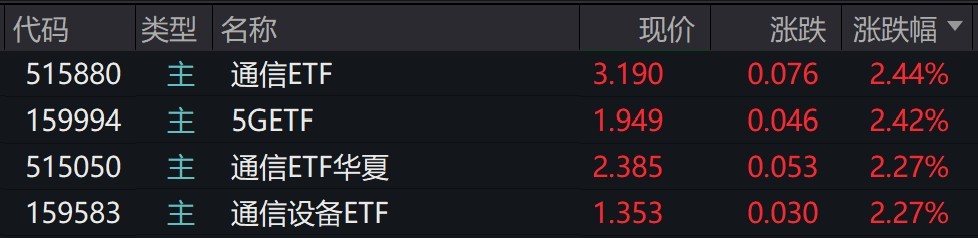
Group 1 - Communication concept stocks strengthened, with Tianfu Communication rising over 7%, Zhongji Xuchuang up over 4%, and Xinyi Sheng and Industrial Fulian increasing over 3% [1] - Influenced by the market, 5G and communication-related ETFs rose over 2% [1] Group 2 - Major communication ETFs showed positive performance, with the main communication ETF at 3.190, up 2.44%, and the main 5G ETF at 1.949, up 2.42% [2] - Analysts indicate that AI may represent the largest industrial opportunity since cloud computing, with hardware growth driven by GPUs and ASICs expected to become a second growth engine this year [2] - The North American computing power industry chain is anticipated to maintain high growth in the coming quarters, supported by increased cloud revenue and capital expenditure from North American cloud companies [2] - The current AI trend is clear, with high capital expenditure growth from domestic and international cloud companies, suggesting that the communication sector, as a "shovel seller" in the computing power industry, is likely to see sustained market growth [2]
阿里正式发布旗舰推理模型,通信ETF(515880)涨超2%,光模块+服务器占比超66%
Mei Ri Jing Ji Xin Wen· 2026-01-27 05:36
Core Insights - Alibaba has launched its flagship inference model Qwen3-Max-Thinking, enhancing AI capabilities with the integration of the Qianwen AI assistant on PC and web platforms, which is expected to positively impact AI development in China [1] - Overseas cloud vendors are maintaining optimistic capital expenditure and guidance in the AI sector, leading to an upward revision in optical module expectations [1] - The communication ETF (515880) has seen a significant inflow of nearly 1.5 billion yuan over the past 10 days, reflecting strong investor interest in the sector [1] Market Performance - The communication ETF (515880) has experienced a broad rally among its constituent stocks, with notable gains from companies like Tianfu Communication and Industrial Fulian [2] - The AI-driven demand is propelling the communication hardware sector, which is characterized by capital expenditure expansion and technological upgrades [2] Key Drivers - Major overseas cloud giants such as Oracle, Google, and Microsoft are increasing their AI-related capital expenditures, which is driving demand for computing hardware, particularly optical modules [3] - Oracle has significantly raised its capital expenditure guidance for FY26 to $50 billion, indicating strong commitment to AI infrastructure [3] Beneficiary Segments - Optical modules are at the forefront of growth, experiencing a generational upgrade from 800G to 1.6T, with market size expected to double by 2026 [4] - The demand for optical modules is driven by the need for higher-speed interconnects in AI servers, with projections for substantial increases in shipment volumes [5] Technological Advancements - New optical interconnect technologies such as NPO and CPO are expected to drive long-term growth, addressing challenges related to power consumption and bandwidth [6][7] - The industry is witnessing a shift in value from optical modules to upstream optical chips and packaging, raising technical barriers and enhancing product value [8] Domestic Market Dynamics - The acceleration of domestic computing power construction is creating new market opportunities for local communication hardware manufacturers, driven by geopolitical factors [9] - The dual market strategy of serving both overseas high-end demand and domestic self-sufficiency is enhancing the stability and growth potential of domestic supply chain companies [9] ETF Overview - The communication ETF (515880) has over 140 billion yuan in assets, with more than 66% of its holdings in optical modules and servers, positioning it well to benefit from the AI wave [10] - The ETF's high liquidity and concentrated exposure to key hardware segments make it an effective tool for investors looking to capitalize on the AI infrastructure sector [10] Investment Strategy - In the context of a long-term bullish outlook for AI, a strategy of "buying on dips" is recommended for investors, as short-term volatility may present attractive entry points [11] Conclusion - The AI computing investment phase is entering a hardware expansion stage driven by real capital expenditures, with the optical module sector poised to benefit from increased overseas cloud spending, technological upgrades, and domestic market growth [12]
指数微红,个股普跌,近4600家绿盘!现在的A股到底该怎么玩?
Sou Hu Cai Jing· 2026-01-27 05:35
Market Overview - The market is characterized by a "split" where indices appear stable but individual stocks are predominantly declining, with over 4600 stocks experiencing losses [1] - The Shanghai Composite Index slightly increased by 0.03% to 4134.03 points, while the ChiNext Index and the STAR Market Index rose by 0.44% and 0.57% respectively [1] - In contrast, the Hong Kong market showed stronger performance, with the Hang Seng Index rising by 1.08%, supported by a policy boost from the central bank [1] Sector Performance - The technology sector, particularly the communication and electronics segments, saw significant gains, with the communication sector up by 2.13% and electronics by 1.50% [1] - The banking sector also rose by 1.03%, contributing to market stability [1] Drivers of Technology Sector - The strong performance in communication and electronics is driven by major advancements in the AI industry, including Alibaba's release of the Qwen3-Max-Thinking model and significant funding for another AI company [2] - Investment is flowing into the entire industry chain, from upstream hardware to related software applications, indicating a long-term trend towards technology and self-sufficiency [2] Market Sentiment and Trends - The current market sentiment reflects a preference for technology growth sectors over traditional cyclical industries, with a structural market trend likely to continue [3] - A-shares may continue to experience volatility, with funds likely to seek balance between technology and undervalued financial blue chips [3] Investment Strategy - Investors are advised to focus on understanding industry trends rather than chasing hot stocks, particularly in areas like AI and domestic substitution [3] - Attention should also be given to sectors with high growth forecasts, such as biopharmaceuticals, while maintaining a rational approach amidst market fluctuations [3]