乳制品

Search documents
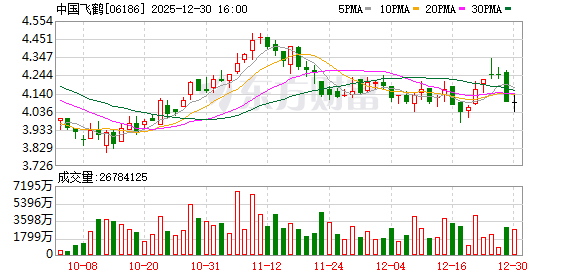
中国飞鹤(06186.HK)12月30日回购883.70万股,耗资3634.24万港元
Zheng Quan Shi Bao Wang· 2025-12-30 14:50
Summary of Key Points Core Viewpoint - China Feihe has been actively repurchasing its shares, indicating a strategy to enhance shareholder value and confidence in its stock performance [2][3]. Group 1: Share Buyback Details - On December 30, China Feihe repurchased 8.837 million shares at a price range of HKD 4.070 to HKD 4.120, totaling HKD 36.3424 million [2]. - The stock closed at HKD 4.090 on the same day, with a total trading volume of HKD 109 million [2]. - Year-to-date, the company has conducted 41 buybacks, acquiring a total of 260 million shares for an aggregate amount of HKD 1.1 billion [2]. Group 2: Historical Buyback Data - The buyback history includes several transactions with varying amounts and prices, such as: - December 19: 8.529 million shares at a maximum price of HKD 4.200, totaling HKD 35.7702 million [3]. - December 18: 3.046 million shares at a maximum price of HKD 4.050, totaling HKD 12.3269 million [3]. - November 21: 12.300 million shares at a maximum price of HKD 4.200, totaling HKD 51.4041 million [3].

妙可蓝多:2025年第三次临时股东会决议公告
Zheng Quan Ri Bao· 2025-12-30 13:43
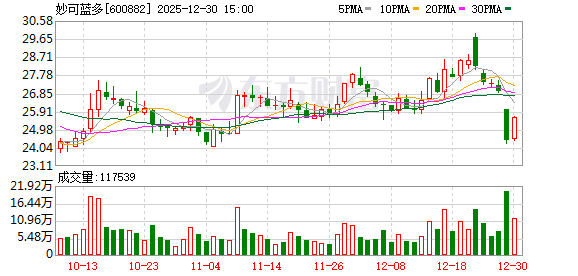
Core Viewpoint - Miaokelan Duo announced the approval of several key proposals during its third extraordinary shareholders' meeting for 2025, indicating strategic financial planning and governance adjustments for the upcoming year [2] Group 1: Financing and Guarantees - The company approved a proposal regarding the estimated financing and guarantee limits for the year 2026, which suggests a proactive approach to securing necessary funding for future operations [2] Group 2: Related Party Transactions - A proposal concerning the expected daily related party transactions with the controlling shareholder and its affiliates for 2026 was also approved, highlighting the company's ongoing business relationships and potential revenue streams [2] Group 3: Board of Directors - The election of Mr. Shen Xinwen as a non-independent director of the twelfth board of directors was approved, indicating a potential shift in governance and oversight within the company's leadership [2]

科技浪潮之下,企业如何保持清醒
3 6 Ke· 2025-12-30 13:36
Core Insights - The rapid advancement of technology, particularly AI, has outpaced the ability of businesses to effectively integrate and capitalize on these innovations, leading to strategic confusion and misallocation of resources [3][5][12] - Companies are increasingly recognizing the value of external perspectives to recalibrate their strategies and clarify their market positions amidst uncertainty [5][10][20] Group 1: Industry Challenges - Many companies are struggling to translate technological innovations into sustainable business value, resulting in a lack of clear growth trajectories [3][12] - The overwhelming pace of innovation has led to a situation where businesses find it difficult to determine where to allocate resources and when to pivot, often resulting in costly trial-and-error processes [3][12] - The issue is not a lack of innovation but rather an excess of it, with many firms focusing on technological capabilities without adequately addressing specific market needs [3][12] Group 2: Strategic Insights - The introduction of strategic consulting firms, such as Ries, has become crucial for companies seeking to navigate complex environments and make informed decisions about long-term investments [5][10] - Successful companies often rely on external consultants to help them compress complexity and clarify strategic choices, which is essential in a rapidly changing market landscape [5][10] - The importance of positioning theory is highlighted, emphasizing that businesses must solve real, identifiable problems for users to achieve sustainable growth [12][21] Group 3: Case Studies - The collaboration between Great Wall Motors and Ries Consulting exemplifies how strategic positioning can lead to significant growth, as seen in the development of the Haval and Tank brands [8][22] - The case of Xpeng Motors illustrates the importance of redefining a company's identity to align with market needs, transitioning from a traditional car manufacturer to a global AI driving technology company [15][21] - The success of brands like Junlebao and Weilong in the competitive dairy and snack markets demonstrates how precise positioning and addressing consumer needs can create new growth opportunities [22][23] Group 4: Market Dynamics - As the Chinese economy shifts from high-speed growth to a more stable phase, companies must adapt their strategies to focus on clarity in decision-making rather than merely expanding [18][20] - The competitive landscape is evolving, with technology becoming less scarce and the challenge now being the ability to translate it into understandable and marketable business forms [21][24] - Companies face the dual challenge of leveraging technological advancements while establishing a clear mental position in the market to ensure sustainable growth [20][25]


中国飞鹤12月30日斥资3634.24万港元回购883.7万股
Zhi Tong Cai Jing· 2025-12-30 10:00
Core Viewpoint - China Feihe (06186) announced a share buyback plan, committing to repurchase 8.837 million shares for a total cost of HKD 36.3424 million, scheduled for December 30, 2025 [1] Group 1 - The company plans to repurchase shares as part of its capital management strategy [1] - The total number of shares to be repurchased is 8.837 million [1] - The total expenditure for the buyback is HKD 36.3424 million [1]
年度盘点|高端化与政策红利加持 2025奶粉市场逆势回暖
Nan Fang Du Shi Bao· 2025-12-30 09:57
Core Insights - The Chinese infant formula market in 2025 is characterized by a dual landscape of challenges and opportunities, with declining birth rates and intense competition on one side, and a recovery in performance for several leading dairy companies on the other [1] - The recovery in the infant formula sector is attributed to strategic adjustments by companies, product innovation, and supportive government policies, leading to a structural rebound after a period of deep adjustment [1] Company Performance - Major dairy companies like Yili, Ausnutria, and Beingmate have reported revenue and profit growth in the infant formula segment, reversing previous trends of slowing growth [2] - Yili's revenue from dairy products grew by 14.26% year-on-year, with infant formula retail sales achieving double-digit growth and a market share of 18.1%, making it the market leader in China [2] - Ausnutria's revenue reached 3.887 billion yuan, a 5.6% increase year-on-year, with net profit rising by 24.1% [2] - The performance of foreign brands like Danone and a2 Milk also showed positive growth, although some domestic brands faced challenges [3] Market Dynamics - The infant formula market is expected to see a retail market growth rate of around 5% in 2025, driven by a rebound in birth rates and supportive policies [3] - The shift in consumer preferences towards high-end products is evident, with the proportion of consumers purchasing formula priced above 300 yuan increasing from 21% to 26% [3] Strategic Adjustments - Companies are shifting focus from market share expansion to value creation, emphasizing product innovation and quality enhancement in response to a saturated market [4] - The competition has moved towards high-end and differentiated products, with companies like Ausnutria and Yili investing in specialized formulas and research [4] Market Expansion - The low-tier cities and rural markets are becoming significant growth areas, with increased acceptance of high-end infant formula products [5] - Companies are accelerating their channel penetration into these markets, with initiatives like Yili's "township station" plan and Mengniu's focus on maternal and infant stores [5] Policy Impact - Recent government policies, including a cash subsidy for families with infants and free preschool education, are expected to stimulate demand in the infant formula market [6] - The implementation of these policies is projected to release approximately 32.4 billion yuan annually for infant care, with a significant portion likely directed towards formula purchases [6] Future Trends - The industry is expected to transition from cyclical recovery to structural growth, with companies needing to develop diversified growth strategies [8] - Product innovation is anticipated to focus on specialized nutritional needs, with segments like adult nutrition and special formulas for children gaining traction [9] - Digital transformation and consumer engagement are becoming critical competitive advantages as younger parents increasingly prefer online research and purchasing [9] - The industry may see accelerated consolidation, with leading companies likely to expand their market share through mergers and acquisitions [9]

年度盘点|高端化与政策红利加持,2025奶粉市场逆势回暖
Sou Hu Cai Jing· 2025-12-30 09:52
Core Insights - The Chinese infant formula market in 2025 is characterized by a dual landscape of challenges and opportunities, with declining birth rates and intense competition on one side, and a recovery in performance for several leading dairy companies on the other [1] - The recovery in the infant formula sector is attributed to strategic adjustments by companies, product innovation, and the implementation of supportive national policies [1] Company Performance - Major dairy companies like Yili, Ausnutria, and Beingmate have reported revenue and profit growth in the infant formula segment, reversing previous trends of slowing growth [2][4] - Yili's infant formula and dairy product revenue increased by 14.26% year-on-year, achieving a market share of 18.1%, while Ausnutria's revenue grew by 5.6% with a net profit increase of 24.1% [2][4] - The performance of foreign brands such as Danone and a2 Milk also showed positive growth, although some leading companies faced pressure, indicating structural differentiation within the industry [6] Market Trends - The retail market for infant formula is expected to grow at around 5% in 2025, driven by a rebound in birth rates and supportive policies [6] - The proportion of consumers purchasing premium infant formula (over 300 yuan) increased from 21% to 26%, reflecting a trend towards higher quality products among younger parents [6] Strategic Shifts - The industry is shifting from a focus on market share expansion to value creation, with companies investing in high-end and functionally differentiated products [10] - Companies are enhancing their supply chains and digital efficiencies to improve profitability, with examples like Ausnutria's EBITDA growth of 29.7% [13] Policy Impact - New national policies, including a cash subsidy for families with infants and free preschool education, are expected to stimulate demand in the infant formula market [15][18] - The implementation of these policies is anticipated to lower childcare costs and boost consumer confidence, leading to increased sales for dairy companies [15][18] Future Outlook - The industry is expected to transition from cyclical recovery to structural growth, with companies needing to diversify their growth strategies [19][21] - Product innovation is crucial, with a focus on specialized nutrition for various age groups and health needs, as well as digital transformation to enhance consumer engagement [20][21] - The consolidation of the industry may accelerate, with larger companies likely to acquire smaller firms to expand their market share [20][21]
蒙牛乳业(02319)12月30日注销1430万股
智通财经网· 2025-12-30 09:08
Group 1 - The company Mengniu Dairy (02319) announced the cancellation of 14.3 million shares that have been repurchased, effective December 30, 2025 [1]

蒙牛乳业(02319.HK)12月30日注销1430万股购回股份
Ge Long Hui· 2025-12-30 09:05
Group 1 - The company Mengniu Dairy (02319.HK) announced the cancellation of a total of 14.3 million shares repurchased, effective December 30, 2025 [1]
乳品行业深度报告:供需优化,提质拓新
Dongguan Securities· 2025-12-30 09:01
Investment Rating - The report maintains an "Overweight" rating for the food and beverage industry, specifically focusing on the dairy sector [1]. Core Insights - The dairy industry in China is experiencing a phase of market size adjustment, with the market growing from 388 billion CNY in 2012 to 686 billion CNY in 2022, reflecting a compound annual growth rate (CAGR) of 5.9%. However, a decline of 3.1% is expected in 2024, bringing the market size to 659 billion CNY [5][13]. - The competitive landscape is characterized by a "two super, many strong" structure, with leading companies like Yili and Mengniu holding approximately 45% market share, which creates brand barriers and enhances competitive advantages [5][31]. - The report emphasizes the importance of monitoring the supply-demand structure in the dairy market, as supply is expected to decrease marginally while demand shows signs of weak recovery [5][36]. Summary by Sections Market Size and Consumption - The dairy market in China is undergoing a phase of adjustment, with liquid milk being the primary consumption category, accounting for 44% of the market in 2024 [5][16]. - Per capita dairy consumption in China is significantly below global averages, with a projected consumption of 41.5 kg per year in 2024, which is about one-third of the global average [5][19]. Competitive Landscape - The dairy industry is structured into three tiers: national, regional, and local companies, with Yili and Mengniu as the leading national players [5][31]. - The competitive advantages of leading dairy companies are expected to improve due to enhanced brand influence and consumer recognition [5][33]. Supply and Demand Structure - The supply of dairy products is expected to decrease marginally, with a reported production of 26.85 million tons in the first eleven months of 2025, a decline of 1.2% year-on-year [5][36]. - The report highlights the need to focus on the supply-demand structure, as policy catalysts may improve dairy demand [5][27]. Low-Temperature Milk and Cheese Market - The low-temperature milk segment is growing faster than the overall industry, with a market size of 41.8 billion CNY in 2024, reflecting a year-on-year growth of 6.63% [5][44]. - The cheese market is also expanding, with production increasing from 127,000 tons in 2019 to 203,000 tons in 2023, although the self-sufficiency rate remains low at 12.3% [5][50]. Online and Retail Channels - The sales structure for dairy products is predominantly offline, with online and instant retail channels contributing to growth, showing year-on-year increases of 4.3% and 2.8% respectively [5][69]. - The report indicates that the dairy industry is increasingly leveraging online channels to enhance market competitiveness and reach consumers more effectively [5][71]. Investment Strategy - The report suggests maintaining an "Overweight" rating for the food and beverage sector, with a focus on companies like Yili (600887), New Dairy (002946), and Miaokelando (600882) as key investment targets [5][73].


中国必选消费品12月成本报告:下游需求偏弱,成本小幅波动
Haitong Securities International· 2025-12-30 09:00
Investment Rating - The report assigns an "Outperform" rating to multiple companies in the essential consumer goods sector, including Guizhou Moutai, Wuliangye, and Yili [1]. Core Insights - Downstream demand remains subdued, with modest fluctuations in costs across various consumer goods categories [1][34]. - The cost indices for six monitored consumer goods showed mixed trends, with soft drinks and instant noodles experiencing increases, while condiments, dairy products, frozen foods, and beer saw declines [34]. Cost Index Summary Beer - The spot cost index for beer decreased by 1.05% month-on-month, while the futures index increased by 0.88%. Year-to-date, the spot index has declined by 3.84% and the futures index by 7.87% [4][35]. - Glass prices fell by 1.9% month-on-month and 18.0% year-on-year, while aluminum prices showed mixed trends [12][35]. Condiments - The spot cost index for condiments dropped by 0.29% month-on-month, and the futures index fell by 0.47%. Year-to-date, the spot index has decreased by 3.95% and the futures index by 9.74% [16][36]. - Soybean prices showed a slight decrease in spot prices but an increase in futures prices [16][36]. Dairy Products - The spot cost index for dairy products decreased by 0.45% month-on-month, while the futures index increased by 0.39%. Year-to-date, the spot index has declined by 2.92% and the futures index by 4.19% [19][37]. - Raw milk prices remained stable at 3.03 yuan/kg, with supply pressures emerging due to cash flow issues in dairy farming [19][37]. Instant Noodles - The spot cost index for instant noodles rose by 0.49% month-on-month, while the futures index fell by 0.51%. Year-to-date, the spot index has decreased by 0.77% and the futures index by 7.05% [23][38]. - Palm oil prices showed a decline, impacting overall costs [23][38]. Frozen Foods - The spot cost index for frozen foods dropped by 0.54% month-on-month, and the futures index fell by 1.13%. Year-to-date, the spot index has decreased by 0.65% and the futures index by 2.42% [27][39]. - Vegetable prices experienced a month-on-month decline but a year-on-year increase, influenced by weather conditions affecting supply [27][39]. Soft Drinks - The spot cost index for soft drinks increased by 1.06% month-on-month, and the futures index rose by 0.99%. Year-to-date, the spot index has increased by 0.42% while the futures index has decreased by 10.18% [30][40]. - PET chip prices rose month-on-month, contributing to the cost increase in soft drinks [30][40].