稀土

Search documents
稀土战争真相,中国靠技术而非资源,垄断全球高端市场
Sou Hu Cai Jing· 2025-11-29 07:36
Core Viewpoint - The article highlights China's strategic advantage in the rare earth industry, emphasizing its comprehensive industrial chain from mining to high-end material production, which poses a challenge to Western countries [1][21]. Industry Analysis - China has established a "rare earth alliance" with 19 developing countries amidst ongoing global trade tensions, drawing attention to the significance of rare earth elements [1]. - China's rare earth reserves account for over 30% of global totals, but its dominance lies in its advanced separation and refining technologies, which are crucial for high purity production [3][4]. - The country possesses over 20 separation technologies, achieving purity levels that are significantly higher than those of the United States, which still relies on outdated methods [4][6]. Competitive Landscape - In 2024, China's gallium production is projected to reach 280 tons, representing 95% of global output, with production costs being only one-fifth of those in the U.S. [6]. - Other countries, including the U.S. and Australia, struggle with refining their rare earth minerals, often sending them to China for processing due to lower purity and higher costs [11]. - Political instability in Myanmar has led to a nearly 20% drop in its rare earth exports, further impacting global supply chains [11]. Technological Developments - China is investing heavily in rare earth research, with a budget of 4.5 billion yuan in 2024 aimed at developing third-generation separation technologies [19]. - The U.S. has attempted to reduce its reliance on Chinese rare earths by exploring alternative materials, but these substitutes have proven less efficient [19]. Future Outlook - The ongoing competition for rare earth resources is not merely about quantity but rather about control over the entire industrial chain [21]. - China's ability to maintain its technological, cost, and ecological advantages suggests that it will continue to dominate the rare earth market for the foreseeable future [24].

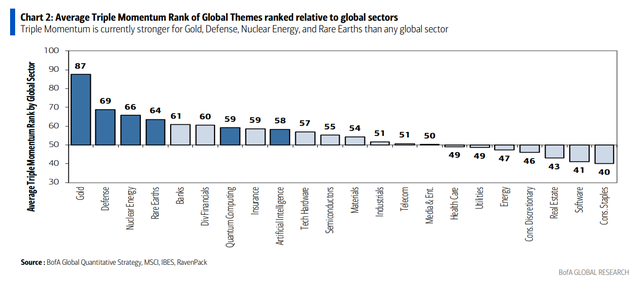
美银“三重动能”模型指明方向:黄金、国防、核能、稀土等板块表现领跑全球 投资者仍显著低配量子及AI类股
智通财经网· 2025-11-29 00:46
Core Insights - The "triple momentum" analysis by Bank of America indicates that sectors such as gold (GLD), defense (ITA, XAR), nuclear energy (NLR, NUKZ), and rare earths are outperforming all major global industry sectors [1] - This analysis combines earnings, price, and news momentum to assess current market sentiment and identify potential investment opportunities [1] Sector Performance - In the artificial intelligence (AI) theme, leading stocks include Celestica (CLS.US), Seagate Technology (STX.US), Western Digital (WDC.US), Lumentum Holdings (LITE.US), and AEMark Technology (AMKR.US) [3] - The top stocks in the defense theme are IonQ (IONQ.US), V2X (VVX.US), General Dynamics (GD.US), BWX Technologies (BWXT.US), and Leidos (LDOS.US) [3] - For the gold theme, leading stocks are New Gold (NGD.US), Equinox Gold (EQX.US), IAMGOLD Corp. (IAG.US), Barrick Mining (B.US), and Dundee Precious (DPMLF.US) [3] - In the nuclear energy theme, the top stocks are Talen Energy (TLN.US) and BWX Technologies (BWXT.US) [4] - The quantum computing theme features leading stocks such as Quantum Computing (QUBT.US), IonQ, and NVIDIA (NVDA.US) [5] - In the rare earth theme, the top stock is MP Materials (MP.US) [6] Positioning and Valuation Insights - Despite strong momentum in quantum and AI sectors, investors are significantly underweight in these areas, primarily due to the difficulty in overweighting large-cap stocks [7] - Bank of America notes that there are significant valuation differences across sectors, which are important for future performance [7] - The expected price-to-earnings ratio is highest in the rare earth sector and lowest in the gold sector, providing a reference for relative valuation levels [7] - The quantum computing sector has the highest price-to-book ratio, while the nuclear energy sector has the lowest, indicating different risk-return characteristics among these investment themes [7]
美股异动 | 稀土概念股盘前上涨 TMC the metals(TMC.US)涨超14%
智通财经网· 2025-11-28 14:22
Core Viewpoint - The rare earth sector in the U.S. stock market experienced a collective rise in share prices on Friday, indicating positive market sentiment towards this industry [1] Company Summaries - TMC the metals (TMC.US) saw a significant increase of over 14% in its stock price [1] - Critical Metals (CRML.US) reported a rise of more than 3.8% [1] - American Resources (AREC.US) experienced a stock price increase of 1.9% [1] - NioCorp Developments (NB.US) had a stock price rise of over 2.3% [1]




中美俄稀土储量差距断崖:美国180万吨,俄1000万吨,中国多少?
Sou Hu Cai Jing· 2025-11-28 13:28
Core Viewpoint - Rare earth resources play a critical role in global technological competition, with China's significant reserves and advanced technology providing it a dominant position in this sector [2][20]. Group 1: Resource Distribution and Comparison - China holds 44 million tons of rare earth reserves, far exceeding other countries, which enhances its strategic autonomy [2][20]. - The United States has approximately 1.9 million tons of rare earth reserves, accounting for less than 2% of global supply, with mining concentrated in the western regions [4][21]. - Russia's reserves are reported to be over 10 million tons domestically, but only 3.8 million tons by international standards, highlighting discrepancies in exploration methods [4][6]. Group 2: Production and Technological Capabilities - China is projected to produce 270,000 tons of rare earths in 2024, representing 70% of global output, supported by an efficient production system [8][10]. - The U.S. production is around 40,000 tons, heavily reliant on a single mining operation, while Russia's output is less than 20,000 tons due to outdated processing technologies [8][10]. - China leads in separation and purification technologies, achieving over 90% recovery rates, significantly higher than the U.S. and Russia [10][12]. Group 3: Economic and Strategic Implications - China's 44 million tons of reserves support rapid development in sectors like semiconductors and wind power, contributing to stable export growth [14][20]. - The U.S. faces limitations in military autonomy due to its 1.9 million tons of reserves, necessitating imports to meet domestic needs [14][21]. - Russia's potential could enhance its export competitiveness if its reserves are developed effectively, despite current low output levels [14][21]. Group 4: Industry Resilience and Future Outlook - China has established a closed-loop system from ore extraction to end products, covering 98% of global gallium and 60% of germanium production, ensuring supply chain security [16][18]. - The U.S. has a fragmented supply chain with high outsourcing in refining, while Russia is stagnant in basic extraction [16][18]. - Looking ahead, China aims to maintain high production levels by 2030, while the U.S. plans to invest in domestic mines to improve self-sufficiency, facing financial and technical challenges [18][20].
美俄稀土合作前,鲁比奥亲口证实,中国依旧富裕强大,美别无选择
Sou Hu Cai Jing· 2025-11-28 06:13
Core Insights - Russia's rare earth resources are estimated at 3.8 million tons, significantly surpassing Ukraine's reserves, with major deposits located in the Tomtor and Zashikhinskoye areas [1] - The Russian government plans to increase its rare earth production from 1.3% to 12% of global output by 2030, backed by a $15 billion investment for new processing facilities [1] - The U.S. is highly interested in Russian rare earth resources to reduce dependence on single sources, with discussions on potential cooperation and technology transfer [3][4] Group 1: Russian Rare Earth Resources - Russia's rare earth reserves include 17 elements such as neodymium, dysprosium, yttrium, and europium, with 380,000 tons immediately available for extraction [1][4] - The Russian Direct Investment Fund is negotiating with U.S. companies on rare earth projects, including a joint exploration agreement for the Tomtor area with a total investment of $5 billion [4] - The U.S. Geological Survey is invited to assess the purity of yttrium and europium in Russian deposits, which can reach 99.9%, making them suitable for military applications [1][3] Group 2: U.S.-Russia Cooperation - The U.S. is considering a dedicated railway from Siberia to the Black Sea to facilitate the transport of rare earth materials, estimated to cost $3 billion [3] - Initial dialogues between Russia and the U.S. have shifted from conceptual discussions to specific project lists, including the construction of a separation line at the Lovozersk mine [6][11] - The U.S. is expected to provide $500 million in exploration equipment in exchange for equity in Russian mining projects [9][14] Group 3: Global Rare Earth Market Dynamics - China remains the dominant player in the global rare earth market, controlling 95% of refining capacity and holding 120 million tons of reserves [13][14] - The U.S. rare earth production accounts for only 5% of global output, with significant reliance on imports, particularly from China [9][14] - China's recent initiatives include a $4.5 billion fund for rare earth research and development to enhance separation purity, ensuring a technological edge in international markets [13]
多个省份发布“十五五”规划建议因地制宜发展新质生产力成关键词
Zheng Quan Shi Bao· 2025-11-27 19:35
Core Insights - The article discusses the regional development strategies during the "14th Five-Year Plan" period, emphasizing differentiated layouts and regional collaboration to drive high-quality economic growth across various provinces in China [1] Group 1: Economic Powerhouses Leading Innovation - Major economic provinces like Zhejiang, Hubei, and Beijing are focusing on becoming leaders in technological and industrial innovation by increasing R&D investments and targeting key technologies [1] - Zhejiang aims for a significant breakthrough in its innovation and industrial system by 2030, with a target R&D investment intensity of around 3.5% and over 1 trillion yuan in technology innovation investments during the "14th Five-Year Plan" [2] - Hubei is implementing a strategy to become a nationally influential technology innovation hub, focusing on foundational research and overcoming critical technological bottlenecks [2][3] Group 2: Innovation Transition in Emerging Regions - Regions like Chongqing and Inner Mongolia are making notable progress in innovation transitions, with Chongqing rising four places in the regional innovation capability rankings [3] - Chongqing plans to elevate technological innovation as a key strategy, aiming to shift from traditional factor-driven growth to innovation-driven development [3] - Inner Mongolia and Ningxia are focusing on new energy systems and high-value utilization of strategic resources like rare earths, with plans to establish significant innovation centers [5] Group 3: Collaborative Innovation in Urban Clusters - The article highlights the importance of collaborative innovation among urban clusters, such as the Beijing-Tianjin-Hebei region, to enhance industrial division and innovation cooperation [6] - Beijing is focusing on resource integration and improving the efficiency of technology transfer, while Hebei aims to attract quality elements from Beijing and Tianjin for technology incubation [6] - The Chengdu-Chongqing economic circle is also emphasized, with Chongqing planning to leverage its unique resources to build a comprehensive innovation framework [6] Group 4: Systematic Approach to Regional Development - The development of new quality productivity and regional coordination is described as a systematic project, requiring mechanisms for shared benefits and risk-sharing [7]
多个省份发布“十五五”规划建议 因地制宜发展新质生产力成关键词
Zheng Quan Shi Bao· 2025-11-27 19:32
王昭丞/制表 各地"十五五"规划建议陆续发布。证券时报记者梳理发现,各地立足自身在全国发展大局中的功能定 位,通过差异化布局与区域联动,凝聚高质量发展的强大动能。 经济大省凭借资源与产业优势勇当先锋,浙江、湖北、北京等省份锚定科创高地建设,加大研发投入、 攻坚"尖刀"技术;重庆、内蒙古等创新转型追赶者立足禀赋,在推进传统优势产业发展的同时,也谋划 在新兴产业领域各展所长。同时,京津冀、成渝地区双城经济圈等城市群也提出了强化协同创新的新思 路。 经济大省勇当科技创新 和产业创新融合先锋 "十五五"时期加速推进现代化产业体系建设,关键在于把因地制宜发展新质生产力摆在更加突出的战略 位置。国研新经济研究院创始院长朱克力对证券时报记者表示,经济大省通常具备科教资源丰富、工业 基础雄厚等优势,可以在科技创新、开放合作等多方面发挥培育新质生产力的引领带动作用。 加快建设创新浙江,因地制宜发展新质生产力,是"十五五"时期浙江高质量发展的核心战略,主要目标 是力争实现"一个突破"和"四个基本建成"。"一个突破"即到2030年,创新浙江建设、现代化产业体系构 建实现重大突破,科创高地、先进制造业基地和人工智能创新发展高地全球竞 ...

三季度公募港股基金规模与持仓齐升
Zheng Quan Ri Bao· 2025-11-27 16:16
Group 1 - The Hong Kong stock market has shown strong performance this year, with active market sentiment and continuous capital inflow driving significant growth in public Hong Kong stock funds, which reached a total scale of 10,330.08 billion yuan by the end of Q3, a substantial increase of approximately 68% from Q2 [1] - The total number of fund shares for public Hong Kong stock funds reached 8,810.67 million, reflecting a quarter-on-quarter growth of 42%. The stock position of these funds increased to 92.71%, up 0.75 percentage points from the end of Q2, with nearly 80% maintaining stock positions above 90% [1] - The technology sector remains the top choice for public Hong Kong stock funds, although its proportion slightly decreased to 37%. The consumer sector holds the second position with a 25.16% holding ratio. The pharmaceutical sector saw the largest increase in holdings, growing by 3.09% quarter-on-quarter [1] Group 2 - As of November 27, 364 out of 381 public funds with "Hong Kong" in their names achieved net value growth this year, with 58 funds exceeding a 50% growth rate. Notably, two funds, Bank of China Hong Kong Stock Connect Pharmaceutical Mixed A and Huitianfu Hong Kong Advantage Selection Mixed (QDII) A, both surpassed a 100% net value growth rate [2] - Institutions generally hold an optimistic outlook for the market, with expectations of continued inflow of southbound funds driven by public funds and insurance capital, which may further boost the Hong Kong stock market [2] - The market is expected to benefit from the liquidity spillover from domestic and foreign markets and the ongoing narrative around AI, as more quality A-share companies list in Hong Kong [2] Group 3 - Predictions indicate that the Hong Kong stock market may experience a second round of valuation recovery and further earnings revival in 2026, supported by a rebound in fundamentals and attractive valuation discounts. Key focus areas include technology, healthcare, resources benefiting from inflation expectations, essential consumer sectors, and industries benefiting from RMB appreciation [3] - The research team suggests a left-side layout of "true value" stocks, selecting targets based on low valuation, large market capitalization, strong profitability, and cyclical recovery [3]
稀土定价权易主?全球买家跳脚,中国立新规,美欧被迫“学中文”
Sou Hu Cai Jing· 2025-11-27 15:01
Core Viewpoint - China's dominance in the rare earth market has shifted from being a low-cost supplier to a key player that sets the rules for the global industry, driven by strategic policies and technological advancements [1][10][16] Group 1: Global Context - The global demand for rare earth elements has surged due to advancements in technology and the renewable energy sector, leading to a scramble among the US and EU to secure their own supplies [1][3] - Despite significant investments and efforts, Western countries have faced challenges in establishing their own rare earth processing capabilities, often resulting in slow progress and unmet expectations [3][5] - Projects in remote locations, such as Greenland, have proven to be unviable due to harsh conditions and high extraction costs, further complicating Western efforts to reduce reliance on China [5][7] Group 2: China's Strategy - In the late 20th century, China faced pressure from foreign buyers to lower prices, which led to environmental degradation and loss of market share in high-end sectors [8][10] - The Chinese government implemented a series of policies to restructure the rare earth industry, including limiting production, cracking down on illegal mining, and consolidating smaller companies into larger entities [8][10] - Technological innovations, such as in-situ leaching and advanced extraction techniques, have significantly improved the environmental impact and purity of rare earth materials produced in China [10][12] Group 3: Shift in Power Dynamics - Recent regulatory changes, such as requiring global buyers to submit documentation in Chinese, signify a shift in the balance of power, indicating that China is now setting the rules for the rare earth market [12][16] - China's transformation from a resource supplier to a rule-maker reflects decades of strategic planning, investment in technology, and a focus on maintaining environmental standards [12][15][16] - The experience of China's rare earth industry serves as a lesson for other nations seeking to avoid the "resource trap" and maintain control over their natural resources [15][16]
邓小平预言成真!中国0.1%红线卡西方脖子,紧握稀土全球话语权!
Sou Hu Cai Jing· 2025-11-27 09:37
Core Viewpoint - The article emphasizes China's strategic dominance in the rare earth market, highlighting its control over production and refining capabilities, which significantly impacts global technology and defense industries [4][10][24]. Group 1: China's Rare Earth Production - China's rare earth production surged from 20 tons in the 1980s to 80,000 tons by 2006, marking a 4000% increase [6]. - By 2025, China is projected to hold 40-50% of global rare earth reserves and 69% of annual production, alongside controlling 90% of global refining capacity [10][24]. Group 2: Export Controls and Global Impact - In 2025, China implemented strict export controls on rare earth elements, including samarium and gadolinium, affecting not only raw materials but also mining and refining technologies [10][12]. - The price of dysprosium oxide surged from $283 to $850 per kilogram, and terbium oxide exceeded $3000 per kilogram in European markets due to these controls, while domestic prices in China remained stable [15]. Group 3: Western Response and Challenges - The West, particularly the U.S. and EU, is attempting to reduce reliance on Chinese rare earths, with initiatives like reopening the Mountain Pass mine and investing in new facilities [18][20]. - However, the technological gap in refining capabilities means that Western efforts will take at least five to ten years to catch up, during which time China's lead is expected to widen [22][24]. Group 4: Strategic Implications - The rare earth competition is fundamentally a contest of technological strength and strategic foresight, with China transitioning from a follower to a leader in the industry [24][26]. - The 2025 export control measures are framed as a defense of national interests, positioning China to leverage its rare earth advantages in future global negotiations [26].