
汽车行业

Search documents
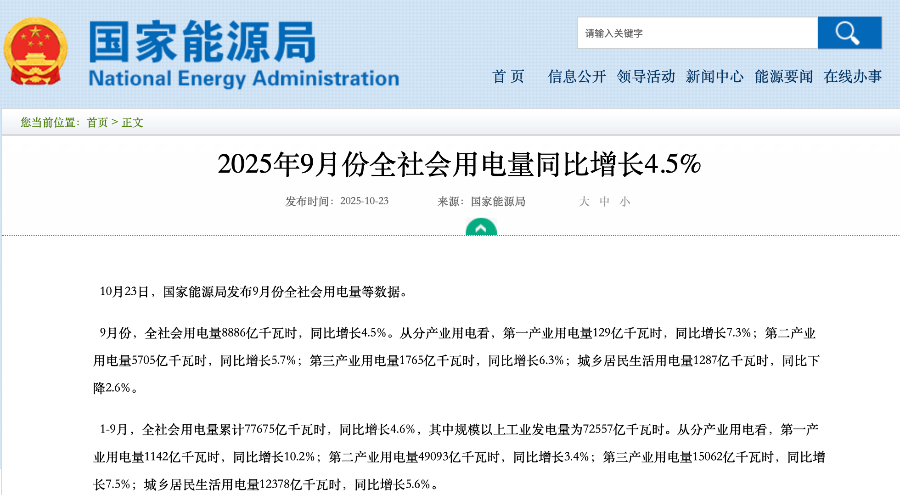
前9月全社会用电量达7.77万亿千瓦时,经济动能持续增强
2 1 Shi Ji Jing Ji Bao Dao· 2025-10-23 09:01
Core Insights - In September, China's total electricity consumption reached 888.6 billion kWh, marking a year-on-year increase of 4.5% [1][3] - From January to September, total electricity consumption accumulated to 7,767.5 billion kWh, with a year-on-year growth of 4.6% [1][3] - The third quarter saw a total electricity consumption of 2.9 trillion kWh, with significant monthly increases, indicating a new phase in energy consumption scale [1][3] Electricity Consumption by Sector - In September, electricity consumption by sector showed varied growth: primary industry at 12.9 billion kWh (7.3% increase), secondary industry at 5,705 billion kWh (5.7% increase), and tertiary industry at 1,765 billion kWh (6.3% increase) [3][4] - Urban and rural residential electricity consumption decreased by 2.6% to 128.7 billion kWh [3][4] - The secondary industry contributed significantly to the overall growth, with a 5.1% increase in the third quarter, accounting for 51% of total electricity consumption growth [4] Policy Impact and Industrial Recovery - Government policies have positively influenced the recovery of the secondary industry, with a notable increase in electricity consumption due to various industry stabilization plans [4] - High-energy-consuming industries saw a 3.2% increase in electricity consumption in the third quarter, driven by traditional peak seasons and recovery in production [4] - High-tech and equipment manufacturing sectors experienced a 9.5% increase in electricity consumption, surpassing the average growth rate of the manufacturing sector [4] Tertiary Industry Performance - The tertiary industry maintained robust growth, with a 7.5% year-on-year increase in electricity consumption for the first three quarters and an 8.3% increase in the third quarter [5] - New infrastructure developments, such as electric vehicles and 5G, significantly boosted electricity consumption in information transmission and retail sectors, with growth rates of 18.3% and 11.7% respectively [5] - The internet and related services saw a remarkable 33.8% increase in electricity consumption, while electric vehicle charging services surged by 49.6% [5] Regional Electricity Consumption Trends - Electricity consumption growth varied significantly across regions, with provinces like Hainan (18.6%), Tibet (15.4%), and Jilin (14.9%) showing the highest increases in September [6] - In the third quarter, Tibet (14.7%), Jilin (11.9%), and Hebei (11.7%) led in electricity consumption growth [6] - High temperatures during the summer contributed to record levels of residential electricity consumption, exceeding 500 billion kWh in the third quarter [6] Residential and Manufacturing Sector Insights - Urban and rural residential electricity consumption grew by 5.6% in the first three quarters, with a 6.4% increase in the third quarter [7] - Several provinces, including Tibet and Jilin, reported manufacturing electricity consumption growth exceeding 5%, with Tibet achieving a remarkable 25.8% increase [7]

“反内卷”“稳增长”组合拳发力,三季度第二产业用电量高增
Bei Ke Cai Jing· 2025-10-23 06:05
Core Insights - In September, the total electricity consumption reached 888.6 billion kWh, marking a year-on-year increase of 4.5% [2] - The secondary industry's electricity consumption was 570.5 billion kWh, with a year-on-year growth of 5.7%, indicating a significant rebound [2] - The third industry's electricity consumption in September was 176.5 billion kWh, showing a year-on-year increase of 6.3% [3] Group 1: Electricity Consumption Trends - The total electricity consumption for the third quarter increased by 5.1% year-on-year, with the secondary industry contributing 51.0% to this growth [2] - Industrial electricity consumption grew by 5.4% year-on-year in the third quarter, an increase of 2.3 percentage points from the second quarter [2] - Manufacturing electricity consumption rose by 5.2% year-on-year in the third quarter, up by 3.2 percentage points from the previous quarter [2] Group 2: Sector-Specific Growth - The rapid development of new energy vehicles and charging infrastructure has significantly boosted electricity consumption in the information transmission/software and IT services sectors, which grew by 18.3% and 11.7% respectively in the third quarter [3] - The internet and related services sector saw a remarkable year-on-year growth of 33.8% in electricity consumption during the third quarter [3] - The electric vehicle charging services sector experienced a staggering year-on-year increase of 49.6% in electricity consumption [3]
海外市场 | 黄金暴跌近5%,道琼斯指数创历史新高
Mei Ri Jing Ji Xin Wen· 2025-10-22 01:11
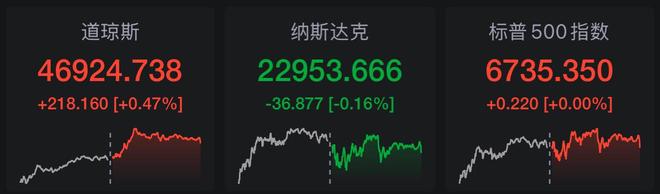
Market Performance - The three major U.S. stock indices showed mixed results, with the Dow Jones Industrial Average rising by 0.47% to reach a historical high, while the S&P 500 remained nearly flat and the Nasdaq fell by 0.16% [1] - General Motors reported better-than-expected earnings, leading to a nearly 15% increase in its stock price, while Beyond Meat saw a cumulative rise of approximately 600% over three days [1] - In the tech sector, Apple experienced a slight increase, reaching a new historical high, whereas Google declined by over 2% and Tesla fell by more than 1% [1] Chinese Stocks - The Nasdaq Golden Dragon China Index decreased by 0.97%, with Alibaba dropping nearly 4%, and both JD.com and Baidu falling by over 2%. In contrast, Bilibili saw a nearly 6% increase [1] Commodity Market - The commodity market faced significant volatility, with spot gold experiencing a nearly 5% drop, marking the largest single-day decline in recent times [1] - Analysts attributed the sharp decline in precious metals to profit-taking and a strengthening U.S. dollar. However, if expectations for Federal Reserve rate cuts strengthen or geopolitical risks resurface, gold and silver prices may find support [1]
美股三大指数涨跌不一 通用汽车涨约15%
Xin Lang Cai Jing· 2025-10-21 20:30
Core Points - The three major U.S. stock indices closed mixed, with the Dow Jones Industrial Average rising by 0.47%, the S&P 500 remaining flat, and the Nasdaq declining by 0.16% [1] - The Dow reached a new all-time high [1] Company Performance - Large tech stocks showed mixed performance, with Amazon rising over 2%, while Meta, Apple, Microsoft, and Intel saw slight gains [1] - Nvidia and Oracle experienced minor declines, while Broadcom, Tesla, and AMD fell by over 1%, and Google dropped by more than 2% [1] - General Motors surged approximately 15%, marking its best single-day performance in the last five years [1]

数说“十四五” ESG笔墨绘就企业发展新底色
Zhong Guo Zheng Quan Bao· 2025-10-20 20:17
Core Insights - The disclosure rate of ESG reports among A-share listed companies has steadily increased, with a 71% year-on-year growth in the number of reports published for the 2024 fiscal year compared to 2021 [2] - ESG has evolved from a conceptual framework to a critical dimension for measuring corporate competitiveness, aligning with national development goals [2][3] - Companies are increasingly integrating sustainable development principles into their corporate culture and operations, demonstrating a commitment to ESG practices [2][3] ESG Disclosure and Performance - As of September 2025, 2,521 A-share listed companies have published ESG reports, representing 46.83% of all listed companies [2] - The quality of ESG disclosures has significantly improved, with 342 companies included in MSCI ESG ratings, and 100 companies receiving upgrades in their ratings [2] - The shift towards actionable ESG practices is evident across various industries, with companies adopting international ESG standards to enhance report quality [2] Green Development Initiatives - The share of renewable energy in China's power generation capacity has increased from 40% to approximately 60% during the "14th Five-Year Plan" period [4] - Significant reductions in carbon emissions have been achieved, with a reported decrease of 11.6% in energy consumption per unit of GDP, equating to a reduction of 1.1 billion tons of CO2 emissions [5] - Companies are increasingly adopting green technologies and practices, contributing to a sustainable business model and enhancing their competitive edge [3][4] Social Responsibility and Community Engagement - A growing number of companies are embedding social responsibility into their operations, with 67.16% engaging in community services and 66.67% supporting educational resources [6] - The third sector's employment capacity has strengthened, with 35.87 million people employed in this sector by the end of 2024, marking a 1.1 percentage point increase from 2020 [6] - Companies are actively participating in housing and elderly care initiatives, significantly improving living conditions and support networks for communities [6][7] Agricultural and Rural Development - Companies are integrating ESG practices with rural revitalization strategies, exemplified by successful projects like the silk industry in Guangxi, which is expected to generate over 8 million yuan in output by 2025 [8] - Digital solutions are being implemented to enhance agricultural productivity, with platforms connecting over 1,000 agricultural regions and benefiting millions of farmers [8] - The contribution of agricultural technology to productivity has reached 63.2%, with mechanization rates exceeding 75%, showcasing the role of innovation in modern agriculture [8]
全球资产配置每周聚焦(20251010-20251017):中美贸易不确定性上升,黄金白银领涨全球-20251019
Shenwan Hongyuan Securities· 2025-10-19 06:10
Group 1: Market Overview - The uncertainty in China-US trade relations has increased, leading to a rise in gold and silver prices globally, with silver up 7.33% and gold up 6.51% during the week[6] - The 10-year US Treasury yield decreased by 3 basis points to 4.02%, while the US dollar index fell by 0.27% to 98.6, remaining below 100[9] - The ChiNext, Hang Seng Index, and Hang Seng Tech have shown significant gains this year but experienced some adjustments this week due to increased trade uncertainties[6] Group 2: Capital Flows - Domestic capital saw a significant inflow into the Chinese stock market, with a total of $133.02 billion inflowing over the past week[3] - Overseas active funds saw an inflow of $1.76 billion, while passive funds saw $1.22 billion inflow during the same period[3] - The US equity market attracted over $130 billion in inflows, particularly in technology, healthcare, and financial sectors[3] Group 3: Valuation Metrics - The A-share equity risk premium (ERP) has risen significantly, with the PE ratio for the Shanghai Composite Index and Hang Seng Index recovering to over 50%[3] - The PE ratio percentiles for the S&P 500 and CAC 40 are at 92.9% and 91.1%, respectively, indicating high valuations compared to historical levels[3] - The risk-adjusted returns for the S&P 500 increased from the 42nd to the 44th percentile, while the risk-adjusted returns for the CSI 300 decreased from the 76th to the 69th percentile[3] Group 4: Economic Indicators - US manufacturing PMI and industrial output index showed marginal improvement, while non-manufacturing PMI and inflation expectations weakened slightly[3] - China's September CPI, core CPI, and PPI showed signs of recovery, with significant improvements in year-on-year import and export growth rates[3] - The probability of a 25 basis point rate cut by the Federal Reserve in October is at 99%, slightly up from 98.3% the previous week[3]
旺季竟然有不少空房,酒店老板有点慌:你们旅游的,不睡酒店睡车上?
3 6 Ke· 2025-10-17 01:45
Core Insights - The rise of car camping and the use of car mattresses during holidays is significantly impacting the hotel industry, as more travelers opt for sleeping in their vehicles instead of booking hotel rooms [1][5][6] - The competition landscape for hotels has shifted, with traditional competitors now including not only other hotels but also higher-end hotels, car camping options, and even tents [3][8] - The self-driving travel trend is growing rapidly, with a notable increase in rental car orders and self-driving tourism demand, indicating a shift in consumer preferences [4][5][6] Industry Impact - During the recent National Day and Mid-Autumn Festival holidays, many hotels reported higher vacancy rates despite high tourist traffic, attributed to the increasing number of travelers choosing to sleep in their cars [3][5] - The hotel industry is facing intense competition due to an oversupply of hotel rooms, with over 600 new hotel rooms added in the vicinity of one hotel, leading to a significant diversion of guests [8][10] - The average daily room rates for high-end hotels have dropped significantly, with some hotels reducing prices from around 1300 yuan to as low as 500 yuan to attract customers [8][9] Consumer Behavior - The trend of "living in cars" is becoming more popular, with many travelers sharing their experiences on social media, highlighting the cost-effectiveness and convenience of car camping [1][3] - The demand for camping-related products, such as inflatable mattresses and outdoor gear, has surged, indicating a shift in consumer spending towards self-sufficient travel options [4][6] - The demographic of self-driving travelers is diversifying, with significant growth among younger generations and older adults, suggesting a broadening appeal of this travel style [4][6] Market Dynamics - The hotel industry is experiencing a supply-demand imbalance, with the number of hotels increasing faster than the growth in customer demand, leading to heightened competition [10][11] - High-end hotels are adopting aggressive pricing strategies to maintain occupancy, which is adversely affecting mid-range hotels and local brands [9][10] - The shift towards self-driving and car camping is prompting hotels to rethink their value propositions and service offerings to better meet evolving consumer needs [11][12]

暴涨65%后还有空间!黄金冲破4370美元 汇丰紧急上调2026年目标价近30%
智通财经网· 2025-10-17 00:20
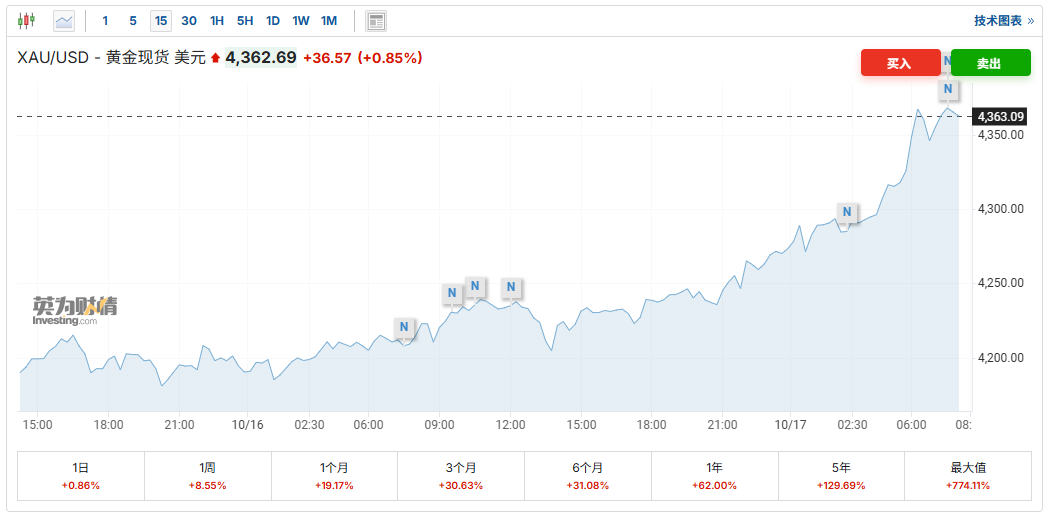
Group 1 - Concerns over credit quality in the economy and geopolitical tensions have increased demand for safe-haven assets, leading to record highs in gold and silver prices [1][3] - Gold prices surged by over 65% this year, driven by central bank purchases, inflows into gold ETFs, and heightened safe-haven demand amid geopolitical and trade tensions [4] - Major Wall Street firms have raised their gold price forecasts, with UBS predicting gold to reach $4200 per ounce in the coming months, and Bank of America raising its 2026 target to $5000 per ounce [4] Group 2 - The bankruptcy of Tricolor Holdings and First Brands has raised investor concerns about the credit market, with JPMorgan's CEO indicating that more issues may follow [3] - The Federal Reserve is expected to implement a significant rate cut by the end of the year, which typically benefits precious metals as lower borrowing costs make them more attractive [3] - HSBC has also raised its gold price forecasts, citing geopolitical tensions and economic uncertainty as key drivers for increased demand [4]
旺季竟然有不少空房,酒店老板有点慌:你们旅游的,不睡酒店睡车上?游客纷纷种草:怒省几大千
Mei Ri Jing Ji Xin Wen· 2025-10-16 15:09
Core Viewpoint - The rise of car camping and the use of mobile sleeping arrangements in electric vehicles are significantly impacting the traditional hotel industry, leading to increased competition and changing consumer preferences [1][3][5]. Group 1: Changes in Consumer Behavior - During the recent National Day and Mid-Autumn Festival holidays, the popularity of car camping surged, with discussions on social media platforms like Xiaohongshu reaching 110 million views [1]. - The proportion of self-driving trips is projected to reach 80% by 2025, indicating a shift in travel preferences towards more flexible and cost-effective options [1][3]. - The demand for car camping has led to a notable increase in related product sales, such as inflatable mattresses and outdoor gear, with some items seeing sales growth of over 80% [4][5]. Group 2: Impact on the Hotel Industry - Hotel occupancy rates are declining, with many hotels experiencing unprecedented levels of vacancy during peak seasons, attributed to competition from car camping and other alternative accommodations [3][5][8]. - The hotel industry is facing increased competition not only from other hotels but also from the growing number of available rooms, with over 600 new hotel rooms added in a specific area, leading to a significant diversion of guests [8][10]. - High-end hotels are engaging in price wars, with room rates dropping significantly to attract customers, which is squeezing the middle-tier hotels and altering the competitive landscape [9][10]. Group 3: Industry Trends and Future Outlook - The hotel industry is undergoing a transformation, moving from expansion to a focus on operational efficiency and service quality in response to changing consumer demands [11]. - The trend of short-distance and county-level travel is becoming more prominent, with lower-tier cities showing higher occupancy rates compared to major urban centers [10][11]. - The increasing comfort and features of electric vehicles, such as improved seating and air conditioning, are making car camping a more appealing option for travelers [6][10].
联合国贸发会议报告显示 南南贸易对全球增长作出重要贡献
Jing Ji Ri Bao· 2025-10-16 03:33
Core Insights - The UNCTAD report indicates that global trade is expected to maintain strong growth in the first half of 2025, with an increase of over $500 billion, driven primarily by trade expansion among developing countries and a rebound in manufacturing exports [1][2] Group 1: South-South Trade - South-South trade is showing strong growth, significantly contributing to global trade expansion, particularly in East Asia, where trade among developing countries is active [1][2] - The growth in South-South trade is attributed to increasing complementarity among developing countries, which possess abundant natural and labor resources, allowing for mutual learning and technology sharing [2] - However, the growth is uneven, with East Asia leading while other regions lag behind; excluding East Asia, South-South trade contracted in Q2 2025, highlighting challenges such as inadequate infrastructure and trade barriers [2] Group 2: Manufacturing Sector - Manufacturing is a key driver of global trade growth, with a quarterly growth rate of 3%, outperforming agriculture and natural resources sectors [3] - The electronics and automotive industries are particularly strong, with electronic products, especially AI-related devices, seeing a quarterly trade increase of 7%, while electric and hybrid vehicles grew by 17% and 10%, respectively [2][3] - The report anticipates continued growth in manufacturing driven by green and technological transitions, particularly in renewable energy equipment and AI-related products [3] Group 3: China's Role - As the world's largest goods trader, China significantly influences global trade dynamics, contributing notably to trade growth in the first half of 2025 [4] - China's robust manufacturing base and complete industrial chain have propelled global manufacturing trade, with strong performance in electronics and green transportation sectors [4] - China's investments in the new energy vehicle sector have boosted its manufacturing exports and increased its share in global automotive trade, while also enhancing trade ties with developing countries through initiatives like the Belt and Road [4]