
债券

Search documents
央行今日开展10000亿元MLF操作;纳指收涨2.69% |盘前情报
2 1 Shi Ji Jing Ji Bao Dao· 2025-11-25 00:57
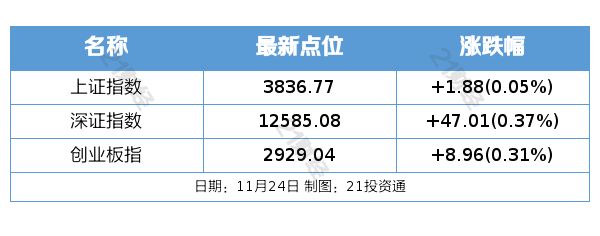
Market Overview - On November 24, the A-share market showed signs of recovery with all three major indices closing in the green. The Shanghai Composite Index rose by 0.05%, the Shenzhen Component Index increased by 0.37%, and the ChiNext Index gained 0.31% [1][2] - The total trading volume in the Shanghai and Shenzhen markets was 1.73 trillion yuan, a decrease of 237.9 billion yuan compared to the previous trading day [1] Sector Performance - The AI application concept stocks experienced a significant surge, with over 4,200 stocks in the market rising. The commercial aerospace sector also saw continued gains [1] - Conversely, lithium mining stocks declined, and computing hardware concepts weakened. The sectors with the highest gains included AI applications and commercial aerospace, while energy metals, Hainan, and gas sectors faced the largest declines [1] International Market - In the U.S. stock market, all three major indices rose on November 24. The Dow Jones Industrial Average increased by 202.86 points (0.44%) to close at 46,448.27 points, the S&P 500 rose by 102.13 points (1.55%) to 6,705.12 points, and the Nasdaq Composite gained 598.92 points (2.69%) to 22,872.01 points [3][4] - In Europe, the market showed mixed results, with the UK FTSE 100 down by 0.05%, the French CAC 40 down by 0.29%, while the German DAX index rose by 0.64% [3][4] - International oil prices increased, with WTI crude oil rising by 1.34% to $58.84 per barrel and Brent crude oil up by 1.29% to $63.37 per barrel [3][4] Key Economic Policies - The People's Bank of China announced a 10 billion yuan MLF operation scheduled for November 25, aimed at maintaining ample liquidity in the banking system [5] Corporate Developments - Huawei is set to launch its Mate80 series and MateX7 products on November 25, with expectations of significant advancements in performance and technology [10] - Alibaba will announce its quarterly earnings on November 25, with a focus on capital expenditure and AI application progress [11] Investment Insights - China Galaxy Securities noted a cautious market sentiment with a "high cut low" characteristic, suggesting a short-term focus on structural adjustments and potential opportunities following recent market corrections [12] - Huatai Securities indicated that the current market adjustment has created a supportive environment, with expectations of improved overseas liquidity and reduced domestic funding pressure [12]


信用利差周报2025年第43期:货币政策报告延续宽松基调,香港百亿数字绿债落地-20251125
Zhong Cheng Xin Guo Ji· 2025-11-25 00:43
1. Report Industry Investment Rating - No relevant content provided 2. Core Viewpoints of the Report - The central bank's monetary policy report maintains a loose tone, focusing on "stable growth" and aiming to lower interest rates and reduce the real - financing cost. It also emphasizes the development of the bond market's "science and technology board" and the use of risk - sharing tools for science and technology innovation bonds [3][11]. - The issuance of Hong Kong's HK$10 billion digital green bonds sets a global record, marks the transition from pilot to regular operation of tokenized bonds in Hong Kong, and provides a reference for the mainland's financial infrastructure construction and product innovation [4][15]. - In October, China's economic indicators weakened, with consumption, investment, and industrial production showing a slowdown, and social financing and credit continuing to decline [5][18]. 3. Summary by Directory Market Hotspots - The Q3 Monetary Policy Report continues the "moderately loose" liquidity management framework, focuses on "stable growth", and emphasizes the development of a multi - level bond market and the support for key areas such as science and technology innovation. It also highlights the use of risk - sharing tools for science and technology innovation bonds, which may guide more funds into the science and technology field [11][13]. - On November 11, Hong Kong issued HK$10 billion digital green bonds, covering four currencies with a 2 - 5 - year term and an over - subscription of about 12 times. It is the first to use tokenized central bank currency for on - chain "delivery versus payment", which improves settlement efficiency and reduces risks, and marks the transition from pilot to regular operation of tokenized bonds in Hong Kong [4][15]. Macroeconomic Data - In October, China's economic indicators weakened. From January to October, the cumulative year - on - year growth rate of fixed - asset investment decreased by 1.2% and was negative for two consecutive months. The growth rate of social retail sales was 2.9%, declining for five consecutive months. Industrial production also declined, affected by factors such as holidays and export slowdown. In terms of financial data, social financing and credit continued to decline in October, with new social financing of 815 billion yuan, a year - on - year decrease of 597 billion yuan for three consecutive months. M1 and M2 increased by 6.2% and 8.2% year - on - year respectively, with their scissors gap expanding to 2% [5][18]. Money Market - Last week, the central bank conducted five 7 - day reverse repurchase operations totaling 1.122 trillion yuan, with 495.8 billion yuan of reverse repurchases maturing, resulting in a net injection of 626.2 billion yuan. Due to factors such as mid - month reserve requirements and tax payments, market capital demand was large, and capital prices generally increased. The pledged repurchase rates of all tenors increased by 2 - 10bp compared with the previous week [6][22]. Primary Market of Credit Bonds - Last week, the issuance scale of credit bonds decreased slightly to 251.409 billion yuan, a decrease of 25.624 billion yuan from the previous value. The average daily issuance scale was 50.282 billion yuan, a decrease of 5.125 billion yuan from the previous period. Except for the short - term financing bonds and publicly issued corporate bonds, the issuance scale of other bond types decreased. The issuance scale of the infrastructure investment and financing industry decreased, while that of industrial bonds increased. The average issuance cost of credit bonds mostly declined [7][25]. Secondary Market of Credit Bonds - Last week, the secondary - market trading volume of bonds was 8.667564 trillion yuan, and the average daily trading volume decreased by 8.2813 billion yuan to 173.3513 billion yuan, with a slight decline in trading activity. The market still had a certain wait - and - see sentiment. Credit bonds performed slightly better than interest - rate bonds. The yields of most tenors of treasury bonds and policy - bank bonds decreased, with a maximum decline of 3bp, and the yield of the 10 - year treasury bond dropped to 1.81%. The yields of credit bonds showed a differentiated performance between short and long - term tenors, with a maximum change of 8bp. Most of the rating spreads narrowed [8][37].
美媒:中国停止抛售美债?美联储无奈让步,中国实际抛售额成谜
Sou Hu Cai Jing· 2025-11-24 17:29
Core Viewpoint - Recent media claims suggest that China has "stopped selling US Treasury bonds," implying a significant victory in the financial arena, but this assertion is misleading as China continues to reduce its holdings of US debt [1][15]. Summary by Sections China's Holdings of US Treasury Bonds - As of February 18, 2025, China's holdings of US Treasury bonds have decreased to $759 billion, the lowest level since 2009 [2]. - From a peak of approximately $1.3 trillion in 2011, China has reduced its holdings by about $550 billion, a decline of over 40% [2]. - In 2024 alone, China sold off $57.3 billion in US Treasury bonds, with nine months of the year showing a reduction in holdings [4]. Reasons for Reducing Holdings - The reduction in US Treasury bonds is driven by several practical considerations: - Risk diversification is a key factor, as China seeks to allocate its foreign reserves of over $3 trillion across various assets, including European bonds and gold [5]. - Concerns over the weaponization of the dollar, particularly in light of US sanctions on Russia, have prompted a reevaluation of reliance on the dollar [5]. - The need to stabilize the yuan's exchange rate during periods of depreciation pressure has also influenced the decision to sell US bonds [5]. US Federal Reserve's Response - The characterization of the Federal Reserve's actions as "forced concessions" is exaggerated; the Fed is adjusting its monetary policy based on economic data [5][10]. - The Fed has been lowering interest rates, with the federal funds rate dropping from a high of 4.25-4.50% at the beginning of 2024 to a range of 4.00-4.25% [5]. - Internal disagreements within the Fed regarding the pace of rate cuts reflect a normal decision-making process rather than external pressures [7]. Market Dynamics - As of the end of 2024, the total US national debt exceeded $36 trillion, with foreign investors holding approximately 25.4% of this debt [8]. - Japan remains the largest foreign holder of US Treasury bonds, followed by the UK, which has surpassed China [8]. - The stability of the US Treasury market is primarily supported by domestic demand, indicating that foreign selling has a limited impact on overall market stability [8]. Implications for the Future - The US government's increasing financing needs, with net interest payments projected to exceed $1 trillion in the 2025 fiscal year, highlight the importance of attracting buyers for new debt issuances [9]. - While foreign investor reductions may exert some pressure on the US, the adjustments in the market are part of a normal regulatory process rather than a crisis [10]. - For China, reducing US Treasury holdings while increasing gold reserves enhances the safety and yield of its foreign reserves, contributing to the stability of the yuan [11]. - The global financial landscape is gradually diversifying, with a shift away from the dollar's dominance, although this change will be gradual [14].
【中金固收·信用】债市延续小幅震荡
Sou Hu Cai Jing· 2025-11-24 15:12
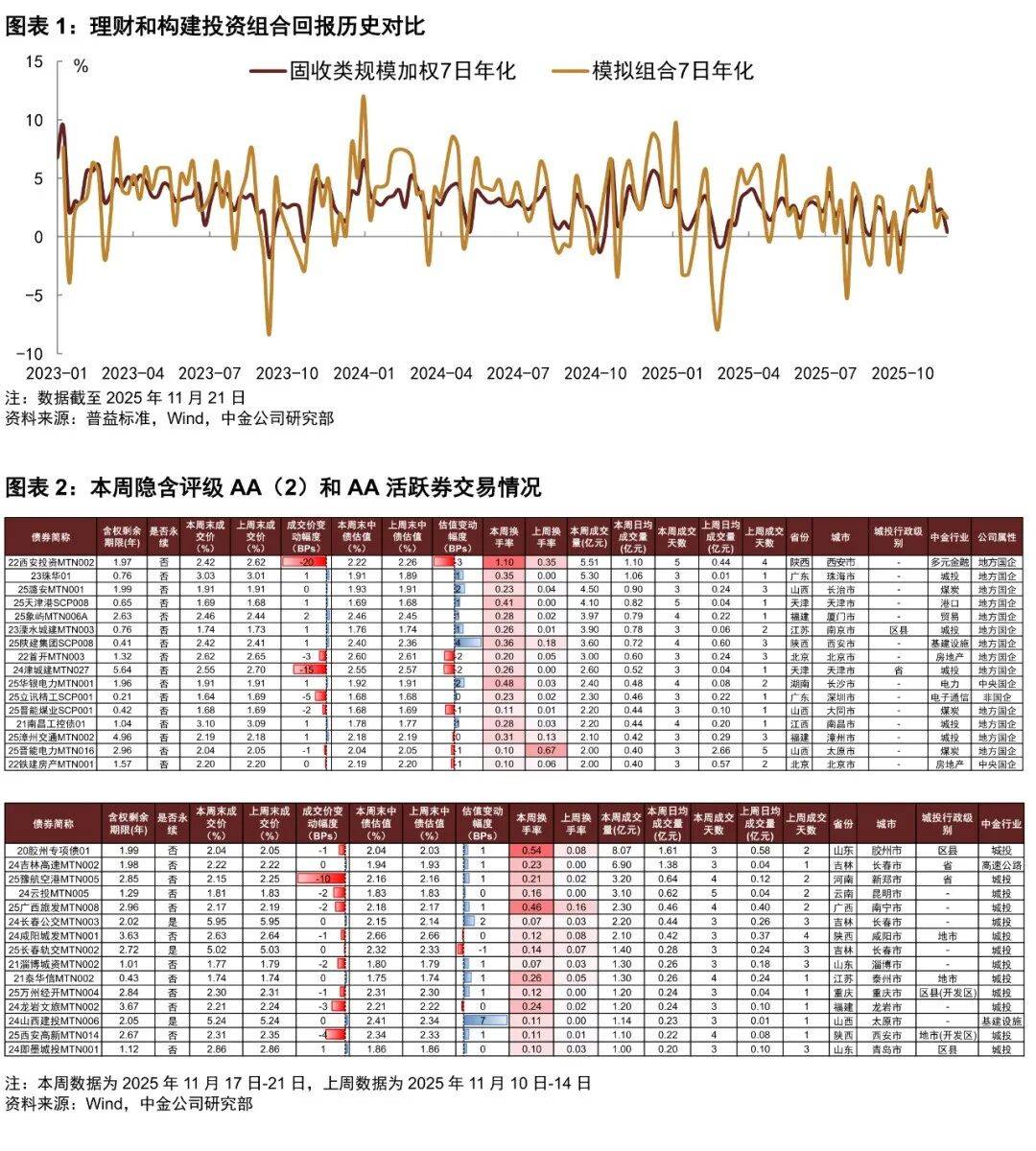
Market Overview - The bond market experienced slight fluctuations last week, with the long-end performing better than the short-end. The overall bond yields showed narrow movements, with the 10-year government bond yield rising by 1 basis point to 1.82% [2] - The issuance of non-financial credit bonds increased significantly, with a primary issuance volume of 409.6 billion yuan, up from 270.2 billion yuan the previous week. The net financing amount rose from 23.1 billion yuan to 132.4 billion yuan [2][3] Credit Bond Demand - Various institutional types showed net buying, although most experienced a decline compared to the previous period. Specifically, the net buying by wealth management decreased from 10.7 billion yuan to 5.5 billion yuan, while funds increased from 27 billion yuan to 34.5 billion yuan [3] - The net buying by insurance companies dropped from 8.2 billion yuan to 3.3 billion yuan, while other asset management institutions increased their net buying from 2.3 billion yuan to 10.3 billion yuan [3] Future Outlook - In the short term, the current market trend is expected to continue, but attention should be paid to stock market movements. A sustained decline in the stock market could lead to redemptions in fixed-income products, triggering bond sell-offs and upward pressure on yields [1][4] - The demand for credit bonds is anticipated to increase, particularly for bonds with maturities of 5-7 years, as a significant amount of amortized cost bond funds will enter the open period in the first half of 2026 [1][4] Issuance Analysis - This week, 418 non-financial credit bonds were issued, totaling 407.8 billion yuan, with a net increase of 130.6 billion yuan, marking a 51% rise in issuance volume and a 465% increase in net increase compared to the previous week [9] - The majority of net increases came from 1-3 year AAA-rated bonds, contributing 110 billion yuan in issuance and 45.1 billion yuan in net increase [9] Yield Trends - The issuance yields varied by rating and maturity, with AAA-rated bonds for maturities of 1 year or less, 1-3 years, and 3-5 years decreasing by 5 basis points, 8 basis points, and 8 basis points respectively [10] - For AA+ rated bonds, the yields for 1 year or less and 1-3 years changed by -3 basis points and 0 basis points, while 3-5 years saw an increase of 30 basis points [10]
信用债市场周观察:关注永续品种定价偏离带来的机会
Orient Securities· 2025-11-24 12:15
Group 1: Research Conclusion and Core View - The report focuses on the opportunities brought by the pricing deviation of perpetual bonds in the credit bond market. In a low - volatility environment, the year - end support for credit bonds mainly comes from the demand of allocation - type institutions, but the intensity of pre - emptive actions should not be over - expected. The report suggests three main directions for exploring urban investment bonds: (1) conduct more credit spreading within 3 years; (2) select bonds with a steep yield curve (>25bp) and certain liquidity between 3 - 5 years; (3) pay attention to the pricing deviation of perpetual and private placement bonds [5][8]. Group 2: Credit Bond Weekly Review 2.1 Negative Information Monitoring - From November 17 to November 23, 2025, the long - term issuer credit rating of Longfor Group Holdings Limited was downgraded from "BB" to "BB -" by S&P, and its senior unsecured notes' long - term rating was downgraded from "BB -" to "B+". Also, several companies had major negative events, such as Xinyuan (China) Real Estate Co., Ltd. with debt overdue and multiple major lawsuits, and Guanghui Automobile Service Co., Ltd. involved in an execution case [13][14]. 2.2 Primary Market Issuance - From November 17 to November 23, the issuance volume of credit bonds exceeded 400 billion yuan again, reaching 403.8 billion yuan, a 49% increase from the previous period. The total repayment amount increased to 262.3 billion yuan, resulting in a net financing of 141.6 billion yuan. The number of cancelled or postponed bond issuances increased to 5, with a total scale of 5.5 billion yuan. The primary issuance cost increased slightly, with the average coupon rates of AAA and AA+ bonds rising by 5bp and 7bp respectively [15][16]. 2.3 Secondary Market Trading - Last week, the valuations of credit bonds with different ratings and maturities fluctuated narrowly, with most remaining unchanged. The credit spreads narrowed at the short - end and widened at the long - end. The 3Y - 1Y term spreads of each rating narrowed, while the 5Y - 1Y term spreads widened slightly. The AA - AAA grade spread widened by 2bp for 3 - year bonds and narrowed by 3bp for 5 - year bonds. The credit spreads of urban investment bonds in each province were mostly flat or narrowed, with Yunnan having the largest narrowing of 3bp. The industry spreads of industrial bonds fluctuated within ±1bp, with the real estate industry narrowing by 3bp. The weekly turnover rate increased by 0.19pct to 1.89%. Among real - estate enterprises, the spreads of Times Holdings, Rongqiao, Yuzhou Hongtu, and Vanke widened significantly [18][20][24].
资金压力仍未缓解,保守打法占优
Hu Xiu· 2025-11-24 12:02
Group 1 - The pressure on funds remains unresolved, caution against "short-term speculation" [2] - The three major indices showed slight gains, but the trading volume decreased to 1.7 trillion, indicating a low activity level [2] - Margin trading saw a net sell-off of nearly 30 billion, the highest since early October, reflecting a strong risk-averse sentiment among investors [2] Group 2 - The bond market is also under pressure, with psychological burdens as year-end approaches, leading to a lack of benefits from stock market declines [2] - Institutions are opting for intermittent exits and profit-taking to secure annual returns, indicating a cautious approach as the year ends [2]
美国股市周四因感恩节休市,“黑色星期五”提前收盘
Xin Lang Cai Jing· 2025-11-24 11:31
在经历了一段繁忙的市场交易期后,交易员本周将迎来休息日。 11 月 27 日(周四)感恩节当天,美国股市和债市均休市。交易将于周五(即 "黑色星期五")恢复,但 当日交易时间将缩短:股市将于当地时间下午 1 点收盘,债市则定于下午 2 点收盘。 来源:环球市场播报 感恩节当天或许适合庆祝,或许不适合,但绝对不适合股票或债券交易。 ...
股债汇下跌,抛售日本开始了?自民党开会反思,高市还未醒悟
Sou Hu Cai Jing· 2025-11-24 10:18
Group 1 - The core issue revolves around the backlash against Japan due to comments made by Prime Minister Kishi Sanae regarding Taiwan, leading to a series of countermeasures from China and travel warnings from multiple countries, exacerbating the sell-off of Japanese assets [1][3] - The sell-off is not limited to the stock market; it also includes a decline in the yen's value and rising Japanese bond yields, indicating a broader capital flight from Japan as investors seek safer havens [3][5] - The Japanese government, particularly the ruling Liberal Democratic Party, is beginning to recognize the need for dialogue with China and to address the root causes of the tensions, although previous hardline stances are being reconsidered [5][7] Group 2 - Public sentiment in Japan is shifting from support for Kishi's hardline approach to a realization of the economic repercussions faced by ordinary citizens and small businesses, with a significant drop in support for military intervention in Taiwan [7][9] - Kishi Sanae's strategy appears to be an attempt to bolster her political standing through a tough stance on China, reflecting a deeper insecurity, but this has backfired as the current geopolitical landscape has changed significantly [9]

日本债市:会成为下一个全球风险源吗?
Jin Rong Shi Bao· 2025-11-24 09:59
Core Viewpoint - The Japanese bond market is experiencing significant volatility, raising concerns among global investors about its potential to become a focal point of market turbulence amid diplomatic crises, high inflation, and economic stagnation [1] Group 1: Economic Stimulus and Market Reaction - The Japanese government announced a massive stimulus plan of 21.3 trillion yen to alleviate public anxiety over inflation, but this has led to increased turmoil in the bond market [1] - The yield on 10-year Japanese government bonds recently approached 1.8%, the highest level since 2008, while the 30-year yield exceeded 3.3%, marking a significant shift for a country that has maintained a "zero interest rate" policy for decades [1] Group 2: Debt Levels and Fiscal Concerns - Japan's debt-to-GDP ratio has remained around 230%, and the new stimulus plan is expected to be accompanied by a large-scale bond issuance, potentially exceeding last year's borrowing of 6.69 trillion yen [2] - The total impact of the stimulus plan, including local government spending and private sector investment, could reach 42.8 trillion yen, surpassing last year's 39 trillion yen plan [2] Group 3: Interest Rate and Financial Health - The Bank of Japan's shift towards raising interest rates marks the end of decades of ultra-loose monetary policy, with rates now at their highest in over a decade [3] - Rising bond yields could create a vicious cycle, forcing the government to allocate more budget to interest payments, which may further increase the need for borrowing and push yields even higher [3] Group 4: Global Investment Implications - Japan is not only the world's most indebted nation but also the largest creditor, holding trillions of dollars in global assets, including U.S. Treasury bonds [3] - If Japanese bond yields continue to rise, it may lead to a reversal of yen carry trades, forcing investors to sell overseas assets to repay yen loans, potentially impacting global markets [3]
宏观周报(11月第3周):全球流动性波动影响市场-20251124
Century Securities· 2025-11-24 09:07
Market Overview - The equity market experienced a decline with an average trading volume of 18,650 billion CNY, down 1,788 billion CNY week-on-week[2] - The Shanghai Composite Index fell by 3.90%, while the Shenzhen Component and ChiNext Index dropped by 5.13% and 6.15%, respectively[2] - The decline in the market was influenced by overseas risk appetite and liquidity factors, particularly due to rising Japanese government bond yields and fluctuating expectations of U.S. Federal Reserve rate cuts[2] Economic Indicators - The GDP growth forecast for Q3 2024 is under pressure, with various economic indicators showing weakness, particularly in October[2] - The M2 growth rate and social financing growth are also expected to remain subdued, reflecting a tightening liquidity environment[2] - The actual growth indicators have weakened significantly, with industrial production and exports continuing to decline[2] Fixed Income Market - The bond market showed limited volatility, with the yield on 10-year government bonds fluctuating within a narrow range[2] - The People's Bank of China conducted a net injection of 5,540 billion CNY through reverse repos, indicating a cautious liquidity stance[2] - Despite the current environment, the risk of a significant bond market decline remains low, with expectations for potential rate cuts in early 2024[2] International Market Dynamics - U.S. stock indices fell, with the Dow Jones down 1.91% and the S&P 500 down 2.74%[2] - The U.S. Treasury yields decreased, with the 10-year yield falling to 4.06%[2] - The Federal Reserve's rate cut expectations fluctuated significantly, with the probability of a December cut rebounding to 67% after initial declines[2] Risk Factors - There is a heightened risk of further deterioration in the economic fundamentals, which could accelerate global liquidity tightening[2] - The absence of key employment data prior to the December Federal Reserve meeting adds uncertainty to market expectations[2]