
服务业

Search documents
全球经济和大类资产月报:大宗商品二浪回调-20250801
Ge Lin Qi Huo· 2025-08-01 09:28
Report Title - Global Economic and Major Asset Monthly Report: Second Wave Correction of Commodities [1] Report Date - August 1, 2025 [2] Core Viewpoint - The global economy maintains an upward trend [47][53] Industry Situation Global Economy - The global manufacturing PMI index resumed expansion in June due to the easing of Sino-US tariffs [6] United States - In June, US manufacturing prices continued to rise rapidly, and service prices continued to increase [12] - In June, US retail and food sales reached $720.1 billion, a month-on-month surge of 0.6%, indicating strong consumer spending [15] - In May, the US goods import value was $264.1 billion, with a year-on-year growth rate of 0.26%, showing that imports are returning to normal [18] - In May, US capital goods imports were $90.9 billion, second only to March, with a year-on-year growth rate of 16.3%, indicating the acceleration of manufacturing reshoring and "re-industrialization" [21] - In May, the US service export value was $98.7 billion, basically flat with the previous month, showing a strong service industry [24] - In June, the US core CPI year-on-year growth rate was 2.9% (previous value 2.8%), and the month-on-month increase was 0.3%. The market expects the Fed to start cutting interest rates in September [27] - In June, the US personal consumption expenditure price index increased by 2.3% year-on-year, reaching a four-month high [30] - In May, the US non-farm enterprise hourly wage was $36.24, with a year-on-year growth rate of 3.9% [35] - In May, the US wholesaler inventory year-on-year growth rate was 1.4%, and the manufacturer inventory year-on-year growth rate was 0.9%, indicating an active inventory replenishment state [38] Eurozone - The Eurozone has cut interest rates for the 8th consecutive time, and Germany's military expansion of 30% will boost the Eurozone's manufacturing industry [41] India - India's manufacturing PMI continued to expand in June, and its manufacturing and service industries have maintained expansion for more than three years [44] Policy and Events - Sino-US and Sweden negotiations extended the tariff truce for 3 months, stabilizing global economic expectations [48] - China strengthened the domestic cycle and started issuing child-raising subsidies [50] - China comprehensively rectified involution-style competition, pushing up commodity prices [51] - The European Central Bank cut interest rates for the 8th consecutive time, and Germany's military expansion of 30% and a 1.2% month-on-month increase in industrial output in May promoted the recovery of European manufacturing [51] - The US government released the "AI Action Plan", and Meta plans to invest hundreds of billions of dollars in building large data centers [52] Major Asset Strategy Stocks - The rebound of US stocks after April was mainly driven by retail investors, while institutions withdrew [56] - The Shanghai Composite Index has limited downside space, with strong support below 3550 points. After sufficient technical consolidation, A-shares are expected to rise with the inflow of off-market funds, and the four major stock index futures contracts are still bullish [67] Bonds - The US Treasury buys long-term bonds and sells short-term bonds to lower long-term bond yields [58] - Japanese government bond yields are rising due to political turmoil [61] - Inflation trends are impacting long-term government bonds, and there has been a large-scale redemption of bond funds [73] Commodities - The Wenhua Commodity Index bottomed on June 4, soared in July, peaked on July 25, and entered a second-wave correction, which is likely to last until late August and enter the main upward wave before the Fed cuts interest rates in September [70] Gold - Gold is still in a technical adjustment, mainly fluctuating in a sideways range [76] Currency - The RMB is expected to have double surpluses in trade and capital accounts, and is still favored [79]
7月份制造业PMI回落 经济总体产出保持扩张
Jing Ji Ri Bao· 2025-08-01 07:04
Group 1: Manufacturing Sector - In July, the Manufacturing Purchasing Managers' Index (PMI) dropped to 49.3%, a decrease of 0.4 percentage points from the previous month, indicating a contraction in manufacturing activity [1] - The new orders index for manufacturing was at 49.4%, down 0.8 percentage points from last month, reflecting weakened market demand [1] - Despite the short-term slowdown, the production index remained at 50.5%, indicating expansion for three consecutive months [1] Group 2: Non-Manufacturing Sector - The Non-Manufacturing Business Activity Index was at 50.1%, down 0.4 percentage points from the previous month, but still above the critical point [4] - The construction sector experienced a slowdown, with the business activity index at 50.6%, a decrease of 2.2 percentage points [4] - Service sector activity remained stable, with the business activity index at 50%, a slight decline of 0.1 percentage points [4] Group 3: Price Trends - The main raw materials purchasing price index rose to 51.5%, an increase of 3.1 percentage points, marking the first rise above the critical point since March [2] - The ex-factory price index was at 48.3%, up 2.1 percentage points, indicating an overall improvement in manufacturing market prices [2] Group 4: Business Expectations - Manufacturing enterprises showed optimism for future market conditions, with the production and business activity expectation index at 52.6%, an increase of 0.6 percentage points from last month [3] - Non-manufacturing enterprises maintained a stable optimistic outlook, with the business activity expectation index at 55.8%, up 0.2 percentage points [4]
多地利用夜间文旅商圈资源打造“人才夜市” 助力求职者与企业“双向奔赴”
Yang Shi Wang· 2025-08-01 07:02
Group 1 - Jiangsu province is leveraging night cultural and tourism business circles to create "Talent Night Markets" to facilitate job seekers and companies in mutual engagement [1][5] - In Yangzhou, 30 local companies are offering 132 job positions, with 80% of these positions aimed at fresh graduates [1][3] - The job market in Yangzhou covers various industries including logistics, service, manufacturing, and education, with a second Talent Night Market planned for August [3] Group 2 - In Zhenjiang, the "Job Night Market" is held outside the "Super League" viewing area, featuring 32 key enterprises offering nearly 1,000 quality job positions across multiple sectors [5] - The human resources supervisor from a smart equipment company in Zhenjiang noted that the event facilitates deeper communication with job seekers, enhancing the likelihood of collaboration [6] - Zhenjiang's human resources department plans to synchronize job market events with each "Super League" match day to attract more citizens and broaden employment channels [6]


固收事件点评:量减价升,反内卷影响初现
East Money Securities· 2025-08-01 06:36
Group 1 - The manufacturing PMI for July recorded at 49.3%, a decrease of 0.4 percentage points, indicating a continued contraction in the manufacturing sector [5][6][10] - The non-manufacturing PMI stood at 50.1%, also down by 0.4 percentage points, with the construction sector PMI declining significantly by 2.2 percentage points to 50.6% [5][17] - The overall PMI output index decreased to 50.2%, reflecting a 0.5 percentage point drop from the previous month [5][6] Group 2 - Both supply and demand sides of the manufacturing PMI showed marginal weakening, but prices improved significantly due to anti-involution policies, leading to a situation of reduced volume but increased prices [4][10][11] - New orders, production, and material inventory all contributed negatively to the PMI, with new orders dropping 0.8 percentage points to 49.4% [6][11][20] - The price index for factory output and major raw material purchases increased by 2.1 percentage points and 3.1 percentage points respectively, indicating substantial improvement [11][20] Group 3 - The construction sector's PMI was adversely affected by weather conditions and a weak real estate market, leading to a notable decline [17][20] - The service sector PMI remained relatively stable at 50.0%, supported by seasonal improvements in industries such as aviation and dining due to holiday travel [17][20] - The overall economic outlook remains weak, with both internal and external demand showing signs of fatigue, which continues to support long-term interest rates [20]
“反内卷”下的价格分化
Xinda Securities· 2025-08-01 05:41
Group 1: Manufacturing PMI Analysis - In July, the Manufacturing PMI dropped to 49.3%, a decrease of 0.4 percentage points from June, breaking the consecutive increase seen in Q2[5] - The decline in PMI is attributed to two main factors: the end of the overseas order recovery phase and disruptions caused by extreme weather[5] - The production index fell by 0.5 percentage points to 50.5%, with significant impacts on industries like non-metallic mineral products and chemical raw materials due to extreme weather events[5] Group 2: Price Dynamics in Manufacturing - The price indicators in manufacturing showed improvement, with the main raw material purchase price index rising to 51.5% and the factory price index at 48.3%, marking increases of 3.1 and 2.1 percentage points respectively from June[10] - Despite the rise in purchase prices, factory prices are contracting, indicating a widening gap that may weaken overall manufacturing profits in the short term[11] - The basic raw materials sector is the only one among four major categories to see an increase in PMI, with its purchase price index rising over 7 percentage points to 52%[11] Group 3: Non-Manufacturing Sector Insights - The Non-Manufacturing PMI fell by 0.4 percentage points to near the threshold line, with both construction and service sectors contributing to this decline[16] - The construction sector's PMI dropped to 50.6%, the largest decline since January, primarily due to extreme weather and ongoing real estate weaknesses[16] - In the non-manufacturing sector, a divergence in price trends was observed, with service sector prices declining while construction input and sales prices increased significantly[19] Group 4: Risk Factors - Consumer confidence recovery is slow, and the implementation of policies is not meeting expectations, posing risks to economic stability[22]
“五年规划”的前世今生
Haitong Securities International· 2025-08-01 05:02
Group 1: Five-Year Plan Overview - The Five-Year Plan has evolved through various stages since the founding of New China, focusing on innovation, livelihood, and safety[2] - The planning process follows a fixed cycle, including seven steps from research to evaluation[8] - The structure of the Five-Year Plan is divided into three main parts: overall goals, sector-specific discussions, and implementation mechanisms[10] Group 2: Economic Goals and Trends - GDP growth targets have shifted from hard constraints to flexible ranges, with the "14th Five-Year Plan" aiming to maintain growth within a reasonable range[14] - The focus of planning goals has diversified, with economic growth targets decreasing from 33% in the "13th Five-Year Plan" to 20% in the "14th Five-Year Plan," while social goals increased from 67% to 80%[15] - The emphasis on innovation, livelihood improvement, and safety has become more pronounced in recent plans[15] Group 3: Industry and Infrastructure Focus - The industrial policy is dynamically adjusting between manufacturing and services, with a growing emphasis on the service sector as a key focus for future planning[19] - Major engineering projects are increasingly concentrated in the fields of livelihood, ecology, and infrastructure, with fixed asset construction projects rising to 51% in the "14th Five-Year Plan"[28] - The green and low-carbon transition is accelerating, driven by the 2030 carbon peak target, with a focus on industries like artificial intelligence and biotechnology[24]
固定收益点评报告:极端天气与反内卷致量价反向波动
Huaxin Securities· 2025-08-01 04:05
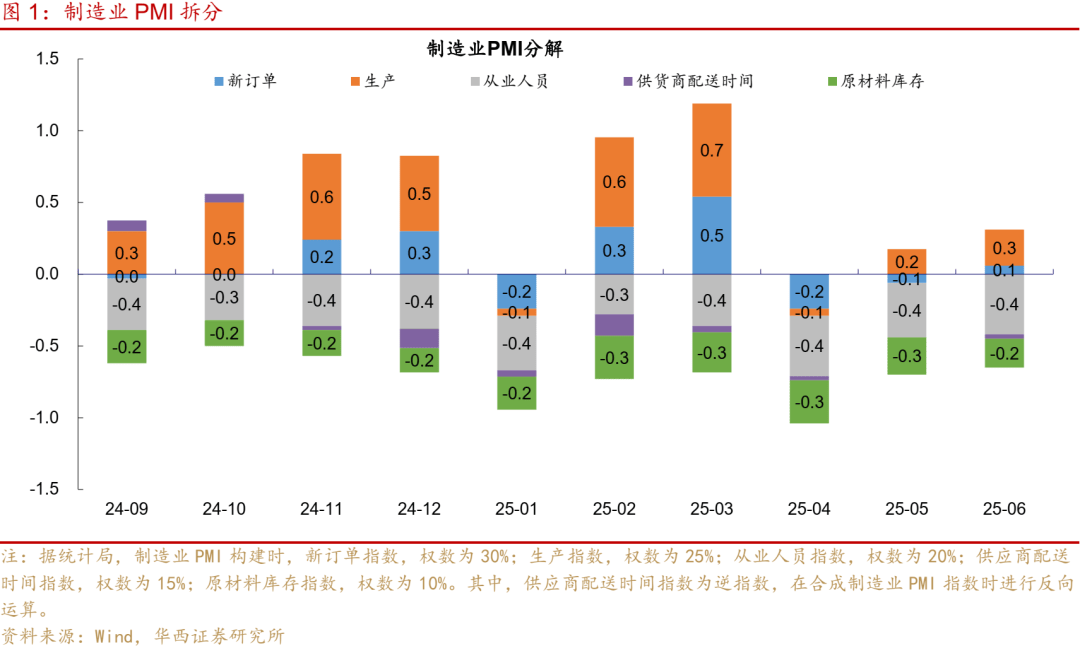
2025 年 08 月 01 日 极端天气与反内卷致量价反向波动 分析师:罗云峰 S1050524060001 luoyf2@cfsc.com.cn 分析师:杨斐然 S1050524070001 yangfr@cfsc.com.cn 事件 受制造业进入传统生产淡季,部分地区高温、暴雨洪涝灾害 等因素影响,7 月制造业 PMI 为 49.3,环比下降 0.4,连续 4 个月低于枯荣线,7 月为 4 个月以来最低;非制造业 PMI 为 50.1,环比下跌 0.4;综合 PMI 产出指数为 50.2,环比下降 0.5 个百分点。 7 月份中国战略性新兴产业 EPMI 为 46.8,比上月回落 1.1 个 百分点。服务业健康医疗服务业、新材料产业表现最好。 投资要点 ▌ 制造业:极端天气影响生产 极端天气与反内卷共同作用下,供需两端边际回调,生产指 数扩张幅度下降 0.5 至 50.5,新订单指数大幅下降 0.8,重 回荣枯线以下(49.4),其中新出口订单指数下降 0.6 至 47.1,一定程度受前期抢出口的影响,内需下滑或有 618 的 影响。企业生产经营活动更趋谨慎:进口指标保持 47.8;原 材料库存下降 0 ...
7月PMI ,淡季偏淡
Sou Hu Cai Jing· 2025-08-01 03:35
7月31日, 统计局发布7月PMI。制造业PMI 49.3%,预期49.7%,前值49.7%。非制造业PMI 50.1%,前值50.5%。关注以下几个方面: 第一,制造业生产和新订单均回落。7月制造业新订单环比下降0.8个百分点至49.4%,生产回落0.5个百分点至50.5%,分别拖累制造业PMI下滑0.24、0.13 个百分点,是7月制造业PMI下滑的主要拖累因素。对比往年同期降幅,2016-2024年(剔除2020/2022)新订单和生产的平均降幅分别为0.14、0.37个百分 点。由于PMI在数据处理过程中已剔除季节性,今年7月相对更弱的表现,指向制造业放缓可能受到常规季节性因素之外的影响,一方面是6月对美出口修 复带来的环比高基数,另一方面是部分地区高温、暴雨洪涝灾害的规模可能超出往年同期。 第二,外需也回落。7月制造业新出口订单回落0.4个百分点至47.1%(6月反弹0.2个百分点),略低于上半年平均值47.3。结合韩国出口旬度数据来看,7 月前20天出口同比-2.2%,这说明6月抢出口可能未在7月延续。7月9日是对等关税截止时点,尽管后来推迟到8月1日,但企业可能已经尽量安排在7月9日 之前出口。 ...
兼评国家生育补贴和7月PMI数据:PMI供需均放缓,“反内卷”提振价格
KAIYUAN SECURITIES· 2025-08-01 02:42
Group 1: National Fertility Subsidy - The national fertility subsidy covers a wider range, with a total subsidy of 10,800 CNY per newborn over three years, compared to a median of 6,600 CNY and an average of 8,700 CNY for local subsidies[3][16] - The first-year budget for the national fertility subsidy is approximately 100 billion CNY, expected to promote the birth of about 330,000 newborns[4][16] - The short-term leverage effect of the subsidy is estimated at 0.9 times, potentially increasing to about 1.4 times in the medium to long term, with a GDP increase of 926 billion CNY in 2025[4][19] Group 2: Manufacturing Sector - The manufacturing PMI for July is reported at 49.3%, down 0.4 percentage points from the previous month, indicating a decline in manufacturing activity[5][13] - The production PMI decreased by 0.5 percentage points to 50.5%, while new orders, new export orders, and imports fell to 49.4%, 47.1%, and 44.7% respectively[5][22] - The "anti-involution" trend is expected to boost commodity prices, with July PPI projected to improve slightly to -3.0% year-on-year[5][29] Group 3: Non-Manufacturing Sector - The construction PMI fell by 2.2 percentage points to 50.6%, indicating a potential continuation of the slowdown in infrastructure investment[6][35] - The service sector remains relatively stable, with a service PMI of 50.0%, down 0.1 percentage points, and new orders declining to 46.3%[6][42] - Infrastructure investment may be affected by high base effects in Q3 and Q4, requiring policy measures to mitigate the impact[6][35] Group 4: Risks and Economic Outlook - Risks include unexpected policy changes and a potential recession in the U.S. economy[7][45] - The overall economic impact of the fertility subsidy includes direct boosts to consumer spending and indirect effects on child-rearing and housing demand[4][18]
经济总体产出保持扩张
Jing Ji Ri Bao· 2025-08-01 01:47
Economic Overview - The overall economic output in China continues to expand, despite fluctuations due to extreme weather conditions and a weak demand side [2][4]. Manufacturing Sector - In July, the Manufacturing Purchasing Managers' Index (PMI) dropped to 49.3%, a decrease of 0.4 percentage points from the previous month, indicating a contraction in manufacturing activity [2]. - The new orders index for manufacturing was at 49.4%, down 0.8 percentage points, while the production index remained at 50.5%, indicating continued expansion for three consecutive months [2]. - High-tech manufacturing and equipment manufacturing PMIs were 50.6% and 50.3%, respectively, both above the critical point, showing sustained growth in these sectors [2]. Price Trends - The purchasing price index for major raw materials rose to 51.5%, marking the first increase above the critical point since March, while the factory price index was at 48.3% [3]. - Industries such as petroleum, coal, and black metal processing saw significant improvements in their purchasing and factory price indices [3]. Business Activity in Non-Manufacturing Sector - The non-manufacturing business activity index was at 50.1%, down 0.4 percentage points, but still above the critical point [5]. - The construction sector experienced a slowdown, with its business activity index at 50.6%, a decrease of 2.2 percentage points [5]. - Service sector activity remained stable, with a business activity index of 50%, slightly down by 0.1 percentage points [5]. Future Outlook - Manufacturing enterprises maintain a positive outlook, with the production and business activity expectation index rising to 52.6%, an increase of 0.6 percentage points from the previous month [4]. - Non-manufacturing enterprises also show stable optimism, with a business activity expectation index of 55.8%, up 0.2 percentage points [5].