能源

Search documents
宏观金融类:文字早评2025/12/01-20251201
Wu Kuang Qi Huo· 2025-12-01 01:47
1. Report's Industry Investment Rating No relevant content provided. 2. Core Viewpoints of the Report - In the short - term, the market rotation has accelerated, and the risk appetite has decreased. However, policy support for the capital market remains unchanged, and technology and growth are still the main market trends. Index investment should focus on buying on dips in the medium - to - long - term [4]. - In the fourth quarter, the bond market supply - demand pattern may improve, but it will maintain a volatile trend under the background of weak domestic demand recovery and improved inflation expectations. Attention should be paid to the impact of stock - bond linkage and liquidity [7]. - For most commodities, the market situation is complex. Some are expected to strengthen due to factors such as supply disturbances and cost support, while others may face pressure due to factors such as over - supply and weak demand. It is necessary to pay attention to macro - events and industry fundamentals [41][42] 3. Summary by Directory 3.1 Macro - financial Category 3.1.1 Stock Index - **Market Information**: In November, the manufacturing PMI was 49.2%, and the non - manufacturing business activity index was 49.5%. The National Space Administration established the Commercial Space Department. The central bank continued to ban virtual currencies. Metal prices soared on Friday, with silver and copper hitting record highs [2]. - **Strategy Viewpoint**: The market rotation has accelerated, and the risk appetite has decreased. The policy support for the capital market remains unchanged, and the index should be bought on dips in the medium - to - long - term [4]. 3.1.2 Treasury Bonds - **Market Information**: On Friday, the main contracts of TL, T, TF, and TS had different changes. In November, the manufacturing PMI improved, and the non - manufacturing business activity index declined. Japan revised its bond issuance plan. The central bank conducted a 7 - day reverse repurchase operation on Friday, with a net withdrawal of funds [5]. - **Strategy Viewpoint**: In November, the manufacturing PMI data showed an overall improvement in manufacturing sentiment, but the service industry was weak. The social financing growth rate may remain weak at the end of the year. The bond market is expected to maintain a volatile trend in the fourth quarter, and attention should be paid to stock - bond linkage and liquidity [7]. 3.1.3 Precious Metals - **Market Information**: Shanghai gold and silver futures rose. COMEX gold and silver also had certain prices. Silver has entered the accelerated peak - hitting stage, and its technical trend conforms to the characteristics of previous second - stage rises. The current overseas position and inventory levels are not in a state of "delivery difficulties" [8]. - **Strategy Viewpoint**: The silver price is in an accelerated rise, and attention should be paid to the pressure level of 14,500 yuan/kg. If the price weakens during the day, profits should be taken in time. It is risky to open new long positions or short at high prices. Shanghai gold is at the end of a triangular convergence breakthrough pattern, and it is recommended to buy on dips [9]. 3.2 Non - ferrous Metals Category 3.2.1 Copper - **Market Information**: Concerns about smelting production cuts led copper prices to break through historical highs. LME copper inventory increased, and domestic futures exchange inventory decreased. The domestic spot import was at a loss, and the refined - scrap price difference widened [11]. - **Strategy Viewpoint**: Geopolitical factors still exist, but the market focuses on the Fed's interest rate meeting. The supply of copper raw materials is tight, and the expectation of smelting production cuts drives copper prices to rise. The downstream operating rate is stable and strong, so copper prices are expected to continue to strengthen [12]. 3.2.2 Aluminum - **Market Information**: Aluminum prices rebounded on Friday. The inventory of domestic and LME aluminum ingots continued to decline. The aluminum rod processing fee continued to decline, and the trading was average [13]. - **Strategy Viewpoint**: The inventory of domestic and LME aluminum ingots is at a relatively low level. Coupled with supply disturbances, stable downstream operating rates, and rising copper prices, the center of gravity of aluminum prices is expected to rise further [14]. 3.2.3 Zinc - **Market Information**: The Shanghai zinc index rose slightly. The LME zinc price fell. The domestic social zinc inventory decreased slightly, but the total inventory increased after considering the in - transit and factory inventories. The zinc import was at a loss [15]. - **Strategy Viewpoint**: The visible inventory of zinc ore has increased, but the zinc concentrate TC has continued to decline, and the zinc smelting profit is under pressure. The downstream operating rate has declined marginally. The current situation of the zinc industry is not in resonance with the strong macro - sentiment, so zinc prices are expected to fluctuate widely in the short - term [16]. 3.2.4 Lead - **Market Information**: The Shanghai lead index rose. The LME lead price also rose. The domestic social lead inventory decreased slightly. The refined - scrap price difference was at par [17]. - **Strategy Viewpoint**: The visible inventory of lead ore has increased, the primary smelting operating rate has declined, and the secondary smelting operating rate has continued to rise. The downstream battery enterprise operating rate has increased marginally, and the visible inventory of domestic lead ingots has decreased. In the Fed's interest - rate cut cycle, the sentiment of the non - ferrous metals industry is relatively positive, so lead prices are expected to be strong in the short - term [17]. 3.2.5 Nickel - **Market Information**: Nickel prices fluctuated narrowly on Friday. The spot price premiums of different brands were stable, and the nickel ore price was stable, while the nickel iron price continued to decline [18]. - **Strategy Viewpoint**: The oversupply pressure of nickel is still large, but with the stabilization of nickel iron prices and the warming of the macro - atmosphere, nickel prices may turn to a volatile trend in the short - term. Attention should be paid to the trends of nickel iron and ore prices [19]. 3.2.6 Tin - **Market Information**: The Shanghai tin main contract price rose. The inventory of the futures exchange increased, and the LME tin inventory also increased. The supply of tin concentrate has been slightly relieved, but the conflict in Congo (Kinshasa) has affected transportation. The demand in traditional fields is weak, but emerging fields provide long - term support. The social inventory has decreased [21]. - **Strategy Viewpoint**: Although the demand in the tin market is weak in the short - term, the supply disturbance is the decisive factor for short - term prices. Therefore, tin prices are likely to fluctuate strongly. It is recommended to wait and see [22]. 3.2.7 Lithium Carbonate - **Market Information**: The spot price of lithium carbonate decreased, while the futures price increased. The price of Australian lithium concentrate increased [23]. - **Strategy Viewpoint**: The improvement of fundamentals boosts the bullish sentiment, but there are differences in future demand expectations. The change of the mining permit of Jiaxiawo Mine is a short - term positive for the spot but a long - term negative for supply. It is recommended to wait and see or use options, and pay attention to the cell production schedule in the first quarter and the atmosphere of the equity market [23]. 3.2.8 Alumina - **Market Information**: The alumina index rose. The domestic spot price was at a premium to the futures. The overseas price fell, and the import window was opened. The futures inventory increased [24]. - **Strategy Viewpoint**: The overseas ore shipment will gradually recover, and the alumina smelting capacity is in an over - supply situation. However, the current price is close to the cost line of most manufacturers, and the expectation of production cuts has increased. It is recommended to wait and see in the short - term [26]. 3.2.9 Stainless Steel - **Market Information**: The stainless steel main contract price fell. The spot prices in different markets were stable or decreased. The raw material prices were stable, and the futures and social inventories decreased [27]. - **Strategy Viewpoint**: The steel mill production is at a high level, the demand has improved marginally, but the cost pressure has squeezed the profit, and the inventory pressure is still significant. The market lacks a clear upward momentum, so stainless steel prices are expected to fluctuate widely in the short - term [27]. 3.2.10 Cast Aluminum Alloy - **Market Information**: The price of cast aluminum alloy rebounded. The trading volume decreased slightly, and the inventory increased. The downstream demand was mainly for rigid needs [28]. - **Strategy Viewpoint**: The cost of cast aluminum alloy is relatively stable, and there are policy disturbances on the supply side. The demand is relatively average, so the price is expected to follow the trend of aluminum prices in the short - term [29]. 3.3 Black Building Materials Category 3.3.1 Steel - **Market Information**: The prices of rebar and hot - rolled coil futures rose. The spot prices in different regions were stable or increased [31]. - **Strategy Viewpoint**: The commodity market adjusted on Friday, and the prices of steel products fluctuated. The supply and demand of rebar decreased, and the inventory continued to decline. The output of hot - rolled coil increased, and the inventory decreased slightly. The anti - dumping tax imposed by South Korea on Chinese steel will affect exports. The demand for steel has entered the off - season, so attention should be paid to the actual progress of production cuts and important meetings [32]. 3.3.2 Iron Ore - **Market Information**: The iron ore main contract price fell. The spot price was at a premium to the futures, and the port inventory increased [33]. - **Strategy Viewpoint**: The overseas iron ore shipment decreased, the demand weakened, the number of blast furnace overhauls increased, and the steel mill profitability was at a low level. The overall inventory of iron ore is still high, but there are structural contradictions, and the spot has certain support. Iron ore prices are expected to operate within an oscillatory range [34]. 3.3.3 Glass and Soda Ash - **Market Information**: The glass main contract price rose, the inventory decreased, and the trading volume of long and short positions decreased. The soda ash main contract price rose slightly, the inventory decreased, and the trading volume of long and short positions also decreased [36][38]. - **Strategy Viewpoint**: For glass, the supply has shrunk, the market sentiment has improved briefly, but the overall trading is still light, and the price is expected to fluctuate widely. It is recommended to try shorting at high prices. For soda ash, the industry operating rate has increased slightly, the inventory has decreased slightly, the price is stable, but it is still recommended to be bearish in the short - term [37][38]. 3.3.4 Manganese Silicon and Ferrosilicon - **Market Information**: The manganese silicon main contract price fell slightly, and the ferrosilicon main contract price was flat. The prices of the two in the spot market were stable, and the spot was at a premium to the futures [39]. - **Strategy Viewpoint**: The market sentiment has improved. The black - building materials sector is still in a weak state, but there is no need to be overly pessimistic. For manganese silicon, the fundamentals are not ideal, and there are no major contradictions. For ferrosilicon, the supply - demand fundamentals have no obvious contradictions, and the operability is low [41][42]. 3.3.5 Industrial Silicon and Polysilicon - **Industrial Silicon** - **Market Information**: The industrial silicon futures main contract price rose slightly. The spot price was stable, and the trading volume decreased [43]. - **Strategy Viewpoint**: The short - term trading volume of industrial silicon has decreased, and the trend has become dull. The production has continued to decline, the demand from the polysilicon sector has weakened, and the overall supply - demand pattern is weak. The price is easily affected by the sentiment of other new - energy varieties [44]. - **Polysilicon** - **Market Information**: The polysilicon futures main contract price rose. The spot prices of different types were stable, and the futures was at a premium to the spot [45][46]. - **Strategy Viewpoint**: The production of polysilicon is expected to decline in December, the downstream silicon wafer production is expected to decrease, and the inventory pressure is difficult to relieve. The spot price is stable, and there are risks in the near - month contract due to delivery games. Attention should be paid to the final implementation of the platform company [47]. 3.4 Energy and Chemicals Category 3.4.1 Rubber - **Market Information**: The rubber price rebounded. The flood in the Thai rubber - producing area receded, and the exchange inventory was low. The tire factory operating rate was weak, and the inventory increased [49][50]. - **Strategy Viewpoint**: It is recommended to adopt a neutral strategy, wait and see, or conduct short - term trading. A partial position can be established for the hedging strategy of buying RU2601 and selling RU2609 [52]. 3.4.2 Crude Oil - **Market Information**: The INE crude oil futures price rose, and the prices of related refined oil products also rose. The gasoline and diesel inventories in Singapore decreased, while the fuel oil inventory increased [53]. - **Strategy Viewpoint**: Although the geopolitical premium has disappeared, the OPEC supply has not increased significantly. It is not advisable to be overly bearish on oil prices in the short - term. A range - trading strategy is maintained, and it is recommended to wait and see in the short - term [54]. 3.4.3 Methanol - **Market Information**: The methanol spot and futures prices rose, the basis was negative, and the 1 - 5 spread increased [55]. - **Strategy Viewpoint**: The potential positive factors of Iranian plant shutdowns have been realized, the market has stopped falling and stabilized, and the market expectation has changed. The supply is expected to remain high, and the market is expected to turn to an oscillatory adjustment after the positive factors are realized. It is recommended to wait and see on a single - side trading and pay attention to the positive spread arbitrage opportunity [55]. 3.4.4 Urea - **Market Information**: The urea spot and futures prices rose, the basis was negative, and the 1 - 5 spread was negative [56]. - **Strategy Viewpoint**: The urea price is expected to gradually emerge from the bottom range. The supply is at a relatively high level, the demand has improved, and the inventory has decreased. The price has support from export policies and costs, so it is recommended to consider buying at low prices [57]. 3.4.5 Pure Benzene and Styrene - **Market Information**: The pure benzene spot and futures prices were stable, the basis decreased. The styrene spot price fell, the futures price rose, and the basis weakened [58]. - **Strategy Viewpoint**: The non - integrated profit of styrene is neutral to low, and the valuation has a large upward - repair space. The supply of pure benzene is still wide, the styrene operating rate is rising, and the inventory is accumulating. When the inventory reversal point occurs, the non - integrated profit of styrene can be long [59]. 3.4.6 PVC - **Market Information**: The PVC futures price rose, the spot price rose, the basis was negative, and the 1 - 5 spread was negative. The production cost increased, the operating rate increased, and the inventory increased [60]. - **Strategy Viewpoint**: The enterprise profit is at a low level, the supply is high, the demand is weak, and the export cannot digest the excess capacity. It is recommended to short at high prices in the medium - term [61][62]. 3.4.7 Ethylene Glycol - **Market Information**: The ethylene glycol futures price rose, the spot price fell, the basis decreased, and the 1 - 5 spread decreased. The supply load increased, the downstream load increased slightly, and the port inventory was stable [63]. - **Strategy Viewpoint**: The domestic supply is expected to decrease in December, the import volume will decrease slightly, and the port inventory accumulation may slow down. In the medium - term, the supply - demand pattern is still weak, and it is recommended to short at high prices [64]. 3.4.8 PTA - **Market Information**: The PTA futures price rose, the spot price rose, the basis was negative, and the 1 - 5 spread was negative. The PTA operating rate increased, the downstream load increased slightly, and the inventory decreased [65]. - **Strategy Viewpoint**: The unexpected maintenance of PTA is expected to decrease. The downstream polyester fiber inventory and profit pressure are low, but the bottle - chip load is difficult to increase. The PTA processing fee has limited upward space, and the PX has a risk of a slight valuation correction [66]. 3.4.9 p - Xylene - **Market Information**: The p - xylene futures price rose, the spot price rose, the basis was negative, and the 1 - 3 spread was negative. The p - xylene operating rate decreased, the downstream PTA operating rate increased, the import volume increased, and the inventory increased [67]. - **Strategy Viewpoint**: The p - xylene load is high, the downstream PTA operating rate is low, and the PX inventory is expected to accumulate slightly in November. The valuation is at a neutral level, and there is a risk of a slight valuation correction [68]. 3.4.10 Polyethylene (PE) - **Market Information**: The PE futures price rose, the spot price was stable, the basis weakened, the upstream operating rate decreased slightly, the inventory decreased, and the downstream operating rate increased slightly [69]. - **Strategy Viewpoint**: The OPEC+ plan to suspend production growth may support oil prices. The PE valuation has limited downward space, but the high number of warehouse receipts suppresses the price. The supply is limited, the inventory is decreasing, and it is recommended to short the LL1 - 5 spread at high prices
能源化工期权:能源化工期权策略早报-20251201
Wu Kuang Qi Huo· 2025-12-01 01:42
1. Report Industry Investment Rating - Not provided in the given content 2. Core Viewpoints of the Report - The energy and chemical sector is mainly divided into energy, alcohols, polyolefins, rubber, polyesters, alkalis, and others. For each sector, options strategies and suggestions are provided for selected varieties. Each option variety's strategy report is compiled based on underlying market analysis, option factor research, and option strategy suggestions [9] 3. Summary by Relevant Catalogs 3.1 Futures Market Overview - The latest prices, price changes, price change percentages, trading volumes, volume changes, open interests, and open interest changes of various energy and chemical futures contracts are presented, including crude oil, liquefied petroleum gas (LPG), methanol, ethylene glycol, etc. [4] 3.2 Option Factors - Volume and Open Interest PCR - Volume and open interest PCR data for different option varieties are provided, along with their changes. These factors are used to describe the strength of the underlying option market and the turning points of the market [5] 3.3 Option Factors - Pressure and Support Levels - Pressure and support levels, as well as the maximum open interests of call and put options, are presented for each option variety, which are determined from the strike prices of the maximum open interests of call and put options [6] 3.4 Option Factors - Implied Volatility - Implied volatility data, including at-the-money implied volatility, weighted implied volatility, and its changes, are provided for each option variety. The weighted implied volatility is calculated using trading volume-weighted average [7] 3.5 Option Strategies and Suggestions 3.5.1 Energy Options - Crude Oil - **Underlying Market Analysis**: The demand from US refineries has stabilized and rebounded. Shale oil production has slightly declined during the recent oil price drop. OPEC's short-term supply remains flat. The market has shown a complex price trend from August to November [8] - **Option Factor Research**: The implied volatility of crude oil options fluctuates above the average level. The open interest PCR is below 0.80, indicating a weak market. The pressure level is 540, and the support level is 430 [8] - **Option Strategy Suggestions**: Directional strategy - Construct a bear spread portfolio of put options; Volatility strategy - Construct a short position combination of call and put options; Spot hedging strategy - Construct a long collar strategy [8] 3.5.2 Energy Options - LPG - **Underlying Market Analysis**: US propane inventory is starting to decline but remains at a historical high. The cost of crude oil is affected by supply surplus and geopolitical issues. LPG has shown a market trend of oversold rebound and consolidation from September to November [10] - **Option Factor Research**: The implied volatility of LPG options has significantly declined to near the lower average level. The open interest PCR is around 0.80, indicating a weak market. The pressure level is 4500, and the support level is 4200 [10] - **Option Strategy Suggestions**: Directional strategy - None; Volatility strategy - Construct a long position combination of call and put options; Spot hedging strategy - Construct a long collar strategy [10] 3.5.3 Alcohols Options - Methanol - **Underlying Market Analysis**: Port inventory has decreased, and enterprise inventory is at a relatively low level. Methanol has shown a market trend of oversold rebound from August to November [10] - **Option Factor Research**: The implied volatility of methanol options fluctuates around the historical average level. The open interest PCR is below 0.60, indicating a weak and volatile market. The pressure level is 2300, and the support level is 2000 [10] - **Option Strategy Suggestions**: Directional strategy - Construct a bear spread portfolio of put options; Volatility strategy - Construct a short position combination of call and put options; Spot hedging strategy - Construct a long collar strategy [10] 3.5.4 Alcohols Options - Ethylene Glycol - **Underlying Market Analysis**: Port inventory is expected to increase at a slower rate, and the supply - demand balance has improved. Ethylene glycol has shown a weak market trend from August to November [11] - **Option Factor Research**: The implied volatility of ethylene glycol options fluctuates below the average level. The open interest PCR is below 0.70, indicating strong short - selling power. The pressure level is 4500, and the support level is 3800 [11] - **Option Strategy Suggestions**: Directional strategy - Construct a bear spread portfolio of put options; Volatility strategy - Construct a short - volatility strategy; Spot hedging strategy - Hold a long position in the spot + buy a put option + sell an out - of - the - money call option [11] 3.5.5 Polyolefins Options - Polypropylene - **Underlying Market Analysis**: PE and PP production enterprise and trader inventories have decreased. Polypropylene has shown a weak market trend from August to November [11] - **Option Factor Research**: The implied volatility of polypropylene options has declined to near the average level. The open interest PCR is around 0.70, indicating a weak market. The pressure level is 7000, and the support level is 6300 [11] - **Option Strategy Suggestions**: Directional strategy - Construct a bear spread portfolio of put options; Volatility strategy - None; Spot hedging strategy - Hold a long position in the spot + buy an at - the - money put option + sell an out - of - the - money call option [11] 3.5.6 Rubber Options - Rubber - **Underlying Market Analysis**: Rubber inventory is expected to decrease significantly in mid - January. Rubber has shown a weak and volatile market trend from August to November [12] - **Option Factor Research**: The implied volatility of rubber options has decreased to near the lower average level after a rapid increase. The open interest PCR is below 0.60. The pressure level has significantly decreased to 16000, and the support level is 15000 [12] - **Option Strategy Suggestions**: Directional strategy - None; Volatility strategy - Construct a neutral combination of call and put options; Spot hedging strategy - None [12] 3.5.7 Polyesters Options - PTA - **Underlying Market Analysis**: PTA inventory has decreased, and it is expected to enter a de - stocking phase. PTA has shown a market trend of rebound from August to November [12] - **Option Factor Research**: The implied volatility of PTA options fluctuates above the average level. The open interest PCR is around 0.70, indicating a volatile market. The pressure level is 4700, and the support level is 4300 [12] - **Option Strategy Suggestions**: Directional strategy - None; Volatility strategy - Construct a neutral combination of call and put options; Spot hedging strategy - None [12] 3.5.8 Alkaline Chemicals Options - Caustic Soda - **Underlying Market Analysis**: Supply is sufficient, and the downstream alumina market is in a stalemate. Caustic soda has shown a weak and bearish market trend from August to November [13] - **Option Factor Research**: The implied volatility of caustic soda options fluctuates at a relatively high level. The open interest PCR is below 0.60, indicating a weak market. The pressure level is 3000, and the support level is 2200 [13] - **Option Strategy Suggestions**: Directional strategy - Construct a bear spread portfolio; Volatility strategy - None; Spot hedging strategy - Hold a long position in the spot + buy a put option + sell an out - of - the - money call option [13] 3.5.9 Alkaline Chemicals Options - Soda Ash - **Underlying Market Analysis**: Soda ash inventory has decreased. Soda ash has shown a low - level and volatile market trend from August to November [13] - **Option Factor Research**: The implied volatility of soda ash options fluctuates at a relatively high historical level. The open interest PCR is below 0.60, indicating strong short - selling pressure. The pressure level is 1860, and the support level is 1100 [13] - **Option Strategy Suggestions**: Directional strategy - Construct a bear spread portfolio; Volatility strategy - Construct a short - volatility combination; Spot hedging strategy - Construct a long collar strategy [13] 3.5.10 Other Energy and Chemicals Options - Urea - **Underlying Market Analysis**: Enterprise inventory has decreased, and port inventory is expected to increase. Urea has shown a market trend of low - level consolidation and rebound from August to November [14] - **Option Factor Research**: The implied volatility of urea options fluctuates slightly around the historical average level. The open interest PCR is below 0.60, indicating strong short - selling pressure. The pressure level is 1800, and the support level is 1600 [14] - **Option Strategy Suggestions**: Directional strategy - None; Volatility strategy - Construct a long - biased combination of call and put options; Spot hedging strategy - Hold a long position in the spot + buy an at - the - money put option + sell an out - of - the - money call option [14]
核心资产,迎增量资金!净流入超25亿元
Zhong Guo Zheng Quan Bao· 2025-11-30 23:42
Group 1 - The technology sector, led by computing power, continues to show strong momentum, with several AI-themed ETFs rising over 8% last week [1][2] - Major stocks in the communication and AI sectors, such as Zhongji Xuchuang and ZTE, saw price increases of over 10% [2] - The recent market fluctuations have led to increased trading activity in broad-based ETFs, with the A500 ETF recording a total transaction volume exceeding 130 billion yuan [5][6] Group 2 - Core assets have attracted incremental capital, with ETFs tracking the SSE 50 index seeing a net inflow of over 2.5 billion yuan last week [7] - The Hang Seng Dividend Low Volatility ETF reached a new historical high in size, surpassing 6 billion yuan, with a net inflow of over 700 million yuan [7] - Several biotechnology-themed ETFs in the US have also seen their premium rates rise above 5%, marking historical highs since their inception [2] Group 3 - The trading volume for various ETFs tracking major indices was significant, with the A500 ETF leading at approximately 133.3 billion yuan, followed by the Hang Seng Technology ETF at around 73.1 billion yuan [6] - The recent adjustments to the sample indices for the CSI 300 and other indices are set to take effect on December 12, with notable changes in constituent stocks [9] - New ETFs tracking the CSI Innovation and Entrepreneurship AI Index have been launched, providing fresh investment opportunities in the tech sector [9]


天壕能源:募投项目结项并将节余募集资金永久补充流动资金
Zheng Quan Ri Bao Wang· 2025-11-30 14:12
证券日报网讯11月30日晚间,天壕能源(300332)发布公告称,公司募集资金投资项目"兴县康宁镇刘 家庄分输站建设工程""神安线兴县连接线建设工程"结项,并将预计节余募集资金6,820.71万元(含利息 收入,具体金额以资金转出当日银行结算余额为准)永久补充流动资金,用于公司日常经营活动。 ...

美股市场速览:格快速修复,业绩预期平稳
Guoxin Securities· 2025-11-30 11:34
Market Performance - The S&P 500 index closed at 6,849, reflecting a weekly increase of 3.7% and a year-to-date increase of 16.4%[6] - The Nasdaq 100 index reached 25,435, with a weekly rise of 4.9% and a year-to-date increase of 21.0%[6] - The Dow Jones Industrial Average increased by 3.2% this week, with a year-to-date growth of 12.2%[6] Sector Analysis - The automotive and auto parts sector saw a significant weekly increase of 9.3% and a year-to-date increase of 9.9%[9] - The information technology sector reported a weekly rise of 4.6% and a year-to-date increase of 32.8%[9] - The healthcare sector experienced a weekly increase of 1.9% and a year-to-date increase of 21.0%[9] Fund Flows - The energy sector recorded a net inflow of $48 million this week, with a total of $572 million over the past 52 weeks[11] - The materials sector faced a net outflow of $290 million this week, totaling a negative $3.344 billion over the past 52 weeks[11] - The financial sector had a net inflow of $2.106 billion this week, with a total outflow of $6.723 billion over the past 52 weeks[11] Earnings Forecast - The overall EPS adjustment for the energy sector was 0.3% this week, with a year-to-date adjustment of -7.4%[14] - The materials sector saw an EPS adjustment of 0.6% this week, with a year-to-date adjustment of 4.9%[14] - The information technology sector's EPS adjustment was 0.6% this week, with a year-to-date adjustment of 28.0%[14]




中科曙光等四家公司突发重大资产重组公告
Sou Hu Cai Jing· 2025-11-30 09:43
Core Viewpoint - The A-share capital market is entering a phase of "scale and high-quality" mergers and acquisitions (M&A) in 2025, with significant restructuring activities from major companies like Zhongke Shuguang, China Shipbuilding, China Shenhua, and Guotai Junan, as evidenced by official disclosures [1][3]. Group 1: Key Information on Company Restructuring - Zhongke Shuguang and Haiguang Information are undergoing a major restructuring through a stock swap to consolidate 100% of Zhongke Shuguang's shares, with the process initiated in May 2025 [3]. - China Shipbuilding has completed a stock swap to absorb China Shipbuilding Industry Corporation, creating a comprehensive platform for shipbuilding and marine engineering [4]. - China Shenhua is integrating 13 energy companies using a "packaged injection" model to enhance its energy supply chain [3]. - Guotai Junan and Haitong Securities are merging to consolidate their brokerage, investment banking, and asset management resources, awaiting regulatory approval [4]. Group 2: Policy Support for Restructuring - The successful advancement of these major restructurings is supported by new policies from the China Securities Regulatory Commission (CSRC) that simplify processes and enhance efficiency [5]. - A new simplified review process allows eligible restructuring transactions to bypass lengthy reviews, with registration results provided within five working days [5]. - The optimization of lock-up period rules increases market liquidity, allowing for shorter lock-up periods for controlling shareholders [6]. - Companies can now register for phased payments, reducing financial pressure during restructuring [6]. Group 3: Industry Logic Behind Restructuring - The restructuring efforts are focused on "industrial synergy" rather than merely increasing market capitalization [8]. - The merger between Zhongke Shuguang and Haiguang Information aims to create a complete industry chain from chip design to data center operations, enhancing competitiveness [8]. - The integration of China Shipbuilding and China Shipbuilding Industry Corporation is intended to eliminate competition and concentrate resources on high-end ship manufacturing [9]. - China Shenhua's asset injection is designed to optimize the energy supply chain and improve resource utilization efficiency, aligning with carbon neutrality goals [10]. - Since 2025, over 57% of restructuring activities have involved horizontal and vertical integrations, reflecting a core demand for resource collaboration to strengthen competitiveness [10].

乌克兰腐败丑闻发酵 乌总统办公室主任辞职
Zhong Guo Xin Wen Wang· 2025-11-29 13:43
报道称,NABU和SAPO正牵头调查一起能源行业的"重大丑闻",多名乌高官牵涉其中,涉及洗 钱、非法敛财等不法行为,已查明洗钱金额近1亿美元。调查人员怀疑主谋是铁木尔·明季奇,他是泽连 斯基步入政坛前的商业伙伴,现已逃离乌克兰。11月19日,乌现任司法部长和能源部长因这起丑闻被乌 克兰最高拉达(议会)免职。 泽连斯基当晚在例行视频讲话中表示,不希望外界质疑乌克兰,希望消除任何谣言和猜测。叶尔马 克已递交辞呈,总统办公室将重组。泽连斯基说,29日,他将与可能接替这一职位的人选进行磋商。 在讲话中,泽连斯基感谢叶尔马克在担任谈判代表团团长期间准确地阐述乌方立场,并始终保 持"爱国"立场。 综合美联社、路透社等媒体报道,28日早些时候,乌克兰国家反腐败局(NABU)和反腐败专门检察 官办公室(SAPO)搜查了叶尔马克的住所,暂未公布搜查结果。叶尔马克当天在社交媒体上发文证实此 事,并表示自己正在"全力配合调查"。 据路透社报道,叶尔马克没有被列为嫌疑人,但乌在野党议员和一些执政党成员呼吁泽连斯基解职 叶尔马克。 中新社北京11月29日电 基辅消息:乌克兰总统泽连斯基当地时间28日表示,乌谈判代表团团长、 总统办公室 ...
【UNFX本周总结】降息时间表被重新定价 就业隐忧成为资产分化的推力源头
Sou Hu Cai Jing· 2025-11-29 03:38
Group 1: Federal Reserve and Interest Rates - The market's expectation for a 25 basis point rate cut in December has risen to approximately 82.8%-87%, marking one of the strongest bets for a rate cut in this cycle [2] - The dovish stance of potential Federal Reserve chair candidate Kevin Hassett has further reinforced market pricing for future rate cuts, putting pressure on the US dollar [2][8] Group 2: Currency Market - The US dollar index has been on a downward trend, expected to record its weakest weekly performance since July [3] - The euro reached a one-and-a-half-week high against the dollar, while the dollar weakened slightly against the yen [3] Group 3: Gold Market - Gold prices remained strong, reaching up to $4,180, supported by interest rate expectations, increased safe-haven demand, and ongoing central bank purchases [4] - Goldman Sachs predicts that gold prices could exceed $4,900 per ounce by 2026, while UBS has raised its target to $4,500 per ounce [4] Group 4: Stock Market - Despite rising signals of layoffs and increasing pressures on the real economy, the US stock market remains resilient [5] - Several investment banks have raised their 2026 S&P 500 index targets to a range of 7,500-8,000 [5] Group 5: Employment and Layoff Signals - The number of corporate layoff announcements and WARN submissions tracked by Goldman Sachs continues to rise, contrasting with official initial jobless claims data [9] - If signals from the private sector translate into official data, it could significantly impact market perceptions of policy windows and economic outlook [9] Group 6: Market Dynamics - The market logic for the week can be summarized as "weak dollar + strong gold + resilient US stocks + pressured employment outlook" [10] - Structural differentiation remains a core focus for investors in the coming weeks, with asset performance driven by easing expectations and technology earnings [10]
芯片巨头,突然暴涨
Zhong Guo Ji Jin Bao· 2025-11-29 00:17
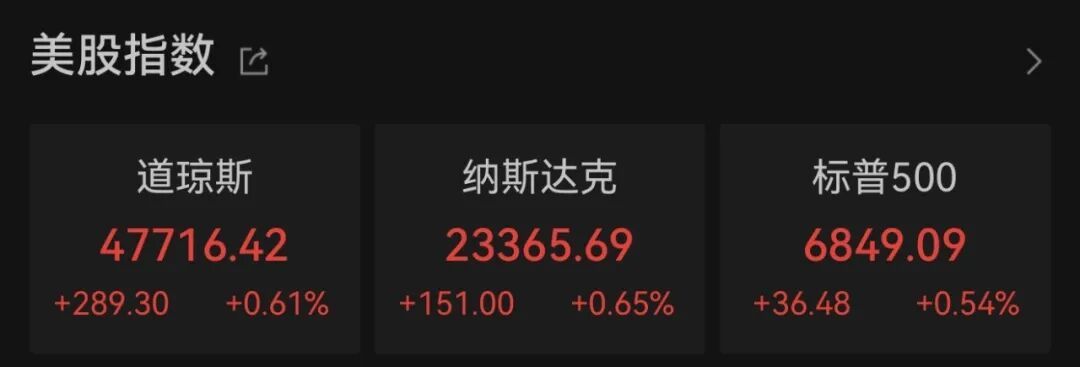
Market Performance - Major U.S. stock indices experienced significant gains, with the Dow Jones up 289.30 points (0.61%) closing at 47,716.42, the Nasdaq rising 151.00 points (0.65%) to 23,365.69, and the S&P 500 increasing by 36.48 points (0.54%) to 6,849.09 [2] - For the week, the Dow Jones saw a cumulative increase of 3.18%, the S&P 500 rose by 3.73%, and the Nasdaq gained 4.91% [4] Technology Sector - Intel's stock surged over 10%, marking its best single-day performance since September 18 [1][6] - Other major tech stocks also saw gains, including Facebook (up over 2%), Amazon (up over 1%), and Microsoft (up over 1%), while Nvidia experienced a decline of over 1% [6] - The Philadelphia Semiconductor Index rose by 1.82%, with notable increases in stocks like Micron Technology (up over 2%) and Qualcomm (up over 1%) [7][8] Commodities - WTI crude oil prices fell for the fourth consecutive month, closing at $58.55 per barrel, marking the longest monthly decline since March 2023 [10] - Silver and copper prices reached record highs, with silver rising 5.7% to $56.46 per ounce and copper climbing 2.5% to a peak of $11,210.50 per ton before settling up 2.2% [11]

2025世界智能制造大会举行 智能工厂重塑制造业
Zheng Quan Ri Bao Zhi Sheng· 2025-11-28 17:04
Core Insights - The 2025 World Intelligent Manufacturing Conference was held in Nanjing, where the Ministry of Industry and Information Technology and five other departments announced the first batch of 15 leading intelligent factories [1] - These 15 companies initiated the "Leading Action Plan" and showcased their innovative practices and experiences at the conference [1] Group 1: Leading Intelligent Factories - Weichai Power Co., Ltd. showcased its "AI Flywheel Intelligent Assembly Unit," demonstrating advanced automation capabilities with AI, enabling precise operations without human intervention [2] - The "Deep Sea No. 1" smart oilfield project by China National Offshore Oil Corporation features a full-process craft model system, creating a "subsea unmanned factory model" through five twin systems [2] - The characteristics of leading intelligent factories include "virtual-real integration" and "extreme flexibility" in production, allowing for proactive management and optimization [3] Group 2: Industry Trends and Future Directions - Nearly 90% of leading intelligent factories have achieved agile flexible manufacturing, allowing for stable production during product changes [3] - Over 30% of these factories utilize process modeling and intelligent control to optimize design and operations, pushing the boundaries of conventional manufacturing [3] - The integration of AI into manufacturing is driving a comprehensive transformation in smart products, production, and services, positioning leading intelligent factories as strategic points for global competition [4]