
建筑业

Search documents
2025年5月中国采购经理指数运行情况
Guo Jia Tong Ji Ju· 2025-05-31 01:30
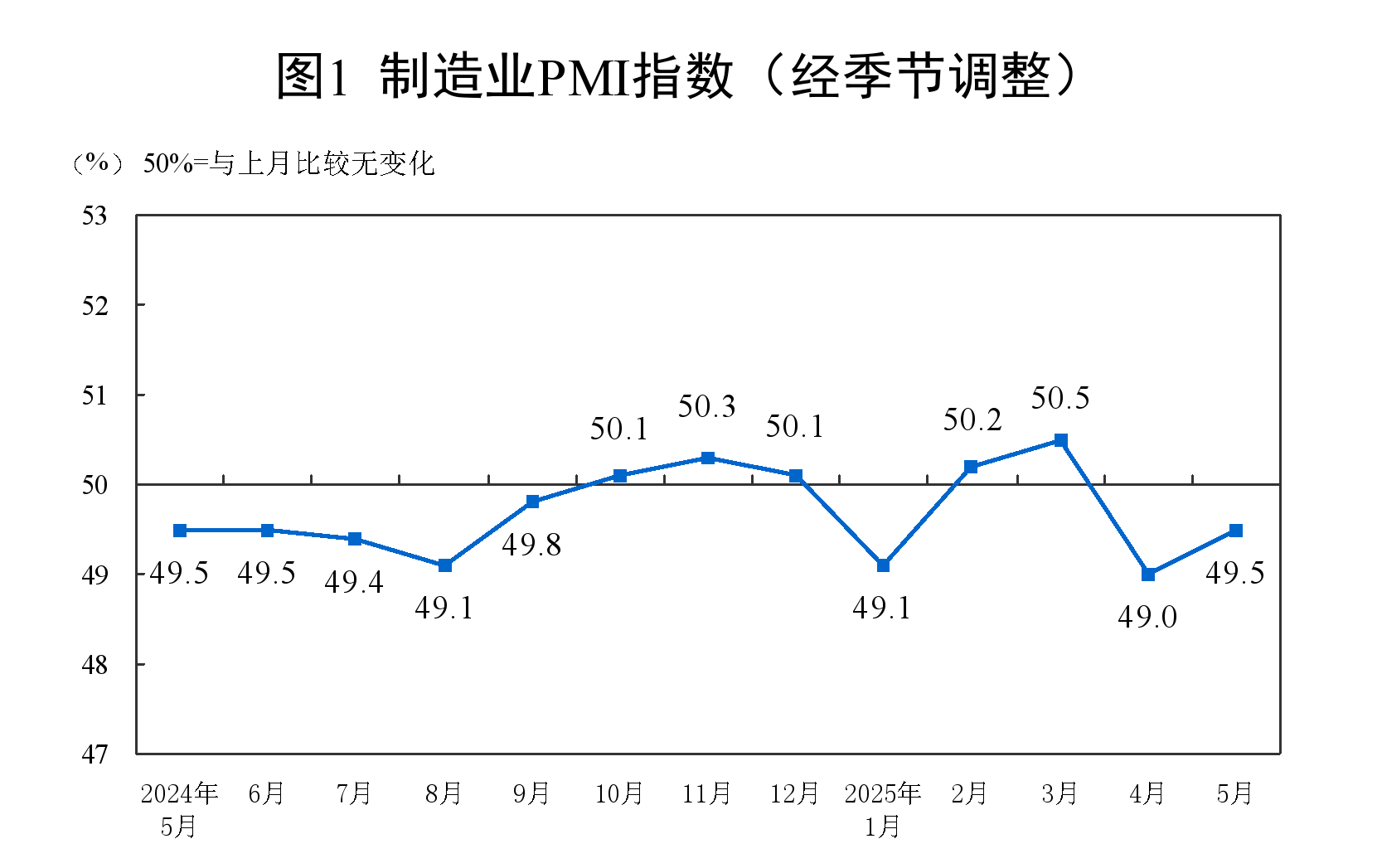
国家统计局服务业调查中心 中国物流与采购联合会 一、中国制造业采购经理指数运行情况 5月份,制造业采购经理指数(PMI)为49.5%,比上月上升0.5个百分点,制造业景气水平改善。 供应商配送时间指数为50.0%,比上月下降0.2个百分点,位于临界点,表明制造业原材料供应商交货时间与上月基本持平。 表1 中国制造业PMI及构成指数(经季节调整) 单位:% 从企业规模看,大型企业PMI为50.7%,比上月上升1.5个百分点,高于临界点;中型企业PMI为47.5%,比上月下降1.3个百分点,低于临界点;小型企业PMI 为49.3%,比上月上升0.6个百分点,低于临界点。 从分类指数看,在构成制造业PMI的5个分类指数中,生产指数高于临界点,供应商配送时间指数位于临界点,新订单指数、原材料库存指数和从业人员指 数均低于临界点。 生产指数为50.7%,比上月上升0.9个百分点,升至临界点以上,表明制造业企业生产活动有所加快。 新订单指数为49.8%,比上月上升0.6个百分点,表明制造业市场需求景气度回升。 原材料库存指数为47.4%,比上月上升0.4个百分点,低于临界点,表明制造业主要原材料库存量降幅有所收窄。 从业 ...

“颠簸之夏”已至,7万亿资金的机会来了!
Xin Lang Cai Jing· 2025-05-30 13:25
Group 1 - The ongoing review of Trump's tariff policy by the courts is causing market volatility, indicating a turbulent summer for Wall Street [1] - The comprehensive tariff policy announced on April 2 has significantly impacted the technology sector, although major stock indices have rebounded to near historical highs by the end of May [1] - The aggressive tariff policy has shaken the confidence of foreign investors holding trillions in U.S. Treasury bonds, leading to labor shortages in agriculture and construction due to immigration restrictions and government spending cuts [1] Group 2 - Despite companies stockpiling goods in the first quarter to cope with tariffs, weak shipping data in May shows continued caution in the business community [2] - The international trade court ruled multiple tariffs illegal, but the execution of this ruling has been temporarily stayed, leaving industries like pharmaceuticals and semiconductors still facing new tariff threats [2] - With the debt ceiling crisis approaching in August and inflation uncertainties, the Federal Reserve is maintaining a wait-and-see approach, suggesting that investors should seize opportunities in high-yielding Treasury bonds before rates decline [2]
热度拉满,广东正在上演……
2 1 Shi Ji Jing Ji Bao Dao· 2025-05-29 15:00
Core Viewpoint - Guangdong's "Hundred-Thousand-Million Project" aims to address regional development imbalances and contribute to China's modernization through a combination of industrial focus, reform, and community engagement [1][15]. Group 1: Project Overview - The "Hundred-Thousand-Million Project" is designed to transform urban and rural areas, leveraging historical trends and development rules [1][2]. - The project emphasizes the importance of county-level governance, with 122 counties identified as key points for regional development [2][3]. Group 2: Agricultural Development - Guangdong has seen a continuous increase in grain sowing area, total output, and yield, leading the nation in agricultural exports [4]. - The establishment of 22 national modern agricultural industrial parks and two trillion-yuan industrial clusters supports the agricultural transformation [7]. Group 3: Urbanization and Infrastructure - 37 counties are advancing new urbanization pilot projects, with 65 central towns aligning with small city development standards [8]. - Significant improvements in rural sanitation and infrastructure have been made, including a 97% coverage rate for sanitary toilets in rural areas [12]. Group 4: Economic Growth and Investment - Over 1,220 projects have been undertaken in the past two years, attracting more than 520 billion yuan in investments, transforming previously underdeveloped areas into vibrant economic zones [7]. - The income ratio between urban and rural areas has narrowed to 2.31:1, indicating a positive trend in income equality [8]. Group 5: Cultural and Environmental Initiatives - The project includes efforts to enhance rural aesthetics and cultural heritage, with initiatives like the "Yue Beautiful Countryside" design competition [13]. - Environmental improvements have been made, including the creation of new green spaces and ecological parks, contributing to a cleaner rural environment [12][14].
韩国央行行长李昌镛:经济增长预期下调主要受建筑业影响。
news flash· 2025-05-29 02:38
Core Insights - The Bank of Korea's Governor Lee Chang-yong indicated that the downward revision of economic growth expectations is primarily influenced by the construction industry [1] Group 1: Economic Growth Expectations - The economic growth forecast has been adjusted downward, reflecting challenges faced by the construction sector [1] - The construction industry is identified as a significant factor impacting overall economic performance [1]
云南连发10个文件支持就业,网络主播纳入职业培训补贴
Di Yi Cai Jing· 2025-05-28 13:17
Group 1 - Yunnan province is implementing various employment measures, including promoting return-to-hometown entrepreneurship, e-commerce startups, and leveraging特色产业 to create new employment channels and growth points [1][5] - The Yunnan provincial government has issued the "15 Measures" to support employment, focusing on enhancing industrial strength, enterprise growth, and employment stability [1][3] - The employment priority strategy aims to ensure at least 500,000 new urban jobs annually and maintain rural labor transfer employment at over 15 million [3][4] Group 2 - In Q1 2025, Yunnan's employment monitoring showed 365,000 employees in 901 surveyed companies, with the wholesale and retail sector experiencing the highest reduction in employment at 1.16% [2] - The "Unemployment Insurance Policy" allows eligible companies to apply for unemployment insurance refunds, with large enterprises receiving 30% and small to medium enterprises receiving 60% of their contributions back [3][4] - The province plans to conduct over 1 million training sessions annually, with at least 500,000 being subsidized vocational skills training [4] Group 3 - The "Return-to-Hometown Entrepreneurship Measures" encourage young graduates to engage in e-commerce, fostering the development of e-commerce industry clusters and promoting high-quality employment [5][6] - The measures focus on highland特色农业, cultural tourism, and cross-border e-commerce, while also emphasizing the training of e-commerce skills [6] - A project library for e-commerce startups will be established, providing financial support and mentorship for promising projects, with annual selections of exemplary returnee entrepreneurs [6]
东平县锚定“五年内GDP和税收收入翻番”目标,2024年同比增长5.8%
Qi Lu Wan Bao Wang· 2025-05-22 08:03
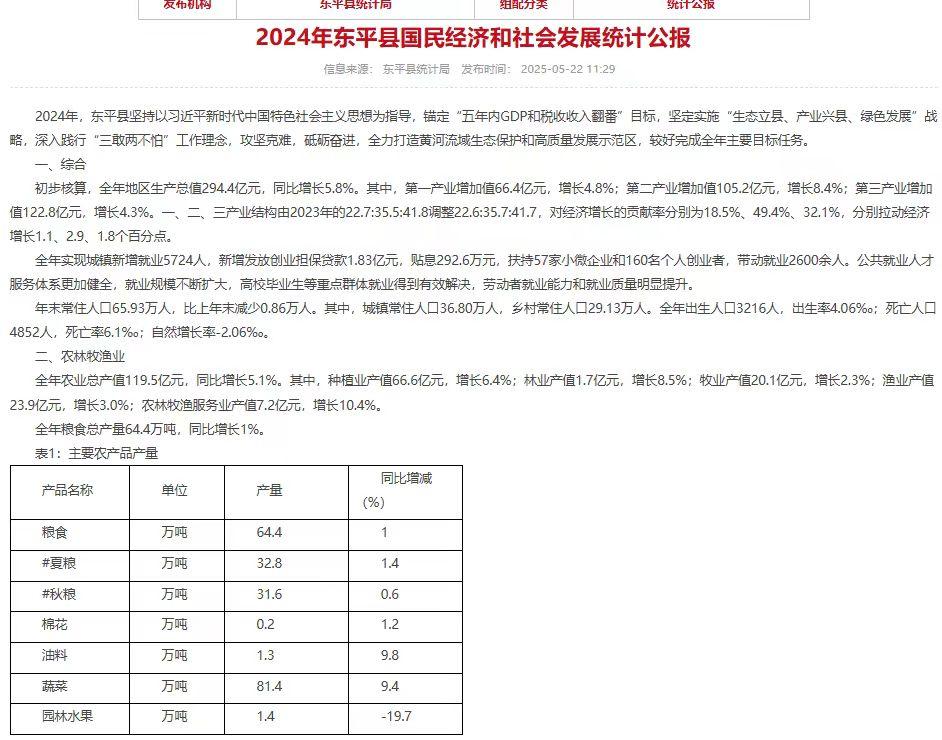
Economic Overview - The county aims to double its GDP and tax revenue within five years, focusing on ecological protection and high-quality development [1] - The preliminary estimate for the total GDP reached 29.44 billion yuan, with a year-on-year growth of 5.8% [1] Agricultural Sector - The total agricultural output value reached 11.95 billion yuan, with a year-on-year increase of 5.1% [2] - Total grain production was 644,000 tons, with summer grain at 328,000 tons and autumn grain at 316,000 tons, showing slight growth [2] - Agricultural mechanization has improved, with total power reaching 971,200 kilowatts and rural tap water coverage at 100% [2] Industrial Sector - The industrial economy showed steady progress, with the added value of industrial enterprises above designated size growing by 8.2% [2] - Notable growth in the pharmaceutical manufacturing and textile industries, with increases of 31.9% and 18.6% respectively [2] - Fixed asset investment grew by 7.3%, with first industry investment surging by 50.7% [2] Consumer Market - The total retail sales of social consumer goods reached 15.86 billion yuan, with a year-on-year growth of 7.2% [3] - The wholesale, retail, accommodation, and catering sectors all experienced growth [3] Foreign Trade and Investment - Total import and export value reached 1.206 billion yuan, with a significant year-on-year increase of 30.0% [3] - Actual foreign investment utilization was 3.698 million USD, growing by 81.1% [3] Tourism and Transportation - The county has a total road mileage of 3,037.7 kilometers, with a density of 226.2 kilometers per 100 square kilometers [3] - Tourist reception reached 13.524 million visitors, a year-on-year increase of 19.2%, with tourism revenue growing by 25.4% to 7.84 billion yuan [3] Social Development - Urban employment increased by 5,724 people, with entrepreneurial loans amounting to 183 million yuan [3] - The per capita disposable income for residents was 31,404 yuan, reflecting a growth of 5.6% [3] - Significant improvements in ecological protection, with water quality meeting Class III standards [3]
如何看待用电增速与经济增速温差
Jing Ji Ri Bao· 2025-05-21 22:41
通过剖析这种"背离",也给我们带来三重启示:其一,要理性看待电力消费弹性系数的波动,建立更立 体的经济监测指标体系;其二,需警惕部分地区为追求用电数据"匹配"GDP而放松能效约束,防止高耗 能项目回潮;其三,应加快构建新型电力系统,通过虚拟电厂、需求侧响应等手段,将波动性新能源与 柔性负荷高效匹配,为高质量发展提供更灵活的能源支撑。 即便剔除这两个"偶然因素",用电量增速仍与经济增速有较大差距,其中的缺口与用电结构有关。第二 产业用电量占比大但增速偏低,是导致全社会用电量增速低于经济增速的主要因素。一季度,工业和建 筑业用电量增长缓慢,对用电量增速低于经济增速的贡献较为明显。其中,房地产市场调整导致相关产 业需求减少,进而影响了用电量;光伏市场深度调整,使得电气机械和器材制造业用电量下降;汽车行 业高端化发展,虽然带来了行业增加值快速增长,但用电量增长却相对滞后。在这些叠加因素作用下, 使第二产业从以往推动用电量增速高于经济增速的主要力量,转变为拉低用电量增速的因素。 有人担心,用电量增速放缓是不是经济发展的后劲不足了呢?其实大可不必如此设想。用电增速与经济 增速的温差,不应简单理解为经济"虚胖"或统计失真, ...
4月宏观数据分析:关税扰动下表现韧性,但复苏动能仍待增强
Xi Nan Qi Huo· 2025-05-21 02:32
Report Industry Investment Rating No relevant content provided. Core Viewpoints of the Report - The macro - economic data in April showed a two - sided nature. The domestic economy demonstrated strong resilience under tariff shocks, with high - speed consumption growth and better - than - expected exports. However, the recovery momentum needed to be strengthened, as indicated by the decline in manufacturing PMI, low price indices, and low real - estate new construction and investment growth rates. The overall macro - economic situation was bottom - supported but lacked upward momentum, and macro - policies were required to enhance market confidence. Despite the setbacks, the macro - economy and asset prices in 2025 were expected to continue the upward - repair trend [3][36][38]. Summary by Relevant Catalogs 1. Manufacturing PMI Significantly Declined under Tariff Shocks - In April, the manufacturing PMI was 49.0%, a 1.5 - percentage - point decrease from the previous month. The PMIs of large, medium, and small enterprises were all below the critical point and declined compared to the previous month. Among the 5 classification indices of manufacturing PMI, the supplier delivery time index was above the critical point, while the production, new order, raw material inventory, and employee indices were below it [4]. - The non - manufacturing business activity index in April was 50.4%, a 0.4 - percentage - point decrease from the previous month but still above the critical point. The construction and service industries also declined. With the reduction of Sino - US tariff rates, the manufacturing PMI in May was likely to rise [7]. 2. CPI and PPI Continued to Be Weak in April - In April 2025, the national CPI decreased by 0.1% year - on - year and increased by 0.1% month - on - month. The CPI was weak due to insufficient domestic demand. The PPI decreased by 2.7% year - on - year and 0.4% month - on - month. The decline in coal and crude oil prices in April dragged down the PPI, reflecting weak domestic demand and relative over - capacity in corresponding industries [8][9][11]. 3. Exports Increased by 8.1% Year - on - Year in April, while Imports Decreased by 0.2% - In April, exports increased by 8.1% year - on - year, with a 4.3 - percentage - point decline in growth rate compared to the previous month. Imports decreased by 0.2% year - on - year, with the decline significantly narrowing by 4.1 percentage points compared to the previous month. The trade surplus was $96.18 billion, a decrease of $6.46 billion from the previous month. Exports to the US decreased by 21% year - on - year. Despite the impact of tariffs, the high export growth rate might be related to "entrepot trade" and "rush - to - export" by enterprises. With the reduction of Sino - US tariffs, exports were expected to maintain high growth in the next few months [14][16]. 4. The Credit Structure in April Was Weak, while M1 and M2 Were in an Improving Trend - In the first four months of 2025, the cumulative increase in social financing scale was 16.34 trillion yuan, 3.61 trillion yuan more than the same period last year. The credit structure was weak, as the confidence and credit demand of residents and enterprises were weakened by tariffs, but the significant increase in government bond issuance offset the decline in credit demand. M1 and M2 were in an upward trend overall [19][24]. 5. Industrial Production Was Stable, and Consumption Growth Remained High - In April, the added value of large - scale industries increased by 6.1% year - on - year and 0.22% month - on - month. The total retail sales of consumer goods in April were 3.7174 trillion yuan, a 5.1% year - on - year increase. The consumption growth rate remained high due to consumption - promotion policies, but the sales of automobiles and petroleum products dragged down the growth [25]. 6. Real - Estate Sales Adopted a Strategy of Trading Price for Volume and Had a Foundation for Stabilization - From January to April, the sales area of new commercial housing decreased by 2.8% year - on - year, and the sales volume decreased by 3.2% year - on - year, with the decline rates narrowing. The real - estate development investment decreased by 10.3% year - on - year. The real - estate market was expected to further narrow the decline in sales area and volume year - on - year. After the "policy bottom" in September 2024, the "market bottom" of this real - estate downward cycle was emerging, and the overall drag of real estate on the macro - economy would significantly narrow [27][31][35]. 7. Summary and Outlook - The macro - economic data in April showed two - sided characteristics. The domestic economy was resilient but lacked recovery momentum. The overall macro - economy was bottom - supported but lacked upward momentum. The domestic market had sufficient policy space to hedge against external demand decline through stimulating domestic demand. The macro - economy and asset prices in 2025 were expected to continue the upward - repair trend [36][38].
国内观察:2025年4月经济数据:关税扰动下,韧性较强的4月经济
Donghai Securities· 2025-05-19 13:51
Economic Overview - In April 2025, the total retail sales of consumer goods increased by 5.1% year-on-year, down from 5.9% in March[2] - Fixed asset investment grew by 4.0% year-on-year, slightly lower than the previous month's 4.2%[2] - The industrial added value for large enterprises rose by 6.1% year-on-year, a decrease from 7.7% in March[2] Industrial Performance - The industrial production growth rate remains above last year's average of 5.6%, despite a slight decline due to reduced "export rush" effects[2] - High-tech manufacturing saw a growth rate of 10.0%, outperforming the overall industrial growth by 3.9 percentage points[2] - Exports showed a decline, with the export delivery value dropping to 0.9% year-on-year in April[2] Consumer Behavior - Offline consumption rebounded significantly, with a year-on-year increase of 5.4% in April[2] - The "trade-in" effect contributed notably to retail growth, with categories like home appliances and office supplies seeing retail growth rates of 38.8% and 33.5%, respectively[2] - Jewelry retail sales increased by 25.3%, driven by high gold prices[2] Investment Trends - Fixed asset investment growth showed a slight decline, with real estate investment remaining low at a year-on-year decrease of 10.3%[2] - Infrastructure investment growth rates were 9.6% for broad infrastructure and 5.8% for narrow infrastructure in April[2] - Real estate sales continued to weaken, with a cumulative year-on-year decline of 2.8%[2] Risks and Outlook - Potential risks include policy implementation falling short of expectations and uncertainties surrounding tariff policies[2] - The easing of U.S.-China trade tensions may provide a temporary boost to exports in the second quarter[2]
一季度陕西重点领域信贷支持稳固有力
Shan Xi Ri Bao· 2025-05-17 23:50
Core Insights - The financial support for key sectors in Shaanxi province has been robust, with significant growth in loans for key industries, inclusive small and micro loans, and green loans, alongside steady growth in loans for technology enterprises [1][2][3] Group 1: Key Industry Loan Growth - As of the end of March, the loan balance for the manufacturing sector in Shaanxi reached 462.53 billion yuan, with a year-on-year growth of 9.05% [2] - The balance of credit loans in the manufacturing sector was 238.86 billion yuan, showing a year-on-year increase of 10.82% [2] - The construction industry loan balance was 348.13 billion yuan, with a year-on-year growth of 12.48% [2] Group 2: Inclusive Small and Micro Loans - The loan balance for small and micro enterprises in Shaanxi reached 1,236.69 billion yuan, with a year-on-year growth of 22.77%, exceeding the overall loan growth rate by 15.42 percentage points [2] - The balance of inclusive small and micro loans was 613.55 billion yuan, with a year-on-year increase of 17.19%, surpassing the overall loan growth rate by 9.84 percentage points [2] Group 3: Support for Private Economy - The loan balance for private enterprises in Shaanxi reached 1.22 trillion yuan, with a year-on-year growth of 11.15%, which is 3.8 percentage points higher than the overall loan growth rate [2] Group 4: Green Loan Expansion - The balance of green loans in Shaanxi reached 804.26 billion yuan by the end of March, with an increase of 51.12 billion yuan in the first quarter, accounting for 25.66% of the total loan increment [2] Group 5: Technology Enterprise Loans - The loan balance for technology enterprises in Shaanxi surpassed 414.6 billion yuan, with a year-on-year growth of 13.07% [3] - The cumulative amount of re-loans for technological innovation reached 3.86 billion yuan, benefiting 6,833 technology enterprises and effectively reducing financing costs [3] - The loan growth rate for the core industries of the digital economy reached 24.1%, supporting the rapid development of the digital economy in Shaanxi [3]