
能源

Search documents
从“水管工”升级到“贴心管家”
Nan Fang Du Shi Bao· 2025-11-25 23:09
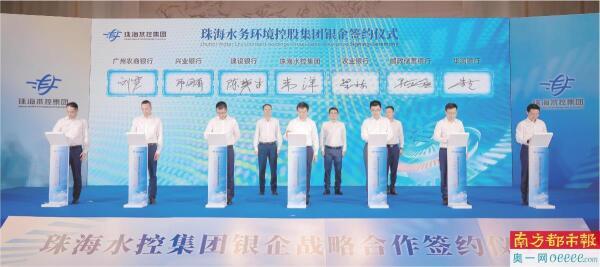
Core Viewpoint - Zhuhai Water Control Group is transforming from a traditional water supply company to a comprehensive public service provider, focusing on ecological collaboration and enhancing urban living experiences through strategic partnerships and innovative services [2][5][7]. Strategic Transformation - The collaboration involves major companies like China Petroleum, China Mobile, China Post, and Zhuhai Agricultural Control, along with six banks, resulting in a 31 billion yuan credit agreement [2]. - The partnership aims to upgrade public services from a single-function model to an ecological collaborative approach, enhancing convenience for citizens [2][3]. - Zhuhai Water Control is developing a smart water service platform, integrating AI monitoring and intelligent alert systems to improve operational efficiency and customer experience [3][5]. Financial Empowerment - The 31 billion yuan credit will support various projects, including the establishment of new energy charging stations and upgrades to smart water systems [5][6]. - The financial backing is based on the group's AAA credit rating and its transition to a technology-driven enterprise, which is expected to create sustainable value [5][6]. - The bank's strategy includes innovative financial products linked to ESG performance, ensuring funds are directed towards essential public service projects [6]. Reform and Strategic Leap - The company faces competition in water treatment and pipeline operations, necessitating continuous transformation to maintain its market position [7]. - The pressure to ensure public safety and environmental compliance drives the company to enhance management and leverage technology for efficiency [7][8]. - The goal is to elevate Zhuhai Water Control to the forefront of the water service sector in the Greater Bay Area through refined management and information technology applications [8].




Core wholesale prices rose less than expected in September; retail sales gain
CNBC· 2025-11-25 14:00
Group 1 - Core wholesale prices rose 0.3% in September, aligning with Dow Jones consensus estimates, indicating potential cooling in pipeline inflation pressures [1] - Excluding food and energy, the index increased by 0.1%, which is below the 0.2% estimate, while both core and headline PPI had decreased by 0.1% in August [2] - Headline PPI increased by 2.9% year-over-year, while core PPI rose by 2.6% [2] Group 2 - Goods prices drove the PPI increase, rising 0.9% month-over-month, marking the largest jump since February 2024, while services prices remained flat [2] - Final-demand energy prices surged by 3.5% for the month, with gasoline prices contributing significantly due to an 11.8% increase [3] - Transportation and warehousing prices rose by 0.8%, and airline passenger fees surged by 4% [3] Group 3 - Retail sales increased by 0.2% in September, slightly below the 0.3% forecast, while sales excluding autos rose by 0.3%, meeting estimates [4] - Miscellaneous retailers experienced a 2.9% increase, while gas stations saw a 2% rise due to higher prices; however, sporting goods and online sales declined by 2.5% and 0.7%, respectively [5] - Retail sales, adjusted for seasonality but not inflation, increased by 4.3% year-over-year, surpassing the 3% CPI rate for the month [5]

美国“创世纪任务”启动:AI驱动国家级科研动员,重塑科技竞争格局
Haitong Securities International· 2025-11-25 12:35
Investment Rating - The report does not explicitly state an investment rating for the industry Core Insights - The U.S. "Genesis Mission" aims to establish a national-level technology initiative comparable to the "Manhattan Project," focusing on integrating scientific datasets, supercomputing resources, and AI models to enhance the U.S.'s global technology leadership [12][14] - The initiative emphasizes the application of AI in scientific discovery as a national security priority, indicating a shift from commercial AI applications to a more integrated national research approach [13][14] - The plan outlines six priority sectors: advanced manufacturing, biotechnology, critical materials, nuclear energy, quantum information science, and semiconductors, which will guide federal budget allocations and industrial policies [14][15] Summary by Sections Event Overview - The Genesis Mission was officially launched on November 24, 2025, by President Trump, with the goal of accelerating scientific breakthroughs in critical fields [12] - The initiative is led by the Department of Energy and aims to create a unified "American Science and Security Platform" [12][14] Strategic Shift - The focus has shifted from regulation to national research empowerment, establishing "AI for Science" as a strategic priority [13] - The government intends to leverage national resources to overcome scientific bottlenecks in key areas [13] Infrastructure Development - The plan includes building a national-level hardware and software infrastructure that integrates supercomputers, cloud-based AI environments, and extensive federal scientific data [14] - This infrastructure aims to create significant barriers to entry for competitors, positioning entities with high-quality data and computing capabilities at the core of future technology ecosystems [14] Priority Sectors - The six identified priority sectors are expected to drive demand for upstream computing infrastructure and benefit industry leaders that can integrate AI into their R&D processes [14][15] - Specific sectors include semiconductors, biotechnology, and clean technology, which are poised for growth due to the initiative [14] Public-Private Partnerships - The initiative emphasizes collaboration with private sector companies and universities, allowing technology firms to participate in national projects [15] - Clear execution milestones have been set, including resource audits and initial platform capabilities, which are expected to accelerate technology transfer from research to application [15]
红利板块震荡上行,恒生红利低波ETF(159545)全天净申购超1.3亿份
Sou Hu Cai Jing· 2025-11-25 12:00
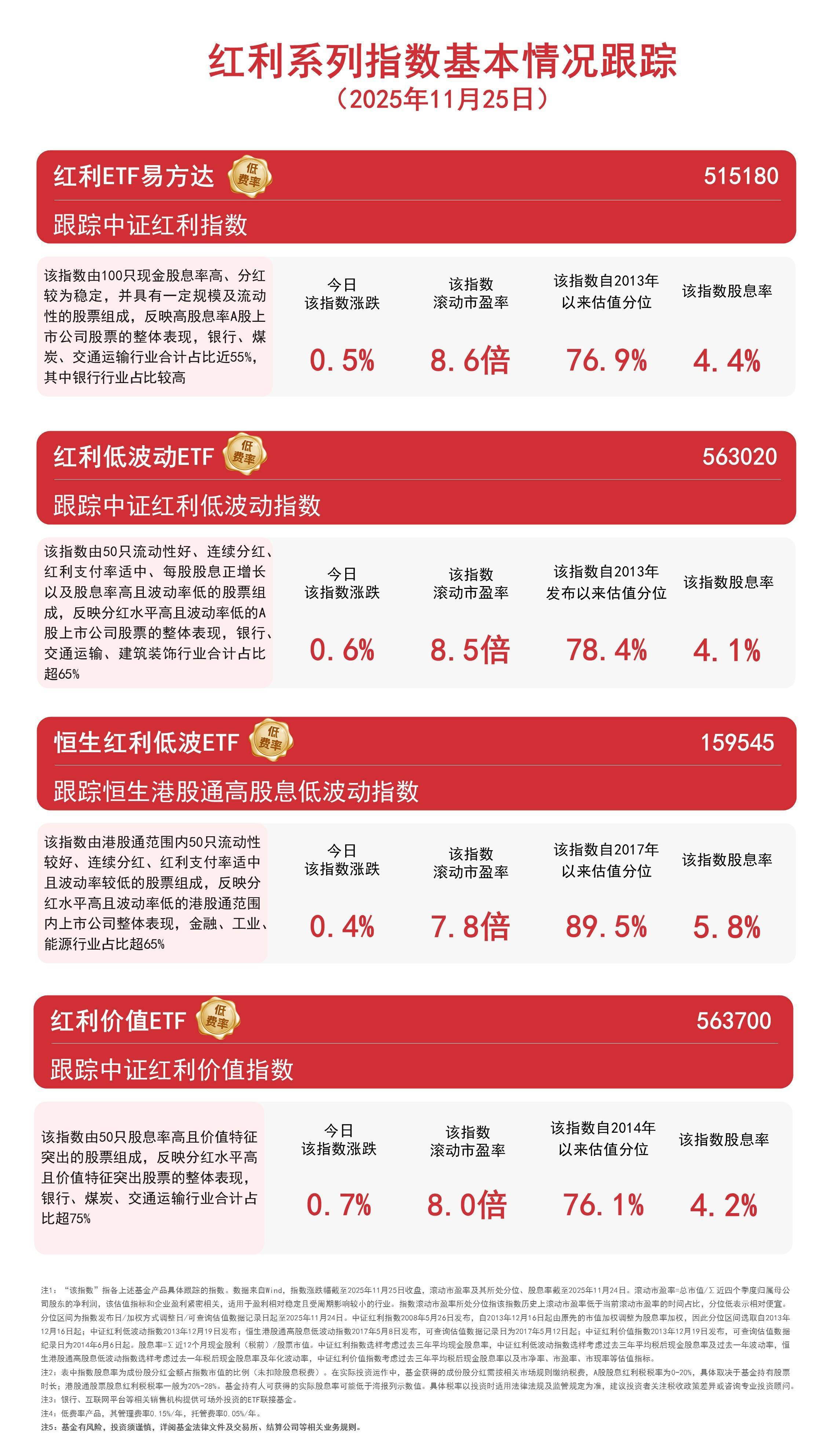
Group 1 - The core viewpoint of the news highlights the performance of dividend-focused indices, with the CSI Dividend Value Index rising by 0.7%, the CSI Low Volatility Dividend Index by 0.6%, and the CSI Dividend Index by 0.5% [1] - The Hang Seng High Dividend Low Volatility Index increased by 0.4%, and the Hang Seng Dividend Low Volatility ETF (159545) saw net subscriptions exceeding 130 million units throughout the day [1] - E Fund is noted as the only fund company offering all dividend ETFs at low fee rates, with management fees set at 0.15% per year for various products, facilitating low-cost investment in high-dividend assets [1] Group 2 - The indices consist of 50 stocks characterized by good liquidity, continuous dividends, moderate dividend payout ratios, positive growth in earnings per share, and high dividend yields with low volatility [3] - The banking, transportation, and construction industries collectively account for over 65% of the index composition, reflecting the overall performance of A-share listed companies with high dividend levels and low volatility [3] - The Hang Seng Dividend Low Volatility ETF tracks the Hang Seng High Dividend Low Volatility Index, which is composed of 50 stocks within the Hong Kong stock market that exhibit similar characteristics [6][7]
特朗普发现世纪漏洞,只要不招惹中国,其他国家都不是美国的对手
Sou Hu Cai Jing· 2025-11-25 06:14
Group 1 - The core strategy of the Trump administration shifted from targeting China with tariffs to focusing on allies and other economies after realizing the ineffectiveness of pressure tactics against China [1][2] - The U.S. imposed tariffs on allies like Japan, South Korea, and the EU, leading to significant concessions, including Japan's agreement to invest $550 billion in U.S. infrastructure and accept a 15% tariff rate [4][5] - The response from countries like Vietnam and Cambodia highlighted their economic dependence on the U.S. market, leading them to agree to trade concessions to avoid punitive tariffs [3][7] Group 2 - The success of the U.S. strategy in extracting investments and orders from allies raised concerns about the trust crisis in U.S. alliances, as allies felt vulnerable to U.S. economic coercion [9][10] - The approach accelerated the process of de-dollarization globally, as countries began to recognize the risks of over-reliance on the U.S. dollar system [12] - The unpredictable trade policies of the Trump administration risked destabilizing global supply chains, prompting multinational companies to develop contingency plans to mitigate political risks [14]

杭州活动报名倒计时|新数据驾驭2026年大宗商品市场展望
Refinitiv路孚特· 2025-11-25 06:02
Core Insights - The article highlights the increasing uncertainty and volatility in the commodity market for 2025, driven by global economic slowdown and geopolitical tensions, leading to a complex scenario of "falling prices and heightened volatility" [2] - It emphasizes the need for companies to redefine resilience and competitiveness in light of these challenges, particularly with the upcoming launch of platinum and palladium futures [2] Market Dynamics - The commodity market is experiencing a divergence in trends across energy, metals, and agricultural products, with traditional supply-demand logic being disrupted [2] - Companies are facing unprecedented challenges in cost control, supply chain stability, and strategic transformation [2] Event Details - A seminar hosted by the London Stock Exchange Group (LSEG) in Hangzhou will explore the opportunities presented by the "14th Five-Year Plan" for the copper market and provide exclusive data on gold, silver, platinum, and palladium [2][3] - The event is scheduled for December 4, 2025, and will feature various expert speakers discussing market insights and forecasts [3][4] Expert Contributions - Kian Pang Tan, an expert in agricultural research, will share insights on the palm oil market, leveraging over ten years of experience and advanced data analysis techniques [6] - Fu Xiaoyan, a senior director at Nanhua Futures, will discuss opportunities in the copper market, drawing from extensive experience in the futures industry [7][8] - Chen Xiaoyan, the agricultural research director at Dadi Futures, will provide an outlook on the cotton market amid changing tariff dynamics [9] Data and Analytics - LSEG emphasizes the importance of structured data utilization in commodity trading, highlighting the need for accurate information to enhance decision-making processes [13][14] - The company offers comprehensive solutions for energy, metals, and agricultural trading, utilizing a vast database and a team of analysts to support clients in identifying market opportunities [16][17][20]

港股市场回购统计周报2025.11.17-2025.11.23-20251125
Zhe Shang Guo Ji Jin Rong Kong Gu· 2025-11-25 06:01
Group 1: Market Overview - The total number of companies repurchasing shares this week is 73, an increase of 17 from the previous week[10] - The total repurchase amount for the week is HKD 4.87 billion, up from HKD 3.96 billion last week[10] - Tencent Holdings (0700.HK) leads with a repurchase of HKD 2.54 billion, followed by Xiaomi Group (1810.HK) with HKD 811 million[10] Group 2: Industry Insights - The majority of repurchase amounts are concentrated in the Information Technology, Industrial, Consumer Discretionary, Consumer Staples, and Energy sectors[13] - The Information Technology sector has the highest number of repurchasing companies, with 21 firms participating[13] - The Healthcare sector ranks second with 18 companies engaging in share buybacks[13] Group 3: Individual Company Data - China Feihe (6186.HK) repurchased shares worth HKD 185 million, accounting for 0.48% of its total share capital[14] - Yum China (9987.HK) repurchased shares worth HKD 233 million, representing 0.17% of its total share capital[14] - Kuaishou Technology (1024.HK) repurchased shares worth HKD 105.98 million, which is 0.04% of its total share capital[14]
港股市场策略周报-20251125
Zhe Shang Guo Ji· 2025-11-25 05:54
Market Performance Review - The Hong Kong stock market experienced a "Beta-style" decline this week, with major indices and style indices falling together, indicating a significant contraction in market risk appetite. The Hang Seng Composite Index, Hang Seng Index, and Hang Seng Tech Index fell by -5.37%, -5.09%, and -7.18% respectively [3][15] - The market sentiment remains cautious, with a notable increase in funds adopting a wait-and-see approach, leading to a weak consolidation phase [3][15] Macroeconomic Environment - In October, fiscal revenue showed strong performance, while fiscal expenditure appeared weak, indicating a potential lack of momentum in fiscal policy towards the end of the year. The overall public budget revenue for the first ten months was 186,490 billion yuan, a year-on-year increase of 0.8% [4][46] - The expectation for a U.S. interest rate cut has increased, with the probability of a 25 basis point cut in December approaching 70%. Southbound capital continued to see net inflows, increasing by 55.8% compared to the previous week [4][45] Sector Outlook - The domestic economy is still in a bottoming phase, with weak economic data. Policy focus is expected to be on technological innovation and expanding domestic demand. The market sentiment is cautious, reflecting a phase of high-level corrections [5][46] - The report favors sectors that are relatively prosperous and benefit from policy support, such as new energy, innovative pharmaceuticals, and AI technology. Additionally, low-valuation state-owned enterprises and local Hong Kong banks, telecommunications, and utility dividend stocks are also seen as favorable due to their relative independence from the economic cycle and benefits from the interest rate cut [5][46] Buyback Statistics - The buyback market has shown significant activity this week, with 73 companies participating, an increase of 17 from the previous week. The total buyback amount reached 4.87 billion HKD, a substantial increase from the previous week [29][32] - Tencent Holdings led the buyback activity with 2.543 billion HKD, followed by Xiaomi Group with 811 million HKD [29][27] Southbound Capital Statistics - The top net buying companies this week included Xiaomi Group (40.31 billion HKD), China National Offshore Oil Corporation (31.73 billion HKD), and Industrial and Commercial Bank of China (20.45 billion HKD) [36] - Conversely, Alibaba (63.35 billion HKD) and other consumer-related stocks saw significant net selling [37]
《能源化工》日报-20251125
Guang Fa Qi Huo· 2025-11-25 05:04
Report Industry Investment Ratings - No information provided on industry investment ratings in the given reports. Core Views Methanol - The inland market is expected to see a continuous increase in production, with marginal devices in the red. The market sentiment has improved due to some Iranian devices starting to limit gas and stop production, leading to a significant strengthening of the disk, with both price and basis rising. In the short term, it is expected to fluctuate strongly, and attention should be paid to the time and intensity of gas limitation [1]. Crude Oil - Overnight oil prices rebounded due to the increasing expectation of a Fed rate cut in December and the ongoing difficulties in Russia - Ukraine negotiations. However, under the pressure of continuous production increase by OPEC+ and a record - high US crude oil production, the supply - demand pattern remains weak. In the short term, Brent crude oil is expected to fluctuate between $60 - 66 per barrel, and attention should be paid to the results of the Russia - Ukraine negotiations [5]. Polyolefins - PP shows a pattern of both supply and demand increasing, with reduced maintenance driving supply recovery and a slight reduction in inventory. PE shows a pattern of increasing supply and decreasing demand, with inventory slightly accumulating under the pressure of new production capacity. The 01 contract is still under significant pressure [8]. Glass and Soda Ash - Soda ash has an overall surplus pattern, with reduced production this week and phased inventory reduction at factories. In the medium term, demand is expected to remain rigid, and there may be further pressure on supply - demand without actual production capacity exit or load reduction. Glass has seen a short - term rebound in the market due to the shutdown of some production lines in Hubei, but in the medium - to - long term, demand is expected to decline, and the industry still needs to clear production capacity to solve the surplus problem [9]. Styrene - Pure benzene has new production capacity and device restarts, with overall supply remaining loose. Demand support is limited, and port inventories are rising. In the short term, the price may be adjusted due to the drag of oil prices. Styrene has limited supply and improved downstream procurement, but demand support is expected to be limited. The rebound space is restricted, and the short - term EB01 is expected to fluctuate [10]. Natural Rubber - Supply is supported by cost, but inventory is accumulating seasonally, and terminal demand is weak. It is expected to enter a range - bound consolidation, and attention should be paid to raw material output in the main production areas and macro - level changes [11]. PVC and Caustic Soda - Caustic soda has supply - demand pressure, with expected weakening prices. PVC has a weak spot market, with supply increasing and demand remaining sluggish. The supply - demand is in an oversupply pattern, and prices are expected to continue to decline at the bottom [12]. Polyester Industry Chain - PX has a short - term weak supply - demand situation but strong mid - term support. PTA has a short - term tight supply - demand situation but a loose mid - term outlook. Ethylene glycol is expected to fluctuate at a low level. Short - fiber has a weak supply - demand situation, and bottle - chip has a loose supply - demand pattern [13]. LPG - No clear overall view is provided in the given LPG report, but price and inventory data are presented [15]. Summaries by Related Catalogs Methanol - **Price and Spread**: MA2601 and MA2605 prices increased, with the MA15 spread and Taicang basis changing. Regional spreads also showed significant changes. For example, the regional spread between Taicang and Inner Mongolia's northern line increased by 475% [1]. - **Inventory**: Methanol enterprise, port, and social inventories all decreased, with decreases of 2.86%, 4.16%, and 3.91% respectively [1]. - **Upstream and Downstream Operating Rates**: Upstream domestic enterprise operating rates decreased slightly, while overseas enterprise operating rates increased slightly. Downstream, the operating rate of externally - purchased MTO devices remained unchanged, and the formaldehyde operating rate increased [1]. Crude Oil - **Price and Spread**: Brent and WTI crude oil prices increased, while SC crude oil prices decreased. Product oil prices and spreads also showed various changes, such as the RBOB price increasing and the ULSD price decreasing [5]. - **Product Oil Crack Spreads**: Crack spreads of various product oils showed different trends, with some decreasing and some increasing [5]. Polyolefins - **Price and Spread**: L2601, L2605, PP2601, and other contract prices changed slightly. Spreads such as L15 and PP15 increased [8]. - **Inventory**: PE and PP enterprise and social inventories decreased to varying degrees [8]. - **Upstream and Downstream Operating Rates**: PE and PP device operating rates decreased, while PP powder operating rates increased [8]. Glass and Soda Ash - **Price and Spread**: Glass and soda ash futures and spot prices changed, with glass 2601 prices increasing and soda ash 2601 and 2605 prices also rising slightly [9]. - **Operating Rates and Production**: Soda ash operating rates and weekly production decreased, while the photovoltaic daily melting volume increased slightly [9]. - **Inventory**: Glass and soda ash inventories showed different trends, with glass warehouse inventories increasing and soda ash factory and delivery warehouse inventories decreasing [9]. Styrene - **Upstream Price and Spread**: Brent and WTI crude oil prices increased, and prices of raw materials such as CFR Japan naphtha and CFR Northeast Asia ethylene changed [10]. - **Inventory**: Pure benzene and styrene inventories in Jiangsu ports increased [10]. - **Industrial Chain Operating Rates**: Operating rates of various links in the pure benzene and styrene industrial chain changed, with some increasing and some decreasing [10]. Natural Rubber - **Spot Price and Basis**: Spot prices of natural rubber such as Yunnan state - owned standard rubber increased, and the full - cream basis also increased [11]. - **Fundamentals**: Production in major producing countries and regions changed, and tire production, export, and import volumes decreased [11]. - **Inventory**: Bonded area and futures warehouse inventories of natural rubber increased [11]. PVC and Caustic Soda - **Price and Spread**: PVC and caustic soda futures and spot prices changed, with PVC futures prices increasing and caustic soda prices decreasing [12]. - **Supply and Demand**: Caustic soda and PVC supply and demand showed different trends, with caustic soda having supply - demand pressure and PVC having an oversupply situation [12]. - **Inventory**: Liquid caustic soda and PVC inventories changed, with some increasing and some decreasing [12]. Polyester Industry Chain - **Downstream Polyester Product Prices and Cash Flows**: Prices of polyester products such as POY, FDY, and DTY changed, and cash flows also showed different trends [13]. - **PX - Related Prices and Spreads**: CFR China PX prices increased slightly, and various spreads changed [13]. - **PTA - Related Prices and Spreads**: PTA spot and futures prices increased, and the basis and processing fees changed [13]. - **MEG - Related Prices and Spreads**: MEG spot and futures prices increased, and the basis and cash flows changed [13]. LPG - **Price and Spread**: LPG futures prices decreased, and spreads such as PG12 - 01 and PG12 - 02 changed [15]. - **Inventory**: LPG refinery storage capacity ratio remained stable, while port inventory and storage capacity ratio increased [15]. - **Upstream and Downstream Operating Rates**: Upstream refinery operating rates decreased, and downstream PDH and MTBE operating rates decreased, while the alkylation operating rate increased [15].
银河期货每日早盘观察-20251125
Yin He Qi Huo· 2025-11-25 03:39
1. Report Industry Investment Ratings No industry investment ratings are provided in the given report. 2. Core Views of the Report - The overall market shows a mixed trend, with different sectors having their own characteristics and influencing factors. Some sectors are affected by supply - demand relationships, while others are influenced by macro - economic policies, geopolitical factors, and cost - related elements [5][9][11]. - In the financial derivatives market, the stock index futures market is expected to rebound, but the performance is differentiated. The bond market lacks driving forces and is expected to be volatile in the short term [18][21][22]. - In the agricultural products market, most varieties are in a state of supply - demand balance or slight imbalance, with prices showing different trends such as oscillation, strength, or weakness [24][27][31]. - In the black metal market, steel prices are oscillating within a range, and the double - coking market is paying attention to the switching of trading logic. Iron ore is considered from a bearish perspective, and ferroalloys are oscillating at the bottom [57][59][62]. - In the non - ferrous metal market, precious metals are oscillating and waiting for data guidance. Copper prices are supported by the expectation of US interest rate cuts. Other non - ferrous metals also have their own price trends based on supply - demand and cost factors [67][71][79]. 3. Summary by Relevant Catalogs Financial Derivatives Stock Index Futures - Market is expected to rebound, with the strength depending on large - scale technology companies. The performance of different contracts is differentiated, and the trading volume and positions of most contracts have decreased [18][19][20]. - Trading strategies include going long on dips, conducting IM/IC long 2512 + short ETF cash - and - carry arbitrage, and using bull spreads [21]. Bond Futures - The bond market lacks driving forces and is expected to be volatile in the short term. The trading volume of treasury bond futures has increased slightly, and the yield of spot bonds has fluctuated slightly [22][23]. - Trading strategies include going long on dips with a small position in the T contract and being cautious about chasing up, and paying attention to the potential cash - and - carry arbitrage opportunities of the TF contract [23]. Agricultural Products Protein Meal - Supply still has pressure, and prices are oscillating. The international soybean market has a pattern of abundant production, and the domestic supply pressure is relatively large [24][26]. - Trading strategies include short - selling a small amount of far - month rapeseed meal contracts, waiting and seeing for arbitrage, and using the strategy of selling wide - straddle options [27]. Sugar - International sugar prices have risen slightly, and domestic sugar prices are slightly stronger. The global main producing areas are increasing production, but the production in Brazil and India may be lower than expected. The domestic market is affected by factors such as imports and production costs [27][30]. - Trading strategies include going long on dips in the short term, conducting long January and short May arbitrage, and selling put options at low levels [30][31]. Oilseeds and Oils - The market continues to oscillate. The palm oil market has a high inventory and weak exports, but the production is expected to decrease in the future. The soybean oil market follows the overall trend, and the rapeseed oil market is expected to continue to destock [31][34]. - Trading strategies include short - term long - short operations and waiting and seeing for arbitrage and options [34][35]. Corn/Corn Starch - Spot prices are strong, and the futures market is oscillating at a high level. The US corn market is affected by factors such as supply and demand, and the domestic corn market is affected by factors such as production areas and price differentials [35][37]. - Trading strategies include short - term long - short operations, conducting cash - and - carry arbitrage on the spread between January corn and starch, and waiting and seeing for options [38]. Live Pigs - The pressure of live pig slaughter continues to increase, and prices continue to decline. The overall inventory of live pigs is relatively high, and the supply pressure still exists [38][39]. - Trading strategies include waiting and seeing, and using the strategy of selling wide - straddle options [41]. Peanuts - Peanut spot prices are stable, and the short - term market is oscillating at the bottom. The price of imported peanuts is stable, and the price of peanut meal is stable. The oil mill has adjusted the purchase price [41][43]. - Trading strategies include short - selling January peanuts on rallies, waiting and seeing for May peanuts, conducting reverse arbitrage on January - May peanuts, and selling pk601 - P - 7600 options [43]. Eggs - Demand is average, and egg prices are stable with a slight decline. The inventory of laying hens is relatively high, and the supply pressure is gradually easing. The price is expected to oscillate within a range [45][48]. - Trading strategies include going long on the January contract on dips, waiting and seeing for arbitrage, and waiting and seeing for options [49]. Apples - Demand is average, and apple prices are mainly stable. The cold - storage inventory of apples is increasing, and the sales in the consumer market are in the off - season. The market is affected by factors such as imports and exports [50][53]. - Trading strategies include waiting and seeing for single - side trading, arbitrage, and options [53]. Cotton - Cotton Yarn - The fundamental contradiction is not significant, and cotton prices are mainly oscillating. The supply of new cotton is increasing, and the demand is in the off - season. The price is expected to oscillate in the short term [54][56]. - Trading strategies include waiting and seeing for single - side trading, arbitrage, and options [56]. Black Metals Steel - Steel prices are oscillating within a range, and there is still room for reducing hot metal. The supply - demand relationship of steel is improving, and the cost is supported. The hot - rolled coil performs better than the rebar [57][58]. - Trading strategies include maintaining an oscillating and slightly strong trend, conducting long - spread trading on the spread between hot - rolled coil and rebar, and waiting and seeing for options [59]. Double - Coking - The risk of price decline has been released, and attention should be paid to the switching of trading logic. The coking coal market is affected by factors such as supply - demand and policy, and the price is expected to oscillate in the short term [59][61]. - Trading strategies include gradually closing short positions, going long on dips after the market stabilizes, conducting reverse arbitrage on January/May coking coal, and waiting and seeing for options [61][62]. Iron Ore - A bearish approach is recommended. The supply of iron ore is relatively loose in the fourth quarter, and the demand for domestic terminal steel is expected to remain low. The price is expected to be weak at a high level [62][63]. - Trading strategies include short - side trading, waiting and seeing for arbitrage, and waiting and seeing for options [64]. Ferroalloys - Ferroalloys are oscillating at the bottom under the trend of production reduction. The supply and demand of silicon - iron and manganese - silicon are both decreasing, and the cost is supported. The price is expected to oscillate at the bottom [64][65]. - Trading strategies include waiting and seeing for single - side trading, arbitrage, and using the strategy of selling out - of - the - money straddle option combinations [66]. Non - Ferrous Metals Precious Metals - Precious metals are oscillating and waiting for data guidance. The expectation of US interest rate cuts has increased, and the prices of gold and silver have risen slightly. The market is waiting for economic data to provide more clear directions [67][68][69]. - Trading strategies include holding long positions cautiously based on the 20 - day moving average, waiting and seeing for arbitrage, and waiting and seeing for options [70]. Copper - Copper prices are supported by the expectation of US interest rate cuts. The supply of copper is expected to decrease, and the demand is improving. The price is expected to oscillate at a high level [71][73]. - Trading strategies include holding long positions below 86,000 yuan/ton in the short term, maintaining a long - term bullish trend, and waiting and seeing for arbitrage and options [74]. Alumina - Substantial production reduction has not been realized, and attention should be paid to the transfer of warehouse receipts. The supply of alumina is relatively stable, and the market is affected by factors such as long - term contracts and new production capacity [75][77]. - Trading strategies include waiting and seeing for single - side trading and arbitrage [78]. Electrolytic Aluminum - The expectation of US interest rate cuts is strengthening, and the price of Shanghai aluminum is stabilizing and rebounding. The supply - demand relationship of aluminum is relatively balanced, and the cost is supported. The price is expected to be strong in the medium term [79][80]. - Trading strategies include going long on dips in the short term, paying attention to the narrowing of the price difference between East China and Central China in the spot market, and waiting and seeing for options [80]. Cast Aluminum Alloy - The macro - expectation has improved, and the price of aluminum alloy has rebounded with the price of aluminum. The cost of raw materials has decreased, and the supply is tight. The price has certain support [81][84]. - Trading strategies include waiting and seeing for single - side trading, arbitrage, and options [84]. Zinc - Zinc prices are oscillating widely. The processing fee of zinc concentrate is decreasing, and the supply of refined zinc is expected to be lower than expected. The demand is in the off - season. The price is expected to be supported in the short term [84][86]. - Trading strategies include going long on dips with a small position, waiting and seeing for arbitrage, and waiting and seeing for options [87]. Lead - Lead prices are oscillating weakly within a range. The supply of lead ingots is increasing, and the demand for lead - acid batteries is decreasing. The price is expected to be weak [90][91]. - Trading strategies include waiting and seeing for single - side trading, arbitrage, and options [91]. Nickel - Production reduction stimulates the rebound of nickel prices, but inventory suppresses the upward space. The supply of nickel is affected by factors such as production reduction in Indonesia, and the demand is in the off - season. The price is expected to be volatile [91][94]. - Trading strategies include waiting and seeing for single - side trading, arbitrage, and options [94]. Stainless Steel - The supply and demand are both weak, and the price rebounds following the raw materials. The terminal demand is in the off - season, and the cost is decreasing. The price is expected to be weak [95][99]. - Trading strategies include short - term rebound trading, waiting and seeing for arbitrage, and selling out - of - the - money call options [98]. Industrial Silicon - Short - term buying on dips is recommended. The supply of industrial silicon is expected to decrease in the dry season, and the demand is relatively stable. The price is expected to be strong [100][101]. - Trading strategies include holding existing long positions and buying on dips [101]. Polysilicon - Attention should be paid to the establishment of platform companies. The market is affected by factors such as policy and demand. The price is expected to be volatile [100][102]. - Trading strategies include short - side trading and waiting and seeing for arbitrage [103].