必需性消费

Search documents
香港交易所:港交所2月份跟踪:联储降息预期下降致使海外流动性收紧,港股交投仍然维持历史高-20260313
Changjiang Securities· 2026-03-13 00:40
Investment Rating - The report maintains a "Buy" rating for the company [5][51]. Core Views - As of March 9, 2026, the company's PE ratio is 29.06x, which is at the 12th percentile historically since 2016, indicating a certain level of value for allocation. It is expected that with the continuous enhancement of the mutual access policy in the Hong Kong capital market, liquidity in the Hong Kong stock market will continue to rise, leading to an increase in overall market activity and valuation. The company is projected to achieve revenue and other income of HKD 365 billion, 391 billion, and 413 billion for 2026, 2027, and 2028 respectively, with net profit attributable to shareholders of HKD 226 billion, 241 billion, and 256 billion, corresponding to PE valuations of 22.9x, 21.4x, and 20.2x respectively [2][51]. Summary by Sections Market Environment - The Hong Kong stock market remains active, with the overall trading volume at historical highs. In February, the average daily trading (ADT) for the Hong Kong Stock Exchange was HKD 2,468 billion, reflecting a month-on-month decrease of 9.4% and a year-on-year decrease of 17.0%. The Northbound trading ADT was HKD 3,807 billion, down 16.1% month-on-month but up 45.2% year-on-year, while Southbound trading ADT was HKD 1,142 billion, down 14.1% month-on-month and down 28.6% year-on-year [6][16]. Derivatives Market - In February, both futures and options trading volumes increased month-on-month. The average daily volume (ADV) for futures was 68.4 million contracts, up 3.8% month-on-month but down 25.5% year-on-year. The ADV for options was 105.0 million contracts, up 0.2% month-on-month but down 21.9% year-on-year [19][20]. Primary Market - The IPO scale in the Hong Kong stock market saw significant growth in February, with a total of 24 new stocks listed, raising a total of HKD 923 billion, which is a year-on-year increase of 1052.4%. The average size of each IPO was HKD 38.5 billion, up 332.2% year-on-year. Notably, 42% of the new listings were from the information technology sector, contributing 48% of the total fundraising [31][32]. Investment Income - As of the end of February, the relevant interest rates for investment income showed a general decline. The 6-month HIBOR was 2.73%, the 1-month HIBOR was 2.41%, and the overnight HIBOR was 2.55%, reflecting month-on-month changes of -0.16 percentage points, -0.20 percentage points, and +0.37 percentage points respectively [41].

香港交易所(00388):港交所 2 月跟踪:联储降息预期下降致使海外流动性收紧,港股交投仍然维持历史高位
Changjiang Securities· 2026-03-12 09:07
Investment Rating - The report maintains a "Buy" rating for the company [2][6]. Core Insights - As of March 9, 2026, the company's PE ratio stands at 29.06x, which is in the 12th percentile historically since 2016, indicating a certain level of value for allocation. It is expected that with the continuous enhancement of the mutual access policy in the Hong Kong capital market, liquidity in the Hong Kong stock market will continue to rise, leading to an increase in overall market activity and valuation. The company is projected to achieve revenues and other income of HKD 365 billion, 391 billion, and 413 billion for 2026-2028, with net profit attributable to shareholders of HKD 226 billion, 241 billion, and 256 billion, corresponding to PE valuations of 22.9x, 21.4x, and 20.2x respectively [2][52]. Company Overview - The Hong Kong stock market experienced overall fluctuations in February, with the trading activity of listed securities on the Hong Kong Stock Exchange remaining high. The monthly average daily turnover (ADT) for February was HKD 2,468 billion, reflecting a decrease of 9.4% month-on-month and 17.0% year-on-year. However, the overall trading activity remains at historical highs [8][11][17]. Market Environment - The overall market trading remains high, and performance is expected to grow alongside market increases. The total market capitalization of Hong Kong stocks as of the end of February 2026 was HKD 498.76 billion, up 27.5% year-on-year, despite a month-on-month decrease of 1.8% [9][11]. Derivatives Market - In the derivatives market, both futures and options trading volumes increased month-on-month. The average daily volume (ADV) for futures was 68.4 million contracts, up 3.8% month-on-month but down 25.5% year-on-year. The ADV for options was 105.0 million contracts, showing a slight increase of 0.2% month-on-month but a decrease of 21.9% year-on-year [21][22]. Primary Market - The IPO scale in the Hong Kong stock market saw significant growth in February, with a total of 24 new stocks listed, raising a total of HKD 923 billion, which is a year-on-year increase of 1052.4%. The average scale of each IPO was HKD 38.5 billion, up 332.2% year-on-year [31][32].
公募积极布局港股 科技与周期品种仍是投资主线
Zhong Guo Zheng Quan Bao· 2026-02-25 20:55
Core Viewpoint - The Hong Kong stock market has shown volatility post-Spring Festival, with public funds actively positioning themselves to seize future opportunities, particularly in technology and cyclical sectors [1][2]. Market Performance - As of February 25, the Hang Seng Index has increased by 0.22%, while the Hang Seng Technology Index has decreased by nearly 2%. Various sectors have shown mixed performance, with telecommunications, energy, industrials, and materials rising, while consumer staples, conglomerates, and healthcare sectors have faced adjustments [2]. - Notable individual stock performances include significant increases for companies like Dachen Microline Group and Jiu Yuan Group, while Tencent Holdings and Alibaba have seen declines [2]. Fund Positioning - Multiple fund institutions maintain a positive outlook on Hong Kong stocks, with significant inflows into ETFs focused on this market. For instance, the Huatai-PB Hang Seng Technology ETF saw an increase of 13.436 billion shares, while several other ETFs also reported substantial share increases [2]. - Active funds are also adjusting their portfolios to include major Hong Kong internet stocks, indicating a strategic focus on these companies [3]. Long-term Investment Outlook - According to Huaxia Fund, the current market conditions may present a valuable investment window for Hong Kong stocks, driven by attractive valuations and expectations of improved liquidity. The market is experiencing a convergence of factors such as low historical valuations and continued inflows from southbound capital [4]. - Fund managers from various institutions express optimism about the potential for valuation recovery in Hong Kong stocks, supported by improving corporate performance and favorable macroeconomic conditions, including a potential decline in U.S. interest rates [4]. Sector Focus - The technology sector remains a primary focus for investment, with expectations of explosive growth in AI-related capital expenditures. Major domestic internet companies are anticipated to maintain stable growth, enhancing both earnings and valuations [5][6]. - The ongoing economic transformation and industrial upgrades in China are expected to provide significant support for the valuation of Hong Kong's technology sector, despite short-term fluctuations in interest rate expectations [5].
港股有望延续结构性上涨,港股通50ETF国泰(159712)涨超1.8%
Mei Ri Jing Ji Xin Wen· 2026-02-09 06:37
Core Viewpoint - The Hong Kong stock market is expected to continue structural growth in the short term, supported by the Federal Reserve's interest rate cut expectations and the ongoing recovery of A-share sentiment [1] Group 1: Market Outlook - The demand for AI is showing continuous improvement, which will benefit the technology sector in Hong Kong stocks [1] - Investors should remain cautious of external policy uncertainties, such as recent adjustments to the value-added tax scope, which have raised concerns about the tax burden on internet value-added services and triggered a rapid decline in platform technology stocks [1] Group 2: Sector Performance - In terms of industry structure, essential consumption and public utilities are relatively resilient, while information technology and materials sectors are leading the decline, reflecting weak market risk appetite [1] Group 3: Investment Strategy - A prudent allocation strategy is recommended, focusing on high-dividend assets as a foundation, while also paying attention to sectors with both profit improvement and growth potential in technology and consumption [1] Group 4: Index Information - The Hong Kong Stock Connect 50 ETF (159712) tracks the Hong Kong Stock Connect 50 Index (930931), which selects 50 representative securities from Hong Kong listed companies available for trading through the Stock Connect, emphasizing the financial sector while also covering telecommunications and consumption [1] - The constituent stocks of this index exhibit high market liquidity and scale characteristics, aiming to reflect the overall performance of large blue-chip enterprises in the Hong Kong stock market [1]
AH股市场周度观察(2月第1周)-20260208
ZHONGTAI SECURITIES· 2026-02-08 13:38
Group 1: A-Share Market - The A-share market continued its adjustment with major indices declining: Shanghai Composite Index fell approximately 1.27%, Shenzhen Component Index dropped about 2.11%, and ChiNext Index decreased around 3.28% [6] - Defensive sectors such as food and beverage, and banking led the gains, while high-beta sectors like non-ferrous metals, telecommunications, and electronics experienced significant declines [6] - The market is expected to maintain a volatile trend, with potential for a more definitive upward movement after the Spring Festival, particularly during the Two Sessions period [6] Group 2: Hong Kong Market - The Hong Kong market also saw a decline, with the Hang Seng Index dropping approximately 3.02%, the Hang Seng China Enterprises Index falling about 3.07%, and the Hang Seng Tech Index decreasing around 6.51% [7] - The market exhibited complex and differentiated characteristics, influenced by recent announcements regarding VAT adjustments, which raised concerns about the tax burden on internet value-added services, leading to a rapid decline in platform tech stocks [7] - The outlook for the Hong Kong market suggests potential structural gains supported by expectations of interest rate cuts from the Federal Reserve and a recovery in A-share sentiment, although investors should remain cautious of external policy uncertainties [7]
中信证券港股2月展望:春季行情延续 关注三大主线
Zhi Tong Cai Jing· 2026-01-29 01:21
Core Viewpoint - The report from CITIC Securities indicates that the Hong Kong stock market is expected to continue its spring rally from late December 2025, with a focus on large-cap stocks before the Lunar New Year and better performance in growth sectors supported by policy directions [1] Group 1: Market Performance and Trends - The performance expectations for Hong Kong stocks have significantly adjusted, with a slowdown in the downward revision of earnings forecasts since late December 2025 [1] - The average return of the Hang Seng Index during the spring rally over the past eleven years is 2.4%, with a weekly win rate of 70.8%, particularly strong in 2019, 2021, and 2023, averaging a 10.6% increase [2] - The upcoming earnings reports for Hong Kong stocks are expected to be concentrated from late March to early April, indicating a period of performance vacuum [1][2] Group 2: Investment Focus Areas - Short-term investment focus should be on three main lines: 1) "14th Five-Year Plan" policy directions including biomanufacturing, embodied intelligence, and 6G; 2) food delivery platforms and real estate benefiting from policy-driven expectations; 3) non-bank financials benefiting from the spring rally [1] - The "15th Five-Year Plan" is expected to guide long-term investment opportunities, with strategic emerging industries like new energy, new materials, and quantum technology likely to receive policy support [3] Group 3: Liquidity and Market Dynamics - The liquidity outlook for Hong Kong stocks is expected to improve as the market approaches the next peak of stock unlocks, with significant reductions in unlock amounts in January and February 2026 [1] - Historical data shows that net inflows from southbound trading in January and February account for an average of 19.3% and 27.9% of the annual total, respectively [2]

AH股市场周度观察(12月第3周)-20251220
ZHONGTAI SECURITIES· 2025-12-20 11:06
Group 1: A-Share Market - The A-share market showed a mixed performance this week, with value sectors being relatively strong. Major indices like the Shanghai 50 and CSI 2000 saw slight increases, while the ChiNext index fell by 2.26%. Value performance was notable across large, mid, and small-cap stocks, with sectors such as retail, consumer services, and non-bank financials leading the gains. The average daily trading volume was 1.76 trillion, down 9.86% week-on-week [6][7]. - The market experienced a pattern of initial decline followed by recovery, indicating structural hotspots. The China Securities Regulatory Commission (CSRC) chairman emphasized the need to deepen the capital market's 14th Five-Year Plan and expand high-level opening-up to boost market confidence. The Central Financial Office highlighted that expanding domestic demand is a primary task for the coming year, aiming to stimulate consumption through supply and demand-side efforts [6][7]. - Looking ahead, the A-share market is expected to remain structurally active due to ongoing policy support for capital markets and consumption. Despite a decline in trading volume, support from emerging industries like technology and new energy, along with the push for domestic demand, will provide market backing. Investors are advised to focus on sectors benefiting from policy support, such as consumption upgrades, technological innovation, and high-end manufacturing [7]. Group 2: Hong Kong Market - The Hong Kong market faced overall pressure this week, with major indices recording declines. The Hang Seng Index, Hang Seng China Enterprises Index, and Hang Seng Technology Index fell by 1.1%, 1.96%, and 2.82%, respectively, with the technology index experiencing the largest drop. Essential consumer and financial sectors rose against the trend, while most sectors, including information technology and non-essential consumer goods, showed weakness [8]. - Despite the overall pressure, the market was supported by expectations of improved liquidity due to anticipated interest rate cuts by the Federal Reserve. In 2025, the Fed has already cut rates three times, with potential for further easing, which may optimize the debt side for Hong Kong stocks. Additionally, a rebound in U.S. tech stocks provided some uplift to the Hong Kong technology sector [8]. - In the future, while the Hong Kong market may experience volatility due to external factors, the expected improvement in liquidity from the Fed's easing cycle will have a positive impact. Strong performance from the mainland economy and ongoing policy support, particularly in high-level opening-up, will provide a solid foundation for the Hong Kong market. Investors are encouraged to focus on sectors benefiting from Fed easing and mainland economic recovery, as well as technology sectors with growth potential amid the AI wave [8].
港股投资周报:原材料行业领涨,港股精选组合年内上涨58.46%-20251220
Guoxin Securities· 2025-12-20 07:46
- The "Hong Kong Stock Selection Portfolio" model aims to construct a portfolio by dual-layer screening based on fundamental and technical aspects of stocks recommended by analysts. The analyst recommendation pool is built using events such as upward revisions of earnings forecasts, initial analyst coverage, and unexpected positive research report titles. Stocks with both fundamental support and technical resonance are selected for the portfolio. The backtesting period is from January 1, 2010, to June 30, 2025, with an annualized return of 19.11% and an excess return of 18.48% relative to the Hang Seng Index [14][16][18] - The "Stable New High Stock Screening" factor identifies stocks that have reached a 250-day high in the past 20 trading days. The screening process includes criteria such as analyst attention (at least five buy or overweight ratings in the past six months), relative stock strength (top 20% in 250-day returns), and stock price stability. Stability is measured using metrics like price path smoothness and the average 250-day high distance over the past 120 days. Stocks are ranked, and the top 50% are selected, with a minimum of 50 stocks [21][23][24] - The formula for calculating the "250-day high distance" is: $ 250\text{-day high distance} = 1 - \frac{\text{Close}_{t}}{\text{ts\_max}(\text{Close}, 250)} $ where $\text{Close}_{t}$ represents the latest closing price, and $\text{ts\_max}(\text{Close}, 250)$ is the maximum closing price over the past 250 trading days. A value of 0 indicates a new high, while positive values represent the degree of fallback from the high [23][24] - The backtesting results for the "Hong Kong Stock Selection Portfolio" model show annualized returns of 19.11%, excess returns of 18.48%, and various performance metrics such as IR of 1.22, tracking error of 14.55%, and maximum drawdown of 23.73% [20][16][18] - The "Stable New High Stock Screening" factor identified stocks across sectors, with the highest number in the cyclical sector (7 stocks), followed by consumer (5 stocks), financial (3 stocks), manufacturing (3 stocks), technology (3 stocks), and healthcare (1 stock) [23][24][28]
港股年内新股破百 超五成募资来自“A+H”
Bei Jing Shang Bao· 2025-12-11 15:38
Core Insights - The Hong Kong IPO market has reached a significant milestone with the listing of JD Industrial, marking the 100th new stock of the year, and the total fundraising amount has exceeded 2700.86 billion HKD, the highest globally for the year [3][4][5] - The market is experiencing a strong recovery, driven by large IPO projects, particularly from A-share companies, which have become a crucial force in boosting fundraising [3][4][5] - Despite the impressive fundraising figures, there are concerns regarding the quality of new listings, an increase in the rate of IPO failures, and a shortage of investment banking talent [8][9] Fundraising Performance - The total fundraising amount for the year has surpassed 2700.86 billion HKD, a significant increase from 64 new stocks last year [3][4] - The Hong Kong Stock Exchange is expected to lead global fundraising with an estimated 36 billion USD in 2025, significantly outpacing the New York Stock Exchange [3][5] - A-share companies have contributed to 51.35% of the total fundraising in the Hong Kong IPO market, with notable contributions from companies like CATL [4][5] Market Structure and Trends - The "new consumption + hard technology" sectors are identified as the main drivers of the current capital influx, with companies in these areas receiving substantial investor interest [6][7] - The healthcare sector has seen the highest number of new listings, with 24 companies, while the information technology sector ranks third with 18 new stocks [6] - The market is shifting towards a dual-driven model of domestic and foreign investment, indicating a structural evolution in investor composition [5][6] Future Outlook - The IPO market is expected to remain active in 2026, with a focus on "A+H" stock models and the return of Chinese concept stocks [7] - Regulatory support for technology companies is anticipated to continue, fostering a favorable environment for new listings in the tech sector [6][7] Challenges and Concerns - There has been a notable increase in the IPO failure rate, with 45.45% of new stocks failing on their first day in November [8][9] - Concerns have been raised regarding the quality of listing applications and the overall execution of the IPO process, leading to regulatory scrutiny [9] - A shortage of experienced investment banking professionals is impacting the quality of service and project handling in the IPO market [9]



香港证监会、港交所联合致函保荐人!
Zhong Guo Ji Jin Bao· 2025-12-10 10:33
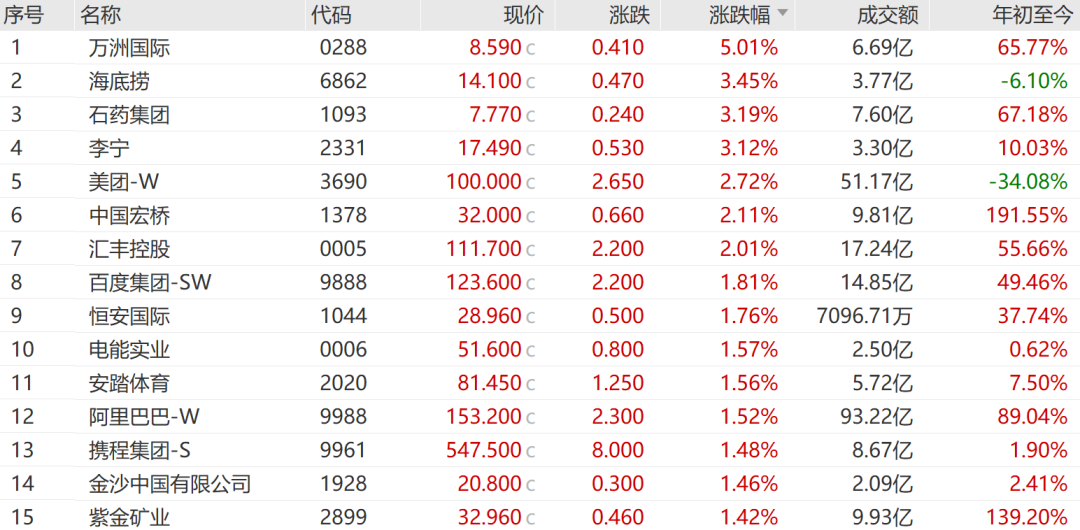
Market Overview - The Hong Kong stock market showed a rebound on December 10, with the Hang Seng Index rising by 0.42% to close at 25,540.78 points, and the Hang Seng Tech Index increasing by 0.48% to 5,581.10 points [1] - The total market turnover was HKD 1,933.92 million, a decrease from HKD 2,102.36 million in the previous trading day [1] Stock Performance - Among the Hang Seng Index constituents, 43 stocks rose while 42 fell, with notable gainers including: - WH Group (万洲国际) up 5.01% to HKD 8.590, with a year-to-date increase of 65.77% [2] - Haidilao (海底捞) up 3.45% to HKD 14.100, with a year-to-date decrease of 6.10% [2] - CSPC Pharmaceutical (石药集团) up 3.19% to HKD 7.770, with a year-to-date increase of 67.18% [2] - Alibaba had a trading volume of HKD 93.22 million, rising by 1.52% [3] Sector Performance - The Hang Seng Industry Index showed mixed results: - Materials sector increased by 1.47% - Consumer discretionary sector rose by 0.85% - Consumer staples sector grew by 0.66% - Industrial sector decreased by 0.84% - Healthcare sector fell by 0.64% [4] Regulatory Developments - The Hong Kong Stock Exchange confirmed a joint letter with the Hong Kong Securities and Futures Commission to IPO sponsors regarding concerns over the quality of recent listing applications and non-compliance issues [5] - The exchange emphasized its commitment to ensuring timely and rigorous reviews of new listing applications to maintain high standards [5] Company-Specific News - Vanke Enterprises (万科企业) experienced a significant surge, with a maximum increase of 18.56% on December 10, closing at HKD 3.78 per share, a rise of 13.17% [6] - Vanke's bondholders meeting discussed the extension of its first bond, "22万科MTN004," and the company announced no adjustment to the interest rate of "21万科02," maintaining it at 3.98% [7][8] New Financial Products - A new actively managed ETF linked to the Hang Seng China Enterprises Index is set to launch on December 11, with a unit price of HKD 8.8 and a management fee of 0.99% [12]