通用自动化

Search documents
2026出海向中上游去-机械设备将成-牛股大本营
2026-02-05 02:21
Summary of Key Points from Conference Call Industry Overview - The mechanical equipment industry is expected to benefit from accelerated industrialization in emerging markets, particularly in Brazil and Saudi Arabia, with significant demand growth in capital goods such as power equipment, construction machinery, and mining machinery. However, the import share from the US has not increased [1][2]. Core Insights and Arguments - **Investment Opportunities**: The investment opportunities in the mechanical industry for 2026 are primarily focused on two areas: equipment exports and technological leadership. Emerging markets are showing increased demand for Chinese machinery, particularly in capital goods [2]. - **Technological Growth**: Emerging sectors like AI hardware and humanoid robots are expected to continue leading the market, with a sustained upward trend in 2026. The cyclical industries such as photovoltaic equipment and general automation are closely tied to the domestic manufacturing cycle [1][2]. - **Engineering Machinery Recovery**: The engineering machinery sector is poised for recovery, with domestic demand expected to rise as the cycle bottomed out in 2024-2025. The competitiveness of Chinese engineering machinery products is increasing, facilitating further international expansion [2][5]. Additional Important Content - **Stock Selection Focus**: Investors should pay attention to emerging growth areas (AI hardware, humanoid robots), cyclical industries (photovoltaic equipment, general automation), and traditional industries at inflection points (engineering machinery) that benefit from the overseas interest rate decline [1][2]. - **AI Equipment Industry**: The AI equipment supply chain is highlighted as a highly certain industry trend, with significant performance already reflected in financial reports. Companies like Dingtai and Zhongtung are expected to benefit from overseas demand and new materials [11]. - **PCB Industry Outlook**: The PCB industry is projected to experience significant growth from 2026 to 2027, with a potential market space increase of around 10 times compared to 2025. This growth is driven by new technologies and materials [12]. - **Engineering Machinery Market Dynamics**: The engineering machinery sector is expected to see strong growth in both domestic and international markets, with leading companies like SANY and XCMG focusing on internationalization strategies [14]. Specific Investment Directions - **Emerging Sectors**: Key sectors to watch include wind and lithium batteries, general automation, and AI-related industries, which are expected to show strong performance in 2026 [15][16]. - **Recommended Stocks**: Specific companies to consider include Zhongtung, Huarui Precision, Oke Yi, and Xinxin Co., which are positioned well within the AI and manufacturing sectors [18][19]. Overall Industry Trend - The mechanical industry is characterized by technological growth and an export cycle, with AI and related sectors expected to lead the market. Export-oriented companies with product, channel, and cost advantages are likely to find more opportunities in the global market [20].
机械2026年策略:科技领航,周期起舞
2025-12-08 00:41
Summary of Key Points from the Conference Call Industry Overview - The mechanical industry is expected to show strong growth in 2024, particularly in technology and AI-related sectors, as well as cyclical assets like engineering machinery. As of the end of October, the overall increase in the mechanical industry was approximately 35%, ranking it among the top sectors [1][2]. Core Insights and Arguments - **Growth Drivers**: AI and technology investments are anticipated to accelerate, with engineering machinery having passed its cyclical low. Domestic demand is at the bottom of its cycle, while sectors like photovoltaic equipment present investment opportunities. Exports are also expected to remain robust [1][4]. - **Performance of Sub-sectors**: From January to November, AI equipment and consumables saw an increase of over 150%, with significant growth in offshore wind installations reflecting positive fundamental changes [1][5]. - **Market Influences**: Key events influencing the market include the rise of humanoid robots, breakthroughs in East's superconducting Tokamak experiments, and strong engineering machinery data in Q1, which have driven asset prices upward [1][7]. Investment Opportunities - **2026 Strategy**: Focus on investments that are positioned for recovery and growth, particularly in AI and technology sectors, as well as engineering machinery and photovoltaic equipment. Export sectors are also expected to maintain a favorable outlook [4][14]. - **Lithium Battery Market**: 2024 is projected to be a low point for the lithium battery market, but signs of recovery are evident in 2025, driven by solid-state battery development and increasing storage demand [3][19]. - **General Automation**: The general automation sector is expected to show improvement after a downturn, with specific focus on the tooling segment, which is crucial for future growth [11][21]. Noteworthy Developments - **Humanoid Robots**: The humanoid robot sector is experiencing a significant upward trend, with potential sales reaching automotive levels. The market is still in its early penetration phase, indicating substantial future growth potential [16]. - **Investment in Key Companies**: Companies like XCMG, LiuGong, and SANY Heavy Industry are highlighted as strong candidates for investment in the engineering machinery sector due to their solid fundamentals and attractive valuations [25][26]. Market Dynamics - **Impact of Global Trends**: The mechanical industry is influenced by global economic conditions, including U.S.-China relations and interest rate expectations, which affect export performance and overall market sentiment [27]. - **Stock Investment Considerations**: Time scales and market space assessments are critical for stock investments, with a projected market size of over 10 billion yuan by 2027, emphasizing the importance of selecting core companies with strong performance metrics [15]. Conclusion - The mechanical industry is poised for growth driven by technological advancements and cyclical recoveries. Key sectors such as AI, engineering machinery, and lithium batteries present significant investment opportunities, while global economic factors will play a crucial role in shaping market dynamics moving forward [1][27].
华泰证券:12月中下旬“春躁”可能提前启动,均衡配置成长和周期
Sou Hu Cai Jing· 2025-12-07 23:59
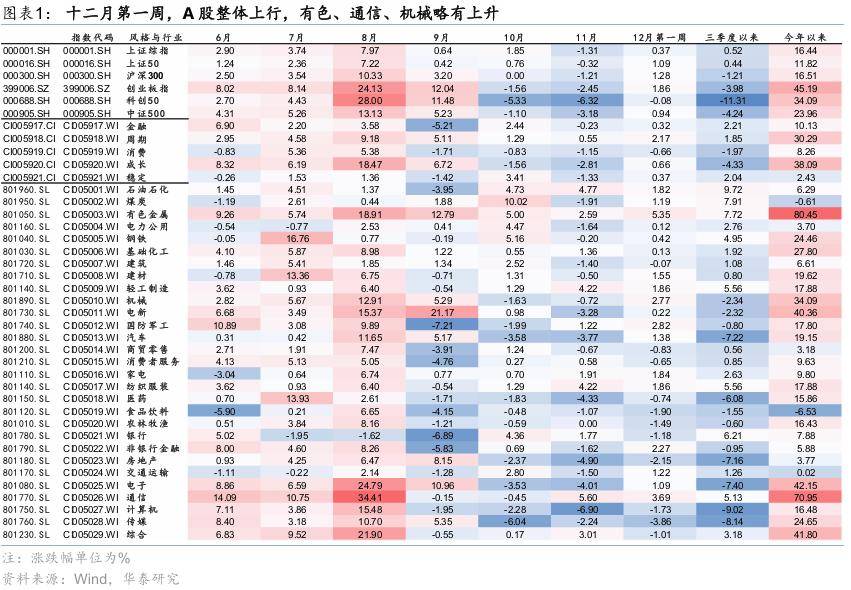
Group 1: Core Insights - The funding environment has improved, with signs of recovery in allocation-type funds and a reduction in insurance risk factors potentially leading to increased equity asset allocation [2][4] - Recent trends indicate a marginal slowdown in trading funds, while private equity registrations have slowed to 178, but product issuance and positioning are expected to accelerate [2][3] Group 2: Economic Trends - The TMT sector, upstream resources, and public industries have shown significant improvement in economic sentiment over the past three months, with AI applications, price increases in commodities, and capital goods leading the way [3][4] - The construction PMI has strengthened, indicating a positive outlook for the infrastructure chain, while consumer goods such as cinema, cosmetics, and dairy products are also experiencing a recovery [3][4] Group 3: Policy Outlook - Anticipation of policy changes ahead of the December Political Bureau and Central Economic Work Conference is rising, with expectations for more proactive macro policies and a focus on expanding domestic demand [4] - Historical data suggests a higher probability of market gains leading up to the Central Economic Work Conference, particularly in sectors like consumer services and home appliances [4] Group 4: Investment Strategy - The market is currently in a phase of recovery, with potential for a "spring rally" to begin in late December, emphasizing a balanced allocation between growth and cyclical sectors [4] - Key sectors to focus on include aviation equipment, AI chains, and power equipment for growth, while non-ferrous metals and certain chemicals are highlighted for cyclical investments [4]


华泰证券:短期哑铃型配置强化,建议在成长、周期和红利中均衡配置
Mei Ri Jing Ji Xin Wen· 2025-11-18 00:30
Core Viewpoint - The overall industry prosperity index continued to decline in October, but the rate of decline has slowed down, with improvements noted in essential consumption, midstream manufacturing, and large financial sectors, while TMT (Technology, Media, and Telecommunications) shows continued differentiation [1] Group 1: Industry Insights - The essential consumption, midstream manufacturing, and large financial sectors are leading in terms of prosperity improvement [1] - The TMT sector continues to exhibit a mixed performance, indicating varying levels of recovery across different segments [1] Group 2: Investment Strategy - A short-term "barbell" strategy is recommended, suggesting a balanced allocation across growth, cyclical, and dividend stocks [1] - Focus on identifying sectors with improving prosperity that have a degree of sustainability, as well as those with relatively low valuations and chip positions [1] - Potential recovery opportunities are highlighted in sectors such as non-ferrous metals, chemicals, new energy, general automation, storage, military industry, and insurance [1] - Additionally, there is a suggestion to consider left-side positioning in certain consumer and service sectors, such as dairy products [1]
汇川技术(300124) - 投资者关系活动记录表(2025年10月27日)
2025-10-27 06:10
Group 1: General Automation Business Performance - The general automation business has seen positive order growth across over 40 downstream industries, indicating a recovery trend in manufacturing [2][3] - The company’s market share in the domestic market continues to rise, primarily by replacing foreign brands, especially in the automotive and semiconductor sectors [2][3] - The lithium battery industry has contributed to the growth of the general automation business, alongside successful penetration in semiconductor, 3C equipment, machine tools, and automotive sectors [3][4] Group 2: Profitability and Competition - The core profit margin of the general automation business has been on the rise, despite some price pressure on products [3][4] - The company has maintained stable overall gross margins through rapid growth in high-margin products and optimization of product structure [3][4] - Inventory levels among downstream distributors are normal, with no signs of stockpiling [3] Group 3: International Expansion and Strategy - The company has invested over 700 personnel in overseas operations, focusing on developing safety products that meet European and North American standards [4][5] - The overseas business has grown nearly 50% from January to September 2025, outpacing domestic growth [5] - The company faces challenges in brand recognition and product requirements in the European and American markets, which it aims to address through international branding efforts and product development [4][5] Group 4: Robotics and AI Development - The company is focusing on developing humanoid robots by first establishing a competitive advantage in core components and then targeting industrial applications [6][7] - The integration of AI and vision technology into industrial robots is a key development area, enhancing the company's competitive edge [6][7] - The company plans to leverage open-source models in AI applications, emphasizing the importance of industrial context in AI deployment [9][10] Group 5: Financial Outlook and Cost Management - The company expects to maintain stable gross margins in the general automation business through product structure optimization and cost control [10][11] - R&D expenses are projected to continue rising, supporting long-term growth, while sales and management expenses are expected to decrease due to scale effects [11] - The target is to keep the overall expense ratio around 17% [11]

步科股份:8月27日召开董事会会议
Mei Ri Jing Ji Xin Wen· 2025-08-28 10:28
Group 1 - The core point of the article is that Buke Co., Ltd. (SH 688160) announced the convening of its fifth board meeting to review the 2025 semi-annual report and its summary [1] - For the fiscal year 2024, Buke Co., Ltd. reported that 99.46% of its revenue came from the general automation industry, while other businesses accounted for 0.54% [1] - As of the report date, Buke Co., Ltd. has a market capitalization of 8.2 billion yuan [1]

华泰证券:7月大金融、中游制造、TMT景气改善
Mei Ri Jing Ji Xin Wen· 2025-08-11 23:53
Core Viewpoint - The overall industry and non-financial sector prosperity index rebounded in July, with improvements noted in major financial, midstream manufacturing, and TMT sectors [1] Group 1: Sector Insights - The rebound in the prosperity index is supported by policies aimed at reducing competition and stabilizing ROE [1] - Various sectors are entering a bottoming or climbing phase, including industrial metals, energy metals, steel, certain chemicals, wind power, automotive, aquaculture, and logistics [1] - Overseas AI capital expenditure continued to rise in Q2, driving improvements or maintaining high levels in AI-related components such as storage, software, and gaming [1] Group 2: Investment Recommendations - Tactical focus should be on sectors showing signs of improvement and potential for catch-up, including storage, software, general automation, chemicals, insurance, and coal [1] - Strategic allocation should continue to favor major financials, military industry, and pharmaceuticals, with the pharmaceutical market potentially expanding from innovative drugs to medical devices [1]
超4200股上涨,沪指再刷年内新高
2 1 Shi Ji Jing Ji Bao Dao· 2025-08-11 03:55
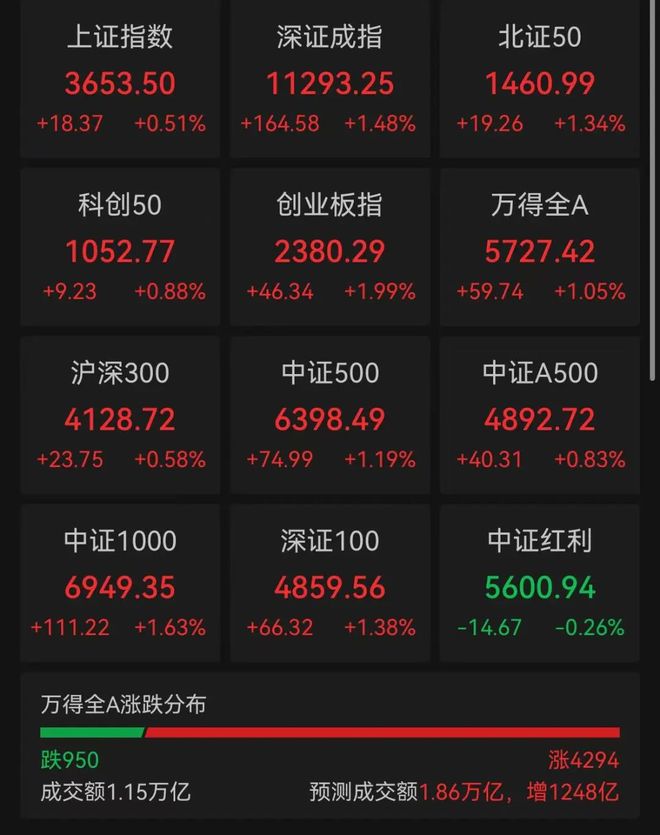
Market Performance - A-shares experienced a collective rise with major indices reaching new highs, with the Shanghai Composite Index up by 0.51%, Shenzhen Component Index up by 1.48%, and ChiNext Index up by 1.99% [1][2] - The trading volume in the Shanghai and Shenzhen markets exceeded 1 trillion yuan for the 53rd consecutive trading day, with an expected total trading amount of over 1.8 trillion yuan [2] Sector Performance - The market showed a healthy rotation of hotspots, with over 4,200 stocks rising, while sectors such as PEEK materials and lithium mining led the gains [3][4] - PEEK materials increased by 6.20%, lithium mining by 5.51%, while sectors like banking, electricity, and gold saw declines [3][4] Investment Insights - Huatai Securities noted a rebound in A-shares driven by trading funds, with a tactical focus on sectors like storage, software, and insurance, while maintaining a strategic outlook on large financials, pharmaceuticals, and military industries [5] - The average price-to-earnings ratios for the Shanghai Composite and ChiNext indices are at 14.93 and 41.75 respectively, indicating a suitable environment for medium to long-term investments [5] - The Chinese economy is showing a moderate recovery, with consumption and investment as core drivers, supported by a favorable liquidity environment [5]
7月中观景气月报——“反内卷”初现成效
2025-08-11 01:21
Summary of Conference Call Records Industry Overview - The conference call discusses the impact of the "anti-involution" policy on various industries, including traditional cyclical goods, wind power, automotive, aquaculture, and logistics, leading to positive effects on advanced manufacturing sectors [1][5] - The AI industry is highlighted, with overseas capital expenditure exceeding expectations, driving an increase in AI agent penetration rates and improvements in the upstream PCB output and revenue [1][6] Key Points and Arguments Economic Indicators - In July, the profitability of industrial enterprises showed a rebound, with accounts receivable turnover days decreasing, indicating the effectiveness of the anti-involution policy at the macro level [1][7] - The overall industry and non-financial sector's prosperity index improved in July, particularly in finance, manufacturing, and TMT sectors, supported by favorable policies [3] Sector Performance - **Industrial Metals and Energy**: Prices for copper and aluminum rose significantly in July, while lithium resource prices showed signs of stabilization [5] - **Automotive Sector**: Strong sales and export data were reported, with new installations in wind power showing improved growth rates [5] - **Gaming Industry**: The number of approved domestic games remained high, with significant new releases expected in August, potentially catalyzing market activity [9] - **AI Industry**: The PCB output and revenue in Japan and Taiwan showed year-on-year growth, with the storage index increasing for five consecutive months [6][8] Specific Industry Trends - **Small Metals and Military Industry**: Prices for rare earths and tungsten have risen significantly, driven by improved demand from military and advanced manufacturing sectors [2][10] - **General Automation Equipment**: Production of machine tools, CNC devices, and robots saw a notable year-on-year increase, with good export data [4][11] - **Pharmaceutical Sector**: The sector is showing signs of recovery, with significant increases in industrial value-added and profit in June [4][12] - **Insurance Sector**: Both liability and investment logic have improved, with continuous growth in premium income [4][13] Additional Important Insights - The current market risk appetite remains high, with strong performances in the robotics and military sectors, driven by events and new product launches [15] - Recommendations for tactical allocations include storage, software, general automation, chemicals, insurance, and coal, while strategically favoring finance, military, and pharmaceuticals [14] - The market is exhibiting a "dumbbell" style, with small-cap stocks performing strongly [16] Market Dynamics - Retail investor funds are still showing a net outflow, although there was a slight increase in account openings in July [18] - Foreign capital outflows have slowed, with recent weeks showing slight net outflows [19] - The derivatives market indicates a moderate recovery, with stock index futures showing no strong bullish or bearish expectations [25] This summary encapsulates the key insights and trends discussed in the conference call, providing a comprehensive overview of the current state of various industries and market dynamics.
十大券商一周策略:A股仍处于牛市中继,避免参与似是而非的资金接力
Zheng Quan Shi Bao· 2025-08-10 23:59
Group 1 - The current market for small and micro-cap stocks needs to slow down, as high valuations and negative TTM profits make it difficult to justify further upward movement [2] - The five strong industry trends (non-ferrous metals, telecommunications, innovative pharmaceuticals, gaming, and military industry) have more reasonable valuations compared to the small and micro-cap stocks [2] - The main drivers of small and micro-cap stocks are liquidity and retail investor contributions, but their overall profit growth is not as strong as in 2015 [2] Group 2 - A rebound in A-shares was observed, driven by trading funds, with a focus on themes like dividends and small micro-cap stocks [3] - The two financing balance reached a nearly 10-year high, indicating that liquidity-driven market conditions may still have incremental support [3] - The PPI has shown signs of bottoming out, and the "anti-involution" policy is beginning to show effects, suggesting a stable economic outlook [3] Group 3 - July exports exceeded expectations, particularly in competitive manufacturing sectors like machinery, automobiles, and integrated circuits [4] - The PPI decline has stabilized, benefiting from price rebounds in sectors like black metals, non-ferrous metals, coal, and photovoltaics [4] - The basic economic fundamentals are showing a trend of steady improvement, with recommendations to focus on sectors with high growth or improvement in earnings [4] Group 4 - The two financing balance has risen above 2 trillion yuan, but remains at historical mid-levels compared to the peak in 2015 [5] - The market is expected to maintain a high volatility range, with a focus on sectors with strong earnings performance during the concentrated reporting period [5] - The "anti-involution" concept is anticipated to be a recurring theme in the market, alongside opportunities in growth sectors driven by AI and emerging industries [5] Group 5 - The current bull market atmosphere is not expected to dissipate easily, with potential mainline directions including domestic technological breakthroughs and competitive manufacturing sectors [6] - The market is likely to maintain its characteristics of sector rotation and high micro-level activity, with small-cap growth stocks continuing to outperform [6] - There are new opportunities for participation, particularly in event-driven individual stocks [6] Group 6 - Short-term upward movement in A-shares may face resistance, but the market remains in a bull market continuation phase [7] - The focus is on new low-level niche products in emerging sectors, with significant potential in areas like brain-computer interfaces and liquid cooling technologies [7] - The military sector is expected to have a short-term rally, with attention on new combat capabilities and military trade-related stocks [7] Group 7 - The current market rally is supported by various sources of incremental capital, with a notable increase in M1-M2 growth rates indicating enhanced liquidity [8] - The two financing balance reaching a 10-year high reflects a rising risk appetite among individual investors [8] - The focus on new technologies and growth directions, such as domestic computing power and robotics, is expected to drive future market trends [8] Group 8 - There is a divergence in judgment regarding the liquidity-driven bull market, with the potential for significant resident capital inflow into the stock market [9] - Historical patterns suggest that the initial phases of a bull market often see improvements in specific channels before broader participation [9] - The current market's rise is still modest compared to previous bull markets, indicating that concerns about a major downturn may be premature [9] Group 9 - The current market adjustment is seen as a structural shift rather than a peak in the broader cycle, with manageable index fluctuations [11] - The market is transitioning from traditional cyclical sectors to technology sectors, driven by policies similar to previous economic stimulus measures [11] - Continued focus on technology sectors, including AI and robotics, is recommended for future investment strategies [11]