人工智能ETF

Search documents
英伟达归零,寒武纪狂飙超20倍!中国半导体正在迎来替代时刻!
市值风云· 2025-10-21 10:07
Core Viewpoint - The article highlights the significant growth of domestic semiconductor companies in China, particularly in the context of Nvidia's exit from the Chinese market, creating a unique opportunity for local firms to fill the gap left behind [3][7]. Financial Performance of Cambrian - Cambrian reported a third-quarter revenue of 1.727 billion yuan, marking a year-on-year increase of 1332.52%, and a net profit of 567 million yuan, achieving profitability for four consecutive quarters [5][6]. - For the first three quarters of 2025, Cambrian's total revenue reached 4.607 billion yuan, a staggering increase of 2386.38% compared to the same period last year [10]. - The gross margin for the third quarter was 54%, which, despite a slight decrease, is considered stable given the increased shipment of high-end chips [11]. R&D Investment - Cambrian invested 260 million yuan in R&D during the third quarter, a year-on-year increase of 22.1%, with R&D intensity nearing 15% [8][9]. Industry Trends - The exit of Nvidia has opened a valuable development window for Chinese semiconductor companies, allowing them to accelerate their growth and establish a self-sufficient ecosystem [8][18]. - Other semiconductor companies, such as Haiguang Information and Ruixinwei, also reported strong financial performances in the first three quarters, indicating a broader positive trend across the industry [15][16]. Investment Opportunities - The semiconductor sector is experiencing a multi-faceted upturn due to Nvidia's exit, improved supply-demand dynamics, and accelerated domestic substitution, suggesting a sustained increase in industry prosperity [18]. - Investors are encouraged to consider a diversified investment strategy in the semiconductor sector, focusing on high-growth areas such as AI and robotics [19][20].



天亮了吗?——通信ETF大涨点评
Mei Ri Jing Ji Xin Wen· 2025-10-20 06:08
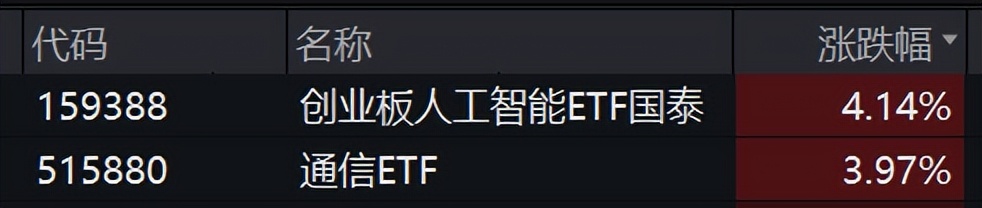
Market Performance - On October 20, the market experienced high-level fluctuations in the early session, with the ChiNext Index leading the gains. The total trading volume in the Shanghai and Shenzhen markets reached 1.16 trillion yuan, a decrease of 16.5 billion yuan compared to the previous trading day. By midday, the Shanghai Composite Index rose by 0.69%, the Shenzhen Component Index increased by 1.38%, and the ChiNext Index surged by 2.49%. Notably, overseas computing power was strong, with the ChiNext AI ETF rising by 4.14% and the communication ETF increasing by 3.97% [1]. Factors Driving the Upsurge - Nvidia's Rubin shipment expectations for 2026 have been raised, and the competitive landscape in the optical module market remains stable. If the market expands, it is theoretically expected that the performance of related manufacturers will also improve [2]. - The upcoming release of Google's Gemini 3 series has generated buzz, with leaked demo tests indicating its strong capabilities. Gemini 3 addresses AI display issues with precision down to the second hand, outperforming GPT-5 in certain aspects. The number of tokens processed by Google has seen a significant increase, surpassing 1.3 trillion monthly, up from 980 trillion in July and 480 trillion in May, indicating a steep growth trajectory [2]. Market Outlook - The AI wave is expected to continue, with a focus on computing power as the main line. The acceleration of industrialization is evident, with overseas infrastructure investments resonating with performance and mature business models leading to a noticeable speed-up in AI. Domestically, the production of domestic GPUs is accelerating, and domestic computing power remains strong. Recent tariff expectations have led to a pullback in computing power, presenting potential low-position investment opportunities [4]. - There is a caution regarding short-term pullback risks. Geopolitical tensions and tariff risks are expected to have a relatively larger impact on consumer electronics and communications sectors, while the semiconductor sector is less affected. Multiple disruptive events may increase market volatility, and significant developments may remain uncertain ahead of APEC [5]. Investment Considerations - Following previous pullbacks, better investment opportunities may arise. Investors are encouraged to consider both domestic and overseas computing power investments, with a focus on communication ETFs (515880) and semiconductor equipment ETFs (159516) [5].
近半资金撤离!高位ETF止盈潮涌,什么情况?
券商中国· 2025-10-15 12:00
Core Viewpoint - A significant amount of capital is fleeing high-position ETFs, indicating a structural shift in market behavior where funds are moving from high-performing sectors to those that have underperformed [1][3][4]. Market Dynamics - Recent market volatility has intensified, with a clear "high-cut low" structural characteristic. Funds are withdrawing from previously high-performing sectors while reallocating to those with lower gains. This rotation is expected to be a prolonged process with multiple reversals [2][4]. - Year-to-date, there is a stark divergence in industry performance, with sectors like non-ferrous metals, communications, electronics, and power equipment seeing gains over 40%, while sectors such as food and beverage, coal, and transportation have not seen positive returns [4]. ETF Performance - High-performing ETFs are experiencing significant capital outflows, with the STAR Market 50 ETF being the most affected, seeing a net outflow of nearly 50 billion yuan this year, reducing its share size by almost half [5]. - Other ETFs, such as the ChiNext ETF, have also faced substantial outflows, with over 20 billion yuan leaving since September [5]. - Conversely, underperforming ETFs, particularly in the brokerage sector, have attracted over 10 billion yuan in net inflows, indicating a shift in investor sentiment towards these lagging assets [8]. Investment Trends - The trend of "selling high and buying low" is evident, with funds increasingly favoring ETFs that have not performed well this year. For instance, the brokerage sector ETFs have seen a significant increase in share size, with the Huabao Brokerage ETF's circulation nearly tripling since the beginning of the year [8]. - The market is witnessing a rotation towards assets with strong balance sheets and robust operational patterns, which are expected to benefit from market volatility [12]. Future Outlook - The ongoing trend of capital moving from high-return sectors to those with lower valuations is anticipated to continue, with the potential for prolonged market reversals. Investors are advised to focus on assets with resilience and long-term value creation potential [10][12].

这只“量化”基金,连亏5年...
Sou Hu Cai Jing· 2025-10-14 10:25
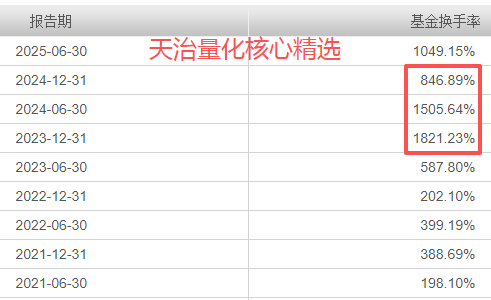
Core Viewpoint - The "Tian Zhi Quantitative Core Selection" fund has experienced significant losses, with a reported decline of 13.39% this year, marking a trend of consecutive annual losses over the past four years, each exceeding double digits [5][27]. Fund Performance - The fund's turnover rate has been exceptionally high, reaching over 1000% since August 2023, indicating frequent trading of its top holdings [14]. - The fund's net asset value has fluctuated significantly, with a reported net asset change rate of 374.38% as of June 30, 2025, despite the overall decline in performance [8]. Fund Management - The fund has undergone management changes, with five different fund managers, each contributing to poor performance rankings [19]. - The previous manager, Xu Jiahan, is noted for making high-risk investments, leading to substantial losses during his tenure [11][23]. Investment Strategy - The fund's investment strategy has been criticized for chasing high-performing stocks, particularly during periods of market volatility, which has exacerbated losses [16][27]. - The current manager, Li Shen, has shifted the fund's focus towards value stocks, particularly in the financial and public utility sectors, but has struggled to capitalize on market rebounds [25][27]. Market Context - The fund's performance is set against a backdrop of broader market trends, with significant fluctuations in growth and value sectors, impacting overall investment strategies [30][34]. - Despite the fund's poor performance, there has been an influx of retail investor interest, leading to an increase in the fund's C share scale from 2 million to 7 million [28].


超300亿,大举加仓
Zhong Guo Ji Jin Bao· 2025-10-13 07:00
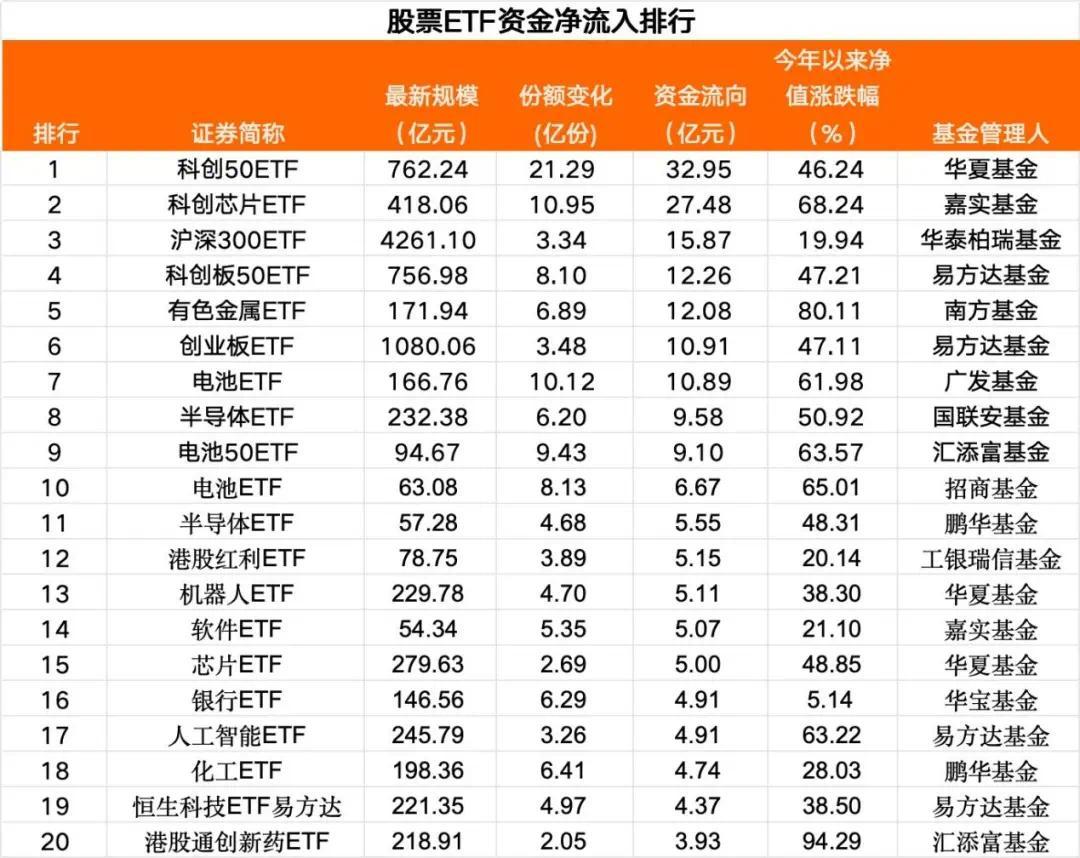
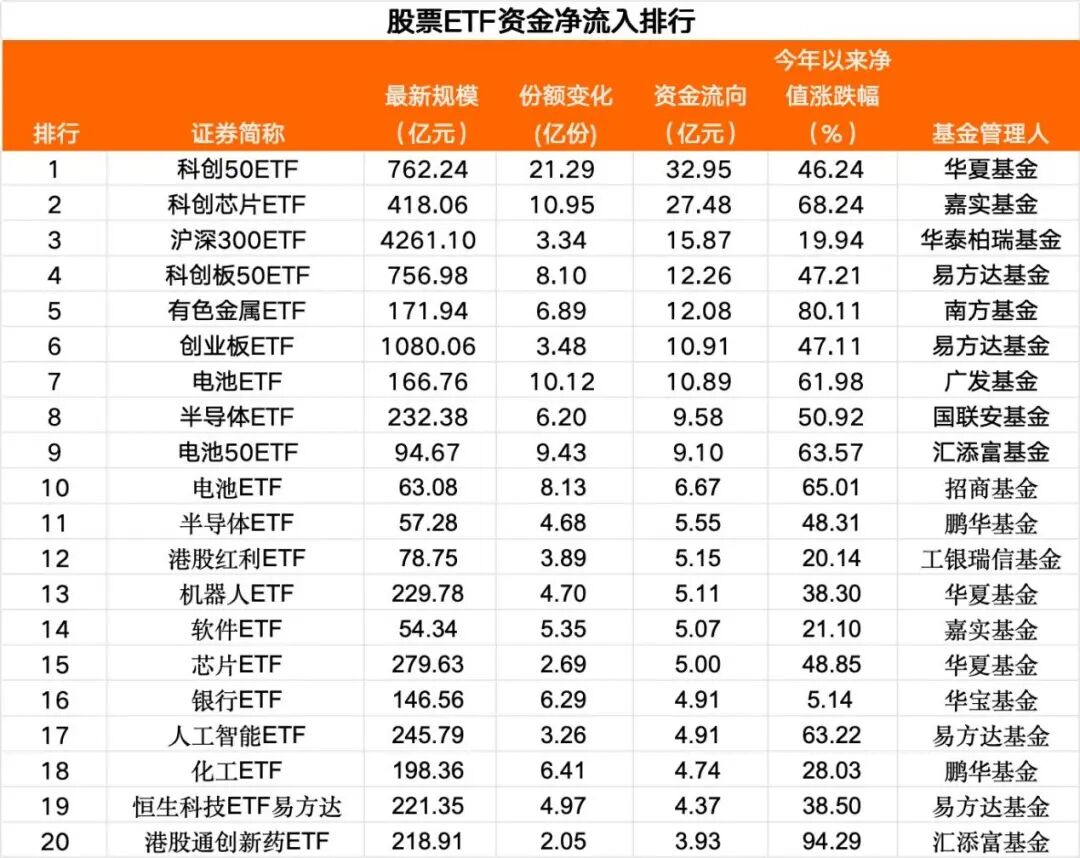
Core Insights - The A-share market experienced a significant adjustment on October 10, with all three major indices declining, particularly the ChiNext index which fell over 4.5% [1] - Despite the market downturn, there was a notable inflow of funds into stock ETFs, with a net inflow exceeding 300 billion yuan on the same day [2] Fund Flow Analysis - On October 10, the total scale of 1,224 stock ETFs in the market reached 4.59 trillion yuan, with a net inflow of approximately 315 billion yuan for the day [2] - The top three stock ETFs by net inflow were the Huaxia Science and Technology Innovation 50 ETF, the Harvest Science and Technology Chip ETF, and the Huatai-PB CSI 300 ETF, each with net inflows exceeding 15 billion yuan [2][4] - The commodity gold ETFs also attracted significant interest, with a net inflow of over 20 billion yuan, driven by rising international gold prices [2] Performance of Specific ETFs - The Huaxia Science and Technology Innovation 50 ETF had a net inflow of 32.95 billion yuan, bringing its total size to 762.24 billion yuan, while the Robot ETF saw a net inflow of 5.11 billion yuan [3][4] - Conversely, several broad-based ETFs experienced significant net outflows, particularly the CSI A500 ETF, which saw a net outflow exceeding 25 billion yuan [5][6] Market Sentiment and Future Outlook - The market is characterized by a "high cut low" trend, indicating a shift in investor focus towards safer assets amid geopolitical tensions and market volatility [8] - Analysts suggest that the recent communication between the US and China may stabilize market risks, while expectations of a weaker dollar and potential interest rate cuts in some economies could create favorable conditions for domestic policy easing [8]
超300亿,大举加仓!
Zhong Guo Ji Jin Bao· 2025-10-13 06:43
Core Insights - The stock ETF market experienced a significant net inflow of over 30 billion yuan on October 10, despite a notable decline in the A-share market, with the ChiNext index dropping more than 4.5% [1][2][3] Fund Flow Analysis - On October 10, the total scale of 1,224 stock ETFs (including cross-border ETFs) reached 4.59 trillion yuan, with a net inflow of approximately 31.5 billion yuan for the day [3] - The top three ETFs by net inflow were the Huaxia Science and Technology Innovation 50 ETF, the Harvest Science and Technology Chip ETF, and the Huatai-PB CSI 300 ETF, each with inflows exceeding 1.5 billion yuan [3][5] - The commodity gold ETFs also attracted significant interest, with a net inflow of over 2 billion yuan on the same day [3] Sector Performance - The inflow of funds was primarily directed towards broad-based ETFs such as the Science and Technology Innovation 50 ETF and sector-specific ETFs in semiconductors, batteries, and non-ferrous metals [2][3] - Conversely, several broad-based ETFs, including the CSI A500 ETF and CSI 1000 ETF, experienced substantial net outflows, with the former losing over 2.5 billion yuan [6][8] Recent Trends - In the first two trading days of October, stock ETFs saw a cumulative net inflow exceeding 40 billion yuan, with significant inflows into ETFs tracking the Science and Technology Innovation Board, ChiNext, and CSI 300 indices [7] - The market is characterized by a "high cut low" trend, indicating a shift in investor focus towards safer assets amid increasing volatility in overseas markets [9]
科技股牛市中,ETF成为锋利的矛!
Ge Long Hui· 2025-10-02 06:57
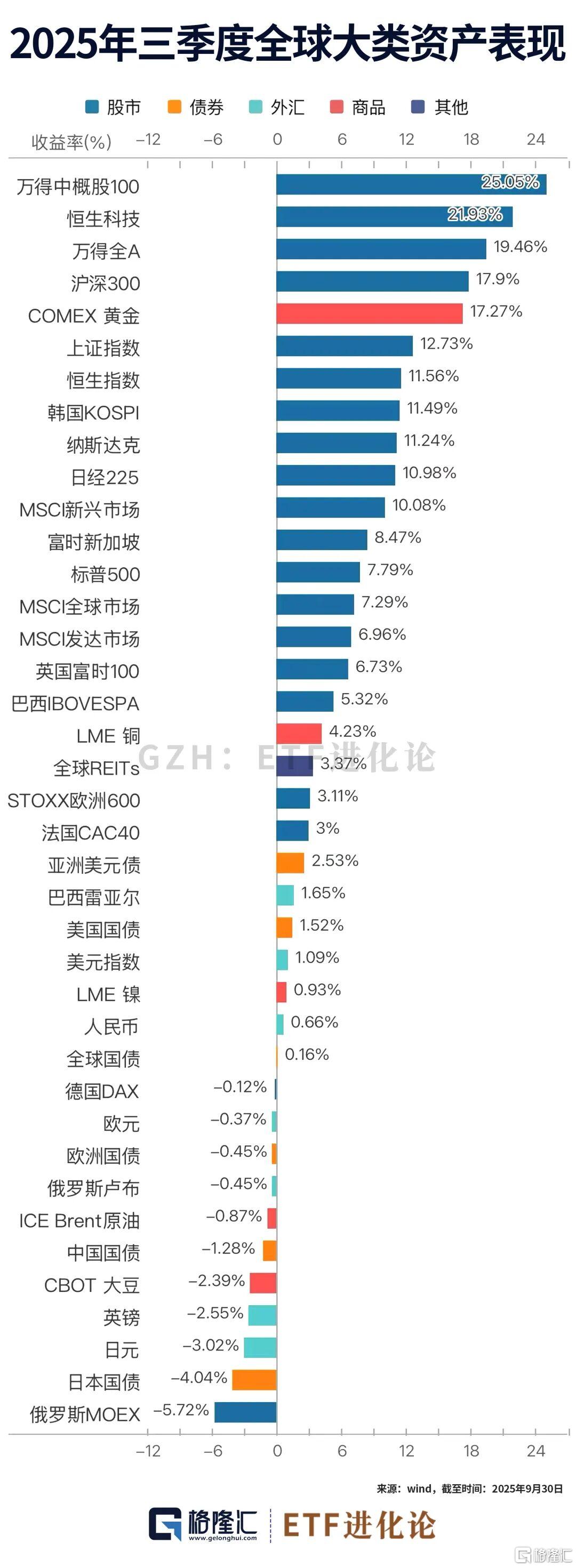
Core Insights - Chinese assets have experienced significant growth, with Hong Kong and A-shares leading global performance in Q3 2025 [1] - Major indices such as the Wind China Concept Stock 100 Index, Hang Seng Tech Index, Wind All A, and CSI 300 topped the global asset performance rankings [1][5] Group 1: Market Performance - In Q3, the ChiNext 50 and ChiNext Index surged over 50%, while the Sci-Tech 50 and Sci-Tech 100 increased by over 40% [5] - The Hang Seng Tech Index and the Hang Seng Index have been the top performers globally this year [5] - The Sci-Tech 100 and ChiNext 50 have led the A-share market in performance year-to-date [5] Group 2: ETF Trends - ETFs have emerged as a crucial investment tool, with significant inflows observed [7] - In Q3, communication ETFs and 5G communication ETFs rose over 80%, while AI ETFs and lithium battery ETFs increased by over 70% [6] - The total domestic ETF scale reached 5.63 trillion yuan by September 30, 2023, marking a growth of 1.89 trillion yuan since the beginning of the year [8] Group 3: Fund Flows - Over 314.7 billion yuan of net inflows into ETFs were recorded in Q3, with a total of 617.1 billion yuan attracted year-to-date [9] - The top ETFs for net inflows in 2023 include the Hong Kong Internet ETF, Securities ETF, and various bond ETFs [10] - Conversely, the Sci-Tech 50 ETF and ChiNext ETF experienced significant net outflows in Q3 [11]
超220亿元,加仓了
Zhong Guo Ji Jin Bao· 2025-09-29 06:31
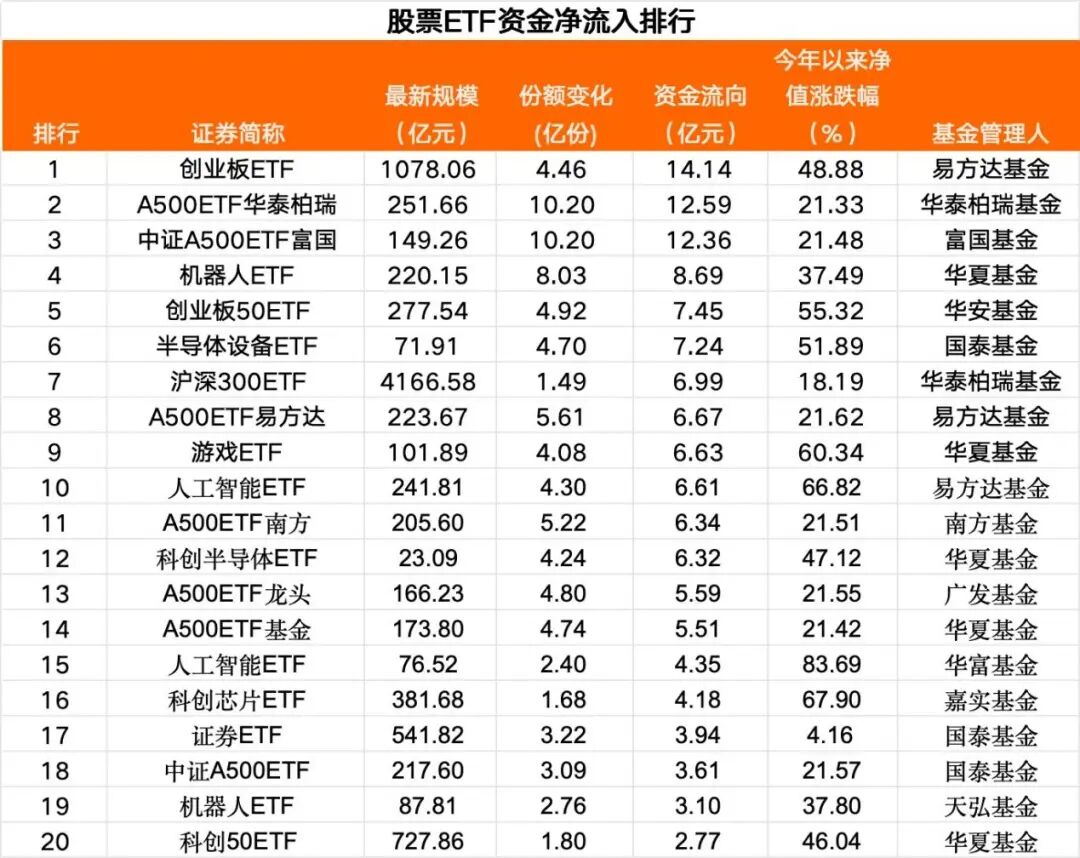
Core Insights - On September 26, stock ETFs saw a net inflow exceeding 22 billion yuan, with significant contributions from broad-based ETFs tracking indices like the CSI A500 and the ChiNext Index, as well as thematic ETFs focused on sectors such as semiconductors, artificial intelligence, and robotics [2][3][4] Summary by Category Market Performance - The A-share market experienced a collective decline on September 26, with the ChiNext Index dropping over 2.5%, while the total trading volume across both exchanges was approximately 2.15 trillion yuan [1] - Over the past week, the A-share market showed an overall upward trend, with stock ETFs accumulating over 30 billion yuan in net inflows, and nearly 100 billion yuan in net inflows for the month of September [2][6] ETF Inflows - As of September 26, the total scale of all stock ETFs in the market reached 4.46 trillion yuan, with 1218 stock ETFs (including cross-border ETFs) [3] - The top three ETFs by net inflow on September 26 were the E Fund ChiNext ETF (13.9 billion yuan), the Huatai-PB A500 ETF (6.6 billion yuan), and the CSI A500 ETF by Fortune (6.5 billion yuan) [4][5] - The net inflows for specific sectors included 52.2 billion yuan for the CSI A500, 37.0 billion yuan for semiconductors, and 20.3 billion yuan for artificial intelligence [3][4] ETF Outflows - On the same day, only six stock ETFs experienced net outflows exceeding 1 billion yuan, with significant losses seen in broad-based ETFs like the CSI 500 and the CSI 300, as well as thematic ETFs focused on rare earths and banking [6][8] - The top outflowing ETFs included the CSI 500 ETF with a net outflow of 2.84 billion yuan and the Rare Earth ETF with a net outflow of 2.40 billion yuan [8] Fund Company Insights - E Fund led the inflows with its ChiNext ETF and A500 ETF, while Huaxia Fund's Robotics ETF and Gaming ETF also saw significant inflows [4][5] - The market is currently characterized by a divergence in performance across sectors, with some sectors facing technical adjustment pressures after substantial prior gains [7]
罕见大资金抄底!单日222亿元涌入ETF
Shang Hai Zheng Quan Bao· 2025-09-29 06:23
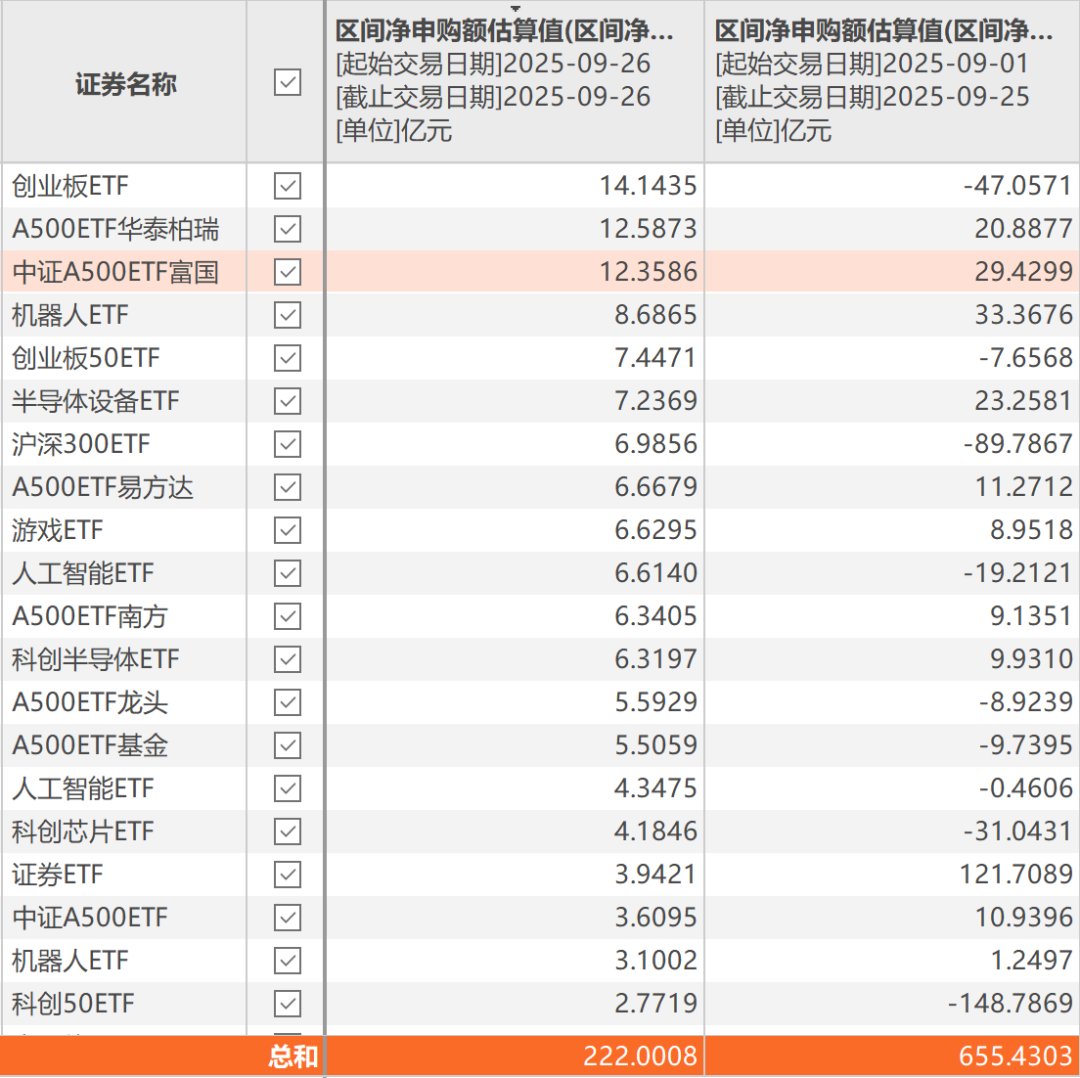
Group 1 - The upcoming National Day and Mid-Autumn Festival holidays have led to increased market focus on the question of "holding cash or holding stocks," with recent ETF subscription and redemption data suggesting a preference for equities [1][2] - On September 26, a total of 222 billion yuan flowed into equity ETFs, marking the highest single-day net subscription in over five months, second only to the 292 billion yuan recorded on April 16 of the same year [3][5] - The inflow of funds was particularly strong in sectors such as semiconductors, Hong Kong stocks, the ChiNext board, and artificial intelligence [1][5] Group 2 - The net subscription amounts for various ETFs on September 26 included over 55 billion yuan for the China A500 ETFs, with individual funds like Huatai-PB and Fuguo's China A500 ETFs each exceeding 12 billion yuan in net subscriptions [4][5] - Other notable ETFs that attracted significant inflows included the E Fund ChiNext ETF with 14.14 billion yuan and the Huatai-PB CSI 300 ETF with 7 billion yuan [5] - The overall trend indicates a shift from previous net outflows, as many investors entered the market to capitalize on perceived bargains during the market adjustment [5] Group 3 - The public fund issuance market has seen a resurgence, with new fund issuance in September reaching 1548.81 billion yuan, a significant increase of over 500 billion yuan compared to August, setting a new monthly record for the year [6][7] - Active equity funds have been particularly popular, with some funds experiencing high subscription rates, such as the招商均衡优选混合基金, which had a subscription confirmation rate of 56.67% despite a 50 billion yuan cap [7] - As of September 26, the average equity fund position was approximately 92.51%, indicating a strong commitment to equity investments as the fourth quarter approaches [7] Group 4 - Looking ahead to the fourth quarter, sectors such as tourism, dining, and entertainment are expected to remain active due to upcoming holidays and promotional events, supported by policies aimed at boosting consumer spending [8] - The A-share and Hong Kong stock markets are showing signs of recovery, with valuations in a reasonable range, which may attract more long-term global capital [8] - Investment opportunities are anticipated in cyclical sectors benefiting from economic recovery, midstream manufacturing, and AI technology driven by industry trends [8]
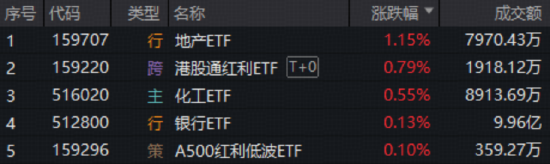
“老登”起舞,“小登”回调!节前资金调仓忙,金融科技、人工智能、创新药等ETF被逢跌抢筹
Xin Lang Ji Jin· 2025-09-28 11:57
Market Overview - A-shares experienced fluctuations with the Shanghai Composite Index down 0.65%, Shenzhen Component Index down 1.76%, and ChiNext Index down 2.60, with a total market turnover of 2.15 trillion yuan [1][2] - Over 3,400 stocks in the market declined, while traditional sectors like real estate, liquor, and banking showed resilience [1][2] Real Estate Sector - The real estate sector outperformed, with the real estate ETF (159707) rising over 1%, reaching a new high for the year, and seeing a net purchase of 23.5 million shares [1][3][5] - The implementation of new housing policies in Shanghai led to a significant increase in new home transactions, with a 30% month-on-month increase in the first week and a 19% increase overall for the month [5][6] - Analysts suggest that the easing of policies in major cities may lead to a short-term recovery in the housing market, with a focus on high-quality developers and those benefiting from debt relief and improved sales [5][6] Food and Beverage Sector - The food and beverage sector, represented by the food ETF (515710), showed a slight decline of 0.16%, with the overall performance of liquor stocks being weak [8][9] - Moutai's sales volume reportedly doubled, with significant growth observed in September, indicating a potential recovery in the liquor market [11][12] - The food ETF's underlying index is at a low valuation, suggesting a good opportunity for long-term investment [12][13] Hong Kong Market - The Hong Kong stock market faced declines, particularly in the internet and innovative drug sectors, with the Hong Kong Internet ETF (513770) down 2.6% and the Hong Kong Innovative Drug ETF (520880) down 1.44% [2][15] - Despite the downturn, there were signs of active buying in the innovative drug sector, indicating potential opportunities for investors [15][19] - Analysts maintain a positive long-term outlook for the Hong Kong market, suggesting that the technology sector may recover as it shifts focus from competition to AI-driven growth [18][19]