
《部落冲突》

Search documents
下一个TikTok?美国盯上腾讯游戏
财富FORTUNE· 2026-03-06 13:09
Core Viewpoint - The article discusses the potential implications of the U.S. government's renewed scrutiny of Tencent's significant stakes in various international gaming companies, positioning it as a new front in the ongoing U.S.-China technology and investment rivalry [1][3]. Group 1: U.S. Government Actions - The U.S. Committee on Foreign Investment (CFIUS) has been monitoring Tencent's global gaming investments for several years, with recent discussions about evaluating Tencent's investment structure in the U.S. and abroad [4]. - The scrutiny is framed under the guise of "data and national security," reflecting a continuation of past U.S. investigations into Chinese tech firms like ZTE, Huawei, and TikTok, but with some new characteristics [4][10]. - A meeting originally scheduled to assess Tencent's investments was postponed, indicating ongoing internal deliberations within the U.S. government [4]. Group 2: Tencent's Gaming Investments - Tencent has a vast gaming investment portfolio, including major stakes in companies like Supercell, Epic Games, and Riot Games, which contribute significantly to its revenue, with gaming accounting for one-third of Tencent's total income [5]. - The data collected from these games, such as user names, device information, and behavioral data, raises concerns about potential misuse for surveillance or influence [5][7]. - The cultural and ideological implications of gaming as a medium can also be leveraged to shape perceptions and influence young players, further complicating the narrative around Tencent's investments [6]. Group 3: Comparison with TikTok - Unlike TikTok, which is a non-public company and easier to divest from, Tencent is a publicly traded company with a transparent ownership structure, making it more challenging for the U.S. to impose drastic measures without considering market reactions [8][10]. - The potential outcomes of the scrutiny could range from selective approval of Tencent's investments to demands for divestiture, which would have significant repercussions for Tencent's revenue and the global gaming industry [10]. Group 4: Broader Implications - If the U.S. allows Tencent to retain its stakes, it may signal a pragmatic shift in U.S. technology policy towards China [10]. - Conversely, if Tencent is forced to divest, it could lead to a loss of independence for various gaming IPs and signal a broader trend of regulatory caution for Chinese internet companies looking to expand internationally [10][11].



下跌别慌,聊四个投资核心
雪球· 2026-03-06 08:28
Core Viewpoint - The article emphasizes the importance of value investing as a long-term strategy that aligns with personal growth and life experiences, advocating for a focus on quality companies and emotional resilience in investment decisions [7][50]. Group 1: Investment Strategy - Value investing is presented as a method that allows for long-term asset accumulation without sacrificing current life enjoyment [7]. - The article suggests that during market downturns, investors should focus on their own decision-making rather than blaming external factors, highlighting that many companies will eventually recover [10]. - It is recommended that investors maintain a portion of their portfolio in broad market indices to simplify investment decisions and reduce emotional stress during market fluctuations [10][50]. Group 2: Behavioral Insights - Many investors fail to make profits due to emotional reactions, such as buying high during market excitement and selling low during downturns, which is attributed to a tendency for simple reasoning [12][13]. - The article discusses the dangers of oversimplifying investment decisions, which can lead to poor outcomes, emphasizing the need for deeper analysis and understanding of market dynamics [24][30]. - It highlights that successful investing requires emotional control, the ability to withstand market volatility, and a clear judgment of a company's future prospects [50][78]. Group 3: Risk Management - The article stresses the importance of avoiding significant losses, as even a few bad outcomes can jeopardize long-term investment success [33][36]. - It references the Blackstone Group's investment philosophy, which prioritizes risk avoidance and survival during market downturns as a key to their sustained success [35][46]. - Investors are encouraged to focus on risk management and ensure they are not overly exposed to any single investment, as this can lead to substantial losses [47][48].

特朗普政府重启审查腾讯千亿游戏资产
制裁名单· 2026-03-04 03:24
Core Viewpoint - The U.S. White House has restarted the review process of Tencent's gaming investments to assess potential security risks, focusing on Tencent's stakes in globally recognized gaming companies such as Epic Games, Riot Games, and Supercell [1]. Background and Core Controversy - The review by the Committee on Foreign Investment in the United States (CFIUS) has been ongoing for several years, making it one of the longest cases under review. The main controversy revolves around whether Tencent's ownership of these gaming companies allows access to personal data of millions of U.S. users, including financial information, privacy, and game chat records. Despite Supercell being headquartered in Finland, its large U.S. user base also falls under scrutiny [3]. Key Assets Involved in the Review - Tencent's global gaming strategy is the focal point of this review, specifically involving the following key assets: - Epic Games: Tencent holds a 28% stake in this company, known for the popular game "Fortnite" [5]. - Riot Games: Tencent fully owns this company, which developed "League of Legends," one of the most popular PC games globally [6]. - Supercell: Tencent has a controlling stake in this company, known for games like "Clash of Clans," which has a vast global user base [7]. Review Progress and Potential Impact - During the Biden administration, there were internal disagreements within CFIUS, with the Department of Justice favoring forced divestment of Tencent's assets, while the Treasury Department preferred to retain the investment through data protection measures. Due to the lack of consensus, no final decision was made at that time. The Trump administration has now restarted the review, but it remains unclear whether the inclination is towards forced divestment or allowing the investment to continue. Tencent has previously engaged with CFIUS regarding mitigation measures to address security concerns [9].

快时代的慢公司——长期主义者的艰辛之旅
3 6 Ke· 2026-02-03 10:31
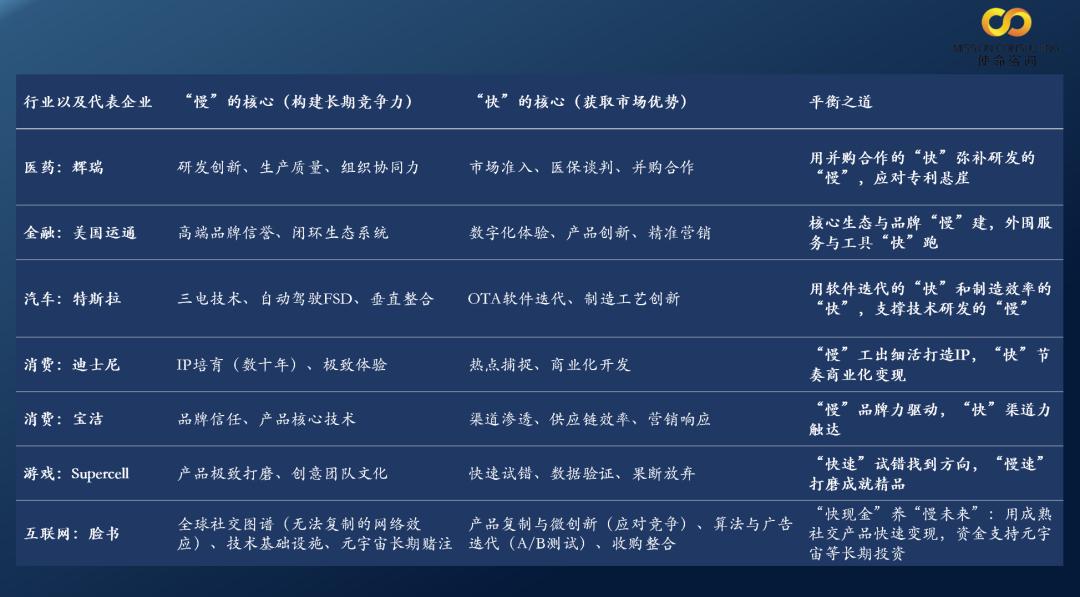
Core Concept - The article emphasizes the importance of "slow companies" in China, advocating for a balance between speed and depth in business strategies, where "slow" represents foundational strength and "fast" signifies market agility [1][4][72]. Group 1: Fast vs. Slow in Business Strategy - "Slow" refers to long-term investments in core competencies such as technology, brand value, and organizational culture, which require time and cannot be rushed [1][3]. - "Fast" indicates the need for agile responses to market demands, including product iterations and capturing market opportunities quickly [2][3]. - Successful companies master the combination of "fast" and "slow," using "slow" to build a solid foundation while leveraging "fast" to seize market opportunities [3][4]. Group 2: Global and Chinese Examples of Slow Companies - Pfizer exemplifies the pharmaceutical industry's balance of "slow" drug development and "fast" market entry strategies, often relying on acquisitions to fill gaps in their pipeline [5][6][10]. - American Express focuses on building a strong brand and ecosystem slowly while rapidly innovating in digital experiences and product offerings [12][16]. - Tesla invests heavily in long-term technology development while maintaining rapid product iterations and manufacturing innovations to capture market share [17][22]. - Disney and Procter & Gamble illustrate the consumer sector's balance, with Disney cultivating IP over decades while quickly monetizing it, and P&G focusing on brand trust and product technology while ensuring efficient market penetration [23][24]. - Supercell emphasizes quality through meticulous product development while employing rapid testing and iteration to find successful game concepts [25][30]. Group 3: Characteristics of Founders and Teams in Slow Companies - Founders of slow companies often exhibit traits such as strategic patience, deep focus, and a mission-driven approach, which guide their long-term decision-making [72][97]. - Teams in these companies are structured to ensure stability and cultural alignment, often combining diverse skills to achieve a common mission [98]. Group 4: Education and Talent Development for Slow Companies - The article discusses the need for educational reforms to cultivate leaders with a long-term vision, emphasizing the importance of foundational knowledge and craftsmanship in training [77][78]. - Innovative educational practices, such as problem-based learning and dual mentorship systems, are highlighted as methods to develop future leaders capable of sustaining slow company principles [79][82].
Supercell内部800人大会:项目被砍、业务被裁撤,失败了怎么办?
3 6 Ke· 2026-01-19 02:48
Core Insights - Supercell's recent blog post titled "What We've Learned from Failures" reveals the heavy side of their optimistic culture of celebrating failures, emphasizing that acknowledging failures does not equate to enjoying them [1][3]. Group 1: Company Culture and Learning from Failures - Supercell held an internal meeting where veteran employees shared significant failures, highlighting the need for newer employees to understand the company's history beyond its current successes [3]. - The blog serves as a declaration that celebrating failure does not mean it is pleasant; rather, it often comes with substantial sunk costs and emotional turmoil [3][5]. Group 2: Key Lessons from Failures - Supercell identified three core lessons from their failures, addressing common issues in the gaming industry: resource management, team dynamics, and value judgment [5]. - The first lesson emphasizes that ambition requires boundaries; unlimited resources can hinder innovation, as seen in the failure of "Clash Mini" due to indecision and lack of focus [6][10]. - The second lesson stresses the importance of team alignment with the game genre; "Hay Day Pop" failed because the team lacked passion for the match-three genre, leading to a reliance on data rather than instinct [11][18]. - The third lesson revolves around pride in the work; a failed marketing campaign for "Clash of Clans" was halted not due to poor data but because it did not meet Supercell's quality standards, reinforcing the importance of maintaining brand integrity [19][26]. Group 3: Psychological Safety and Organizational Structure - Supercell's commitment to celebrating failures through rituals like "opening champagne" fosters a culture of psychological safety, allowing employees to feel secure in taking risks without fear of retribution [28][30]. - This safety net is crucial for a decentralized organization where decision-making is distributed, as it encourages innovation and risk-taking among project leaders [30][32].

90亿,腾讯买了
投资界· 2025-11-25 07:23
Core Viewpoint - Tencent has completed a strategic investment of €11.6 billion (approximately ¥90 billion) in Ubisoft, marking a significant partnership aimed at revitalizing Ubisoft's financial health and expanding its core IPs [2][4][6]. Group 1: Investment Details - Tencent's investment will grant it approximately 26% ownership of the newly established subsidiary, Vantage Studios, which is valued at €3.8 billion [4]. - Ubisoft retains exclusive control over Vantage Studios, with a five-year lock-up period for Tencent's shares unless Ubisoft loses control [4]. - The new subsidiary will focus on accelerating the revenue growth of key franchises such as Assassin's Creed, Far Cry, and Rainbow Six, targeting an annual revenue of €1 billion for these brands [3][4]. Group 2: Financial Performance - Ubisoft reported a 20.3% year-on-year increase in total net bookings for the first half of the 2025-2026 fiscal year, reaching approximately €770 million, driven by strong performance from Assassin's Creed and Tom Clancy's The Division [5]. - Despite the revenue growth, Ubisoft faced a net loss of approximately €161.3 million during the reporting period [5]. Group 3: Historical Context - Ubisoft has faced challenges in recent years, with several anticipated titles underperforming and a significant decline in stock price, prompting discussions about potential privatization and the search for new investors [8][9]. - Tencent's involvement as a "white knight" comes after previous attempts by Vivendi to acquire Ubisoft, which were met with resistance from the Guillemot family [7][8]. Group 4: Industry Implications - Tencent's investment reflects its ongoing strategy to expand its international gaming portfolio, having previously made significant acquisitions in the gaming sector [9][10]. - The investment also highlights the growing trend of Chinese gaming IPs gaining global traction, contrasting with the struggles of established Western companies like Ubisoft [10].

大行评级丨里昂:维持腾讯“高度确信跑赢大市”评级 预期收入将持续稳健增长
Ge Long Hui· 2025-11-14 07:40
Core Insights - Tencent's total revenue and adjusted net profit for Q3 increased by 15% and 18% year-on-year, reaching 192.9 billion and 70.6 billion respectively, exceeding expectations by 1.5% and 4.5% [1] Group 1: Financial Performance - The standout performance came from online gaming, which grew by 23% year-on-year, driven by the success of new titles such as "Delta Operation" and "Valorant Mobile," along with growth from established games like "Honor of Kings," "Peacekeeper Elite," and "Clash of Clans" [1] - Marketing services accelerated to a year-on-year growth of 21%, primarily due to increased user engagement, ad load volume, and AI targeting technology [1] - The fintech and enterprise services segment rebounded, supported by cloud services and e-commerce transactions [1] Group 2: Future Outlook - The company is expected to maintain steady revenue growth due to its rich game portfolio, more AI advertising tools, and growth in small shop businesses [1] - Tencent anticipates significant upgrades to its next-generation mixed Yuan model and plans to continuously enhance AI features and virtual currency services within WeChat [1] - The firm maintains a "highly confident outperform" rating with a target price of 740 HKD [1]
Supercell《爆裂小队》官宣停运:7个月收入超7亿,仍然被砍
3 6 Ke· 2025-10-31 05:17
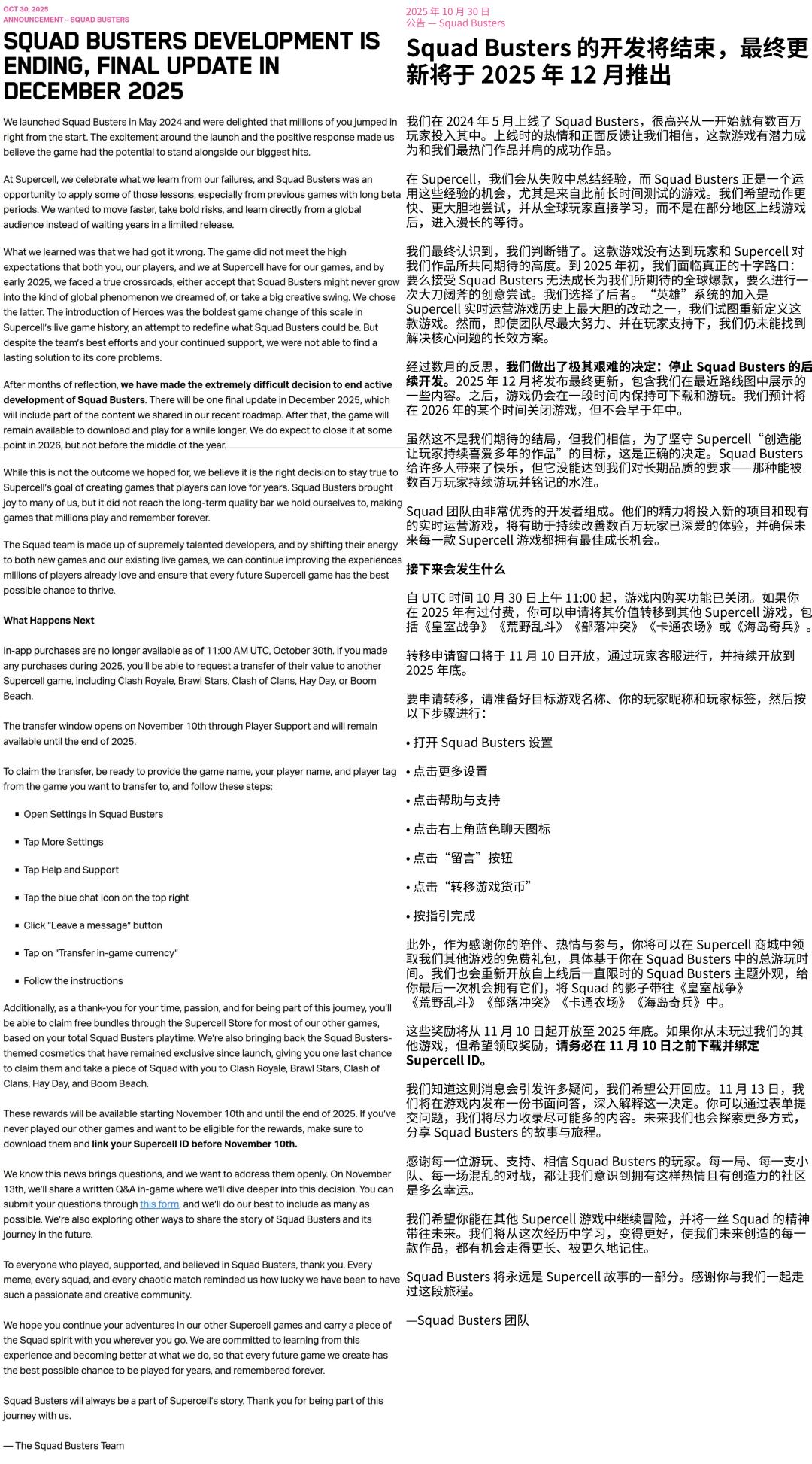
Core Insights - The development of "Squad Busters" will end, with the final update scheduled for December 2025, as the game did not meet Supercell's long-term quality standards despite initial success [2][4][5] - Supercell acknowledges the lessons learned from the failure of "Squad Busters" and emphasizes the importance of creating games that players can enjoy for years [3][5][16] - The decision to cease development was made after months of reflection, as the game failed to maintain its player base and did not evolve into a global phenomenon [3][10][23] Summary by Sections Game Launch and Initial Reception - "Squad Busters" launched in May 2024 and initially attracted millions of players, leading to optimism about its potential success [1][9] - The game received positive feedback at launch, which led Supercell to believe it could become a major hit alongside their other successful titles [2][9] Development Challenges - Despite efforts to address core issues, including the introduction of a new "Heroes" system, the game could not find a lasting solution to its problems [3][10] - By early 2025, Supercell faced a critical decision point regarding the game's future, ultimately opting for a bold creative change that did not yield the desired results [3][10] Conclusion of Development - The decision to end active development was described as extremely difficult, with a final update planned for December 2025, after which the game will remain available for a limited time before being closed in 2026 [4][5][20] - Supercell aims to redirect the talented team behind "Squad Busters" to new projects and existing successful games to enhance player experiences [6][11] Player Transition and Rewards - In-app purchases were disabled on October 30, 2025, and players can transfer their purchases to other Supercell games starting November 10, 2025 [6][12] - As a gesture of appreciation, players will receive free bundles in other Supercell games based on their playtime in "Squad Busters" [7][14] Industry Context - The announcement of "Squad Busters" ending its operations marks a significant moment for Supercell, which has historically maintained a 100% success rate for new game launches prior to this title [22][23] - Despite the setback, Supercell continues to see success with its established titles, indicating resilience in its long-term game development strategy [29][30]
+30%收入,切支付,大厂们都是怎么做的?
3 6 Ke· 2025-09-15 00:23
Core Insights - The article discusses how mobile game developers are increasingly directing players to external payment options to avoid Apple's 30% commission, referred to as the "Apple tax" [1][3][12] - A study by Liquid & Grit analyzed over 30 cases of leading mobile game companies like Supercell and Niantic, focusing on their strategies to sell in-app purchases (IAP) directly to players outside of the App Store [1][3] Group 1: Strategies for Redirecting Players - Liquid & Grit categorized the new store designs into four main types: offering web store discounts in the native IAP store, pop-ups, buttons on the main game interface, and using in-game news and email systems for guidance [1][3] - "Social Casino" games are the most proactive in redirecting players to web stores, utilizing all four methods, while other game categories show varied adoption [3][5] - Specific games like "Dragon City" and "PUBG Mobile" employ different strategies, such as banners and pop-ups, to encourage players to use web stores for purchases [5][7] Group 2: Incentives and Challenges - To enhance conversion rates, developers must reduce payment friction and increase player motivation to choose external payment options over Apple’s [11][12] - Companies like Epic Games offer incentives, such as a 20% cash back, to encourage players to opt for web payments [11] - The report suggests that the most effective design so far is the "purchase pop-up," which allows players to complete transactions without leaving the game, thus maintaining a seamless experience [11][12] Group 3: Alternative Payment Solutions - Companies with in-house resources are encouraged to build their own web stores and utilize payment processors like Stripe or Adyen to handle transactions [12] - For developers who prefer not to create their own stores, managed web store service providers like Xsolla and Stash are available, offering a quicker setup at a cost lower than Apple's commission [12]


腾讯控股(00700.HK):AI带动广告持续高增长 海外游戏表现亮眼
Ge Long Hui· 2025-08-16 10:44
Core Insights - Tencent reported a revenue of 184.5 billion yuan for Q2 2025, representing a year-on-year growth of 14.5% driven primarily by advertising and gaming sectors [1] - Adjusted operating profit for Q2 2025 was 69.2 billion yuan, up 18% year-on-year, while non-IFRS net profit reached 63 billion yuan, reflecting a 10% increase [1] - The company’s comprehensive gross margin improved to 57%, a 4 percentage point increase year-on-year, with notable improvements in gross margins across value-added services, online advertising, and fintech services [1] Revenue Breakdown - Online gaming revenue for Q2 2025 was 59.2 billion yuan, showing a robust year-on-year increase of 22%, with domestic gaming revenue rising 17% to 40.4 billion yuan [2] - International gaming revenue surged by 35% to 18.8 billion yuan, driven by strong performances from titles like VALORANT and PUBG MOBILE [2] - The deferred revenue at the end of Q2 2025 stood at 120.9 billion yuan, marking a 13% year-on-year increase [2] Advertising and Fintech Performance - The company’s online advertising revenue reached 35.8 billion yuan in Q2 2025, reflecting a 20% year-on-year growth, attributed to higher click-through rates from AI deployment [3] - Fintech and enterprise services revenue grew by 10% year-on-year to 55.5 billion yuan, with commercial payment services and consumer credit driving growth [3] - Cloud service revenue is estimated to have increased by 17% in Q2 2025, benefiting from AI-related service demands [3] Future Outlook - The company is well-positioned for future growth, particularly in areas like WeChat e-commerce and AI applications, which are not fully reflected in current profit forecasts [4] - Projected adjusted net profits for 2025, 2026, and 2027 are 258.7 billion yuan, 296 billion yuan, and 335.2 billion yuan respectively, with slight upward adjustments [4] - Tencent's ecosystem continues to leverage its user and scenario advantages, positioning it as a leading player in the AI era [4]