
民营企业债券融资支持工具

Search documents
21社论丨货币政策灵活高效,支撑“十五五”良好开局
Xin Lang Cai Jing· 2026-01-23 22:58
Core Viewpoint - The People's Bank of China (PBOC) will continue to implement a moderately accommodative monetary policy in 2026, focusing on promoting stable economic growth and reasonable price recovery as key considerations for monetary policy [1][4] Group 1: Monetary Policy Direction - The monetary policy will emphasize flexibility and precision while maintaining a moderately accommodative stance, shifting focus from mere scale expansion to supporting high-quality development and price stability [1][4] - The PBOC plans to adjust policy rates based on actual changes in corporate financing costs rather than solely aiming for unilateral reductions, stabilizing social financing costs within a reasonable range [1][3] Group 2: Liquidity Management - The PBOC intends to supplement market funds through a "combination of long and short" strategies, with room for further rate cuts and reserve requirement ratio (RRR) reductions in 2026 [2] - Innovative tools like buyout reverse repos will be utilized to smooth out short-term shocks from government bond issuance and maintain stable liquidity [2] Group 3: Structural Tools - Structural monetary policy tools will focus on key areas, aiming for a "precise drip irrigation" effect to support major strategies and weak links [2][3] - The PBOC has increased the quota for technology innovation re-loans from 800 billion yuan to 1.2 trillion yuan, now including "high R&D investment private enterprises" to ensure resources are allocated to genuine innovators [3] Group 4: Risk Management - The PBOC will enhance monitoring and assessment of systemic financial risks, accelerating reforms in small financial institutions to mitigate regional risks [3] - The management of cross-border capital flows will focus on dynamic balance, using macro-prudential tools to prevent short-term capital volatility [3] Group 5: External Environment - The easing of external constraints on China's monetary policy due to the Federal Reserve's rate cuts provides a window for interest rate adjustments, although policy changes will remain independent [4] - The ongoing process of renminbi internationalization and the development of cross-border payment systems are expected to enhance international market interest in renminbi assets [4]
新年伊始,央行八项举措助力逆周期跨周期调节力度
Xin Hua She· 2026-01-17 07:06
Group 1 - The People's Bank of China will implement eight measures to enhance credit support in key areas, aiming to assist in the optimization of economic structure transformation [1] - The one-year interest rate for various relending types will be reduced from 1.5% to 1.25%, with other term rates adjusted accordingly [3] - The quota for relending to support agriculture and small enterprises will be increased by 500 billion, with a total quota of 1 trillion specifically for private enterprises [3] Group 2 - The quota for relending aimed at technological innovation and technological transformation will be increased from 800 billion to 1.2 trillion, including support for high R&D investment private small and medium enterprises [3] - The minimum down payment ratio for commercial property loans will be lowered to 30% to support the destocking of commercial real estate [6] - Financial institutions are encouraged to enhance foreign exchange risk management services, providing cost-effective and flexible tools for enterprises [6]

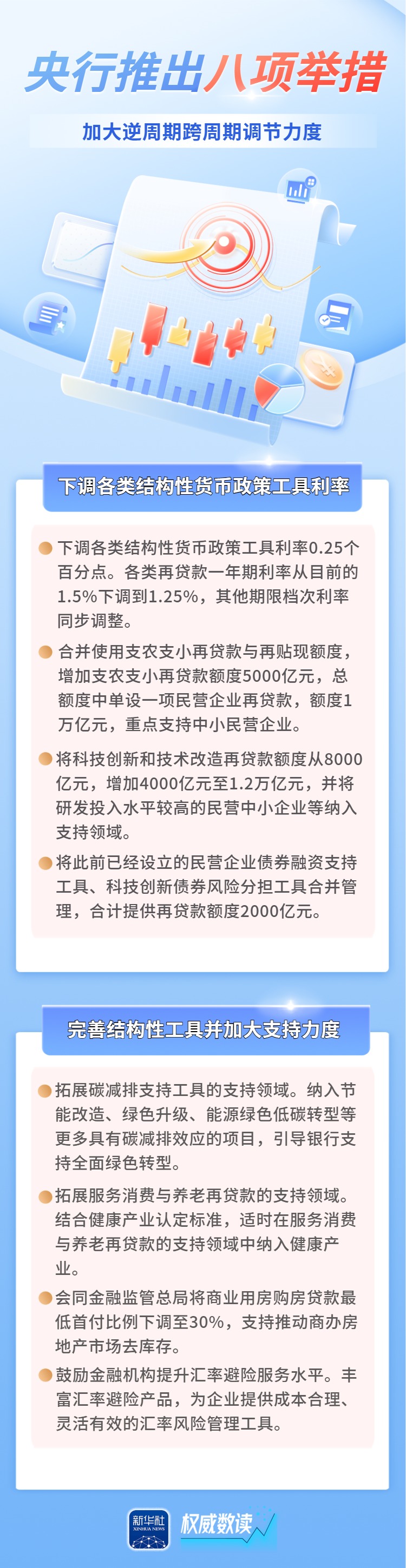
下调再贷款利率,增加再贷款额度……央行出台一批重磅政策
Sou Hu Cai Jing· 2026-01-16 06:16
Core Viewpoint - The People's Bank of China announced eight new financial policies to support the high-quality development of the real economy, indicating potential for further monetary easing in 2023 [1] Group 1: Monetary Policy Adjustments - The central bank lowered the interest rates of various structural monetary policy tools by 0.25 percentage points, with the one-year re-lending rate reduced from 1.5% to 1.25% [2] - There is still room for further reductions in the required reserve ratio, currently averaging 6.3% for financial institutions [1][2] Group 2: Support for Specific Sectors - The quota for re-lending to support agriculture and small enterprises has been increased by 500 billion yuan, with a separate quota of 1 trillion yuan designated for private enterprises [2] - The quota for re-lending aimed at technological innovation and technological transformation has been raised from 800 billion yuan to 1.2 trillion yuan, expanding support to high R&D investment private small and medium-sized enterprises [2] Group 3: Risk Management and Financial Services - The commercial property loan down payment ratio has been lowered to 30% to support the destocking of the commercial real estate market [2] - Financial institutions are encouraged to enhance their foreign exchange risk management services, providing cost-effective and flexible tools for enterprises [2]
解码央行发布会:八项措施落地,全面降准降息还有多远?
Hua Er Jie Jian Wen· 2026-01-16 00:37
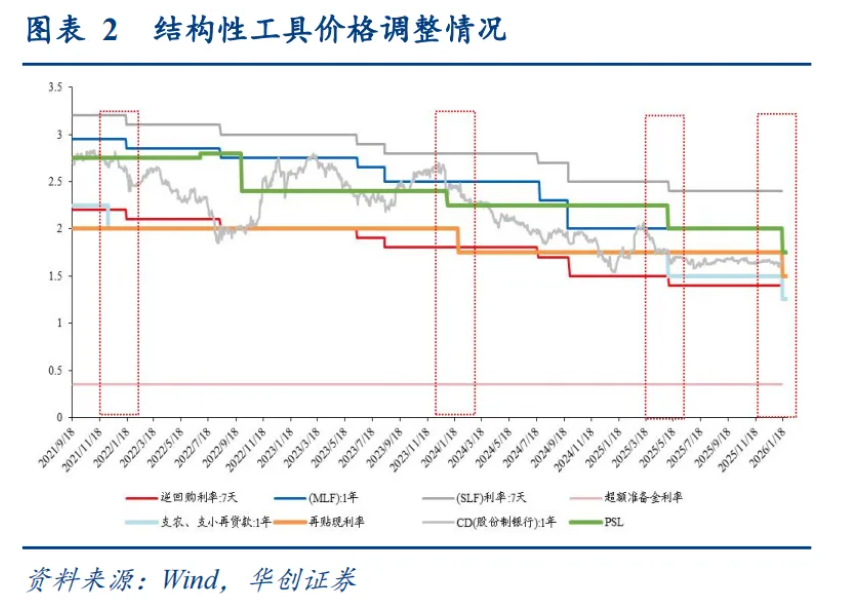
Core Viewpoint - The People's Bank of China (PBOC) has introduced a set of structural monetary policy measures, including a 0.25 percentage point reduction in various structural monetary policy tool rates, signaling a targeted approach to enhance liquidity without a broad interest rate cut [1][2][5]. Group 1: Structural Monetary Policy Measures - The PBOC announced a reduction in the one-year relending rate from 1.5% to 1.25%, and the rediscount rate from 1.75% to 1.5% [2]. - The total balance of structural monetary policy tools was approximately 5.4 trillion yuan as of Q3 2025, with the rate cut expected to save banks around 13.5 billion yuan [8]. - The measures aim to support domestic demand, technological innovation, and small and medium-sized enterprises [12]. Group 2: Specific Policy Tools - The PBOC will increase the relending quota for agricultural and small enterprise support by 500 billion yuan, with a dedicated quota of 1 trillion yuan for private enterprises [16]. - The relending quota for technological innovation and transformation will be increased by 400 billion yuan, totaling 1.2 trillion yuan [16]. - The minimum down payment ratio for commercial property loans will be lowered to 30% to support the commercial real estate market [18]. Group 3: Future Monetary Policy Outlook - The PBOC indicated that there is still room for further reductions in reserve requirement ratios and interest rates, with a potential 50 basis point cut in the first quarter of 2026 [19][20]. - Constraints on interest rate cuts are easing, with improvements in exchange rates and net interest margins noted [21]. - The PBOC aims to guide overnight rates to operate near policy rate levels, indicating a shift in monetary policy management [24][26]. Group 4: Market Implications - The structural easing is expected to positively impact various asset classes, with a potential "spring rally" in the stock market anticipated due to the release of monetary signals [29]. - The bond market is expected to remain stable, with 10-year government bond yields projected to stay between 1.6% and 1.9% [30]. - The Chinese yuan is forecasted to appreciate moderately, with expectations of reaching around 6.9 by the end of 2026 [30].
新年伊始 央行八项举措助力逆周期跨周期调节力度
Xin Hua She· 2026-01-15 22:48
Group 1 - The core viewpoint of the articles is that the People's Bank of China (PBOC) is implementing eight measures to enhance credit support in key areas, aiming to assist in the structural transformation and optimization of the economy [1] Group 2 - The PBOC plans to expand the support areas of carbon reduction tools to include energy-saving renovations, green upgrades, and low-carbon energy transitions [3] - The one-year interest rate for various relending facilities will be reduced from 1.5% to 1.25%, with other term rates adjusted accordingly [3] - The PBOC will merge the quotas for agricultural and small enterprise relending with rediscounting, increasing the relending quota for agricultural and small enterprises by 500 billion yuan, with a specific quota of 1 trillion yuan for private enterprises [3] - The relending quota for technological innovation and technological transformation will be increased from 800 billion yuan to 1.2 trillion yuan, including support for private small and medium-sized enterprises with high R&D investment levels [3] - Existing private enterprise bond financing support tools and technological innovation bond risk-sharing tools will be managed together, providing a total relending quota of 200 billion yuan [3]
权威数读|新年伊始,央行八项举措助力逆周期跨周期调节力度
Xin Hua Wang· 2026-01-15 14:50
Group 1 - The People's Bank of China will implement eight measures to enhance credit support in key areas, aiming to boost the economy's structural transformation and optimization [1] - The central bank plans to increase the support for structural monetary policy tools, focusing on carbon reduction and green transformation initiatives [3] - The one-year re-lending rate will be reduced from 1.5% to 1.25%, with other term rates adjusted accordingly [3] Group 2 - The total re-lending quota for supporting agriculture and small enterprises will be increased by 500 billion, with a specific quota of 1 trillion for private enterprises [3] - The re-lending quota for technological innovation and technological transformation will be raised from 800 billion to 1.2 trillion, including support for high R&D investment private SMEs [3] - Existing bond financing support tools for private enterprises and technology innovation will be merged, providing a total re-lending quota of 200 billion [3]
下调!央行重磅发布
Sou Hu Cai Jing· 2026-01-15 13:18
Core Viewpoint - The People's Bank of China (PBOC) is implementing two main policy measures to support the economy, including lowering interest rates on various structural monetary policy tools and enhancing support for economic structural transformation [1]. Group 1: Monetary Policy Adjustments - The PBOC will lower the interest rates on various structural monetary policy tools by 0.25 percentage points, with the one-year re-lending rate decreasing from 1.5% to 1.25% [1]. - The PBOC will merge the quotas for agricultural and small enterprise re-lending and re-discounting, increasing the agricultural and small enterprise re-lending quota by 500 billion yuan, with a separate quota of 1 trillion yuan designated for private enterprises [1]. - The quota for re-lending aimed at technological innovation and technological transformation will be increased from 800 billion yuan to 1.2 trillion yuan, expanding support to private small and medium-sized enterprises with high R&D investment levels [1]. Group 2: Support for Specific Sectors - The PBOC will merge the management of the previously established private enterprise bond financing support tool and the technological innovation bond risk-sharing tool, providing a total re-lending quota of 200 billion yuan [1]. - The carbon reduction support tool will be expanded to include more projects with carbon reduction effects, guiding banks to support comprehensive green transformation [2]. - The support areas for service consumption and elderly care re-lending will be expanded to include the health industry, based on health industry recognition standards [2]. Group 3: Real Estate and Financial Services - The minimum down payment ratio for commercial property loans will be lowered to 30% in collaboration with the financial regulatory authority, supporting the destocking of the commercial real estate market [2]. - Financial institutions are encouraged to enhance their foreign exchange risk management services, providing enterprises with cost-effective and flexible foreign exchange risk management tools [2].
8项政策举措出炉,回应汇率、物价等热点话题,央行外汇局发布会要点速览
Sou Hu Cai Jing· 2026-01-15 10:16
Group 1 - The People's Bank of China (PBOC) announced 8 policy measures to support the optimization of economic structure transformation [1] - The interest rate for various structural monetary policy tools will be reduced by 0.25 percentage points, with the one-year re-lending rate decreasing from 1.5% to 1.25% [1] - The re-lending quota for supporting agriculture and small enterprises will be increased by 500 billion yuan, with a dedicated quota of 1 trillion yuan for private enterprises [1] Group 2 - The quota for re-lending for technological innovation and technological transformation will be increased from 800 billion yuan to 1.2 trillion yuan, including support for high R&D investment private SMEs [1] - The existing private enterprise bond financing support tool and technological innovation bond risk-sharing tool will be merged, providing a total re-lending quota of 200 billion yuan [1] - The carbon reduction support tool will be expanded to include more projects with carbon reduction effects, guiding banks to support comprehensive green transformation [2] Group 3 - The minimum down payment ratio for commercial property loans will be lowered to 30% to support the destocking of the commercial real estate market [2] - Financial institutions are encouraged to enhance their foreign exchange risk hedging services, providing cost-effective and flexible tools for enterprises [2] - The PBOC will maintain liquidity and conduct flexible government bond trading operations alongside other liquidity tools [3] Group 4 - The PBOC sees room for further reserve requirement ratio (RRR) and interest rate cuts this year, aiming to keep social financing costs low [4] - The PBOC will focus on promoting stable economic growth and reasonable price recovery as key considerations for monetary policy [5] - The PBOC will further expand the support areas for service consumption and elderly care re-lending, including the health industry once recognized [6] Group 5 - The State Administration of Foreign Exchange (SAFE) anticipates stable operation of the foreign exchange market by 2026, with smooth cross-border capital flows [8] - SAFE will enhance monitoring of cross-border capital flows and improve macro-prudential management to maintain stability in the foreign exchange market [8] - New policies will be introduced to support enterprises in going global and developing foreign trade, including cross-border capital management for multinational companies [8] Group 6 - Further optimization of cross-border fund policies for Qualified Foreign Institutional Investors (QFII) will be researched, along with orderly issuance of investment quotas for Qualified Domestic Institutional Investors (QDII) [9] - Efforts will be made to simplify foreign exchange registration procedures for foreign direct investment, facilitating the use of investment funds [9] - The cross-border fund centralized operation management policy will be promoted nationwide for more medium-sized multinational companies [9]
商业用房最低首付下调至30%!央行最新宣布
Sou Hu Cai Jing· 2026-01-15 09:44
Core Viewpoint - The People's Bank of China (PBOC) is implementing two main policy measures to support economic transformation and optimization in response to the current economic and financial situation. These measures include lowering interest rates on various structural monetary policy tools and enhancing support through structural tools [1]. Group 1: Monetary Policy Adjustments - The PBOC will lower the interest rates on various structural monetary policy tools by 0.25 percentage points, reducing the one-year relending rate from 1.5% to 1.25% [1]. - The PBOC will increase the quota for agricultural and small enterprise relending by 500 billion yuan, with a separate quota of 1 trillion yuan designated for private enterprises [1]. Group 2: Support for Innovation and Technology - The relending quota for technological innovation and technological transformation will be increased from 800 billion yuan by 400 billion yuan to 1.2 trillion yuan, expanding the support to include private small and medium-sized enterprises with high R&D investment levels [1]. Group 3: Risk Management and Financial Support - The PBOC will merge the existing risk-sharing tools for bonds of private enterprises and technological innovation, providing a total relending quota of 200 billion yuan [1]. - The PBOC will expand the support areas for carbon reduction tools to include energy-saving renovations and green upgrades, guiding banks to support comprehensive green transformation [2]. - The minimum down payment ratio for commercial property loans will be lowered to 30% to support the destocking of commercial and real estate markets [2].
央行官宣:结构性降息落地,万亿再贷款力挺民企
Di Yi Cai Jing Zi Xun· 2026-01-15 09:33
Group 1 - The central bank has announced a reduction in structural monetary policy rates by 0.25 percentage points, following a previous cut in May 2025, to stimulate credit flow to key sectors [1] - The one-year interest rate for various structural monetary policy tools has been lowered from 1.5% to 1.25%, which will reduce the cost for banks to obtain refinancing from the central bank [1] - This rate cut is expected to encourage banks to offer loans at lower rates to small and micro enterprises, technological innovation, and green transformation, thereby reducing the overall financing costs for the real economy [1] Group 2 - The targeted nature of the structural policy tool rate cut is designed to enhance the efficiency of fund utilization and improve financial services for the real economy [2] - The policy signals a strong commitment from the government to support specific industries such as technology, consumption, and elderly care, which is anticipated to boost confidence among business entities and stabilize market expectations [2] - The central bank plans to enhance support for structural tools, including increasing the quota for agricultural and small enterprise refinancing by 500 billion yuan and establishing a separate refinancing quota of 1 trillion yuan for private enterprises [2] Group 3 - The refinancing quota for technological innovation and technical transformation has been increased from 800 billion yuan to 1.2 trillion yuan, expanding the support to high R&D investment private small and medium enterprises [2] - The central bank aims to streamline the management of existing bond financing support tools for private enterprises and technological innovation, providing a combined refinancing quota of 200 billion yuan [2] - Future monetary policy will focus on effectively balancing short-term and long-term goals, growth stability, and risk prevention, while directing financial resources towards technological innovation, green development, and consumption [3]