
金属硅

Search documents
基础化工行业研究:国际柴油、燃料油等涨幅居前,建议关注进口替代、纯内需、高股息等方向
Huaxin Securities· 2026-03-11 00:24
Investment Rating - The report maintains a "Buy" rating for several companies in the chemical industry, including Sinopec, China National Offshore Oil Corporation, and others [11]. Core Viewpoints - The report highlights significant price increases in international diesel and fuel oil, with international diesel rising by 66.38% and fuel oil by 38.73% [16][19]. - It suggests focusing on sectors such as helium, biodiesel, and agricultural chemicals due to the geopolitical tensions affecting oil prices and supply chains [7][20]. - The report anticipates a substantial upward adjustment in the central value of international oil prices for 2026, driven by ongoing geopolitical uncertainties [7][21]. Summary by Sections Industry Investment Recommendations - The report recommends attention to import substitution, pure domestic demand, and high-dividend stocks within the chemical sector [5][12]. Market Performance - The basic chemical sector has shown a performance increase of 47.8% over the past 12 months, significantly outperforming the Shanghai Composite Index [2]. Price Movements - Notable price increases this week include international diesel (66.38%), fuel oil (38.73%), and international gasoline (35.73%) [16][19]. - Conversely, industrial-grade lithium carbonate and battery-grade lithium carbonate saw declines of -11.63% and -11.49%, respectively [6][16]. Geopolitical Impact - The report discusses the impact of the closure of the Strait of Hormuz on oil prices, with Brent crude oil reaching $92.69 per barrel, reflecting a 27.88% increase [7][21]. - It emphasizes the need to monitor the geopolitical situation closely, as it is a significant driver of market volatility [22][27]. Focused Sectors - Helium is highlighted as a critical sector due to its supply constraints, with Qatar being a key supplier [8][19]. - Biodiesel is expected to gain traction in Europe, driven by rising SAF prices and energy security concerns [9][20]. - The agricultural chemicals sector is projected to benefit from rising food prices, with increased demand for fertilizers and pesticides anticipated [20][21].



国际柴油、燃料油等涨幅居前,建议关注进口替代、纯内需、高股息等方向
Huaxin Securities· 2026-03-10 13:42
Investment Rating - The report maintains a "Buy" rating for several companies in the chemical industry, including Sinopec, China National Offshore Oil Corporation, and others [11]. Core Views - The report highlights significant price increases in international diesel and fuel oil, with recommendations to focus on sectors such as import substitution, pure domestic demand, and high dividend stocks [1][7]. - The report notes that the geopolitical situation in the Middle East has led to a rapid increase in international oil prices, with Brent crude reaching $92.69 per barrel, up 27.88% from the previous week [7][21]. - The report suggests that the chemical industry should look for products deeply affected by the Middle East conflict that are unlikely to recover in the short term [19]. Summary by Sections Chemical Industry Investment Suggestions - The report indicates that international diesel prices increased by 66.38%, fuel oil by 38.73%, and international gasoline by 35.73% [16][19]. - Conversely, industrial-grade lithium carbonate and battery-grade lithium carbonate saw declines of -11.63% and -11.49%, respectively [6][16]. Market Performance - The report provides a comparative performance analysis of the basic chemical sector, which has outperformed the Shanghai Composite Index over various time frames [2][3]. Key Focus Areas - Helium: The report identifies helium as a critical product due to its supply constraints, particularly from Qatar, and suggests related companies such as Guanggang Gas and Jiufeng Energy [8][19]. - Biodiesel: The report anticipates increased demand for biodiesel in Europe due to rising SAF prices and energy security concerns [9][20]. - Agricultural Chemicals: The report predicts a significant cycle for agricultural chemicals due to rising food prices linked to oil price increases, benefiting companies in phosphate and potash fertilizers [20]. Price Trends - The report notes that the PTA market has seen a price increase, with the average price in East China rising to 5396.43 CNY per ton, reflecting a 4.59% increase [34][36]. - The report also highlights a significant rise in polyester filament prices, driven by geopolitical tensions and rising costs [36][37].
Ferroglobe(GSM) - 2025 Q4 - Earnings Call Transcript
2026-02-18 14:32
Financial Data and Key Metrics Changes - In Q4 2025, sales increased by 6% quarter-over-quarter to $329 million, while adjusted EBITDA declined by 20% to $15 million, resulting in an adjusted EBITDA margin of 4% [12][19][24] - Free cash flow for the year was -$12 million, with a fourth-quarter cash flow consumption of $4 million due to weak EBITDA and an increase in net working capital [23][24] - The company expects revenues in 2026 to improve to a range of $1.5 billion to $1.7 billion, representing a 20% increase at the midpoint over 2025 [11][12] Business Line Data and Key Metrics Changes - Silicon metal revenue declined by 3% sequentially to $96 million, with shipments down to 33,000 tons, while adjusted EBITDA dropped from $12 million to $1 million [20] - Silicon-based alloys revenue grew by 12% to $104 million, driven by a 19% increase in volumes to 51,000 tons, with adjusted EBITDA increasing to $60 million [20] - Manganese-based alloys revenue increased by 10% to $93 million, with a 16% volume increase to 81,000 tons, and adjusted EBITDA doubled to $9 million [21] Market Data and Key Metrics Changes - In Europe, ferrosilicon index prices rose by 22% following the implementation of safeguards, while U.S. prices retreated by 4% in Q4 [16][19] - The European market for manganese is expected to grow by 3% in 2026, driven by solid demand from steel customers and safeguards [18] - The company noted that imports of silicon metal from China doubled in 2025, impacting pricing and demand negatively [13] Company Strategy and Development Direction - The company has converted three furnaces from silicon metal to ferrosilicon to optimize production in response to market dynamics [6][9] - A new competitive 10-year energy agreement in France is expected to enhance operational flexibility and improve earnings potential [9][27] - The company is actively pursuing long-term opportunities in Venezuela, which could become strategically meaningful due to its proximity to the U.S. market [8][9] Management's Comments on Operating Environment and Future Outlook - Management expressed optimism about the long-term outlook due to trade measures in the EU and U.S. that are expected to improve competitive conditions [4][26] - The company anticipates considerable growth in most segments in 2026, driven by strong volume growth in silicon-based and manganese-based alloys [11][12] - Management acknowledged the challenges posed by muted demand and elevated levels of predatory imports but emphasized proactive cost control measures [4][8] Other Important Information - The company increased its dividend by 7% to $0.015 per share starting in Q1 2026, reflecting confidence in the business [11][24] - The company has invested a total of $10 million in Coreshell for the development of advanced silicon-rich EV batteries, indicating a focus on long-term technological advancements [10] Q&A Session Summary Question: Volume expectations across the three businesses for 2026 and plans for EU silicon assets - Management indicated that safeguards would free up 25% of imports, providing significant opportunities for local producers [34] - The company has converted furnaces to ferrosilicon and is selectively restarting others based on demand [36] Question: Component of minimum prices with EU safeguards for ferroalloys - Management noted that demand is critical for price recovery and that there is sufficient capacity in the EU to meet the safeguards [38][39] Question: EU's appetite to revisit inclusion of silicon metal in safeguards - Management explained that the exclusion was due to technical and political reasons, but they are working on new measures for silicon metal [54][56] Question: High-level breakdown of end market exposure - Management stated that 70-80% of the business is protected, with only 20% exposed to silicon metal in Europe [62][63] Question: Working capital and CapEx expectations - Management expects to continue releasing working capital while maintaining similar levels of CapEx as in 2025 [66][69]

仲钨酸铵、铝棒——大宗商品热点解读
2025-12-04 15:36
Summary of Key Points from Conference Call Records Industry Overview - The conference call discusses the aluminum and tungsten industries, focusing on market trends, pricing, and demand dynamics for 2025 and 2026. Aluminum Industry Insights - **Aluminum Rod Processing Fees**: Processing fees for aluminum rods have generally decreased, with a nearly 20% drop in the Foshan region due to ample supply, weak downstream demand, and high inventory levels, particularly in the construction materials sector [1][3] - **Electrolytic Aluminum Prices**: The price of electrolytic aluminum in East and South China is expected to rise by over 3% year-on-year in 2025, influenced by various factors including overseas policies, tariffs, domestic inventory, and international situations [1][4] - **Market Demand**: The real estate market's downturn has negatively impacted the demand for construction aluminum, but the growth in the new energy vehicle and photovoltaic industries has partially offset this decline, leading to significant increases in production and export volumes in the automotive sector [1][8] - **Export Challenges**: Trade tensions between China, the US, and Europe, along with adjustments to export tax rebate policies, have suppressed Chinese exports, which decreased by about 2% from January to October, particularly affecting construction-related materials [1][9] Price Forecasts - **2026 Price Predictions**: The average spot price for electrolytic aluminum is projected to be around 21,300 yuan, with emerging industries continuing to drive demand despite the traditional real estate sector remaining weak [2][10][11] Metal Magnesium and Silicon Market - **Price Trends**: The price of magnesium is expected to decline by approximately 9% year-on-year in 2025 due to weak demand and ample supply, while silicon prices have dropped by 24%, reaching a historical low [1][6] - **Future Outlook**: Both magnesium and silicon markets are anticipated to remain in a low-level fluctuation in 2026, with magnesium prices expected to range between 15,500 and 18,500 yuan, and silicon averaging around 9,000 yuan per ton [1][6] Capacity and Production Insights - **New Aluminum Rod Capacity**: By the end of 2025, China is expected to add approximately 29 million tons of aluminum rod capacity, primarily in Guangxi and Fujian, aligning with electrolytic aluminum production capacity [1][7] - **Market Dynamics**: The overall growth rate for new capacity is projected to be around 3%, with ongoing construction and commissioning of new facilities in various regions [1][7] Trade and Economic Factors - **Impact of Trade Policies**: The implementation of tariff barriers and the EU's carbon border adjustment mechanism have increased export costs, further complicating the competitive landscape for Chinese products [1][9] - **Supply and Demand Balance**: The domestic market is experiencing a tightening supply situation, with a projected increase in the supply-demand gap from 2,000 tons to around 5,000 tons by 2026, influenced by mining regulations and environmental controls [1][14][15] Conclusion - The aluminum and tungsten industries are facing a complex interplay of supply, demand, and pricing dynamics, with emerging sectors like new energy vehicles and photovoltaics providing some growth amidst challenges in traditional markets like real estate. The outlook for 2026 suggests continued price volatility and a focus on high-quality product demand driven by technological advancements in related industries [1][10][11]
新材料周报:宇树科技IPO辅导完成,工信部通知集中攻关50大关键新材料和装备:基础化工-20251117
Huafu Securities· 2025-11-17 13:13
Investment Rating - The industry rating is "Outperform the Market" [5][50]. Core Insights - The report highlights the completion of the IPO counseling for Yushu Technology, which is set to apply for listing between October and December 2025, marking it as the first humanoid robot company to go public in A-shares [3][30]. - The Ministry of Industry and Information Technology has initiated a focus on 50 key new materials and equipment, targeting critical demand areas such as new energy vehicles and medical equipment, to ensure downstream application needs are met [3][30]. - The semiconductor materials sector is experiencing accelerated domestic production, with significant expansion in downstream wafer factories, indicating a favorable environment for leading companies to maximize industry benefits [3][30]. Market Overview - The Wind New Materials Index closed at 5217.67 points, reflecting a week-on-week increase of 0.32% [2][12]. - Among the six sub-industries, the semiconductor materials index decreased by 1.56%, while the lithium battery index saw a notable increase of 9.86% [2][12]. - The top five gainers for the week included Aok Shares (25.36%) and Dongyue Silicon Materials (15.29%), while the top five losers included Xiangyuan New Materials (-15.42%) and Dongcai Technology (-13.52%) [2][26][27]. Recent Industry Highlights - Yushu Technology's IPO counseling completion is a significant milestone, as it aims to be the first humanoid robot company listed in A-shares [3][30]. - The Ministry of Industry and Information Technology's notification emphasizes the importance of innovation in fine chemical products, focusing on 50 advanced technologies with high application value [3][30]. - Reports indicate that Samsung has raised memory prices by 30%-60% due to a surge in demand from AI data centers, impacting the market dynamics for memory products [31].
湖北江瀚新材料股份有限公司2025年第三季度报告
Shang Hai Zheng Quan Bao· 2025-10-27 22:43
Core Viewpoint - The company, Hubei Jianghan New Materials Co., Ltd., has released its third-quarter operational data for 2025, ensuring the accuracy and completeness of the information provided in the report [7]. Financial Data Summary - The financial statements for the third quarter of 2025 have not been audited [3]. - The report includes major accounting data and financial indicators, with all figures presented in Renminbi [3]. Operational Performance - The company has reported on the production volume, sales volume, and revenue of its main products, with specific details on functional silane intermediates [7]. - The average sales prices of major products and their year-on-year changes are also included [8]. Raw Material Procurement Prices - The average procurement price of anhydrous ethanol decreased by 5.63% in Q1, increased by 2.57% in Q2, and increased by 4.36% in Q3 [9]. - The average procurement price of high-grade chloropropene increased by 0.89% in Q1, 10.6% in Q2, and 18.41% in Q3 [10]. - The average procurement price of metallic silicon decreased by 7.71% in Q1, 14.92% in Q2, and 1.79% in Q3 [11]. - The average procurement price of allyl glycidyl ether decreased by 4.99% in Q1, increased by 0.25% in Q2, and decreased by 4.07% in Q3 [12]. - The average procurement price of methanol increased by 5.18% in Q1, decreased by 5.14% in Q2, and decreased by 2.07% in Q3 [12]. Other Significant Information - As of the date of the announcement, there are no other undisclosed significant matters affecting the company's production and operations [12].

江瀚新材(603281) - 2025年第三季度主要经营数据公告
2025-10-27 09:01
证券代码:603281 证券简称:江瀚新材 公告编号:2025-055 湖北江瀚新材料股份有限公司 2025 年第三季度主要经营数据公告 本公司董事会及全体董事保证本公告内容不存在任何虚假记载、误导性陈述 或者重大遗漏,并对其内容的真实性、准确性和完整性承担法律责任。 根据《上海证券交易所上市公司自律监管指引第 3 号——行业信息披露》及 其附件《第十三号——化工》规定,湖北江瀚新材料股份有限公司(以下简称"公 司")将 2025 年第三季度主要经营数据公告如下: 一、主要产品的产量、销量及收入实现情况 单位:吨、万元 | 序号 | 产品名称 | 产量 | 销量 | 营业收入 | | --- | --- | --- | --- | --- | | 1 | 功能性硅烷 | 86,705.45 | 87,582.15 | 139,870.33 | | 2 | 功能性硅烷中间体 | 133,251.75 | 1,081.50 | 1,552.47 | 注:功能性硅烷中间体主要用于合成制备功能性硅烷产品,仅少量对外销售。 二、主要产品的销售价格及其同比变化幅度 单位:元/吨 | 序号 | 产品名称 | 本期销售均价 ...
恐慌中找良机,从年度级别看化工ETF(159870)仍处历史底部
Sou Hu Cai Jing· 2025-10-17 13:15
Market Overview - The stock market experienced a significant pullback today, with all major indices closing lower and all sectors underperforming. High dividend stocks performed well while growth stocks were hit hardest. The prevailing sentiment is attributed to uncertainties in regional political events and reduced liquidity, with many investors questioning the timing of the downturn [1] - Macro disturbances include ongoing concerns over international trade tensions and worsening loan issues at two U.S. regional banks, which have heightened fears regarding the credit market [1] International Trade Tensions - The recent escalation in tariffs is seen as a significant setback, especially given prior market expectations for a broad trade and investment agreement. The high tariffs impose strong constraints on both sides, particularly affecting U.S. inflation and Treasury yields [2] Chemical Industry Analysis - The recent decline in the chemical sector is primarily due to a notable pullback in phosphate chemicals, driven by market focus on Q3 price increases and the seasonal shift towards Q4, which is typically a weaker period [3] - Despite the recent downturn, the chemical sector's fundamentals show slight growth in Q3 compared to Q2, indicating some improvement in market conditions. However, the sector remains at historical lows in terms of profitability [4][7] - The overall operating rate in the chemical industry is approximately 67.79%, nearing historical highs, as domestic companies capture a significant share of the international market [7] Future Outlook for the Chemical Industry - The chemical sector is expected to play a crucial role in supporting China's high-end manufacturing as industries like semiconductors and automotive shift towards China. However, the current market has not fully priced in the value of this potential [9] - Capital expenditure in the industry has turned negative, with a cumulative year-on-year decline of 4.7% in July and 5.2% in August. Historical patterns suggest that a turnaround in the Producer Price Index (PPI) may occur in early 2026 [10] - The chemical sector's stock performance is correlated with PPI trends, indicating that investment opportunities may arise before PPI turns positive [10] Summary of Resource Attributes - International trade tensions primarily impact market recovery confidence, but many chemical ETFs contain resource-oriented assets, such as phosphate and potash, which have recently shown strong price increases. This trend may extend to other resource products [12] - If trade tensions do not escalate further, market confidence may rebound, and the resource attributes of chemical ETFs could provide a defensive advantage [13]

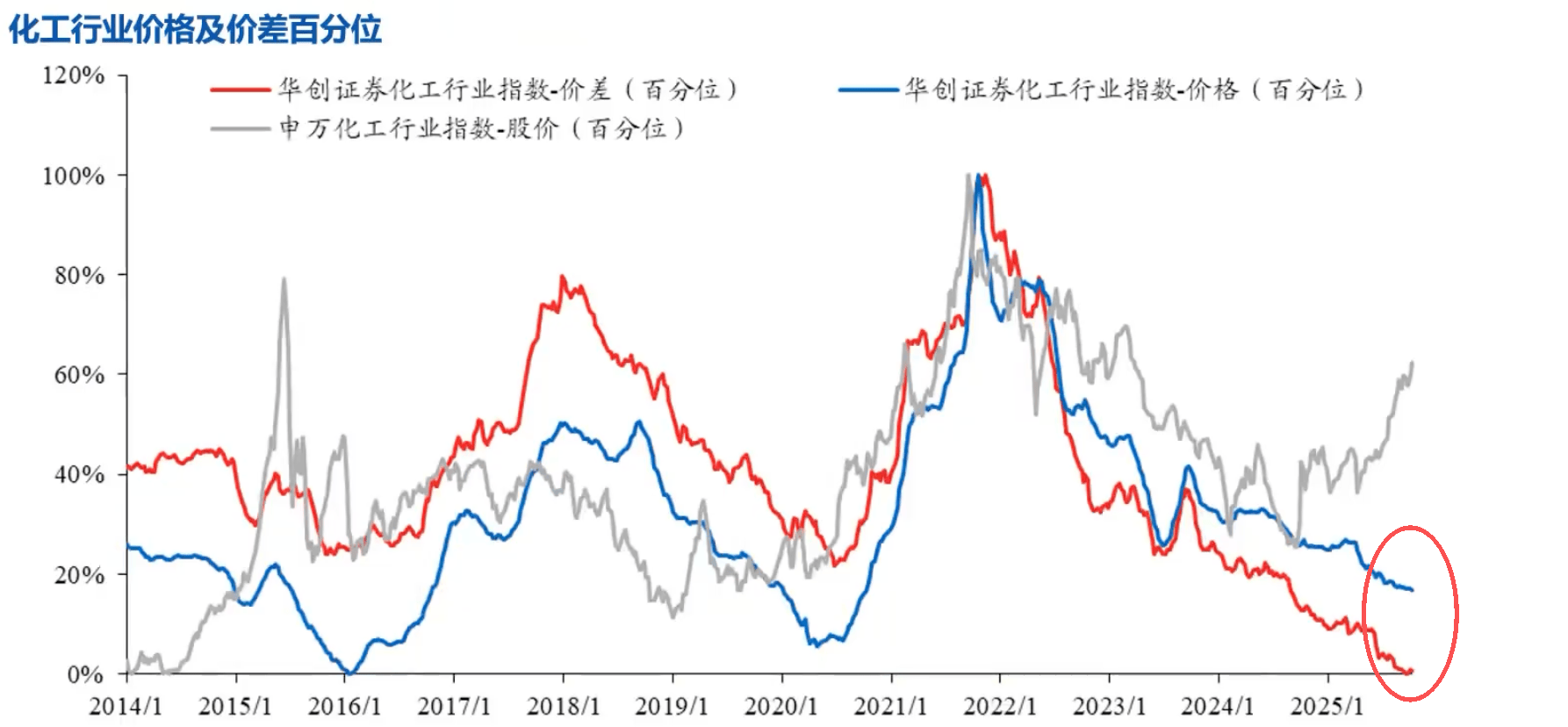
再提治理无序竞争,持续表明政策关注重点 | 投研报告
Zhong Guo Neng Yuan Wang· 2025-10-10 01:30
Core Viewpoint - The announcement by the National Development and Reform Commission and the State Administration for Market Regulation aims to address chaotic price competition in key industries, providing a framework for reasonable pricing based on average costs and market conditions [1][2] Event Summary - On October 9, 2025, the National Development and Reform Commission and the State Administration for Market Regulation issued a notice to combat price chaos, emphasizing fair and lawful pricing practices based on production costs and market supply-demand dynamics [2][3] Event Analysis - The policy continues the "anti-involution" approach initiated earlier in 2025, focusing on curbing disorderly low-price competition and reinforcing supply-side management across various sectors, including cement, steel, and coal [3][4] - The announcement is a continuation of previous policies aimed at regulating low-price competition, enhancing market confidence, and facilitating the implementation of sector-specific policies [3][4] Supply-Side Management - Strong supply-side controls are expected to lead to significant changes in traditional cyclical industries, particularly in the chemical sector, which is characterized by cyclical pressures and supply-demand mismatches [4][5] - If effective supply-side constraints are established, it could fundamentally improve the long-term supply trends of cyclical products, allowing for extended profitability [4][5] Industry Collaboration - Certain industries are beginning to collaborate to improve profitability ahead of stringent supply-side constraints, with initial efforts to control production and pricing already underway [5][6] - The policy is likely to foster further collaboration among industries that have already started self-regulating against low-price competition, particularly in sectors with strong market concentration and manageable new capacity [5][6] Investment Recommendations - The announcement is seen as a continuation of previous policies, with a focus on energy consumption, approvals, environmental protection, and safety in the chemical industry [6] - Key areas for monitoring include supply-side management in petrochemical and coal chemical sectors, as well as industries with steep cost curves or significant process cost differences [6]
有色金属行业周报:金银围绕降息交易展开,白银存在逼仓可能-20250928
GOLDEN SUN SECURITIES· 2025-09-28 09:30
Investment Rating - The report maintains a "Buy" rating for several companies in the non-ferrous metals sector, including 山金国际, 赤峰黄金, 洛阳钼业, 中国宏桥, and 中钨高新 [3]. Core Insights - Precious metals, particularly gold and silver, are trading around interest rate cuts, with silver showing potential for a short squeeze due to low inventory levels and continued inflows into ETFs [1][33]. - Industrial metals like copper are supported by production cuts at the Grasberg mine and a reduction in global copper supply, while aluminum prices are expected to fluctuate as the market awaits demand recovery [1][33]. - Energy metals, particularly lithium, are experiencing active trading ahead of the holiday, with expectations of strong supply growth in the fourth quarter [1][33]. Summary by Sections Precious Metals - Gold and silver continue to trade based on interest rate expectations, with silver's strong performance linked to low inventory levels and ETF inflows [1][33]. - The U.S. core PCE price index for August recorded a year-on-year rate of 2.9%, aligning with expectations and reducing concerns about interest rate cuts [1][33]. Industrial Metals - Copper prices are supported by production cuts at the Grasberg mine, with a projected reduction of over 500,000 tons in global copper supply over the next 12 to 15 months [1][33]. - Aluminum supply is increasing as production capacity is restored, but prices are expected to remain stable in the short term [1][33]. Energy Metals - Lithium prices are stable, with active trading as companies prepare for the holiday season, and supply expectations remain strong for the fourth quarter [1][33]. - The report notes a slight increase in lithium carbonate production, with inventory levels decreasing [1][33]. Key Companies to Watch - The report highlights several companies to monitor, including 兴业银锡, 盛达资源, 万国黄金集团, 中金黄金, 紫金矿业, 山东黄金, 赤峰黄金, 银泰黄金, 招金矿业, 洛阳钼业, 明泰铝业, and others [1][3].

