
Zheng Quan Shi Bao

Search documents
夯实资本市场“天骏方阵” 护航北疆战略产业安全
Zheng Quan Shi Bao· 2026-01-08 18:13
Group 1 - The core viewpoint of the articles highlights the significant advancements in Inner Mongolia's capital market during the "14th Five-Year Plan" period, focusing on the implementation of the "Tianjun Plan" to support enterprise listings and regional economic transformation [1][2] - Inner Mongolia's securities regulatory authority has facilitated the listing of 12 new companies, maintaining a continuous listing trend for five years, and has established a comprehensive service system for enterprise cultivation [1] - By the end of 2025, Inner Mongolia is projected to have 30 A-share listed companies with a total market capitalization exceeding 1 trillion yuan, reflecting a 68% increase from the end of 2020 [1] Group 2 - The capital market in Inner Mongolia has developed a collaborative system involving stocks, bonds, funds, and futures, with companies raising over 30 billion yuan through bond financing [2] - The private equity fund management scale has surpassed 35 billion yuan, focusing on sectors such as renewable energy, rare earth materials, and modern agriculture [2] - Looking ahead to the "15th Five-Year Plan," the regulatory authority aims to enhance the efficiency of multi-level capital markets and support the development of high-quality capital markets to ensure strategic security and economic growth [2]
广州发布加快建设先进制造业强市规划
Zheng Quan Shi Bao· 2026-01-08 18:12
Core Viewpoint - Guangzhou aims to become a strong advanced manufacturing city by 2030, achieving significant progress in modern industrial system construction and enhancing overall industrial efficiency, forming a new pattern driven by trillions, supported by hundreds of billions, and elevated by tens of billions [1] Group 1: Key Industrial Directions - The plan emphasizes the integration of advanced manufacturing and modern services, as well as the dual transformation of industrial digitization and greening [2] - It aims to cultivate 15 strategic industrial clusters and develop six emerging pillar industries, including smart connected new energy vehicles, ultra-high-definition and new display technologies, biomedicine and health, green petrochemicals and new materials, software and the internet, and intelligent equipment and robotics [2] - The plan also focuses on five strategic leading industries such as artificial intelligence, semiconductors and integrated circuits, new energy and new energy storage, low-altitude economy and aerospace, and biomanufacturing [2] Group 2: Automotive Manufacturing Example - During the 14th Five-Year Plan period, Guangzhou produced 2.25 million smart connected new energy vehicles, highlighting the city's traditional strength in the automotive sector [3] - The plan encourages traditional car manufacturers to transition to smart connected new energy vehicles, focusing on the development of next-generation modular high-performance vehicle platforms and breakthroughs in common energy-saving technologies [3] - It aims to establish a complete industrial chain for key components such as power batteries, drive motors, and fuel cell systems, achieving leading advantages in the fields of "three electrics," sensors, and specialized chips [3] Group 3: Greater Bay Area Collaboration - The plan emphasizes the collaborative construction of a world-class manufacturing cluster in the Guangdong-Hong Kong-Macao Greater Bay Area [3] - It promotes the development of the Guangzhou-Shenzhen-Hong Kong-Macao Science and Technology Innovation Corridor and participation in high-end electronic information manufacturing and advanced equipment manufacturing industry belts [3] - The plan aims to deepen comprehensive cooperation with Hong Kong and Macao, establishing various cooperative industrial parks and enhancing the synergy between Guangzhou and Foshan [3]
时报观察 | 协同攻坚“内卷式”竞争 为高质量发展注入持久动能
Zheng Quan Shi Bao· 2026-01-08 18:12
Group 1 - The core viewpoint of the articles emphasizes the need for regulatory actions to address "involutionary" competition in various industries, particularly in the battery and e-commerce sectors [1][2] - Multiple government departments, including the Ministry of Industry and Information Technology, National Development and Reform Commission, State Administration for Market Regulation, and National Energy Administration, are collaborating to combat irrational behaviors such as blind construction and price competition [1][2] - The central economic work conference has highlighted the importance of establishing a unified national market and addressing "involutionary" competition as a key reform task for 2026 [1][2] Group 2 - The measures taken by the government reflect a multi-dimensional approach to governance, focusing on cross-departmental collaboration and comprehensive law enforcement [2] - The introduction of capacity monitoring and standard-setting in industries like power and energy storage batteries aims to guide enterprises towards orderly competition and scientific layout [2] - The ongoing efforts to eliminate "involutionary" competition are crucial as the industry transitions towards high-end, intelligent, and green development, ensuring sustainable growth and fostering innovation [2]
光大证券股份有限公司 关于撤销山东分公司的公告
Zheng Quan Shi Bao· 2026-01-08 18:11
特此公告。 光大证券股份有限公司 为进一步优化网点布局,加强资源整合,推动分支机构高质量发展,光大证券股份有限公司(以下简 称"公司")决定撤销山东分公司。根据《中华人民共和国证券法》(2019年修订)和《关于取消或调整 证券公司部分行政审批项目等事项的公告》(证监会公告〔2020〕18号)相关要求,现就相关事宜公告 如下: 一、山东分公司无客户,原山东分公司辖区内各营业部的正常经营不受影响,客户原有证券账户、资金 账户及相关业务资格保持不变,各项交易委托、资金存取、业务办理等服务均正常开展。 二、公司将妥善做好山东分公司撤销的各项衔接工作,有序推进工商注销等相关手续,并向中国证监会 青岛监管局备案。 2026年1月9日 ...

资本狂热卡位商业航天:“绝不错过2026年大热门” 产业链上下游投资空间广阔 “太空算力”争夺战一触即发
Zheng Quan Shi Bao· 2026-01-08 18:10
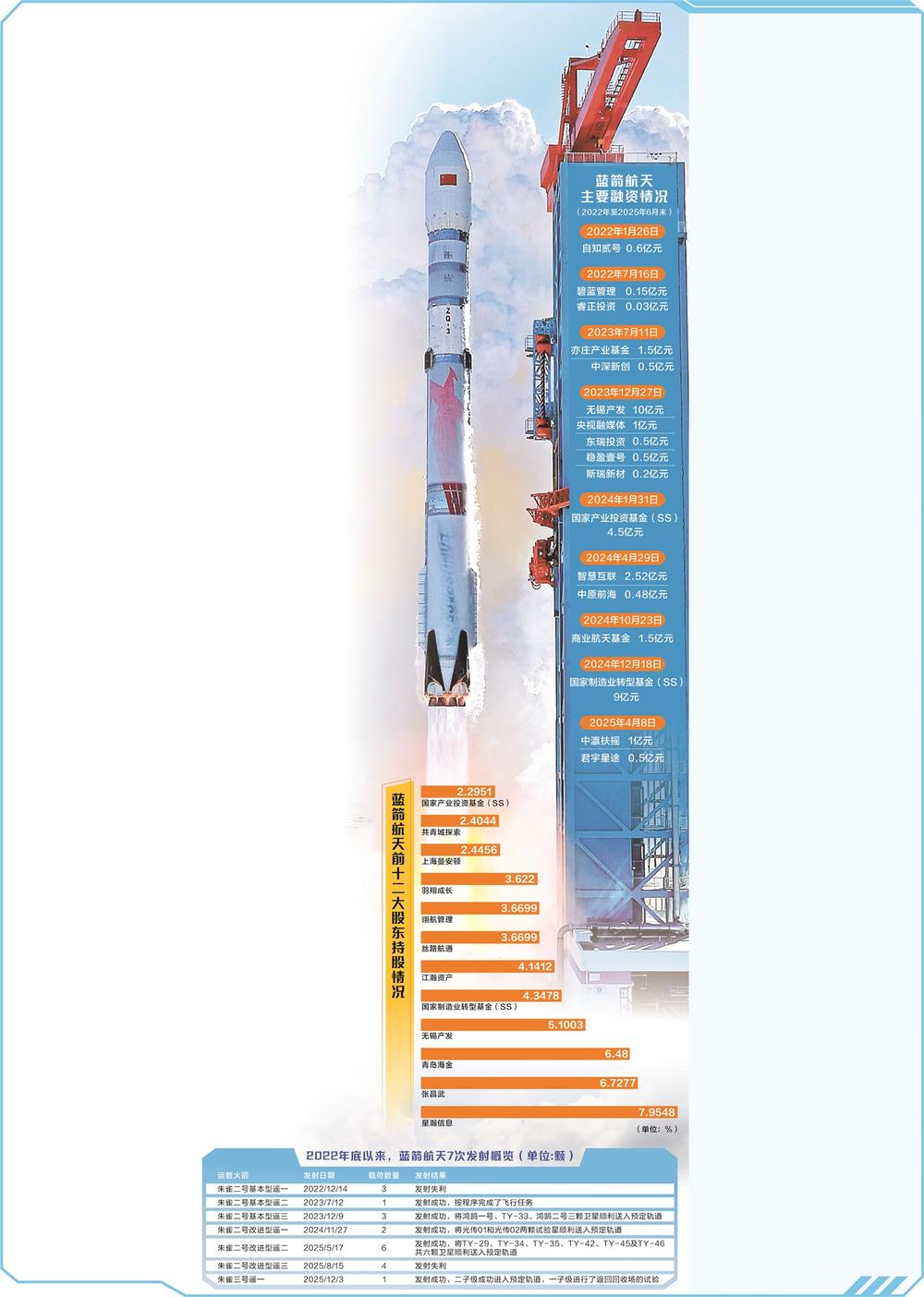
Core Insights - The commercial space sector in China is experiencing significant momentum, with companies like Blue Arrow Aerospace, Tianbing Technology, Xinghe Power, and others aiming to become the "first commercial rocket stock" [2] - The valuation of these companies has surpassed 10 billion yuan, reflecting a broader trend of increasing investment interest in the sector [2] - The competitive landscape is intensifying, driven by policy support and a growing demand for space resources, leading to a rush for capital and project shares [2][3] Financing Overview - Blue Arrow Aerospace has secured multiple rounds of financing from various investors, totaling approximately 27.5 billion yuan from 2022 to mid-2025 [1] - Notable funding rounds include 10 billion yuan from Wuxi Industrial Development and 9 billion yuan from the National Manufacturing Transformation Fund [1] Market Dynamics - There is a growing interest from investors in acquiring shares of established companies in the commercial space sector, with many original shareholders reluctant to sell [3] - The market is witnessing a surge in demand for secondary shares, indicating a strong appetite for investment in this rapidly evolving sector [3] Investment Opportunities - The commercial radar satellite segment is showing signs of mergers and acquisitions, which may provide opportunities for domestic funds to enter the market [4] - The increasing competition in the space sector, particularly with the success of SpaceX, is pushing Chinese companies to accelerate their development and market entry [7] Policy and Regulatory Environment - The Chinese government has implemented supportive policies to encourage private sector participation in the space industry, which has led to the emergence of several startups [5] - Recent reforms in the STAR Market have made it easier for commercial space companies to go public, enhancing investor confidence [6] Future Growth Potential - The commercial space sector is expected to see significant growth as the demand for low Earth orbit satellites increases, with plans for over 51,300 satellite launches in the pipeline [6] - The successful implementation of reusable rocket technology is seen as a critical factor for reducing costs and increasing launch frequency [10] Emerging Trends - The concept of "space computing" is gaining traction, with major tech companies exploring opportunities in this new frontier, indicating a shift from merely launching satellites to leveraging space for data processing [9] - The focus on reducing launch costs through technological advancements and supply chain optimization presents further investment opportunities across the industry [10]

逆周期监管等多重因素助推 险企发债规模连续三年超千亿元
Zheng Quan Shi Bao· 2026-01-08 18:08
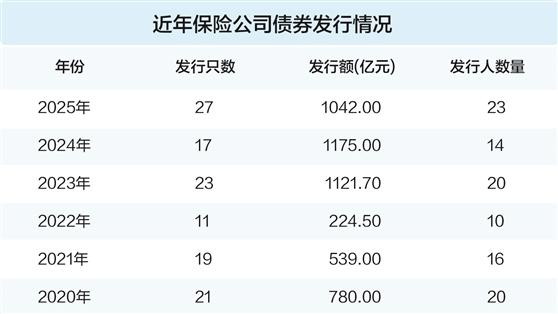
Core Viewpoint - The insurance industry in China has seen a continuous increase in bond issuance, with 2025 marking the third consecutive year that the total issuance exceeded 100 billion yuan, driven by various factors including low interest rates and regulatory support [1][2]. Group 1: Bond Issuance Trends - In 2025, 23 insurance companies issued a total of 27 bonds, amounting to 104.2 billion yuan, following previous years' issuances of 112.17 billion yuan in 2023 and 117.5 billion yuan in 2024 [2][3]. - The bond issuance peaks in the insurance sector have historically been linked to regulatory changes and capital adequacy requirements, with significant peaks noted in 2011-2012, 2015, and 2020 [2][3]. - The current wave of bond issuance is attributed to the implementation of stricter capital recognition rules and a strong demand for capital replenishment due to declining solvency ratios [3]. Group 2: Regulatory Support and Market Expansion - Regulatory support has played a crucial role in expanding the bond issuance capabilities of insurance companies, particularly for smaller firms, as part of a counter-cyclical regulatory approach [4][5]. - The number of insurance companies issuing bonds has increased, with notable first-time issuers like Dongfang Jiafu Life and Dongwu Life entering the market in recent years [5]. - The introduction of perpetual bonds has provided additional financing tools for insurance companies, with 18 firms having issued a total of 127.47 billion yuan in perpetual bonds by the end of 2025 [5]. Group 3: Default and Risk Management - The bond market witnessed its first defaults from insurance companies in 2025, with Tianan Insurance and Tianan Life unable to meet their debt obligations, marking a significant shift in the industry's previously unblemished record [6][7]. - The defaults highlight the importance of investor awareness regarding the governance and risk management capabilities of insurance firms, especially in light of the evolving financial landscape [6][7]. - Investors are advised to focus on core financial indicators and the implications of potential insolvency or restructuring on their rights and interests [7].
实探深圳华强北内存市场的狂热与忐忑:内存价格创历史新高 商家喜忧参半
Zheng Quan Shi Bao· 2026-01-08 18:05
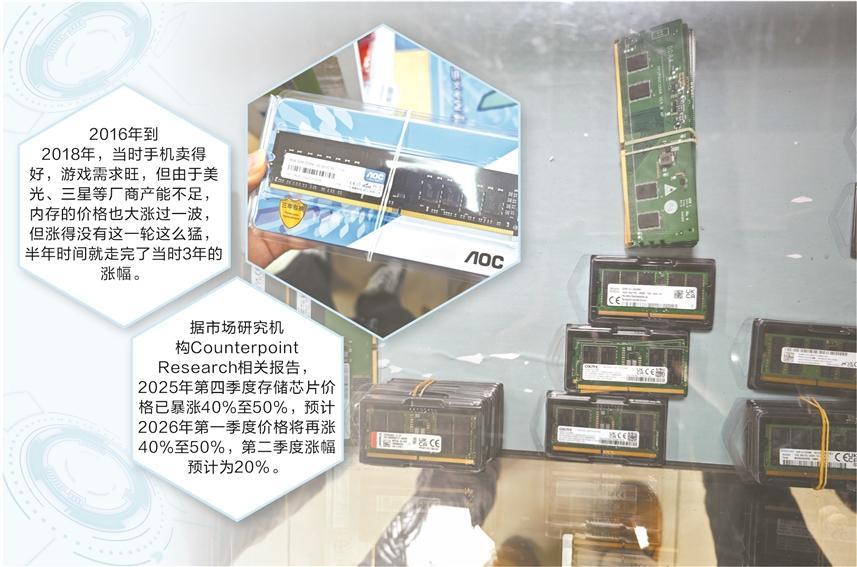
Core Viewpoint - The memory market has entered a "super bull market" since the second half of 2025, with prices for various memory modules generally increasing by over 200%, surpassing historical highs from 2018 [1][2] Price Trends - Prices for memory modules have seen significant fluctuations, with some products experiencing price increases of up to 400% [1] - The most intense price surge occurred from September to October last year, with an average daily increase of 100 yuan for various memory types [2] - The core component, storage chips, is driving further price increases, with forecasts indicating a 40% to 50% rise in prices by Q4 2025 and an additional 40% to 50% in Q1 2026 [2][6] Market Sentiment - Many merchants in Huaqiangbei express mixed feelings about the price surge; while higher prices lead to increased profit margins, sales volumes have significantly declined [4][5] - Some shops report a drop in sales by over 90%, as non-essential consumers reduce purchases of computer components due to high memory prices [4][5] Supply Chain Dynamics - The surge in memory prices is attributed to AI servers consuming production capacity from major manufacturers like Samsung and Micron, leading to shortages in consumer-oriented memory products [6] - Analysts predict that the supply constraints for DDR4 and DDR5 memory will persist, with further price increases expected in early 2026 [6] Impact on Other Industries - The rising memory prices are expected to impact downstream markets, including smartphones and automotive sectors, with potential BOM cost increases of up to 15% for certain smartphone models [7] - The automotive industry is particularly affected, as it competes with AI and computing sectors for memory components, leading to significant cost pressures [7]

天和磁材:双轮驱动 拓展新兴应用领域
Zheng Quan Shi Bao· 2026-01-08 18:05
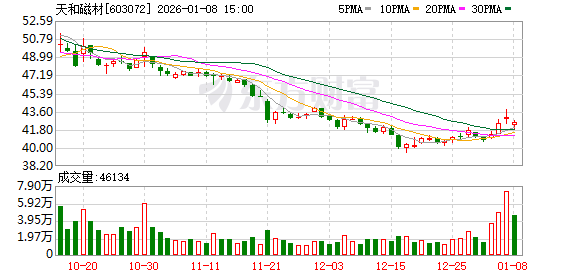
Core Viewpoint - The company, Tianhe Magnetic Materials, is positioned as a leading player in the rare earth permanent magnet materials industry, leveraging its scale, capacity, and core technological advantages, with plans to go public in January 2025 [2]. Group 1: Business Strategy - The company focuses on high-performance rare earth permanent magnet materials, maintaining a dual business model of "neodymium-iron-boron as the main product and samarium-cobalt as a supplement" [2]. - The company aims to expand its high-performance finished product business in emerging applications such as electric vehicles, automotive parts, wind power generation, energy-saving appliances, and robotics [2]. Group 2: Capacity Development - The company is advancing its fundraising projects systematically, implementing automation upgrades, digital management systems, and green production processes to significantly enhance manufacturing efficiency [2]. - These improvements ensure optimized capacity matching and production processes from raw material production to finished product inspection, laying a solid foundation for customer expansion and market share growth [2]. Group 3: Research and Development - The company has achieved preliminary research results in the humanoid robot magnet sector, establishing dedicated research projects and a team led by the chief engineer, with small batch product deliveries already completed [2]. - As of June 30, 2025, the company holds 108 authorized patents, with 49 obtained in Europe, Japan, and the United States, and 59 in China, indicating a continuous enhancement of its R&D capabilities [2]. Group 4: Future Outlook - Looking ahead to the 14th Five-Year Plan, the company will continue to deepen its focus on high-performance rare earth permanent magnet materials, implementing three core strategies: technological innovation, intelligent manufacturing, and market diversification [3]. - The goal is to become a global leader in comprehensive solutions for high-performance magnetic materials [3].
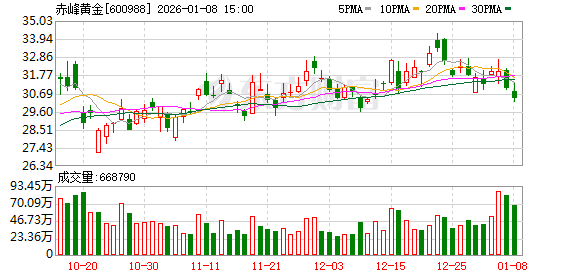
赤峰黄金借A+H平台增强全球市场竞争力
Zheng Quan Shi Bao· 2026-01-08 18:04
Core Viewpoint - Chifeng Gold successfully listed on the Hong Kong Stock Exchange in 2025, becoming the first "A+H" listed company in Inner Mongolia, marking a significant milestone in its development journey [2]. Group 1: Company Development - The company went public on the Shanghai Stock Exchange in 2012 through a major asset restructuring, adopting a "merger-acquisition-integration-development" model to enhance its gold resource volume and production capacity [2]. - The successful listing on the Hong Kong market is seen as a major achievement in the company's development phase during the 14th Five-Year Plan [2]. Group 2: Future Outlook - Looking ahead to the 15th Five-Year Plan, the company aims to strengthen its core business in gold, enhance its resource exploration efforts, and expand its resource volume and reserves [2]. - The company plans to accelerate the construction and production of key projects for domestic and overseas mines, aiming for a significant increase in production capacity [2]. Group 3: Financial Strategy - The company intends to leverage the financing potential of its A+H dual listing to enhance capital operation efficiency and inject strong financial momentum for sustainable development [3]. - It aims to capture global acquisition opportunities and expand its industrial footprint by targeting high-quality resource assets [3]. - The company will deepen cost management and ESG system construction to solidify its core competitiveness of "high efficiency, low cost," aligning with international capital market standards [3].

广州发布 加快建设先进制造业强市规划
Zheng Quan Shi Bao· 2026-01-08 18:04
Core Viewpoint - Guangzhou aims to become a strong advanced manufacturing city by 2030, achieving significant progress in modern industrial system construction and enhancing overall industrial efficiency, with a new structure driven by trillions, supported by hundreds of billions, and elevating to billions [1] Group 1: Key Industry Directions - The plan promotes the integration of advanced manufacturing and modern services, as well as the dual transformation of industrial digitization and greening, accelerating new industrialization [2] - It aims to cultivate and strengthen 15 strategic industrial clusters, focusing on six emerging pillar industries including smart connected new energy vehicles, ultra-high-definition and new displays, biomedicine and health, green petrochemicals and new materials, software and the internet, and intelligent equipment and robotics [2] - The plan also emphasizes the development of five strategic leading industries such as artificial intelligence, semiconductors and integrated circuits, new energy and new energy storage, low-altitude economy and aerospace, and biomanufacturing [2] Group 2: Automotive Manufacturing Example - During the 14th Five-Year Plan period, Guangzhou produced 2.25 million smart connected new energy vehicles, with a focus on transforming traditional car manufacturers towards smart connected new energy [3] - The plan includes the development of a new generation of modular high-performance vehicle platforms and breakthroughs in common energy-saving technologies such as integrated design of electric vehicle chassis and lightweight structures [3] - It aims to establish a complete industrial chain for key components like power batteries, drive motors, and fuel cell systems, achieving leading advantages in the fields of "three electrics" and sensors [3] Group 3: Greater Bay Area Collaboration - The plan emphasizes the collaborative construction of world-class manufacturing clusters in the Guangdong-Hong Kong-Macao Greater Bay Area [3] - It promotes the development of the Guangzhou-Shenzhen-Hong Kong-Macao Science and Technology Innovation Corridor and deep participation in high-end electronic information manufacturing and advanced equipment manufacturing industry belts [3] - Continuous deepening of comprehensive cooperation with Hong Kong and Macao is highlighted, along with the establishment of various cooperative industrial parks [3]