Hua Xia Shi Bao

Search documents
中央政治局会议“划重点”:建设强大国内市场,加紧培育壮大新动能|中央经济工作会议前瞻
Hua Xia Shi Bao· 2025-12-10 01:55
本报(chinatimes.net.cn)记者张智 北京报道 "下半年以来,消费增长势头回落、投资需求陷入收缩区间,导致中国经济下行压力显著加大,呈现 出'前高后低'的走势。这意味着,扩大内需迫在眉睫。"中国人民大学国家发展与战略研究院副院长刘 晓光表示。 本次会议提出,要持续"扩大内需、优化供给,做优增量、盘活存量","扩大内需"依然被排在了各项工 作的第一位,新增表述"优化供给"。同时提出,"要坚持内需主导,建设强大国内市场","持续扩大内 需""坚持内需主导"。 事实上,过去三年以来,中央政治局会议对"扩大国内需求"的期待与日俱增。 在国务院发展研究中心原副主任刘世锦看来,当前,需求不足已经成了中国经济增长的主要痛点。 政策抓手上,此次会议首次提出"坚持内需主导",也首次提出"优化供给",意在增强国内大循环的内生 动力和可靠性。 "扩大内需不只是需求侧的改革,还需要新的消费产品和新的消费场景供给,推动新质生产力的发展成 果在市场中变现,对扩大消费形成引领性的作用。"远东资信研究院副院长张林对《华夏时报》记者表 示。 精准发力内需痛点 扩大内需再次被放到重要位置上! 12月8日,中共中央政治局召开会议分析 ...


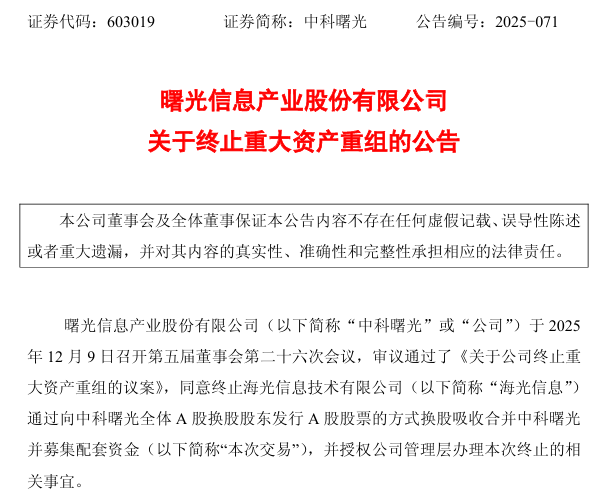
突发!688041、603019,宣布终止重大资产重组
Hua Xia Shi Bao· 2025-12-10 00:57
Core Viewpoint - The major asset restructuring plan between Haiguang Information and Zhongke Shuguang has been officially terminated due to changes in market conditions and the complexity of the transaction, which was deemed not mature enough for implementation [5][6]. Group 1: Termination of Restructuring - Both companies announced the termination of the major asset restructuring plan on December 9, 2025, with Haiguang Information and Zhongke Shuguang holding board meetings to approve the decision [1][3]. - The termination was based on extensive discussions and research, with both companies emphasizing that the decision was made in the interest of maintaining long-term benefits for the companies and their investors [5][6]. Group 2: Background of the Restructuring - The restructuring plan began in May 2025, with Haiguang Information suspending trading on May 26 and resuming on June 10, during which time they disclosed progress updates [5]. - The original plan involved Haiguang Information issuing A-shares to all A-share shareholders of Zhongke Shuguang at a swap ratio of 0.5525:1, with the intention of absorbing Zhongke Shuguang and raising additional funds [6]. Group 3: Market Impact and Future Plans - Prior to the termination, Haiguang Information had a market capitalization of 315.8 billion yuan, while Zhongke Shuguang was valued at approximately 90.3 billion yuan, totaling over 400 billion yuan [6]. - Following the announcement of the merger, both companies experienced significant increases in market capitalization, with Haiguang Information reaching 509.7 billion yuan and Zhongke Shuguang 146.5 billion yuan, leading to a combined market value of 656.2 billion yuan [7]. - Both companies have committed to not planning any major asset restructuring for at least one month following the termination announcement and will hold an investor briefing on December 10, 2025, to address market concerns [5].


中央政治局会议定调2026:宏观政策更加积极有为,“十五五”开局之年“稳中求进”
Hua Xia Shi Bao· 2025-12-10 00:47
Core Viewpoint - The Central Political Bureau of the Communist Party of China held a meeting to analyze and set the direction for economic work in 2026, emphasizing a stable yet progressive approach to economic growth and the implementation of proactive fiscal and moderately loose monetary policies [1][2]. Group 1: Economic Policy Direction - The meeting highlighted the importance of maintaining a stable economic environment while pursuing quality improvements and efficiency [1][2]. - It was noted that the macroeconomic policy will continue to be characterized by a loose stance, focusing more on policy effectiveness rather than sheer scale [1][3]. - The economic growth target for 2026 is likely to be set around 5%, as it marks the beginning of the "15th Five-Year Plan" [1][2]. Group 2: Fiscal Policy Insights - The projected new government debt for 2026 is approximately 12.4 trillion yuan, with a fiscal deficit estimated at around 5.9 trillion yuan [3][4]. - Local government special bonds are expected to increase to 4.5 trillion yuan, with a focus on debt repayment rather than strong stimulus for fixed asset investment [3][4]. - Fiscal spending in 2026 is anticipated to diversify, with a significant emphasis on both material and human investments [4]. Group 3: Monetary Policy Outlook - The central bank is expected to adjust liquidity primarily through reverse repos and government bond transactions, with a cautious approach to interest rate cuts [5][6]. - If there is no significant downward pressure on key economic indicators, the annual interest rate cut may be limited to around 20 basis points [5][6]. - The focus will be on enhancing the effectiveness of existing policies rather than pursuing aggressive new policies [6]. Group 4: Capital Market Development - The meeting indicated a strategic upgrade for the capital market, positioning it as a core hub for supporting the modern industrial system [5]. - Key issues to address in capital market development include the integration of investment and financing, development of derivatives, and strengthening the management of listed companies' market value [5].
“鲶鱼”英伟达再入池:H200获“有条件”解禁,中国高端AI芯片竞争增变数
Hua Xia Shi Bao· 2025-12-10 00:42
Core Viewpoint - The U.S. government has conditionally lifted the ban on NVIDIA's H200 AI chips for sale to China, allowing NVIDIA to regain access to a significant market, albeit with a 25% revenue share taken by the U.S. government [3][4][5]. Group 1: Market Impact - NVIDIA's stock price rose by 2.34% after the announcement, with a current market capitalization of $4.51 trillion, maintaining its position as the world's largest company [3]. - Prior to the ban, revenue from the Chinese market accounted for 20% of NVIDIA's total income, but the company has since lost its market share in high-end AI chips from 95% to 0% [5][6]. - The conditional lifting of the ban is seen as a strategic move for NVIDIA to potentially recover some market share, although it may not return to previous highs due to domestic competition and geopolitical risks [6][7]. Group 2: Competitive Landscape - The H200 chip is considered NVIDIA's second most powerful chip, with the more advanced Blackwell and Rubin chips also in the pipeline [4]. - The absence of NVIDIA in the Chinese market has allowed local AI chip manufacturers to grow, creating a competitive environment that may limit NVIDIA's ability to regain its former dominance [7][8]. - Despite the potential short-term impact of the H200's return on domestic competitors, the long-term outlook suggests a dual-track market where both NVIDIA and local manufacturers coexist [7]. Group 3: Regulatory Challenges - NVIDIA has faced scrutiny from Chinese authorities regarding security concerns related to its chips, which has complicated its market position [8]. - The company is also under investigation for potential antitrust violations, further complicating its operations in China [8]. - These regulatory challenges highlight the complexities of navigating the Chinese market for foreign tech companies, particularly in the AI sector [8]. Group 4: Financial Performance - In the third quarter of fiscal year 2026, NVIDIA reported record revenues of $57 billion, a 22% increase from the previous quarter and a 62% increase year-over-year, with a net profit of $31.9 billion [9]. - The competitive landscape is intensifying as more companies, including domestic Chinese firms and established tech giants like AMD, Google, and Qualcomm, enter the AI chip market [9].


「新消费观察」“10元鲜啤”冲击行业?鲜啤福鹿家全面开放加盟,复制雪王路线欲掀平价风暴
Hua Xia Shi Bao· 2025-12-09 14:51
Core Insights - The core point of the article is that Mixue Group's fresh beer brand, Xianpi Fulujia, is launching an aggressive expansion strategy by opening up its franchise opportunities and eliminating previous approval processes, aiming to capitalize on the backing of its parent company, Mixue Group [2][3]. Expansion Strategy - Xianpi Fulujia has announced a new franchise policy that will fully open franchise channels from December 1 to December 31, 2025, eliminating the previous "old recommend new" approval process [3]. - The new franchise policy includes incentives such as waiving the annual franchise fee of 10,000 yuan for the first three years and exempting 1,500 yuan in fees for three winter months [3]. - The initial investment required to start a franchise is approximately 60,000 yuan, excluding store renovation and rent [3]. Financial Backing - Mixue Group plans to invest 286 million yuan to acquire 51% of the registered capital of Xianpi Fulujia's parent company, Fulu Jia (Zhengzhou) Enterprise Management Co., Ltd., making it a non-wholly owned subsidiary [3][4]. - Following the acquisition, Xianpi Fulujia's financial performance will be consolidated into Mixue Group's financial results [3]. Market Positioning - Xianpi Fulujia's pricing strategy aligns with Mixue Group's low-cost model, with products priced significantly lower than competitors, such as 5.9 yuan for 1 kg of Fulu Fresh Beer [4]. - The average consumer spending at Xianpi Fulujia is reported to be 16.55 yuan, which is considerably lower than other fresh beer brands [4]. Growth Metrics - The number of Xianpi Fulujia stores has rapidly increased from over 1,400 to more than 1,500 within approximately one month [5]. - The brand's expansion strategy is characterized by low entry barriers and high support for franchisees, mirroring the successful model of Mixue Ice City [5]. Industry Context - The craft beer segment, including fresh beer, is still in its early development stage, with no clear market leader established yet [6]. - The overall chain store density in the industry is low, with 57.9% of brands having five or fewer locations, while only 5.1% have over 100 locations [6]. - Compared to established daily consumer products like tea and coffee, craft beer still faces challenges in terms of market penetration and consumer frequency [6]. Competitive Landscape - The entry of Mixue Group into the craft beer market is expected to change the dynamics of the industry, promoting a low-cost and franchise-based expansion model [7]. - This move may intensify competition, forcing smaller brands to either optimize their supply chains or pursue differentiation strategies [7].

存量+增量政策协同发力,财政货币延续积极|中央经济工作会议前瞻
Hua Xia Shi Bao· 2025-12-09 11:36
Group 1 - The core viewpoint of the article emphasizes the importance of the Central Political Bureau meeting in December as a precursor to the upcoming Central Economic Work Conference, outlining the economic policy direction for 2026 [2][3] - The meeting acknowledged the overall stability and progress of China's economy in 2025, highlighting the steady development of new productive forces and effective risk mitigation in key areas [3][4] - The policy focus for 2026 will be on maintaining stability while promoting quality and efficiency, with a commitment to more proactive fiscal policies and moderately loose monetary policies [3][4][5] Group 2 - The meeting reiterated the need for a combination of stable growth and quality improvement, indicating a shift in policy focus from merely stabilizing growth to optimizing structure [4][5] - Analysts expect that the macroeconomic policies for 2026 will be more forward-looking, aiming to lay a foundation for high-quality development over the next five years [4][5] - The emphasis on "integrating stock and incremental policies" suggests a coordinated approach across various departments and regions to enhance policy effectiveness [5][6] Group 3 - The three main policy principles for 2026 include implementing more proactive macroeconomic policies, enhancing the foresight and coordination of policies, and continuing with active fiscal and moderately loose monetary policies [7][8] - Fiscal policy is expected to maintain a deficit rate of around 4%, with an increase in special bonds and long-term special government bonds to support new productive forces and social welfare [8][9] - Monetary policy is anticipated to see further reductions in deposit and policy interest rates, with potential cuts in reserve requirements and interest rates to support economic stability [8][9][10]

11月出口超预期反弹,货物进出口连续10个月保持同比增长
Hua Xia Shi Bao· 2025-12-09 10:34
Core Viewpoint - China's import and export activities have shown strong growth despite international uncertainties, with a total trade value of 41.21 trillion yuan, reflecting a year-on-year increase of 3.6% in the first 11 months of the year [3][5]. Group 1: Trade Performance - In November, China's total trade reached 3.9 trillion yuan, with a year-on-year growth rate of 4.1%, marking ten consecutive months of growth and exceeding market expectations [3][5]. - Exports in November grew by 5.9% year-on-year, slightly surpassing expectations, while imports increased by 1.7% [5][6]. - For the first 11 months, exports and imports reached 24.46 trillion yuan and 16.75 trillion yuan, respectively, with year-on-year growth rates of 6.2% and 0.2% [5][6]. Group 2: Economic Outlook - The forecast for 2026 suggests that China's exports will maintain resilience, with an expected growth rate of around 5%, driven by increased openness and the Belt and Road Initiative [3][6]. - The Ministry of Commerce plans to enhance import efforts to better meet domestic demand and promote industrial transformation [4]. Group 3: Sectoral Insights - Machinery and electrical products remain the main export drivers, accounting for 60.9% of total exports, with an 8.8% increase year-on-year [5]. - The growth in exports is attributed to various factors, including base effects, holiday timing, and disruptions in freight schedules [5][6]. Group 4: Global Trade Relations - China's trade with over 110 countries and regions has seen simultaneous growth, with significant increases in trade with ASEAN, Africa, Latin America, and the EU [6][7]. - The establishment of free trade zones and zero-tariff policies for least developed countries has contributed to expanding China's trade partnerships [7][8]. Group 5: Emerging Markets - The industrialization of Southern countries presents significant opportunities for Chinese enterprises, with Africa projected to be the second-fastest growing region in terms of economic growth in 2024 [8]. - The global supply chain is evolving, with increased reliance on Chinese industries from regions like Africa, Latin America, and Southeast Asia [8].
「寻芯记」“鲶鱼”英伟达再入池:H200获“有条件”解禁,中国高端AI芯片竞争增变数
Hua Xia Shi Bao· 2025-12-09 10:17
Core Viewpoint - The U.S. government has conditionally lifted the ban on NVIDIA's H200 AI chip sales to China, allowing NVIDIA to regain access to a significant market, albeit with a 25% revenue share taken by the U.S. government [2][3][4]. Group 1: Market Impact - Following the announcement of the lifting of the ban, NVIDIA's stock price rose by 2.34% in after-hours trading, bringing its market capitalization to $4.51 trillion, maintaining its position as the world's largest company [2]. - Prior to the ban, revenue from the Chinese market accounted for 20% of NVIDIA's total income, but the company has seen its market share in high-end AI chips drop from 95% to 0% due to U.S. export restrictions [5][9]. - The conditional lifting of the ban is expected to allow NVIDIA to generate approximately $15 billion in revenue by clearing inventory, despite the 25% revenue share impacting its income [5][4]. Group 2: Competitive Landscape - The H200 chip is considered NVIDIA's second most powerful AI chip, with the more advanced Blackwell and the upcoming Rubin chips also in the pipeline [3]. - The return of the H200 may help NVIDIA regain some market share in China, but it is unlikely to return to previous highs of 90%, with estimates suggesting a recovery to 50%-60% market share due to domestic competition and geopolitical risks [6][7]. - The absence of NVIDIA in the Chinese market has provided opportunities for local AI chip manufacturers to grow, with companies like Cambrian and Moore Threads gaining traction during this period [6][7]. Group 3: Regulatory Challenges - NVIDIA faces additional challenges in the Chinese market, including scrutiny over security issues related to its chips and ongoing investigations by Chinese regulatory authorities regarding potential antitrust violations [8]. - The Chinese government has previously raised concerns about security vulnerabilities in NVIDIA's H20 chip, leading to demands for explanations and compliance with local laws [8]. Group 4: Financial Performance - In the third quarter of fiscal year 2026, NVIDIA reported record revenues of $57 billion, a 22% increase from the previous quarter and a 62% increase year-over-year, with a net profit of $31.9 billion, reflecting a 65% year-over-year growth [9].

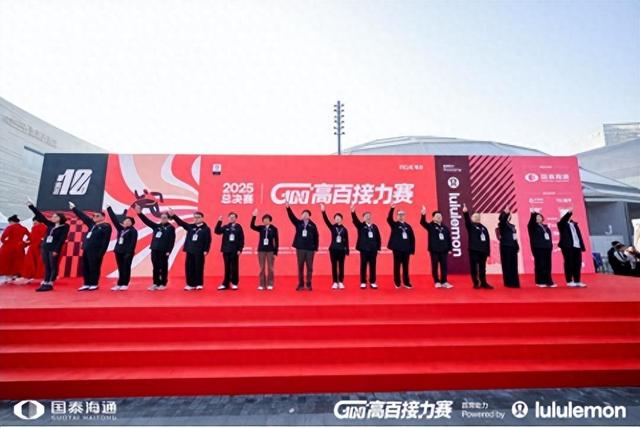
国泰海通携手高百接力赛共谱申城活力新篇章
Hua Xia Shi Bao· 2025-12-09 09:42
Core Viewpoint - The event marks the 10th anniversary of the Gaobai Relay Race and the launch of the 2025 strategic plan, emphasizing the integration of sports and education as part of a broader health initiative for students [1][6]. Group 1: Event Overview - The Gaobai Relay Race is a key component of the 2025 Shanghai student sports activities and serves as a benchmark event for promoting student health [3]. - The final event attracted 100 university teams and nearly 1,300 young athletes from seven major regions and cities across the country [4]. Group 2: Company Involvement - Guotai Junan received the "Dream Partner Award" for its comprehensive support of the Gaobai Relay Race, aligning with national strategies for sports industry development [6]. - The company aims to enhance its brand image by promoting financial knowledge and responsible investment concepts among students and citizens through various engaging activities [8]. Group 3: Educational Initiatives - The company has introduced innovative educational projects, such as the "MBTI Investment Personality Test" and interactive games, to make financial knowledge accessible to the younger generation [11]. - Initiatives like the "Campus Challenge Plan" and the "Financial Knowledge Relay Challenge" aim to provide personalized financial education experiences for youth [11]. Group 4: Commitment to Social Responsibility - Guotai Junan has a long-standing commitment to educational philanthropy, having established multiple Hope Primary Schools and scholarship programs across various educational levels [14]. - The company actively participates in significant Shanghai events, integrating high-quality brand building with the city's development and contributing to its cultural soft power [16].


强化内需主导!年末政治局会议楼市再度“隐身”,城乡融合连续三年被提及|中央经济工作会议前瞻
Hua Xia Shi Bao· 2025-12-09 09:38
Core Insights - The Central Political Bureau meeting on December 8 emphasized urban-rural integration and regional coordinated development for economic work in 2026, without directly mentioning real estate, contrasting with previous meetings that focused on stabilizing the real estate market [2][3] Group 1: Real Estate Risk Management - Despite the lack of direct mention of real estate, the meeting highlighted the importance of "safeguarding the bottom line and actively and steadily resolving key area risks," indicating that real estate remains a focus for risk management [3] - The China Academy of Social Sciences noted that the deep policy adjustments in the real estate sector have led to declines in housing and land prices, exacerbating macroeconomic debt issues, making it crucial to stabilize the real estate market [3][4] - The Shanghai E-House Real Estate Research Institute suggested that new strategies are needed for risk prevention, including ensuring housing delivery and exploring new funding sources, while emphasizing market-oriented debt restructuring for real estate companies [4] Group 2: Urban-Rural Integration and Domestic Demand - Urban-rural integration has been repeatedly emphasized in recent Political Bureau meetings as a core goal of new urbanization, aiming to enhance domestic demand and promote coordinated regional development [5][6] - As of 2023, the urbanization rate of China's registered population was 48.3%, indicating a significant gap of nearly 18 percentage points compared to the overall urbanization rate of 67%, highlighting the need for further integration of rural labor into urban areas [5] - The State Council's recent emphasis on human-centered new urbanization aims to unlock the potential of urban-rural integration to drive economic growth, focusing on equal access to public services and infrastructure connectivity [6]