
Zhong Guo Qi Che Bao Wang

Search documents
创富・新能源:第九届 “意见领袖” 活动在京举行
Zhong Guo Qi Che Bao Wang· 2025-12-31 10:28
Core Insights - The event "China Truck Customer Operation Survey Opinion Leader" focuses on user operations, product performance, and quality, reflecting industry opinions and voices [1] - The event has been held annually since 2017, accumulating thousands of user voices through extensive surveys across the country [1] Industry Trends - The evaluation emphasizes the core track of new energy, focusing on key models such as electric heavy trucks, light trucks, micro trucks, VANs, and pickups [3] - The survey targets regions with high concentrations of heavy trucks and mainstream markets for new energy light trucks, including Beijing-Tianjin-Hebei, Yangtze River Delta, and Greater Bay Area [3] - Five major industry trends identified include: 1. Continuous improvement of policy support, with benefits like charging subsidies and road rights stimulating market potential [3] 2. More affordable prices for new energy trucks and lower entry barriers promoting green transportation [3] 3. Maturing battery technology leading to lightweight and high-capacity solutions, significantly increasing customer acceptance [3] 4. Highlighting operational cost advantages as key to driver profitability under pressure on freight rates, driving green transformation in the industry [3] 5. Upgraded adaptability for specific scenarios, with customized models emerging and steadily increasing penetration rates [3] Market Dynamics - The sales and penetration rates of new energy commercial vehicles in China are on the rise, with diverse categories developing simultaneously and regional advantages becoming more pronounced [5] - The future focus should be on "improving quality, reducing costs, and increasing efficiency" to explore development potential [5] Technological Innovations - Insights from industry leaders highlight how electric light trucks can overcome scenario limitations through technological innovation, and how open-source batteries can empower green upgrades in heavy truck logistics [6] Industry Participation - The event saw active participation from leading companies such as China National Heavy Duty Truck Group, Foton Motor, Dongfeng Liuzhou Motor, BYD Commercial Vehicles, and others, showcasing the vitality of high-quality development in the truck industry [8] - The current market exhibits a symbiotic relationship between traditional and new energy vehicles, with traditional fuel vehicles still playing an irreplaceable role in key areas like long-haul and specialized operation vehicles [8] Future Outlook - As the event approaches its 10th anniversary in 2026, the organizing team plans to comprehensively analyze ten years of survey data and release the "China Truck User Operation White Paper," focusing on core topics such as cost control, fleet management, low-carbon transformation, and value-added services [8]


传统模式式微,转型迫在眉睫,进口车市场亟待变革
Zhong Guo Qi Che Bao Wang· 2025-12-31 09:33
Core Viewpoint - The Chinese imported car market is undergoing a significant transformation, with a sharp decline in import volumes and a need for companies to shift from traditional sales models to value-added services and cultural recognition [2][8]. Group 1: Market Decline - In the first ten months of 2025, China's imported car volume was 404,000 units, a year-on-year decrease of 30% [2]. - Compared to the historical peak of 1.43 million units in 2014, the market has shrunk by more than two-thirds over the past decade [2]. - The decline is attributed to the rise of domestic brands and changing consumer demands, necessitating a shift in business models for imported car companies [2]. Group 2: Service Transformation - The core direction for imported car companies is to build a service-oriented ecosystem, moving away from a "one-time sale" profit logic to "long-term relationship management" [3]. - Companies must integrate service throughout the entire vehicle lifecycle, enhancing service efficiency through digital tools and creating brand loyalty through personalized experiences [3]. - The Ministry of Industry and Information Technology's 2025-2026 work plan supports this transition by emphasizing quality, technology, and service over mere product competition [3]. Group 3: Cultural and Collectible Market - The second path for transformation involves tapping into the cultural value of automobiles, particularly classic models with historical significance [4]. - The potential for the collectible car market is significant, as evidenced by the International Auto Culture Exhibition at the 8th China International Import Expo, showcasing classic cars that attract considerable attention [4][5]. - The Ministry of Commerce's regulations on classic cars provide a legal framework for their circulation and trade, enabling companies to cater to the cultural collector segment [5]. Group 4: Integration into Local Ecosystem - The third path for transformation is to integrate into China's automotive ecosystem, particularly in the context of electrification and smart technology [6][7]. - Imported car brands must move away from outdated global models and focus on localized development to meet Chinese market demands [7]. - Collaboration with local supply chains and technology partners is essential for reducing maintenance costs and enhancing service offerings [7]. Group 5: Future Outlook - The imported car market is at a critical juncture, with a significant decline in imports indicating that traditional models are no longer viable [8]. - Companies that adapt quickly to changes and embrace transformation will find new growth opportunities, while those that resist change risk being eliminated from the market [8].

国内降温、国外火热,插混出口暴涨 跳板作用凸显
Zhong Guo Qi Che Bao Wang· 2025-12-31 09:33
Core Viewpoint - The demand for plug-in hybrid vehicles (PHEVs) is declining in the domestic market but is surging in overseas markets, driven by global automotive industry transformation, changes in trade environments, and technological advancements by Chinese automakers [2][16]. Group 1: Market Performance - In November, PHEV exports reached 124,000 units, a month-on-month increase of 37.3% and a year-on-year increase of 400%, significantly outpacing pure electric vehicle (EV) growth [2]. - From January to November, PHEV exports totaled 842,000 units, a year-on-year increase of 240%, compared to less than 300,000 units for the entire previous year [2]. - In Shanghai, the export value of hybrid vehicles reached 25.72 billion yuan, a substantial increase of 174.8% [2]. Group 2: Charging Infrastructure Disparities - The development of charging infrastructure is uneven globally, creating a natural market space for PHEVs, especially in regions like Europe and Southeast Asia where fast-charging facilities are lacking [3]. - As of the end of 2024, Europe is projected to have nearly 1 million public charging stations, but this growth is insufficient to meet the demand from the increasing number of EVs [3]. - In Germany, the ratio of electric vehicles to public charging stations is approximately 16.7:1, indicating a significant shortfall in charging infrastructure [4]. Group 3: Trade Policy Impacts - Trade policies favoring PHEVs have emerged as a significant driver for their export growth, as many countries impose high tariffs on pure EVs while exempting PHEVs [6][7]. - The EU has announced a 5-year anti-subsidy tax on Chinese pure EVs, while PHEVs remain exempt due to their classification as transitional technologies [7]. - Similar favorable policies exist in markets like Brazil and Indonesia, where PHEVs benefit from lower import tariffs compared to pure EVs [7][8]. Group 4: Domestic Market Trends - The domestic PHEV market is experiencing a slowdown, with a year-on-year growth of 16.4% from January to November, compared to 41.2% for pure EVs [9][11]. - The initial demand for PHEVs driven by license plate advantages is diminishing as cities adjust their policies, leading consumers to prefer pure EVs [9]. - The improvement of charging infrastructure in urban areas has reduced the appeal of PHEVs, as consumers find pure EVs more convenient [9]. Group 5: Competitive Landscape - The domestic PHEV market has become highly competitive, with over 150 models available, leading to price wars that have reduced prices by 10% to 15% [10]. - The increase in competition has pressured profit margins for manufacturers, prompting a more rational consumer choice [10]. Group 6: Technological and Cost Advantages - Chinese automakers have developed advanced PHEV technologies, such as the series-parallel hybrid system, which enhances energy efficiency and driving experience [13][14]. - The complete supply chain for PHEVs in China allows for lower production costs compared to European counterparts, making Chinese PHEVs more competitively priced in international markets [14]. - The cost advantage is evident, with Chinese PHEV SUVs starting at approximately 36,000 euros, significantly lower than similar models from European brands [14]. Group 7: Future Outlook - The growth of PHEVs in overseas markets provides a crucial support for the global expansion of Chinese automakers, allowing them to leverage their technological and cost advantages [15][16]. - As global charging infrastructure improves and pure EV technology advances, PHEVs may gradually exit mature markets but will continue to meet demand in emerging markets [15]. - The long-term vision remains focused on pure EVs as the ultimate goal, but PHEVs will play a vital role during the global energy transition [15].





鸿蒙智行大酒店勇闯汽车零售创新之路
Zhong Guo Qi Che Bao Wang· 2025-12-31 09:33
Core Insights - The automotive industry is witnessing a significant transformation with the emergence of the "Hongmeng Intelligent Hotel," which has gained popularity for its premium customer experience, surpassing traditional luxury car dealerships [2][3] - The monthly delivery of new vehicles under the Hongmeng Intelligent system has exceeded 80,000 units, indicating strong market demand and operational success [2] - A strategic collaboration among the five brands under Hongmeng Intelligent aims to enhance R&D, manufacturing, charging, and marketing, while establishing a standardized service system for a high-quality customer experience [2][5] Group 1: Customer Experience and Service Innovation - The "Hongmeng Intelligent Hotel" has introduced unique dining experiences at various locations, enhancing customer satisfaction and engagement [4][9] - Despite the positive reception, there are concerns regarding service consistency and quality across different service centers, highlighting the need for a unified approach to after-sales service [4][5] - The recent adjustments to free services due to cost pressures raise questions about the sustainability of the current customer experience model [3][10] Group 2: Strategic Developments and Industry Trends - The shift from direct sales to a dealership model aims to reduce operational costs and accelerate market penetration, reflecting a broader trend in the automotive industry [6][7] - The establishment of a cross-brand shared after-sales service network is seen as an innovative move, although it is not the first instance of such a model in the industry [8][9] - Analysts suggest that the focus on user experience must be balanced with cost management to ensure long-term viability and profitability [10][11]


养路费分担“油电不公”难题待解
Zhong Guo Qi Che Bao Wang· 2025-12-31 09:25
Core Viewpoint - The increasing penetration of electric vehicles (EVs) in China raises questions about the fairness of road usage fees, as currently, only fuel vehicle owners bear these costs. The government is considering a mechanism for equitable cost-sharing between fuel and electric vehicles [3][4][5]. Group 1: Current Situation of Electric Vehicles - As of now, there are 360 million vehicles in China, with 36.89 million being electric vehicles, accounting for 10.27% of the total. Among these, 25.54 million are pure electric vehicles [3]. - The rapid growth of electric vehicles has led to concerns about the sustainability of road maintenance funding, as these vehicles do not contribute to road usage fees [4][5]. Group 2: Fairness and Cost Sharing - The concept of "equal rights for oil and electricity" is gaining traction, emphasizing fairness for fuel vehicle users and market stability [6]. - Industry experts suggest that electric vehicles should share road usage fees to ensure fairness and sustainability in road maintenance funding [6][10]. Group 3: International Practices - Various countries in Europe are implementing tax models for electric vehicles based on weight or mileage to adhere to the principle of "who uses pays" [8]. - In New Zealand, a road usage fee for electric vehicles will be introduced, while in the U.S., states are exploring different fee structures for electric vehicles [9]. Group 4: Technological Solutions - Advances in technology, such as high-precision positioning and vehicle networking, are paving the way for implementing mileage or weight-based road usage fees for electric vehicles [9]. - Ensuring accurate and fair charging through technology is crucial, with suggestions for using satellite positioning and real-time data collection [11]. Group 5: Policy Recommendations - Experts recommend a gradual implementation of road usage fees for electric vehicles, starting with commercial vehicles and allowing a buffer period for consumers to adapt [13][14]. - A dynamic fee adjustment mechanism could be established to align with economic indicators and ensure that the fees remain reasonable for users [14]. Group 6: Balancing Interests - Achieving a balance between user fairness and industry development is essential for the sustainable growth of the electric vehicle sector [15]. - Collaboration among government, industry, and society is necessary to create a fair and effective road usage fee system that supports the long-term development of the electric vehicle industry [15].

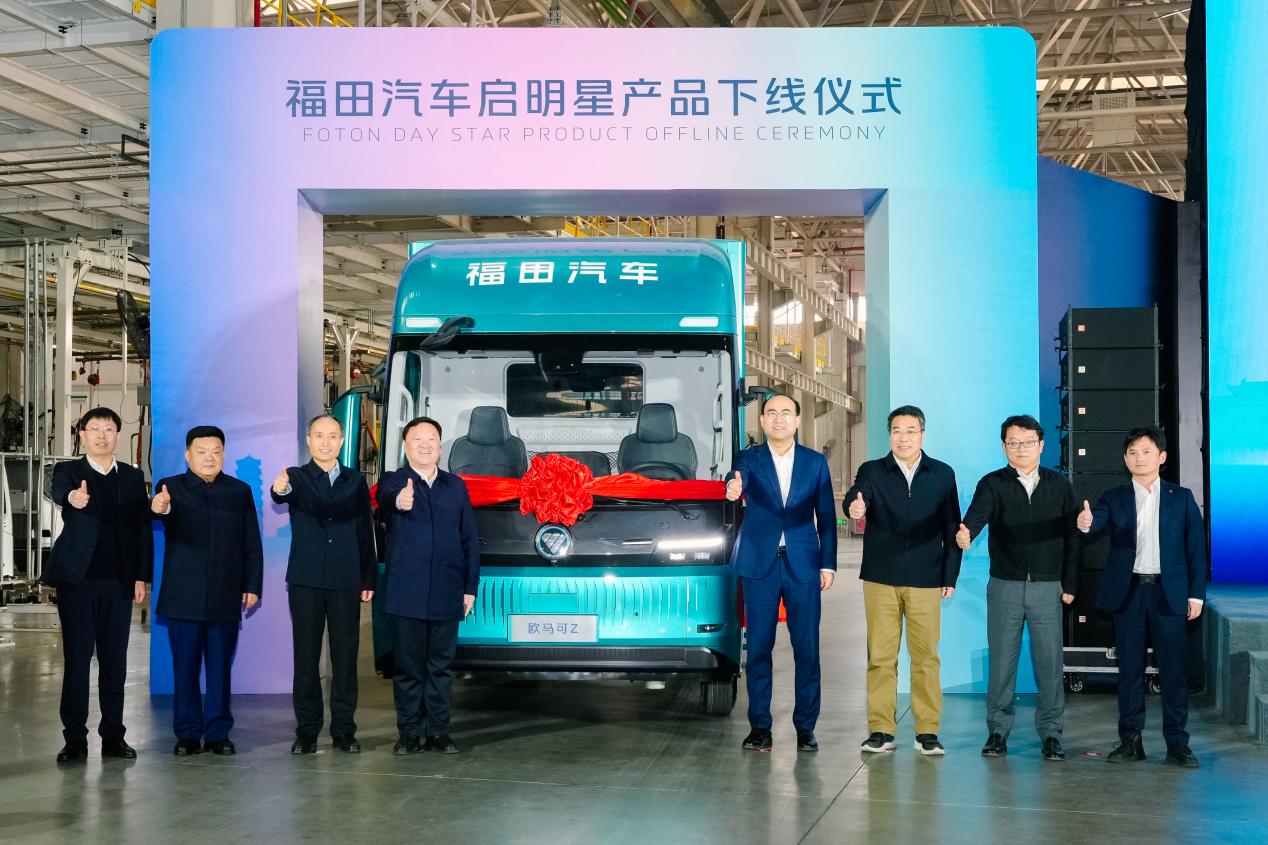
开启绿色货运新纪元 福田启明星全矩阵下线
Zhong Guo Qi Che Bao Wang· 2025-12-31 08:11
Core Insights - The launch of the Foton Motor's "Qimingxing" series of pure electric light trucks marks the first mass production of a dedicated platform for pure electric light trucks globally, reflecting strong market confidence and a shift from policy-driven to market-driven growth in China's new energy commercial vehicle industry [1][3] Group 1: Production and Market Impact - The mass production of the Qimingxing platform is a critical step in Foton's new energy strategy and signifies a transition in the commercial vehicle sector from "oil-to-electric" to "forward development" [3][6] - Foton's new energy vehicle sales reached 92,000 units from January to November 2025, a year-on-year increase of 89.1%, indicating a leading position in the industry [6] - The signing of 1,682 bulk orders at the launch event demonstrates the strong market demand for efficient and economical green logistics solutions [12][16] Group 2: Technological Advancements - The Qimingxing platform represents a revolutionary shift in design, moving away from the "oil-to-electric" approach to a fully electric power system and intelligent architecture, addressing key industry pain points such as limited space, short range, and low intelligence [9][11] - The platform's development involved over 1.7 billion yuan in R&D investment, achieving breakthroughs in five core dimensions: efficiency, intelligence, safety, comfort, and ecology [7][9] Group 3: Strategic Goals and Future Plans - Foton aims to become a world-class commercial vehicle enterprise by 2025, with the Qimingxing platform solidifying its position as the leading brand in China's commercial vehicle sector [3][6] - The company plans to produce 32,000 units and generate 3.5 billion yuan in output value by 2025, with a focus on localizing parts production and enhancing supply chain resilience [6][12] Group 4: Industry Transformation - The launch of the Qimingxing platform signifies a shift in the commercial vehicle industry from adaptive innovation to leading innovation, establishing a new technical paradigm for pure electric light trucks [11][16] - The green transformation of the logistics industry is becoming a necessity, with the Qimingxing platform expected to lower the barriers to electric vehicle adoption and accelerate the industry's transition to greener solutions [14][16]
中保研汽车技术研究院发布第19期和第20期汽车零整比研究结果
Zhong Guo Qi Che Bao Wang· 2025-12-31 07:22
Core Insights - The automotive zero-to-whole ratio is a key actuarial indicator for insurance premium pricing and is essential for optimizing after-sales maintenance costs for automotive companies, thereby protecting consumer rights in the long term [1] Group 1: Automotive Zero-to-Whole Ratio Indicators - The 20th period's "Automotive Zero-to-Whole Ratio 100 Index" for fuel vehicles is 391.07%, an increase of 2.00 percentage points from the 19th period, reflecting a growth rate of 0.51% [2] - The average zero-to-whole ratio coefficient for 10 new fuel vehicle models is 545.11%, which significantly contributed to the rise in the 20th period's index [2] - The "Repair Burden 100 Index" for fuel vehicles is 20.86, up by 0.10 from the 19th period, indicating a 0.47% increase, which highlights the rising repair costs and insurance payout pressures for traditional vehicle users [2] Group 2: Component-Specific Zero-to-Whole Ratios - Among 18 commonly used components in fuel vehicles, 11 saw an increase in their average single-component zero-to-whole ratios, with the rearview mirror assembly experiencing the highest increase of 4.82% [4] - The average price of 12 commonly used components also rose, with the rearview mirror assembly showing the highest price increase of 7.82% [4] - The average single-component zero-to-whole ratio for front headlights is 3.20%, an increase of 0.02 percentage points, with the highest ratio recorded for the Audi A6L at 10.40% [5] Group 3: New Energy Vehicle Indicators - The 20th period's "Automotive Zero-to-Whole Ratio 100 Index" for new energy vehicles is 312.24%, an increase of 3.30 percentage points from the 19th period, reflecting a growth rate of 1.07% [6] - The "Repair Burden 100 Index" for new energy vehicles is 27.66, up by 0.55 from the 19th period, indicating a 2.03% increase, which reflects the rising repair costs and insurance payout pressures for new energy vehicle users [6] - Among 18 commonly used components in new energy vehicles, 16 saw an increase in their average single-component zero-to-whole ratios, with the outer tail light showing the highest increase of 11.59% [8] Group 4: Battery Component Insights - The average single-component zero-to-whole ratio for power batteries in new energy vehicles is 49.59%, a decrease of 0.38 percentage points from the 19th period [11] - The average unit energy price for power batteries is 1538.83 yuan/kWh, reflecting a decrease of 2.23%, indicating improved cost-effectiveness [12] - The research results aim to enhance transparency in the automotive aftermarket and support the insurance industry in refining premium rates and risk assessment models [12]

AC-HUMs 5百分位女性人体数字模型发布——从“一个模型”到“一个体系”:守护生命安全的技术基石
Zhong Guo Qi Che Bao Wang· 2025-12-31 04:30
Core Viewpoint - The automotive safety industry is transitioning towards digitalization and precision, with a focus on developing a series of human digital models that cover multiple physical characteristics and scenarios. The China Automotive Engineering Research Institute (CAERI) has led the development of the first series of Chinese anthropometric digital models (AC-HUMs), which now includes the release of a 5th percentile female digital model available for free trial across the industry, marking a significant advancement in safety protection for all genders in vehicles [1][12]. Group 1: Model Development - The AC-HUMs 05F model is based on multimodal medical imaging data (CT/MRI/X-Ray) from Chinese female volunteers and has undergone dual calibration to ensure geometric standardization and anatomical accuracy, providing more precise safety protection for female road users [6][12]. - The AC-HUMs model family was developed using entirely Chinese anthropometric data, ensuring that the model parameters are representative of the Chinese population, thus achieving the goal of "Chinese data defining Chinese models" [12]. Group 2: Technical and Validation Framework - The development process involved collaboration with experts from eight top universities in China, focusing on segment-specific modeling and technical challenges, with CAERI overseeing the project and validation of the full-body model [12]. - A comprehensive validation system was implemented, including 42 segment-level and 23 full-body biological realism validation tests, alongside real-world accident data for accident reconstruction verification, ensuring the model's biological realism and practical engineering value [12]. Group 3: Industry Collaboration and Innovation - CAERI established a collaborative platform called the Human Model Joint Application and Innovation Center, aimed at promoting model development and establishing evaluation application standards, which has hosted 13 industry seminars and made 15 presentations at international conferences [14]. - The center plans to form a virtual evaluation research group with international human modeling experts by 2025 to foster continuous innovation and collaboration within the industry [14]. Group 4: Model Trial Application Process - Interested parties can apply for a trial of the model by downloading and completing the application form, which must be stamped by the organization and sent via email to CAERI for review [18][19]. - Initial applicants are required to sign a confidentiality agreement before receiving the model and user manual, with the trial period available from now until February 6, 2026, for a maximum duration of three months [21].


观车 · 论势 || 警惕“噱头创新”
Zhong Guo Qi Che Bao Wang· 2025-12-31 03:50
Core Viewpoint - The automotive industry is experiencing a trend where new entrants focus on flashy designs and features to attract consumers, particularly the younger demographic, which may lead to a misalignment between innovation and safety [2][3] Group 1: Industry Trends - The rise of electric and intelligent vehicles has led to a surge in innovative designs, such as hidden door handles and large screens, which are perceived as futuristic and appealing [2] - By 2025, over 30% of new energy vehicles are expected to feature non-mechanical door handles, reflecting the industry's shift towards these trendy designs [2] Group 2: Safety Concerns - Recent serious traffic accidents have highlighted safety vulnerabilities in innovative designs, prompting regulatory scrutiny, such as the upcoming mandatory safety standards for door handles by the Ministry of Industry and Information Technology [3] - The new standards require that every car door must have a mechanical release handle to ensure safety in emergencies, indicating a tightening of regulations around design innovations [3] Group 3: Innovation Philosophy - The automotive industry must prioritize safety as a fundamental principle of innovation, ensuring that any new design undergoes rigorous testing and validation [4] - Companies are encouraged to focus on meaningful technological advancements that enhance user safety and experience, rather than pursuing superficial innovations that may compromise safety [4][5] Group 4: Future Directions - The industry should adopt a balanced approach to innovation, investing in core technologies that genuinely impact the future of mobility while avoiding gimmicky designs that lack substance [5] - A commitment to practical and reliable innovations will help the industry move towards a safer and more user-centric future, respecting the lives of all road users [5]

星宸科技:车规级激光雷达SPAD芯片将于2026上半年量产,适配L3及以上智驾
Zhong Guo Qi Che Bao Wang· 2025-12-31 03:50
目前两款芯片均已进入客户对接落地阶段,首批产品预计将于2026年上半年正式量产。 12月30日,星宸科技在互动平台披露,公司自研车规级激光雷达SPAD芯片已形成全系列布局,其 中高线数SS905HP、低线数SS901两款核心产品,可覆盖192线至超1000线分辨率的长距离探测应用, 完美适配L3及以上高阶智能驾驶场景。 ...