
Jin Rong Shi Bao

Search documents
金融之力 破瘠成沃
Jin Rong Shi Bao· 2026-01-07 01:46
Core Viewpoint - The article highlights the transformation of rural assets in Guangxi through financial innovation and technology, addressing the challenges faced by the agricultural sector and promoting sustainable development in rural areas [1][11][21]. Group 1: Challenges in Rural Development - Rural areas in Guangxi face multiple challenges, including asset dormancy and industry shackles, which hinder development [4]. - The lack of standardized valuation systems for livestock and other agricultural assets makes it difficult for farmers to secure loans from traditional banks [5]. - Natural and market risks, such as flooding and price volatility, further exacerbate the vulnerability of agricultural production [6][8]. Group 2: Financial Innovations and Solutions - Financial institutions are innovating by developing policy insurance for local agricultural products, such as the "富硒星油藤" brand, which has secured insurance coverage of 4.1592 million yuan for 1,040 acres [3]. - The introduction of property rights certificates for aquaculture has allowed farmers to convert their rights into collateral, facilitating access to credit [11][12]. - Advanced technologies, such as AI facial recognition for livestock, have improved the efficiency of insurance and loan processes, enabling better risk management [12]. Group 3: Collaborative Financial Ecosystem - A collaborative model involving insurance, credit, and government support has been established to address financing challenges in the agricultural sector [12][21]. - The implementation of tailored financial products, such as marine carbon sink loans and index insurance for aquaculture, has been initiated to support specific agricultural needs [15][21]. - The establishment of e-commerce platforms and training programs for local farmers aims to enhance market access and sales of agricultural products [16][18]. Group 4: Systematic Policy Support - The People's Bank of China has implemented policies to provide financial resources to the agricultural sector, including fiscal subsidies and risk compensation mechanisms [19]. - The promotion of digital credit profiles for farmers has facilitated access to unsecured loans, significantly increasing loan amounts for agricultural projects [20]. - The establishment of a financial service command center for the sugar industry has led to the development of specialized financing models that support the entire supply chain [21].



“两新”政策更加注重提质增效
Jin Rong Shi Bao· 2026-01-07 01:46
Core Viewpoint - The National Development and Reform Commission and the Ministry of Finance have issued a notice regarding the implementation of large-scale equipment updates and the old-for-new policy for consumer goods in 2026, emphasizing the importance of domestic demand and optimizing the "two new" policies for better effectiveness [1]. Group 1: Large-Scale Equipment Updates - The 2026 equipment update policy expands its support to include the installation of elevators in old residential areas, equipment updates in elderly care institutions, and fire rescue facilities, while maintaining the overall support scope from 2025 [2]. - The 2026 policy increases support for small and medium-sized enterprises (SMEs) by lowering the investment threshold for project applications, aiming to enhance the effectiveness of investment and ensure that policy benefits reach those who need them [2]. - The policy is expected to stimulate domestic consumption by improving the quality and efficiency of the supply system, thereby creating a positive cycle of investment and consumption [3]. Group 2: Old-for-New Policy for Consumer Goods - The 2026 old-for-new policy will cover a broader range of products, including six major categories of home appliances, and aims to ensure precise allocation of funds to maximize the policy's impact [4]. - The policy will also expand support for digital and smart products, including smart glasses, to meet consumer demand for new technologies and products [4]. - A unified subsidy standard will be implemented nationwide for specified products, which will help prevent market segmentation and promote the free flow of goods and resources across the country [6].
碳市场质效双升 碳金融大有可为
Jin Rong Shi Bao· 2026-01-07 01:46
Core Insights - The national carbon market in 2025 is characterized by expansion, increased vitality, and structural optimization, with Shanghai leading in innovative practices such as carbon finance and quota allocation [1][2] Group 1: Market Expansion and Performance - The national carbon market has expanded its coverage to include the steel, cement, and aluminum industries as of March 2025, marking the first time these sectors are included [2] - Shanghai has achieved a 100% compliance rate in carbon quota submissions for 12 consecutive years, covering 28 industries including electricity, steel, and aviation [2] - By the end of November 2025, the total transaction volume in Shanghai's carbon market reached 2.66 billion tons, amounting to 5.611 billion yuan, ranking among the top in the nine local pilot carbon markets [2][3] Group 2: Market Mechanisms and Innovations - Shanghai has introduced a "power-carbon" collaborative mechanism and established incentives for pollution reduction, rewarding outstanding companies with 0.3% to 0.5% in free quota allocations [2] - The market has seen a steady growth in trading volume and improved market balance, with the price mechanism maturing amidst fluctuations [3] - Shanghai has launched a "carbon spot + carbon forward" linkage model and has engaged in practices such as carbon pledging, carbon repurchase, and carbon insurance [3] Group 3: Financial Services and Challenges - The entry of the steel industry into the national carbon market is expected to significantly impact pricing in both steel products and related financial products [4] - There is a gap between available carbon financial tools and the actual needs of enterprises, complicating financial business models like pledge financing [4] - Financial institutions are focusing on building capabilities in carbon emission measurement, scenario analysis, and strategic policy guidance to manage climate-related financial risks [5] Group 4: Future Directions and Policy Framework - Shanghai aims to enhance its carbon market into an internationally influential center for carbon trading, finance, pricing, and innovation by 2026-2030 [6] - The market is set to improve quota management and attract more non-compliance entities, while also enhancing regulatory frameworks [6] - Carbon financial innovation will proceed cautiously, prioritizing services before products and expanding coverage of carbon accounts to facilitate individual and corporate compliance [6]
乡土中国 金融支持更需要有“温度”
Jin Rong Shi Bao· 2026-01-07 01:46
Core Insights - The relationship between finance and rural China is being redefined, showcasing how financial products can serve as a safety net for vulnerable communities [1][4] - The integration of technology in agriculture is transforming traditional insurance practices, enabling livestock to serve as collateral for loans, thus addressing long-standing challenges in the sector [2] - Financial services are acting as a bridge connecting rural resources with urban markets, facilitating the sale of local products and supporting farmers in accessing credit [2] Group 1: Financial Safety Nets - Financial products like "poverty alleviation insurance" have significantly reduced out-of-pocket medical expenses for families, exemplifying the protective role of finance in rural areas [1] - The design of financial products reflects a blend of actuarial precision and human empathy, providing a robust safety net for families at risk of falling back into poverty [1] Group 2: Technological Integration - The use of technology, such as facial recognition for livestock, is revolutionizing agricultural insurance, allowing farmers to secure loans against their live assets [2] - This technological advancement not only enhances operational efficiency but also unlocks new avenues for credit flow in the agricultural sector [2] Group 3: Bridging Urban and Rural - Financial institutions are playing a crucial role in connecting rural producers with broader markets through e-commerce platforms and training initiatives [2] - The efforts of financial professionals, such as rural bank managers, are vital in facilitating access to loans and supporting local agricultural initiatives [2][3] Group 4: Challenges and Collaboration - The implementation of financial support in rural areas faces challenges such as geographical complexities, labor shortages, and the need for a shift in local mindsets [3] - Successful financial support for rural revitalization requires collaboration across various sectors, including agriculture, education, and infrastructure development [3] - Financial institutions must engage deeply with local contexts to effectively address the unique needs of farmers and rural communities [3]

2026年货币政策定调“适度宽松”
Jin Rong Shi Bao· 2026-01-07 01:35
Core Viewpoint - The People's Bank of China (PBOC) continues to implement a moderately accommodative monetary policy to support economic stability and growth in 2026, following a year of effective monetary measures in 2025 that boosted market confidence and facilitated economic recovery [1][5]. Group 1: Monetary Policy Effectiveness - The steady recovery of the real economy in 2025 was significantly supported by proactive monetary policy measures, which included a series of targeted policies to address challenges such as supply-demand imbalances [2][3]. - The monetary policy in 2025 was characterized by rapid total growth, with tools like reserve requirement ratio (RRR) cuts and interest rate reductions maintaining ample liquidity [2][4]. - The overall financing cost for society decreased to historically low levels, with the average interest rate for new corporate loans at approximately 3.1%, down about 30 basis points year-on-year [2][3]. Group 2: Structural Adjustments - The PBOC increased the quota for re-lending aimed at technological innovation and consumption, with 300 billion yuan allocated for tech innovation and 500 billion yuan for consumption and elderly care [3]. - By the end of November 2025, the balance of various loans in renminbi reached 271 trillion yuan, growing by 6.4% year-on-year, with significant increases in loans to small and micro enterprises and the manufacturing sector [3]. Group 3: Future Monetary Policy Directions - The PBOC plans to enhance counter-cyclical and cross-cyclical adjustments in 2026, ensuring that monetary supply aligns with economic growth and price stability targets [5][6]. - The proportion of financing methods outside traditional loans exceeded 50% in 2025, indicating a shift towards a more diversified financing structure that aligns with high-quality development goals [6]. - The PBOC aims to improve transparency in loan costs, helping businesses understand their financing expenses better, which is expected to enhance consumer confidence and stimulate demand [7].
资本市场财务造假综合“惩防网”不断织密
Jin Rong Shi Bao· 2026-01-07 01:15
Group 1 - The core viewpoint of the articles emphasizes the strengthening of a comprehensive system for preventing and punishing financial fraud in the capital market, with a focus on protecting investors' rights and improving market ecology [1][2][4] - In 2024, a total of 159 financial fraud cases were investigated, with 111 administrative penalties imposed, amounting to 8.1 billion yuan in fines [2] - The regulatory environment is becoming more stringent, with 74 A-share listed companies being investigated in 2025, primarily for information disclosure violations [2] Group 2 - The regulatory authorities are increasingly holding major shareholders and actual controllers accountable for financial fraud, with 43 cases pursued since 2024 [3] - The introduction of a "multi-dimensional accountability" system combines civil, criminal, and administrative penalties, enhancing the overall enforcement framework [4] - The implementation of special representative litigation has been reinforced, allowing investors to collectively pursue claims against companies involved in financial fraud [4][6] Group 3 - The accountability of intermediary institutions has been strengthened, with significant penalties imposed on auditing firms for negligence, including a ban on providing securities services [7] - In a notable case, an auditing firm was fined over 65 million yuan for failing to fulfill its duties, marking a significant regulatory action since the revision of the Securities Law in 2019 [7] - The case of Lifan Technology involved inflated revenues and costs totaling 638 million yuan and 628 million yuan, respectively, leading to substantial penalties for the company and its responsible individuals [7]
为实现“十五五”良好开局提供有力的金融支撑
Jin Rong Shi Bao· 2026-01-06 14:07
Core Viewpoint - The 2026 People's Bank of China work conference emphasizes the need for a stable and sustainable monetary policy to support economic growth and financial market stability, marking the beginning of the "14th Five-Year Plan" period [2][5]. Group 1: Monetary Policy - The conference highlights the effectiveness of moderately loose monetary policy implemented in 2025, which included multiple rounds of significant adjustments to policy rates and structural monetary policy tools to lower overall financing costs [3][5]. - Future monetary policy will focus on optimizing liquidity mechanisms, enhancing the structure of financing, and improving the market-based interest rate formation and transmission mechanisms [3][4]. Group 2: Financial Reform and Opening-up - Financial reform and opening-up will be deepened, with an emphasis on institutional innovation to stimulate internal momentum, including improvements in cross-border payment systems and the establishment of mechanisms like "Bond Connect" [4][5]. - The conference outlines plans to enhance the infrastructure for cross-border use of the Renminbi and support the construction of international financial centers in Shanghai and Hong Kong [4]. Group 3: Financial Risk Prevention - The importance of robust financial risk prevention measures is underscored, with a focus on enhancing macro-prudential and financial stability management tools to prevent systemic financial risks [5]. - The conference calls for continued efforts to combat illegal activities in financial markets and to ensure an orderly exit of financing platforms to mitigate risks effectively [5].
金融如何当好科技企业“战略合伙人”
Jin Rong Shi Bao· 2026-01-06 11:24
Core Viewpoint - The article emphasizes the importance of integrating technological innovation with financial support to foster a modern industrial system with international competitiveness, as highlighted by President Xi Jinping's directives for Guangdong Province. Group 1: Technological Innovation and Financial Support - Companies like Global Digital Technology Co., Ltd. have evolved from traditional industries to technology-driven enterprises, showcasing a significant transformation in their business models [2][3]. - The "Tengfei Loan" 3.0 model introduced by the People's Bank of China focuses on providing financial support based on a company's technological capabilities and growth potential rather than traditional asset collateral [3][4]. - The "Tengfei Loan" has successfully provided credit to 146 companies, amounting to 8.63 billion yuan, demonstrating its effectiveness in supporting high-growth technology firms [7]. Group 2: Industry Trends and Financial Innovations - The bond market's "Technology Board" has been established to attract long-term capital into hard technology sectors, addressing the funding needs of companies with high R&D costs [8][10]. - The "Investment, Guarantee, and Loan" integrated model in Dongguan has effectively combined equity investment, credit loans, and guarantees to provide comprehensive financial support to technology enterprises [12][14]. - The "Kehui Tong" initiative facilitates cross-border funding flows for research institutions, enhancing the financial ecosystem for innovation in the Greater Bay Area [15][16]. Group 3: Future Prospects and Strategic Developments - The establishment of the He Tao Shenzhen-Hong Kong Technology Innovation Cooperation Zone aims to create a world-class research hub, with policies like "Kehui Tong" enabling smooth cross-border financial transactions [16][19]. - The introduction of knowledge property securitization models in the He Tao area is expected to broaden funding sources for technology companies, further integrating financial services with innovation [18][19]. - The ongoing support from regulatory bodies is anticipated to strengthen the role of the He Tao zone as a pioneer in technology finance reform and innovation [19].
60亿股股份,3年没转出去?
Jin Rong Shi Bao· 2026-01-06 10:25
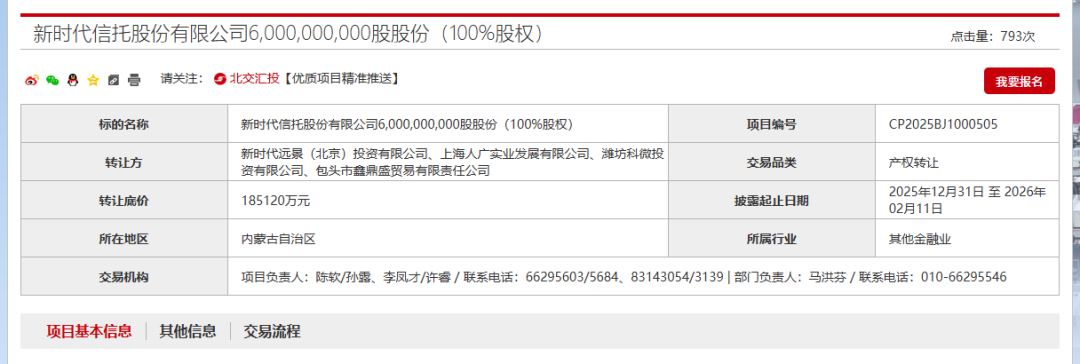
梳理这家信托公司的发展历程,其前身可追溯至1987年1月成立的包头市信托投资公司。据公司官网信息,2003年经原中国银行业监督管理委员会核准重 新登记后,公司更名为新时代信托投资股份有限公司;2009年6月,经原银监会批准,公司正式更名为新时代信托股份有限公司并换领新的金融许可证。 值得关注的是,这并非新时代信托股权首次寻求转让。回溯其风险处置进程,自2020年7月中旬因违法违规经营导致产品大面积逾期被原银保监会依法接 管以来,公司处置工作一直在持续推进。2022年9月,刚结束两年接管期的新时代信托,首次将60亿股股份挂牌转让,转让底价23.14亿元,转让方为新时 代远景(北京)投资有限公司、上海人广实业发展有限公司、潍坊科微投资有限公司、包头市鑫鼎盛贸易有限责任公司。 首次挂牌未果后,2024年5月,北京产权交易所再次挂出新时代信托100%股权,转让底价较首次下调两成,降至18.51亿元。如今,历经三年两次挂牌未 成交,这已是新时代信托第三次推出股权整体转让方案,此次底价与2024年第二次挂牌时保持一致。 近日,《金融时报》记者从北京产权交易所获悉,新时代信托股份有限公司(以下简称"新时代信托")60亿股股 ...
5.76万亿元!金融监管总局发布最新数据
Jin Rong Shi Bao· 2026-01-06 08:16
Core Insights - The insurance industry in China has shown robust growth in premium income, with a total of 5.76 trillion yuan in original insurance premium income for the first 11 months of 2025, reflecting a year-on-year increase of 7.6% [1] - Life insurance premiums reached 4.42 trillion yuan, growing by 9.2%, while property insurance premiums totaled 1.34 trillion yuan, marking a 2.5% increase [1] Group 1: Industry Performance - The insurance sector's net assets reached 3.68 trillion yuan, with total assets amounting to 40.64 trillion yuan as of November 2025 [1] - Life insurance companies accounted for 4.15 trillion yuan in premium income, with a 9.1% year-on-year growth [2] - The total assets of life insurance companies were 35.75 trillion yuan, while property insurance companies held 3.15 trillion yuan in total assets [1] Group 2: Premium Breakdown - Life insurance premium income included 3.39 trillion yuan from life insurance, 725.2 billion yuan from health insurance, and 34.6 billion yuan from accident insurance [1] - Property insurance premium income was 1.62 trillion yuan, with significant contributions from motor vehicle insurance (843.2 billion yuan), liability insurance (133.6 billion yuan), agricultural insurance (149.4 billion yuan), health insurance (218.7 billion yuan), and accident insurance (54.6 billion yuan) [2] Group 3: Market Dynamics - The growth in life insurance premiums is primarily driven by the sales of savings-type products, with competitive settlement rates in linked insurance products attracting consumers [2] - The implementation of the "reporting and operation integration" policy has led to a significant reduction in sales costs for bank insurance channels, boosting new policy sales [2] - In the property insurance sector, while motor insurance remains stable, non-motor insurance is identified as the main growth driver, particularly in health insurance due to strong demand and manageable risks [2]