半导体行业观察

Search documents
软银在印度搞芯片,投资近百亿
半导体行业观察· 2025-10-09 02:34
Group 1 - SoftBank's Graphcore plans to announce a £1 billion ($1.3 billion) investment plan, including the establishment of a new research center in India [1] - The investment announcement is expected during UK Prime Minister Keir Starmer's visit to India, with plans to hire up to 500 employees in Bangalore over the next five years [1] - Graphcore, initially seen as a promising competitor to Nvidia, has struggled to gain commercial traction despite a $2.8 billion valuation in 2020 [1] Group 2 - Nvidia has been actively investing in numerous AI startups, significantly boosting the market, while OpenAI has also made substantial investments in companies building services on its AI models [2] - Following a $100 billion investment agreement between Nvidia and OpenAI, OpenAI confirmed a $300 billion deal with Oracle to build data centers in the U.S. [2] - India is emerging as a significant player in AI, with major global tech companies betting on its growth potential outside of China [2] Group 3 - The U.S.-China tensions have made India more attractive to global tech companies, although its AI infrastructure is still developing [3] - Indian Prime Minister Narendra Modi aims to establish a domestic semiconductor industry, with the first locally manufactured chips expected by the end of the year [3] - The Indian government has set up a ₹760 billion ($8.6 billion) fund to attract international chip manufacturers, but large-scale investments are still lacking [3]




手机芯片的关键组件,缺货了
半导体行业观察· 2025-10-09 02:34
Group 1 - The core viewpoint of the article highlights the significant impact of the ongoing demand for AI GPUs and ASICs on the broader semiconductor supply chain, particularly leading to a shortage of key components used in smartphone SoCs [1] - Goldman Sachs has released a report indicating that the high demand for Ajinomoto Build-up Film (ABF) substrates has monopolized most of the current supply of T-glass, which is essential for manufacturing [1] - The report warns of a potential "double-digit percentage shortage" of T-glass supply for Bluetooth substrates in the coming months to quarters, raising concerns for the smartphone market as it prepares for a vibrant 2026 [1] Group 2 - Ajinomoto plans to invest at least 25 billion yen (approximately 166 million USD) by 2030 to increase its semiconductor material production capacity by 50%, aiming to strengthen its revenue base beyond its core food business [2] - The company holds over 95% market share in the data center and CPU sectors, producing ABF, an insulating material crucial for the latest GPUs and CPUs [2] - Ajinomoto's functional materials business, including ABF, is expected to account for 20% of its total operating profit for the fiscal year ending March 2024, with a projected 35% profit growth this year [3] Group 3 - The ABF film is essential for producing high-efficiency semiconductor products and has become a critical insulating material in the semiconductor packaging process [5] - Ajinomoto's ABF film has gained significant traction in the PC market, with major clients including Intel and AMD, and it dominates the global PC market share [5] - The ongoing demand for ABF is driven by rapid advancements in smartphones, personal computers, servers, and automotive technologies, leading to a supply-demand imbalance [6]

GPU警钟敲响,AI过热了?
半导体行业观察· 2025-10-08 02:09
Core Insights - The article discusses the competitive landscape in the AI infrastructure market, highlighting the significant investments and partnerships involving OpenAI, Nvidia, and AMD, as well as the potential risks associated with these developments [1][2][19]. Group 1: OpenAI and Nvidia Partnership - OpenAI has signed contracts worth approximately $1 trillion for computing power to run its AI models, raising questions about its funding sources [2]. - Nvidia plans to invest up to $100 billion in OpenAI over the next decade to support the construction of large data centers equipped with Nvidia chips [8]. - OpenAI is expected to deploy millions of Nvidia chips in these data centers, which are crucial for its AI operations [8]. Group 2: Financial Performance and Challenges - Oracle's cloud business, which relies heavily on Nvidia chips, reported $900 million in sales with a gross margin of only 14%, significantly lower than Oracle's overall gross margin of about 70% [1]. - OpenAI's executives estimate that deploying 1 gigawatt of AI computing capacity costs around $50 billion, contributing to a total cost of approximately $1 trillion for its infrastructure [3]. - Analysts express skepticism about OpenAI's ability to fulfill its ambitious commitments, with predictions of a potential loss of around $10 billion this year [5]. Group 3: AMD's Role and Market Dynamics - OpenAI has also entered into a partnership with AMD, which includes deploying AMD chips worth several billion dollars, potentially making OpenAI one of AMD's largest shareholders [8][10]. - AMD's CEO stated that the partnership could generate "tens of billions" in annual revenue for AMD, with future revenues possibly exceeding $100 billion [22]. - The competition between Nvidia and AMD is intensifying, with AMD aiming to challenge Nvidia's dominance in the AI chip market [23]. Group 4: Broader Market Trends - Other tech giants like Meta and Microsoft are also heavily investing in AI infrastructure, with Meta planning to spend up to $600 billion on AI data centers by 2028 [11]. - The total capital expenditure on AI infrastructure by major companies like Amazon, Meta, Microsoft, and Google is estimated to reach $320 billion this year [16]. - Concerns are raised about a potential "AI bubble," drawing parallels to the internet bubble of the early 2000s, as massive investments are made in a technology with uncertain profitability [19][21].


美国想全面限制芯片设备
半导体行业观察· 2025-10-08 02:09
Core Viewpoint - The article discusses the loopholes in the efforts by the U.S. and its allies to restrict China's advanced chip manufacturing capabilities, allowing China to purchase nearly $40 billion worth of cutting-edge chip manufacturing equipment [2][3]. Group 1: Legislative Actions and Recommendations - A bipartisan investigation by U.S. lawmakers revealed that existing export controls are insufficient, as Chinese entities can effectively collaborate to circumvent these restrictions [2]. - Lawmakers are advocating for nationwide controls on China, proposing a presumption of denial policy for licenses related to advanced and traditional chip manufacturing tools [2]. - The report calls for an expansion of the restricted entity list and a ban on all allied manufacturers from selling products to more Chinese military entities [2]. Group 2: Sales and Market Impact - The report highlights that last year, Chinese companies purchased $38 billion worth of equipment from five leading semiconductor manufacturing equipment suppliers, marking a 66% increase from 2022 [3]. - This figure represents nearly 39% of the total sales of Applied Materials, Lam Research, KLA, ASML, and Tokyo Electron [3]. - The sales to China have made the country increasingly competitive in the semiconductor manufacturing sector, impacting global human rights and democratic values [4]. Group 3: Industry Response and Coordination - Tokyo Electron's U.S. president noted a decline in sales to China this year due to new regulations and welcomed increased coordination between the U.S. and Japanese governments [4]. - The report suggests that allies should enhance coordination and broaden the scope of restrictions, including limiting components that China can use to manufacture its own chip-making tools [4]. - A senior researcher from the Foundation for Defense of Democracies emphasized that China is attempting to rewrite the entire supply chain, indicating a shift in the competitive landscape [4].



DRAM巨头,暂停报价
半导体行业观察· 2025-10-08 02:09
公众号记得加星标⭐️,第一时间看推送不会错过。 这是记忆体模组业2017年以来,首次出现厂商暂停报价,意味市场严重供不应求,厂商看好价格还会继续飙,只 能先「盖牌」惜售,借此创造最大化获利,并宣告这波DRAM涨价潮从南亚科、华邦等上游晶片端蔓延至下游模 组端,整个产业链一片火热。 这波DRAM狂潮,起因AI带动资料存储需求爆发,三星、SK海力士、美光等三大国际记忆体制造商全力冲刺高 频宽记忆体(HBM),排挤DDR4、DDR5生产,甚至退出DDR4制造,但在终端需求对DDR4、DDR5不减反 增、且力道强劲,DDR4价格率先拉出一波倍数涨幅,DDR5也跟进激昂,整个产业全面大复苏。 由于严重缺货,市场疯狂追价囤货导致价格狂涨,美光、南亚科等DRAM厂先前都已陆续传出暂停报价,过往模 组厂都在价格大幅波动时,多半透过「低买高卖」,即先前囤积的低价库存与之后涨上来的现货价之间的价差套 利,「赚价差」,如今威刚、十铨转为主导暂停报价,显示市况比外界预期更热。 威刚是全球第二大、台湾最大记忆体模组厂。威刚董事长陈立白证实,公司这波暂停报价措施将延续至10月中 旬,主要考量DRAM货源严重不足,因此要管控库存和调整配售 ...

倒计时!边缘 AI 赋能硬件未来创新论坛重磅来袭,引领半导体新时代
半导体行业观察· 2025-10-08 02:09
Core Viewpoint - The article highlights the upcoming "Edge AI Empowering Hardware Future Innovation Forum" scheduled for October 15, 2025, in Shenzhen, which aims to explore technological breakthroughs and policy implementation in the context of Shenzhen's AI industry development plan [1][3]. Policy Support - Shenzhen has introduced several significant policies in the second half of 2025 to boost AI technology innovation and market application, including funding subsidies for AI research and development [3]. - The "2025 Shenzhen AI Corpus Voucher Special Fund Application Guide" offers up to 2 million yuan in subsidies for companies purchasing non-related party data for AI R&D, with additional rewards for compliant data [3]. - The "Smart Terminal Industry Development Support Plan" provides up to 20 million yuan for technical breakthroughs and 3 million yuan for popular product rewards, aimed at reducing costs and increasing efficiency for smart hardware companies [3]. Forum Highlights - The forum will feature prominent industry leaders discussing various topics, including the latest research on edge AI chips and the impact of policy incentives on industry challenges [4][5]. - Key discussions will focus on the integration of AI with advanced manufacturing and the role of policy in driving semiconductor factory upgrades [7][16]. Interactive Sessions - The forum will include interactive sessions designed to connect participants with industry experts and facilitate collaboration opportunities [9][12]. - A roundtable discussion will address practical issues related to policy subsidies and the challenges of implementing edge AI solutions [12]. Future Outlook - The event aims to provide insights into the intersection of policy, technology, and market trends, helping stakeholders navigate the evolving landscape of the AI and semiconductor industries [16]. - The forum is positioned as a platform for exploring new opportunities arising from policy incentives and technological advancements, particularly in the context of Shenzhen's ambition to become a leading AI city by 2026 [16].

高通再收购一家公司
半导体行业观察· 2025-10-08 02:09
Group 1 - Qualcomm has agreed to acquire Arduino, an Italian open-source hardware and software company, with financial terms undisclosed. Arduino will operate as an independent subsidiary post-acquisition [2] - The acquisition aims to expand Qualcomm's edge technology and product portfolio, facilitating easier realization of ideas for a wide range of users, from students to professionals [2] - Arduino's community, which boasts over 33 million members, will gain full access to Qualcomm's technology stack, potentially enhancing customer relationships and product preference towards Qualcomm's hardware [2] Group 2 - Qualcomm announced Arduino's next hardware product, the Uno Q, described as the company's first "dual-brain" board, featuring a microprocessor and microcontroller that supports Linux Debian [3] - The Uno Q is powered by Qualcomm's Dragonwing QRB2210 platform, equipped with 2 GB of RAM, 16 GB of built-in eMMC storage, dual-band Wi-Fi 5, Bluetooth 5.1, and USB-C connectivity, marketed as a preferred tool for various development applications [3] - The Uno Q will be the first Arduino board compatible with App Lab, allowing seamless collaboration with the Edge Impulse platform for creating and adjusting AI models using real-world data [4] Group 3 - The Uno Q is available for pre-order at a price of $44 and is expected to start shipping on October 24 [4]

EUV的真正老大
半导体行业观察· 2025-10-08 02:09
Core Viewpoint - The article emphasizes the critical role of Zeiss in the semiconductor industry, particularly in supplying high-precision optical components for ASML's EUV lithography machines, which are essential for advanced chip manufacturing [2][4]. Group 1: Zeiss's Dominance in the Semiconductor Industry - Zeiss supplies approximately 80% of the optical components used in chip manufacturing globally [4]. - The long-term collaboration between Zeiss and ASML dates back to the DUV lithography era, allowing them to outperform competitors like Nikon and Canon [4]. - Zeiss's optical components are indispensable for ASML's lithography equipment, used in various applications from automotive to consumer electronics [4]. Group 2: Technological Superiority and Challenges - Zeiss has accumulated over 1,500 patents related to EUV technology, creating a significant barrier for other companies attempting to manufacture EUV lithography machine optics independently [5]. - The precision of Zeiss's manufacturing is highlighted by the fact that if their optical components were scaled to the size of Germany, the flatness error would still be within 0.1 millimeters [4][5]. - Zeiss has established a high-cleanliness factory to ensure the manufacturing quality of its core components, significantly reducing airborne particles [5]. Group 3: Global Collaboration and Supply Chain - The development of EUV technology is a result of global collaboration, supported by various stakeholders including American capital, the German government, and the EU [5]. - The supply chain for EUV lithography involves over 1,200 suppliers worldwide, showcasing the importance of global division of labor and resource integration in the semiconductor industry [5]. Group 4: Geopolitical Implications and Local Developments - In light of geopolitical tensions, regions like China are reconsidering their reliance on global supply chains and are exploring paths toward self-reliance and domestic development [6]. - Taiwanese optical manufacturers are making strides in areas like smartphone lenses and medical devices, although achieving the precision required for lithography optics remains a significant challenge [6]. - The article suggests that a dual approach of global collaboration and independent technological development is essential for maintaining competitiveness in the semiconductor sector [6].
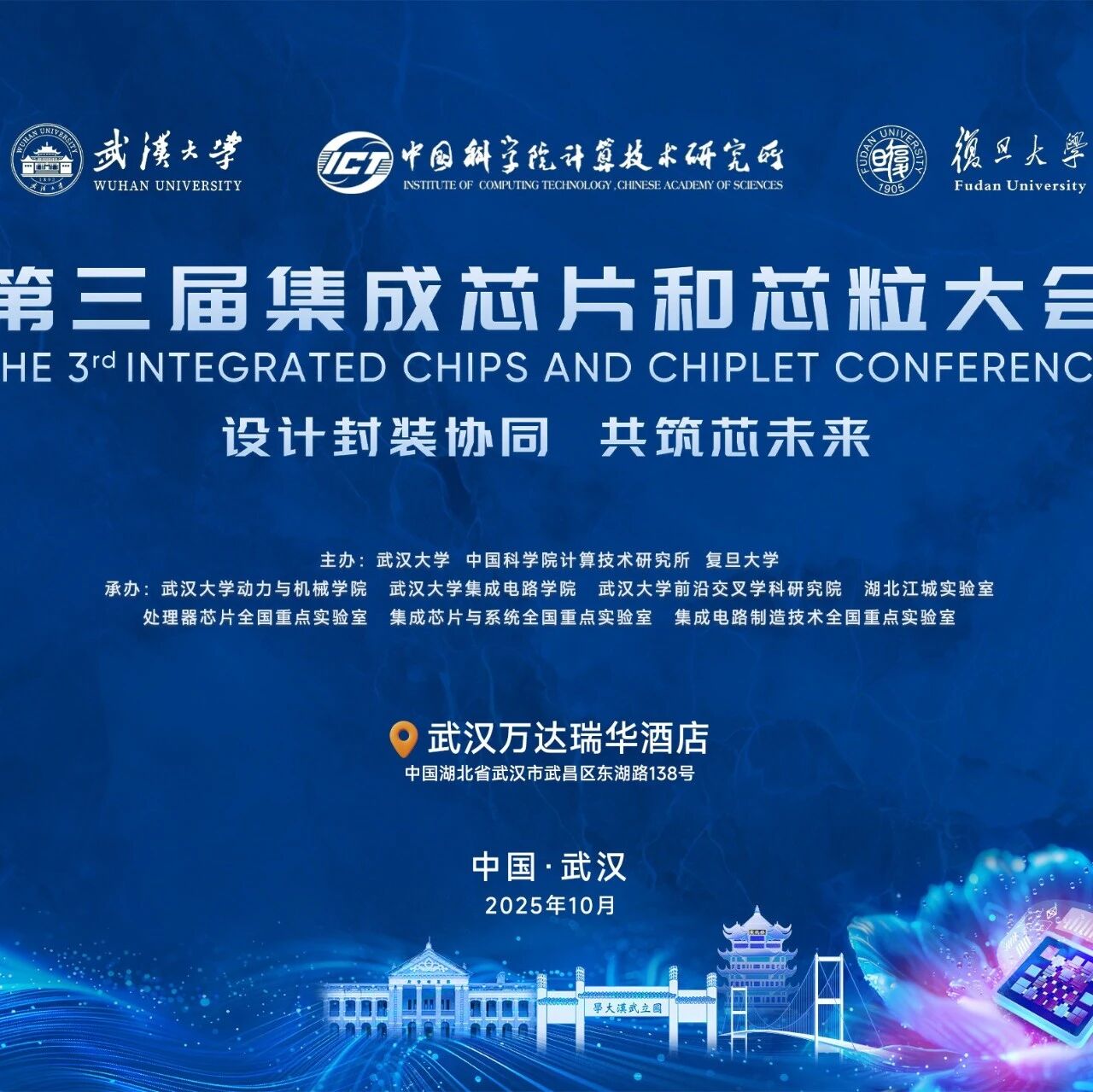
第三届集成芯片和芯粒大会倒计时2天!
半导体行业观察· 2025-10-08 02:09
Core Viewpoint - The Third Integrated Chip and Chiplet Conference will be held from October 10-13, 2025, in Wuhan, focusing on collaborative design and packaging to advance chip technology [1]. Event Overview - The conference is organized by Wuhan University, the Institute of Computing Technology of the Chinese Academy of Sciences, and Fudan University, featuring 7 keynote speeches and 16 technical forums [1]. - The theme is "Design and Packaging Collaboration, Building the Future of Chips," aiming to foster discussions on cutting-edge topics such as 3D integration, heterogeneous integration, multi-physical field collaboration, high-speed interconnects, EDA design methods, and advanced storage and packaging technologies [1]. Schedule Highlights - The opening ceremony will take place on October 11, 2025, followed by various sessions including: - Keynote on cutting-edge technology research in integrated chips [1]. - Forums addressing topics like storage and computing integration, multi-physical field simulation, and thermal management technologies [4]. - Notable speakers include experts from prestigious institutions such as the Chinese Academy of Sciences and Fudan University [4][1]. Participation Information - Registration for the conference can be completed online or on-site, with a countdown of only 2 days remaining until the event [5].
GaN市场,迎来新巨头
半导体行业观察· 2025-10-08 02:09
Core Insights - Gallium Nitride (GaN) has emerged as one of the most disruptive semiconductor technologies of the decade, with a projected market size of $3 billion by 2030 [2] - Consumer electronics, particularly fast charging, are early adopters driving sales growth and ecosystem maturity, expected to account for over 50% of the total power GaN device market by 2030 [2] - The power GaN market is entering a decisive phase, driven by accelerated investments, strategic acquisitions, and ongoing innovation across the value chain [2] Automotive Market Expansion - The next wave of expansion is anticipated in the automotive market, with a remarkable compound annual growth rate (CAGR) of 73% from 2024 to 2030, driven by the shift towards electrification and advanced driver-assistance systems [4] - GaN devices are now widely used in LiDAR systems, and onboard chargers (OBC) are expected to be the next sales driver [4] - Non-automotive DC chargers and traction inverters are maturing with the emergence of more reference designs [4] Data Center and AI Applications - Hyperscale data centers are seeking energy-efficient solutions to manage increasing workloads, with NVIDIA collaborating with leading wide bandgap chip manufacturers to integrate SiC and GaN technologies into its 800V high-voltage direct current (HVDC) power systems [4] - GaN's unique advantages in power conversion efficiency and circuit board space optimization are making it essential for AI servers and networking equipment [4] - The telecommunications sector is also expected to see significant growth, with a projected CAGR of 53% from 2024 to 2030 [4] Competitive Landscape - The power GaN ecosystem is transitioning from a mature phase to one shaped by consolidation and vertical integration, driven by integrated device manufacturers (IDMs) [6] - Infineon has strengthened its position in GaN through the $830 million acquisition of GaN Systems, while Renesas acquired Transphorm for $339 million [6] - Innoscience leads the market with a 30% share in 2024, focusing on fast charging, automotive, data centers, and home appliances [6] - Other key players include Navitas, Power Integrations, and EPC, each expanding their product offerings and market presence [6][7] New Entrants and Future Outlook - New entrants like Samsung and onsemi are expected to intensify competition in the GaN market, with onsemi preparing to enter the GaN space soon [7] - The report confirms that the power GaN ecosystem is evolving into a strategically driven market, with increasing competition solidifying GaN's role as a core pillar of next-generation power electronics [7]