日经中文网

Search documents
中国股市第三波大行情已到?
日经中文网· 2025-08-22 02:56
Core Viewpoint - The article discusses the significant shift in China's banking deposits, with a notable decrease in bank deposits and an increase in non-bank deposits, indicating a potential influx of funds into the stock market, reminiscent of past market bubbles in 2007 and 2015 [2][4]. Group 1: Banking Deposit Changes - In July, Chinese residents' bank deposits decreased by approximately 1 trillion yuan, while non-bank deposits increased by 2 trillion yuan, signaling a "fund migration" towards stock investments [4]. - The People's Bank of China reported that new bank loans fell for the first time in 20 years, raising concerns about the implications for the stock market [2][4]. Group 2: Stock Market Performance - The total market capitalization of China's A-shares has surpassed 100 trillion yuan, with the Shanghai Composite Index reaching its highest point in a decade [2]. - The number of new A-share accounts opened in July approached 2 million, a 70% increase compared to the same period last year, indicating growing investor interest [4]. Group 3: Historical Context of Market Bubbles - The article compares the current market conditions to previous bubbles in 2007 and 2015, highlighting the factors that led to those bubbles and subsequent crashes [6][8]. - In 2007, the Shanghai Composite Index peaked at 6092.057 points, driven by rapid economic growth and state-owned enterprise reforms, but collapsed following the listing of China National Petroleum Corporation [7][8]. - The 2015 bubble saw the index rise to 5166.350 points, fueled by government stimulus measures and increased leverage, but ultimately crashed due to regulatory interventions [9][10]. Group 4: Current Market Dynamics - The current financing balance in Shanghai exceeds 1 trillion yuan, approaching levels seen during the 2015 bubble, raising concerns about potential overvaluation [11]. - Unlike previous bubbles, there is a diversification in investment vehicles, with increased interest in ETFs linked to various assets beyond traditional stocks [11].


日本要力争与非洲各国签署自贸协定
日经中文网· 2025-08-22 02:56
Core Viewpoint - Japan aims to strengthen economic cooperation with Africa by establishing a preparatory committee for Free Trade Agreements (FTAs) with African countries, focusing on enhancing the business environment for Japanese enterprises in Africa [2][4]. Group 1: Economic Cooperation Initiatives - The Japanese government plans to form a preparatory committee for economic cooperation with Africa, which will include private enterprises and experts to assess the effectiveness and challenges of such cooperation [4]. - Japan has not yet signed any FTAs or Economic Partnership Agreements (EPAs) with African countries, but aims to start with key nations like Kenya and eventually expand to the entire continent [4]. Group 2: Strategic Goals - Prime Minister Kishida expressed Japan's desire to be a solid bridge connecting Africa with regions outside of Africa, emphasizing the importance of digital industries and the nurturing of startups as foundational elements for accelerating economic growth [4]. - The initiative also includes the "Indian Ocean-Africa Economic Circle Initiative," which aims to build a logistics network with India and Middle Eastern countries [5].
日经BP精选:睡不好容易发胖?助你成功减肥的10个技巧
日经中文网· 2025-08-22 02:56
Core Viewpoint - The article emphasizes the importance of sleep in relation to appetite control and successful weight loss, alongside dietary and exercise considerations [3]. Dietary Aspects - Drinking a glass of water before meals can suppress appetite and enhance metabolism through thermogenesis, while also alleviating mental stress [7]. - Changing cognitive perceptions can help prevent overeating [6]. Sleep Considerations - The article suggests that sleep is a fundamental factor influencing appetite and weight management, highlighting the need for effective sleep strategies [5].

中国芬太尼走私组织构建跨国网,从日本发出指示
日经中文网· 2025-08-22 02:56
Core Viewpoint - The article highlights the establishment of a large-scale international drug trafficking network involving synthetic opioids, particularly fentanyl, with a significant operational base in Japan, facilitated by a Chinese organization [1][4][6]. Group 1: Organization and Operations - The Chinese organization has set up a base in Japan to manage drug trafficking and money laundering activities, utilizing Japan as a "safe zone" for operations [3][9]. - The organization is linked to various international drug trafficking groups, including those in Mexico, the United States, Russia, Australia, and India [1][8]. - The organization operates under the guise of legitimate businesses, such as Hubei Amarvel Biotech, which has connections to the Sinaloa Cartel [7][9]. Group 2: Financial Transactions and Dark Web Activity - Approximately 40% of transactions are conducted through the dark web, indicating a reliance on anonymous online platforms for drug sales [8]. - The organization utilizes multiple virtual currency accounts to facilitate payments, with significant transactions often exceeding $10,000 [8][14]. - The financial analysis indicates that the Chinese organization has become a key supplier of drug precursors on an international scale [8]. Group 3: International Investigations and Implications - The U.S. Drug Enforcement Administration (DEA) has initiated formal investigations into the fentanyl issue in Japan, suggesting the potential for a large-scale international drug case [6]. - Investigations reveal that the organization has connections with other Chinese smuggling groups, indicating a broader network of illicit activities [15][19]. - The complexity of international drug trafficking cases often requires extensive cooperation between countries, and the fentanyl issue may take years to fully unravel [19].

日本7月机床订单增长4%,中国汽车需求坚挺
日经中文网· 2025-08-22 02:56
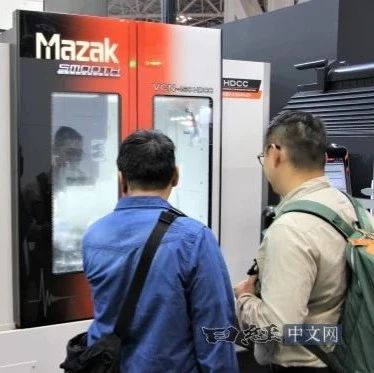
Group 1 - The core viewpoint of the article highlights the growth in overseas orders for Japanese machine tools, particularly driven by strong demand from Asia and a recovery in Europe after 18 months of decline [2][4] - In July, the total value of machine tool orders in Japan increased by 4% year-on-year, reaching 128.3 billion yen, marking a return to positive growth after one month [2] - Overseas orders accounted for 70% of the total orders, growing by 5% to 92.9 billion yen, with Asia showing a 9% increase to 47.5 billion yen [4] Group 2 - Chinese orders represent nearly 70% of the Asian total, with a robust performance in the automotive sector, which grew by 8% [4] - European orders increased by 12% to 16.4 billion yen, driven by growth in defense equipment, electrical, and precision-related sectors, despite a downturn in automotive-related orders [4] - North American orders decreased by 1% to 26.7 billion yen, marking the first negative growth in three months, with strong performance in the U.S. but a significant decline in Mexico [4]
日本制造业的出口竞争力在下降
日经中文网· 2025-08-21 08:00
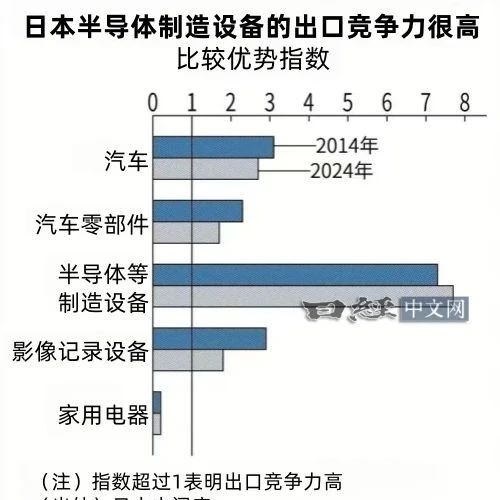
Core Insights - Japan's export competitiveness in manufacturing is declining, particularly in the automotive and home appliance sectors, as emerging countries enhance their technological capabilities [2][4][5] - The "Revealed Comparative Advantage Index" indicates that Japan's automotive sector has a score of 2.7 and automotive parts at 1.7 for 2024, both exceeding 1, indicating strong export competitiveness [5] - The index for home appliances, including refrigerators and washing machines, is notably low at 0.2, remaining below 1 since 1994, highlighting a significant loss of competitiveness [5] Summary by Category - **Automotive Sector** - The automotive index for 2024 is 2.7, indicating strong competitiveness, but it has declined compared to 10 years ago [5] - The automotive parts index stands at 1.7, also reflecting a competitive edge [5] - **Home Appliances** - The index for home appliances is 0.2, indicating a persistent lack of competitiveness, with a continuous decline since 1994 [5] - The report highlights that China and ASEAN countries are gaining advantages in the electrical appliance sector [5] - **Other Sectors** - The index for imaging recording devices is 1.8 for 2024, maintaining a comparative advantage but has decreased by 1.1 percentage points over the last decade [5] - The highest comparative advantage is seen in semiconductor manufacturing equipment, with an index of 7.7, which has increased by 0.4 percentage points since 2014 [5]

小米EV业务年内或盈利,入局仅1年
日经中文网· 2025-08-21 08:00
Core Viewpoint - Xiaomi's electric vehicle (EV) business is expected to achieve profitability by 2025, leveraging its competitive pricing and strong sales momentum, despite facing challenges related to rapid expansion and production capacity [2][4][6]. Group 1: Financial Performance - In the fiscal quarter from April to June 2025, Xiaomi reported a 30% year-on-year increase in overall revenue, reaching 115.9 billion yuan, with net profit soaring to 11.8 billion yuan, a 2.3-fold increase compared to the same period last year [4]. - Xiaomi's EV-related business incurred a loss of 300 million yuan, despite the company investing approximately 30 billion yuan in the EV sector over the past three years [4][5]. - The gross margin for Xiaomi's automotive business reached 26.4%, surpassing BYD's automotive gross margin of 22% for the 2024 fiscal year [5]. Group 2: Product Launch and Sales - The EV sedan "SU7," launched in March 2024, has seen strong sales, while the SUV "YU7," released in June, received over 240,000 pre-orders within 18 hours [6]. - Xiaomi is currently able to deliver 30,000 vehicles per month, but faces long delivery times of 34-58 weeks for new models, which could lead to customer attrition if not addressed [6]. Group 3: Market Challenges - Despite strong performance in the EV sector, Xiaomi faces issues related to production capacity and sales disputes, which could harm its brand image if unresolved [6]. - The company is also experiencing a 2% decline in overall smartphone revenue, prompting a downward revision of its 2025 shipment target by 5 million units to 175 million [9]. - The economic uncertainty and low demand in the Chinese real estate market are contributing to a challenging operating environment, necessitating the establishment of a business model that does not rely on subsidies [9].


铂金价格出现复苏迹象,中国支撑行情
日经中文网· 2025-08-21 08:00
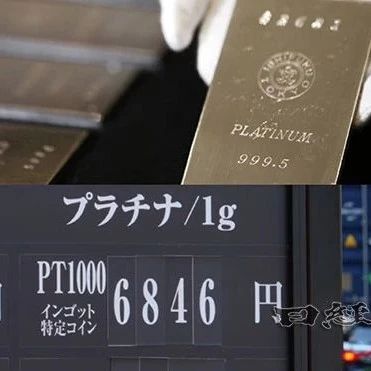
Core Viewpoint - The price of platinum is rising significantly, driven by increased demand in China and a shift in investor interest towards undervalued assets like platinum, which has outperformed gold and the S&P 500 index [2][6]. Group 1: Price Trends - Platinum prices have surged to around $1360 per ounce, representing a 50% increase compared to the end of 2024, significantly outpacing gold's 30% rise and the S&P 500's 10% increase [6]. - In Japan, the price of platinum is approximately 6846 yen per gram (around 333.3 RMB), with a notable increase in sales, reportedly rising sevenfold since January [4][6]. - The global platinum supply for 2024 is projected at 180 tons, with China's imports from April to June accounting for about 20% of this total [9]. Group 2: Demand Drivers - The demand for platinum is being bolstered by younger consumers in China, who are increasingly favoring platinum jewelry over gold [9]. - In Japan, the sales of platinum bars have surged, with reports indicating a sevenfold increase in sales compared to earlier in the year [4]. - The industrial demand for platinum remains significant, with approximately 70% of its usage in automotive catalytic converters [9]. Group 3: Market Dynamics - The recent price increase is attributed to a combination of factors, including a shift in investor focus towards platinum as a low-valued asset amid a backdrop of high gold prices [6][10]. - South Africa, the largest platinum producer, experienced a production decrease due to early-year flooding, which may impact supply through September [10]. - Financial institutions have raised their price forecasts for platinum, with predictions suggesting it could reach $1600 per ounce by the second half of 2025 [10].
FT中文网精选:社保司法解释背后的局部与整体、短期与长期理性
日经中文网· 2025-08-21 03:07
Core Viewpoint - The recent "social security new regulations" have garnered significant attention, particularly the Supreme Court's ruling that any agreement to voluntarily waive social security will be deemed invalid starting September 1, 2025 [6]. Group 1: Social Security Regulations - The Supreme Court's interpretation states that labor contracts that stipulate non-payment of social security are invalid, reinforcing the legal obligation for employers to contribute to social security [6]. - There have been previous cases where agreements to not pay social security were upheld in practice, despite being legally invalid, indicating a gap between law and enforcement [6]. - Employers are required to compensate employees if they terminate contracts due to non-payment of social security, and they can seek reimbursement if they have previously compensated employees through other means [6].