GEELY AUTO(00175)
Search documents
【读财报】上市车企10月销量:整车销量超231万辆 北汽蓝谷、蔚来等销量增速加快
Xin Hua Cai Jing· 2025-11-12 22:59
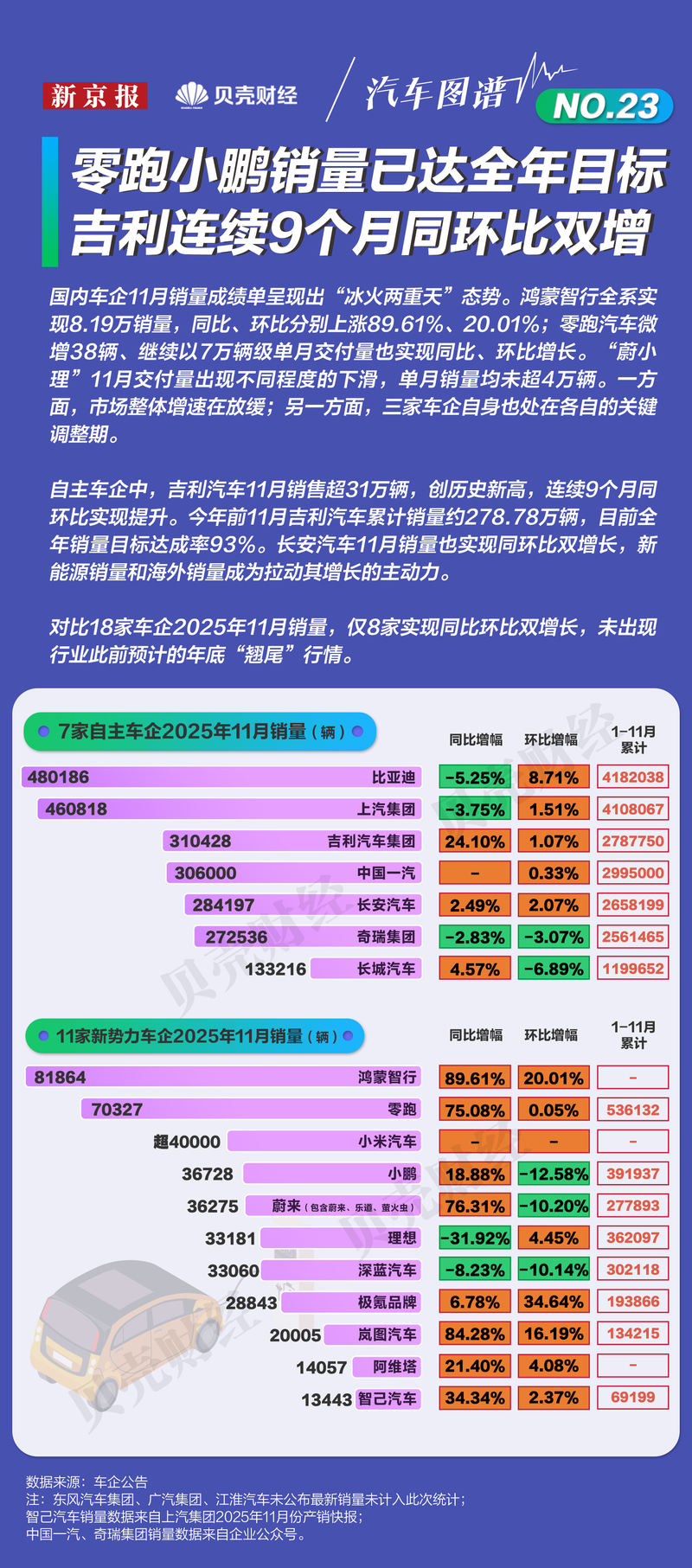
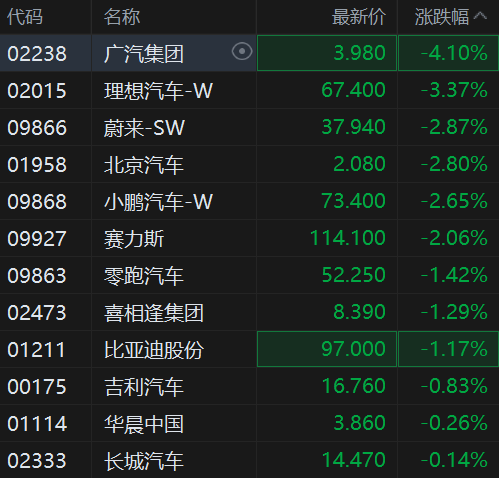
Core Insights - In October 2025, 20 A and H-share listed automotive manufacturers collectively sold 2.3166 million vehicles, representing a year-on-year increase of 8.82% and a month-on-month increase of 5.97% [2][12]. Group 1: Overall Vehicle Sales - The top-selling company in October was SAIC Motor, with sales of 454,000 vehicles, showing a year-on-year growth of 12.96% [11][19]. - BYD followed closely with sales of 441,706 vehicles, but experienced a decline of 12.13% year-on-year [19]. - Other notable performers included Geely Automobile with 307,133 vehicles sold (up 35.49%) and Changan Automobile with 278,436 vehicles (up 11.00%) [8][19]. - Companies like BAIC Blue Valley and Qianli Technology saw significant growth, with year-on-year increases exceeding 100% [7][11]. Group 2: New Energy Vehicle Sales - A total of 16 companies reported new energy vehicle sales, with approximately 1.3078 million units sold in October, marking a year-on-year increase of 15.63% and a penetration rate of 57.48% [12][15]. - Leading new energy vehicle manufacturers included BYD, SAIC Motor, and Geely, with sales of 441,706, 206,692, and 177,882 units respectively [15][19]. - BAIC Blue Valley and NIO reported growth rates exceeding 100%, while Li Auto and BYD experienced declines in year-on-year sales [15][19].
固态电池设备行业深度报告:产业化进程加速
材料汇· 2025-11-12 15:48
Core Viewpoint - Solid-state batteries exhibit superior performance and have a wide range of applications, with accelerated industrialization processes both domestically and internationally [5]. Group 1: Advantages of Solid-State Batteries - Solid-state batteries have higher energy density and better safety compared to liquid batteries, with energy density expected to reach over 500 Wh/kg [15][11]. - They can operate under extreme conditions without the risk of combustion or explosion due to the use of non-volatile solid electrolytes [15]. - The design of battery cells, modules, and systems is simplified due to the non-flowing nature of solid electrolytes, optimizing the PACK design [15]. Group 2: Solid Electrolyte Technologies - Solid electrolytes are the core component of solid-state batteries, with various technology routes including polymers, oxides, sulfides, and halides, with sulfides being the most widely accepted due to their high ionic conductivity [16][14]. - Each type of solid electrolyte has its advantages and disadvantages, with sulfides offering excellent processing advantages and flexibility [16]. Group 3: Production Challenges - The mass production of solid-state batteries faces challenges such as the interface contact between solid electrolytes and electrodes, as well as the engineering issues related to cost reduction [19][22]. - Key challenges include ensuring the stability of the solid-solid interface and the large-scale preparation of sulfide solid electrolytes, which significantly impact the commercial viability of solid-state batteries [22][19]. Group 4: Domestic and International Industry Landscape - Major domestic battery manufacturers have clarified their technology routes, focusing on sulfide electrolytes and aiming for small-scale production by 2027, with energy density targets around 400 Wh/kg [26][23]. - Internationally, companies in the US and Japan are advancing rapidly, with many planning to achieve large-scale production of solid-state batteries by 2030 [27][25]. - Policies in China are accelerating the development of solid-state batteries, with significant support from government agencies aimed at achieving commercial applications by 2026 [29][31].
“银十”车市销量同比微降0.8% 自主品牌市占率升至68.7%
Mei Ri Jing Ji Xin Wen· 2025-11-12 14:01
Core Insights - In October, China's passenger car retail sales reached approximately 2.242 million units, showing a year-on-year decline of 0.8% and a month-on-month decline of 0.1% [1] - The cumulative retail sales for the year reached about 19.25 million units, reflecting a year-on-year growth of 7.9% [1] Group 1: Market Performance - The October car market performance was relatively mild, not reaching the previously expected "hot" scenario, primarily driven by the replacement purchase group [1] - The tightening of "old-for-new" subsidy policies in some regions led to differentiated sales growth across areas, preventing a sustained increase in October sales [1] Group 2: Brand Performance - In October, domestic brands achieved retail sales of approximately 1.55 million units, a year-on-year increase of 4%, capturing a domestic retail market share of 68.7%, up 3 percentage points year-on-year [2] - The cumulative market share of domestic brands for the first ten months of the year was 65%, an increase of 5.5 percentage points compared to the same period last year [2] - Major domestic groups like SAIC, Dongfeng, Changan, Chery, and BAIC saw a combined year-on-year sales growth of 17% in October [2] Group 3: Export Growth - In October, China's automobile exports reached 828,000 units, marking a year-on-year increase of 42%, with total exports for the first ten months reaching approximately 6.51 million units, up 23% year-on-year [2] - Specific companies like BYD, Chery, and Geely reported significant export figures, with BYD exporting about 80,000 units in October [3] Group 4: New Energy Vehicles (NEVs) - NEVs remain a crucial growth driver, with wholesale sales of NEVs in October reaching approximately 1.621 million units, a year-on-year increase of 18.5% [4] - The penetration rate of NEVs reached 55.3% in October, with domestic brand NEVs achieving a penetration rate of 70.1% [4] Group 5: Future Outlook - Starting January 1, 2024, the purchase tax for NEVs will shift from full exemption to a 50% reduction, prompting consumers to feel a stronger urgency to purchase vehicles by year-end [5] - The upcoming months are expected to see increased enthusiasm for vehicle purchases in rural areas, particularly for NEVs and mid-to-low-end fuel vehicles [6]
多款长度超5米、宽度近2米的车型上市—— 车企为何纷纷造“大车”
Ren Min Ri Bao Hai Wai Ban· 2025-11-12 13:15
Core Viewpoint - The trend of producing larger vehicles, particularly SUVs over 5 meters in length, is gaining momentum in the Chinese automotive market, driven by changing consumer demands and a robust automotive supply chain [5][9][10]. Group 1: Market Trends - A surge in the launch of large SUVs has been observed, with models like NIO's ES8 and Geely's Galaxy M9 entering the market, both exceeding 5 meters in length and offering significant storage capacity [5][6]. - The Passenger Car Market Information Joint Conference predicts a 26.5% year-on-year growth in C-class SUV sales for 2024, with August 2023 showing a 51.6% increase in sales compared to the previous year [5][9]. Group 2: Consumer Demand - The demand for larger vehicles is driven by rising household incomes, changing family structures, and a shift towards multi-functional vehicles that offer more space and comfort [9][10]. - Families with multiple children are increasingly viewing larger SUVs as a necessity for accommodating their needs during outings, with many consumers expressing a desire to upgrade to larger vehicles [7][9]. Group 3: Supply Side Dynamics - The production of larger vehicles is supported by advancements in technology and a well-established automotive supply chain in China, particularly in the electric vehicle sector [10][11]. - Larger SUVs typically command higher profit margins, with many models priced above 300,000 yuan, allowing manufacturers to leverage consumer preferences for larger vehicles [10][11]. Group 4: Challenges and Considerations - The increasing size of vehicles poses challenges for parking and urban infrastructure, with reports of difficulties in parking and the potential for congestion in densely populated areas [12][13]. - Experts suggest that future urban planning should consider the implications of larger vehicles on parking and road usage, advocating for smarter city planning and flexible pricing strategies [14].
全球份额稳定提升,中国汽车持续释放活力
Zhong Guo Qi Che Bao Wang· 2025-11-12 13:03
Core Insights - The global automotive market is experiencing significant growth, with global sales reaching 8.55 million units in September 2025, marking a 10% year-on-year increase and a 12% month-on-month increase. China's market share has risen to 38%, up 2 percentage points from the previous year, indicating an acceleration in the globalization of Chinese automobiles [2] Group 1: Domestic Market Dynamics - A series of favorable policies in China have injected strong momentum into the automotive and particularly the new energy vehicle (NEV) sector, driving domestic consumption through trade-in and replacement incentives [2] - Major Chinese automakers, including SAIC, BYD, and Geely, reported sales exceeding 300,000 units in October, with significant year-on-year growth, and the share of NEVs in traditional automakers' sales continues to rise [2] - New energy vehicle startups like Leap Motor, Xiaomi, and Xpeng have also achieved record sales, with Leap Motor's monthly sales surpassing 70,000 units for the first time [2] Group 2: Global Market Position - Chinese automakers are increasingly influential in the global market, with two Chinese companies, BYD and Geely, ranking 6th and 9th respectively among the world's top 10 automakers, and Chery approaching the top 10 at 11th place [4] - The shift in product strategy for Chinese automakers has moved from a one-size-fits-all approach to localized development tailored to the specific needs of different regional markets, enhancing their competitiveness [4][5] - Chinese NEV companies are adapting to stringent European emission regulations and are exploring mid-to-high-end products, improving their brand perception and market presence [4] Group 3: Strategic Shifts in Global Operations - Chinese automakers are transitioning from "going out" to "going in," establishing local production facilities overseas to comply with local regulations and reduce trade barriers [5] - The "ecological going out" strategy represents a new model of globalization for Chinese automotive companies, focusing on systematic output, localized R&D, and supply chain collaboration [5] - The future direction for Chinese automotive companies includes deepening technological innovation, enhancing supply chain collaboration, and building a comprehensive global service ecosystem to maintain stable growth in global market share [5]
全链路低碳实践助力全球气候治理 吉利亮相COP30
Huan Qiu Wang· 2025-11-12 10:21
Core Insights - Geely was invited to participate in the 30th Conference of the Parties (COP30) in Belém, Brazil, to share its achievements in green low-carbon transformation and collaborative innovation across the entire value chain [2] - Geely was included in the "Belt and Road" green supply chain case and recommended technology product directory released by the China Environmental Protection Federation at COP30 [2] - Geely has been recognized for three consecutive years in the "Pioneer 100" list of Chinese ESG-listed companies by China Central Television, achieving a five-star rating, demonstrating its progress in sustainable development [2] - The company aims to achieve full-chain carbon neutrality by 2045 and will work with partners across the value chain to accelerate the low-carbon transformation of the global automotive industry [2]
燃油车又杀回来了
商业洞察· 2025-11-12 09:25
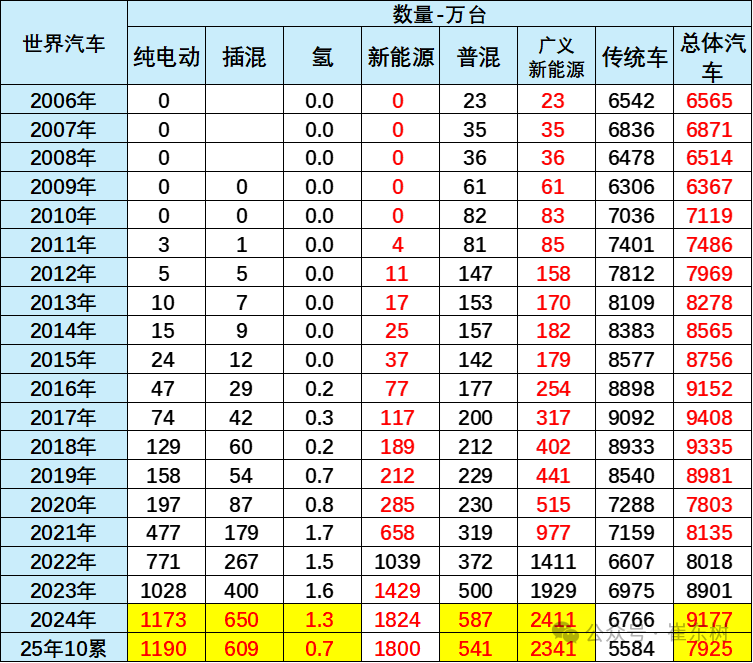
Core Viewpoint - Despite the rise of electric vehicles, traditional fuel vehicles continue to show resilience in the market, with recent data indicating a rebound in sales and market share [3][5][6]. Group 1: Sales Performance - In September, domestic sales of traditional fuel vehicles reached 1 million units, marking a year-on-year increase of 6.4% and a month-on-month increase of 10.9%, continuing a trend of growth for four consecutive months [5]. - From January to September, cumulative sales of traditional fuel vehicles totaled 8.141 million units, reflecting a year-on-year growth of 1.7%, while the sales of traditional fuel passenger vehicles are projected to decline by 17.7% in 2024 [5]. - Fuel vehicles accounted for 47.76% of total passenger vehicle sales in the first nine months of the year, indicating that they still hold a significant market share [5]. Group 2: Market Dynamics - The resurgence of fuel vehicles is attributed to a combination of market demand and aggressive pricing strategies, with discounts averaging around 30% and some luxury models offering discounts exceeding 40% [10][12]. - The Nissan Sylphy emerged as the best-selling fuel vehicle in September, with sales of 33,000 units, while the Toyota Camry also saw significant sales growth, achieving a monthly sales record [11][12]. - Traditional automakers are adjusting their pricing strategies to compete with electric vehicles, with many reducing prices to below 80,000 yuan and enhancing vehicle configurations to improve value [12]. Group 3: Strategic Shifts in Traditional Automakers - Major automakers like Honda and FAW-Volkswagen reported significant sales increases in fuel vehicles, with Honda's CR-V being a key contributor to its growth in the Chinese market [15][16]. - Geely and Chery have also announced new strategies to enhance their fuel vehicle offerings, emphasizing the importance of maintaining a dual focus on both fuel and electric vehicles [18][19]. - The automotive industry is witnessing a shift towards promoting fuel vehicles alongside electric models, with a focus on technological advancements and product positioning [16][19]. Group 4: Technological Advancements - Fuel vehicles are increasingly incorporating advanced technologies such as intelligent driving systems and high-performance chips, narrowing the gap with electric vehicles in terms of smart features [19][20]. - Recent launches of fuel vehicles have highlighted their enhanced smart capabilities, including features like voice interaction and OTA updates, which were previously more common in electric vehicles [20][22]. - Despite challenges in achieving the same level of intelligence as electric vehicles, traditional fuel vehicles are making strides in integrating smart technologies [23][24].
吉利汽车(00175):2025年10月销量点评:月销突破30万辆,总量及新能源再创历史新高
Changjiang Securities· 2025-11-12 01:42
Investment Rating - The investment rating for Geely Automobile is "Buy" and is maintained [6]. Core Insights - Geely Automobile reported a total sales volume of 307,000 units in October 2025, representing a year-on-year increase of 35.5% and a month-on-month increase of 12.5% [2][4]. - Cumulative sales from January to October 2025 reached 2.477 million units, up 44.3% year-on-year [2][4]. - The company is expected to enter a new product era supported by the GEA architecture, with positive developments across its brands including Zeekr, Lynk & Co, and Galaxy [7]. - The transition to new energy vehicles is progressing smoothly, with scale effects expected to enhance profitability [7]. - Geely's strong foundation in fuel vehicles and innovative overseas expansion strategies are opening new markets [7]. - The company is set to launch 10 new energy models in 2025, with significant advancements in smart driving capabilities [7]. Summary by Sections Sales Performance - October 2025 sales reached 307,000 units, with Geely brand, Lynk & Co, and Zeekr sales at 245,000, 40,000, and 21,000 units respectively [7]. - Galaxy brand achieved 127,000 units in October, marking a 100.8% increase year-on-year [7]. - Exports in October totaled 42,000 units, up 22.6% year-on-year [7]. - New energy vehicle sales in October were 178,000 units, accounting for 57.9% of total sales, a year-on-year increase of 63.6% [7]. Product Strategy - Geely plans to launch 10 new energy models in 2025, including five new models and several facelifts [7]. - The company is enhancing its smart driving capabilities, with new models expected to feature advanced driving technologies [7]. Financial Outlook - The projected net profit for 2025 is 16.1 billion yuan, with a corresponding price-to-earnings ratio of 10.6X [7].
汽车2026年投资策略:品牌化、全球化、智能化,迎接AI浪潮下的产业升级机遇【国信汽车】
车中旭霞· 2025-11-11 16:02
Core Viewpoint - The Chinese automotive industry is transitioning from a growth phase to a mature phase, with a significant slowdown in sales growth and a shift in focus towards brand building and globalization to maintain profitability and market share [1][11]. Group 1: Industry Characteristics and Changes - The automotive industry is experiencing three main characteristics: diminishing total volume dividends, low growth normalization in sales, and a shift in production capacity from traditional fuel vehicles to new energy vehicles [11][19]. - The industry has undergone significant changes, including the transition from a focus on meeting transportation needs to a broader application in various life scenarios, and the evolution of vehicles from mere transportation tools to intelligent entities [42][45]. Group 2: Sales and Market Trends - The sales volume of the automotive industry is expected to reach 34.89 million units in 2025, with a growth rate of approximately 11%, driven by tax incentives and subsidies [1][11]. - The penetration rate of new energy vehicles is projected to increase significantly, with sales expected to rise from 1.21 million in 2019 to 14 million by 2024, reflecting a compound annual growth rate of 63% [19][24]. Group 3: Brand and Globalization Strategies - Brand building and globalization are essential strategies for automotive companies to counteract intense competition and maintain market share, with a focus on creating brand premiums and establishing barriers through advanced technologies [2][4]. - Domestic automotive brands are increasingly expanding overseas, supported by the establishment of production capacities, distribution channels, and service systems in international markets [2][4]. Group 4: Technological Advancements - The automotive industry is on the brink of a technological revolution, with advancements in intelligent driving expected to transition from co-pilot (L3) to agent (L4) capabilities, creating new investment opportunities in various components [2][3]. - The expected mass production of robots in 2026 will mark a significant milestone for the robotics industry, with a high overlap in components between automotive and robotics sectors, presenting investment opportunities in related supply chains [3][4]. Group 5: Policy and Economic Influences - The automotive industry is influenced by macroeconomic cycles, industry cycles, and policy cycles, with the latter playing a crucial role in shaping market dynamics through incentives and regulations [1][50]. - The upcoming reduction in new energy vehicle purchase tax incentives in 2026 is anticipated to stabilize overall automotive sales, with a slowdown in the growth rate of new energy vehicle sales [1][50].
乌镇夜话:李书福为什么强调“元动力”
Zhong Guo Jing Ji Wang· 2025-11-11 14:10
Core Viewpoint - Geely Holding Group's Chairman Li Shufu emphasized the company's core values of "User First, Strategic Leadership, and Source of Motivation" during the World Internet Conference, highlighting the importance of user-centric strategies and internal motivation for employees [1][2]. Group 1: Company Values and Strategy - The core values of Geely are articulated as "User First, Strategic Leadership, and Source of Motivation," which reflect the company's commitment to prioritizing user needs and aligning strategies accordingly [1]. - Li Shufu humorously noted that Geely's user base is the reason for his presence on stage, reinforcing that the company's operations are fundamentally driven by user satisfaction [1]. - Geely's strategic framework, exemplified by the recent "Taizhou Declaration," consists of five strategic pillars aimed at ensuring user-centricity [1]. Group 2: Employee Engagement and Motivation - Li Shufu defined "Source of Motivation" as the enthusiasm and commitment of employees to execute the company's strategies and understand the principle of user-first [2]. - The company provides extensive benefits beyond the standard social insurance, including insurance for employees' family members and special provisions for employees' children, demonstrating a commitment to employee welfare [2]. - A culture of respect and honesty is essential for fostering employee loyalty and motivation, as employees are perceptive and will evaluate the company's integrity [2]. Group 3: Cultural Integrity and Employee Relations - Li Shufu shared a historical example of maintaining cultural integrity by prohibiting the use of "water armies" (fake reviews), emphasizing the importance of trust in corporate culture [3]. - The concept of "Source of Motivation" was further illustrated through a story about addressing employee grievances rather than resorting to punitive measures, highlighting the need for understanding and respect [3][4]. - The transition from punitive actions to dialogue with employees led to improved morale and productivity, establishing a foundation for Geely's growth as a leading automotive company in China [4].