TENCENT(00700)

Search documents
游戏厂商争先布局UGC 能否打造中国版“Roblox”?
Xin Lang Cai Jing· 2026-01-16 20:08
Core Insights - The article discusses the growing trend of User-Generated Content (UGC) in high Daily Active User (DAU) games, allowing players to create and share their own game content, which helps alleviate development pressures and enhances social engagement [2][6][10] Group 1: UGC Implementation in Games - Major DAU games are adopting UGC models to distribute development tasks to players, enabling them to create diverse gameplay experiences and address content development bottlenecks [2][6] - "Genshin Impact" launched its UGC mode "Thousand Star Realm" in October 2025, attracting over 30,000 creators and generating over 150 million total play sessions by January 3, 2026 [3] - Tencent's "Peacekeeper Elite" introduced its UGC mode "Oasis Genesis" in 2021, achieving over 33 million daily active users by Q3 2025, with player-created content expanding beyond traditional shooting genres [3][4] Group 2: Economic Impact of UGC - "Oasis Genesis" has reportedly distributed over 100 million yuan in incentives, with revenue from top player-created content reaching 5 million yuan in a single month [4] - UGC models provide additional monetization channels beyond traditional in-game purchases, allowing creators to earn from in-game transactions while platforms benefit from increased content consumption [7] Group 3: Challenges and Opportunities - The UGC model faces challenges in China, where previous attempts like Roblox struggled due to high entry barriers for creators and a lack of supportive infrastructure [9] - However, the current landscape shows promise, with a large user base in DAU games and improved support systems for creators, indicating potential for successful UGC implementation [10] Group 4: Role of AI in UGC Development - The advancement of generative AI is expected to lower the barriers for UGC creation, enabling faster game prototype development and enhancing the creative process [10][11] - AI tools are being integrated into UGC platforms to assist in content creation, quality assessment, and gameplay enhancement, potentially transforming the complexity and variety of UGC offerings [11]




累计开发者数量超40万 微信小游戏生态日益成熟
Zheng Quan Ri Bao· 2026-01-16 16:49
Group 1 - The core viewpoint of the articles highlights the rapid growth and significant user engagement of WeChat mini-games, with monthly active users reaching 300 million for IAP mini-games and 400 million for IAA mini-games [1] - The developer ecosystem for WeChat mini-games has surpassed 400,000 developers, with over 5,000 developers publishing their first works on the platform in 2025 [1] - Mini-games are becoming a new fertile ground for IP value derivation, with 70 mini-games achieving daily active users in the millions and over 300 games generating quarterly revenues exceeding 10 million yuan [1] Group 2 - 80% of the developers on the WeChat mini-game platform are teams with fewer than 30 members, allowing smaller teams to find opportunities in a market dominated by larger investments [2] - The introduction of a new incentive policy for IAP mini-games, increasing the maximum incentive for newly launched games to 4 million yuan, is a key driver for the growth of the mini-game ecosystem [2] - The revenue-sharing model has been adjusted to provide developers with an additional 15% discount on top of the 70% revenue share, enhancing financial support for developers during the critical launch period [2] Group 3 - The contribution of mini-games to Tencent's financial performance is evident, with growth in video account live service revenue and mini-game platform service fees contributing to a 5% increase in social network revenue in Tencent's Q3 2025 financial report [3] Group 4 - The "going global" strategy for mini-games is accelerating, with low-cost, short-cycle development of light games at its core, relying on overseas traffic platforms for user acquisition [4] - The PC segment is becoming the fastest-growing area for mini-games, with a 30% increase in active users, a 35% increase in in-app purchase revenue, and a 50% increase in payment penetration rate in 2025 [4] - The integration of AI technology into the mini-game ecosystem is being supported by a new growth plan for AI applications and online tools, providing developers with comprehensive resources [4]
头部厂商争夺AI“超级入口” 生态协同能力成胜负手
Zheng Quan Ri Bao· 2026-01-16 16:48
Core Insights - AI technology is transitioning from a validation phase to a commercialization phase, with a focus on how to effectively utilize it in business applications [1] - A competitive landscape is emerging among tech giants for the "super entry point" in AI applications, with companies like Alibaba, ByteDance, and Tencent vying for dominance [1][3] Group 1: AI Integration and Competition - Alibaba has integrated its Qianwen App with core services such as Taobao, Gaode, and Alipay, allowing users to complete the entire shopping process within a single app using natural language commands [1] - Other major players are also enhancing their AI capabilities; for instance, ByteDance's "Doubao" focuses on cross-platform product comparison and recommendations within the Douyin ecosystem [3] - The competition is not just about software but also hardware, with companies like ByteDance and Xiaomi entering the AI hardware space, indicating a trend towards integrated software and hardware solutions [4] Group 2: User Experience and Trust - The shift from app-centric to task-centric user experiences is crucial, as companies aim to create AI assistants that users rely on for various tasks [3] - Trust and security are becoming critical factors as AI systems take on more responsibilities, such as making decisions and managing payments, highlighting the need for robust data privacy measures [5] - The future of AI competition may hinge on the ability to build user trust while providing convenience, rather than solely on technological advancements [5]

谁才是中国民企真龙头?两份榜单背后,藏着两套生存哲学
Sou Hu Cai Jing· 2026-01-16 15:59
Core Insights - The contrasting rankings of JD.com and Tencent/Alibaba highlight two distinct business philosophies in China's private sector, focusing on current revenue versus future growth potential [1][2] Group 1: Rankings and Evaluation Standards - JD.com topped the "2025 China Private Enterprises 500" list with a revenue of 1.16 trillion RMB, surpassing Alibaba and Huawei, based on a revenue-centric evaluation of 6,379 companies [4][5] - Goldman Sachs' report ranked Tencent, Alibaba, and BYD as the "Top Ten Private Enterprises," emphasizing investment value and growth potential rather than current size [7] Group 2: Business Models - JD.com adopted a heavy asset model, investing significantly in logistics and self-operated goods, which has created substantial competitive barriers despite initial losses [8][6] - In contrast, Tencent and Alibaba utilize a light asset model, focusing on technology, data, and user relationships, allowing for high profitability with lower operational costs [10][12] Group 3: Manufacturing Sector Growth - The manufacturing sector is a significant contributor to the private economy, with 66.4% of the top 500 companies being manufacturers, accounting for 68.84% of revenue and 53.21% of net profit [13][14] - Companies like BYD and CATL are leading in innovation and R&D, with substantial investments in new energy technologies [16][17] Group 4: Future Directions - The diversity in business models among private enterprises is a strength, with companies like JD.com and Tencent exploring synergies between heavy and light asset strategies [18][19] - The implementation of the "Private Economy Promotion Law" in May 2025 is expected to provide a more supportive legal environment for private enterprises [19][20] - A significant portion of the top 500 companies is focusing on digital transformation and green initiatives, with international revenue growth indicating a push towards global expansion [20]



南向资金今日成交活跃股名单(1月16日)
Zheng Quan Shi Bao Wang· 2026-01-16 15:35
Market Overview - On January 16, the Hang Seng Index fell by 0.29%, with southbound funds totaling a transaction amount of HKD 110.94 billion, comprising HKD 55.52 billion in buying and HKD 55.42 billion in selling, resulting in a net buying amount of HKD 0.94 million [1] Southbound Trading Activity - The southbound trading through Stock Connect (Shenzhen) recorded a total transaction amount of HKD 41.37 billion, with buying at HKD 20.23 billion and selling at HKD 21.14 billion, leading to a net selling amount of HKD 0.91 billion [1] - Conversely, the Stock Connect (Shanghai) saw a total transaction amount of HKD 69.57 billion, with buying at HKD 35.29 billion and selling at HKD 34.28 billion, resulting in a net buying amount of HKD 1.00 billion [1] Active Stocks - Alibaba-W had the highest transaction amount among southbound funds, totaling HKD 69.52 billion, followed by SMIC and Tencent Holdings with transaction amounts of HKD 57.02 billion and HKD 56.66 billion, respectively [1] - In terms of net buying, SMIC led with a net buying amount of HKD 10.84 billion, with a closing price increase of 2.39%. Xiaomi Group-W followed with a net buying of HKD 8.67 billion, while Hua Hong Semiconductor had a net buying of HKD 5.85 billion [1] - The stock with the highest net selling was China Mobile, with a net selling amount of HKD 10.74 billion and a closing price decrease of 0.62%. Other notable net sellers included Alibaba Health and CNOOC, with net selling amounts of HKD 4.62 billion and HKD 1.08 billion, respectively [1] Continuous Net Buying - Among the stocks, SMIC, Xiaomi Group-W, and Hua Hong Semiconductor were listed as active stocks in both Stock Connect (Shenzhen) and (Shanghai), with SMIC having a total transaction amount of HKD 57.02 billion and a net buying of HKD 10.84 billion [2] - Tencent Holdings and Alibaba-W have seen continuous net buying for 8 days and 5 days, respectively, with Tencent Holdings having the highest net buying amount of HKD 96.85 billion, followed by Alibaba-W with HKD 44.24 billion [2]




腾讯控股(00700):Q4前瞻:广告和游戏持续释放势能,增强AIInfra投入
GF SECURITIES· 2026-01-16 14:15
Investment Rating - The investment rating for Tencent Holdings (00700.HK) is "Buy" with a current price of 617.50 HKD and a fair value estimate of 744.46 HKD [2]. Core Insights - The report emphasizes that advertising and gaming continue to show strong momentum, with significant investments in AI infrastructure [3][7]. - The forecast for Q4 2025 anticipates revenue of 1,947 billion RMB, representing a year-over-year growth of 13% [7]. - The report projects that Tencent's revenue will reach 7,522 billion RMB in 2025 and 8,290 billion RMB in 2026, with corresponding growth rates of 13.9% and 10.2% respectively [7][24]. Financial Projections - Revenue (in billion RMB): - 2023A: 6,090 - 2024A: 6,603 - 2025E: 7,522 - 2026E: 8,290 - 2027E: 8,973 - Growth Rates (%): - 2023A: 9.8% - 2024A: 8.4% - 2025E: 13.9% - 2026E: 10.2% - 2027E: 8.2% [4]. - Adjusted Net Profit (in billion RMB): - 2023A: 1,577 - 2024A: 2,227 - 2025E: 2,564 - 2026E: 2,929 - 2027E: 3,235 - Growth Rates (%): - 2023A: 36.4% - 2024A: 41.2% - 2025E: 15.1% - 2026E: 14.2% - 2027E: 10.5% [4]. Business Segment Performance - Gaming revenue for Q4 2025 is expected to reach 574 billion RMB, with a year-over-year growth of 17% [7]. - Social network revenue is projected at 324 billion RMB for Q4 2025, reflecting a 9% year-over-year increase [7]. - Marketing services revenue is anticipated to be 421 billion RMB for Q4 2025, showing a 20% year-over-year growth [7]. Valuation Methodology - The report employs a Sum-of-the-Parts (SOTP) valuation method, estimating the fair value of Tencent's core business at 6.35 trillion HKD, leading to a total fair value of 744.46 HKD per share [24][27].
刚刚,腾讯退股广州明昼科技:前库洛员工创立
3 6 Ke· 2026-01-16 12:12
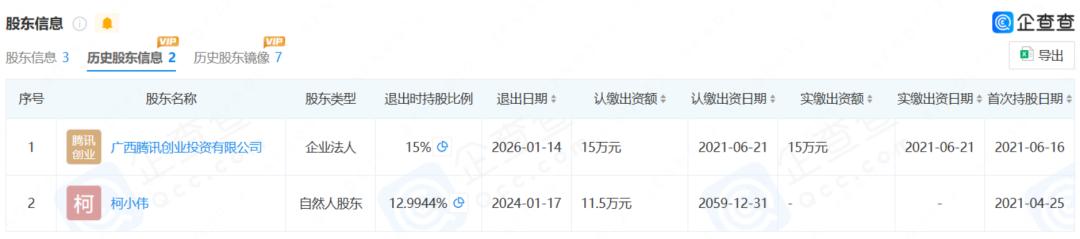
Core Viewpoint - Tencent has exited its investment in Guangzhou Mingzhou Technology, which held a 15% stake, indicating potential concerns about the company's performance and future prospects [1]. Group 1: Company Performance - Mingzhou Technology's main product, "Black Beacon," launched its domestic version in April last year but peaked at only 50th place on the iOS game sales chart, showing a rapid decline in performance thereafter [2]. - The international version of "Black Beacon" was launched earlier but has since been shut down, reflecting poor performance in overseas markets [2]. - The game's ratings on platforms like Good Game and TapTap are relatively low, at 5.6 and 6.2 respectively, indicating a lack of player satisfaction [2]. Group 2: Operational Challenges - Significant operational issues were reported during the game's launch, including server failures that led to delays [4]. - The development team reportedly vacated their original office space, and there were claims of project halts where only social security was paid during downtime, contributing to delays in updates [6]. - Recent updates, such as the introduction of a new character, have been criticized for their quality, further suggesting a decline in the game's development standards [8]. Group 3: Industry Context - The gaming industry has seen a notable number of game closures, with 23 games reported to have shut down by the end of last year, indicating a challenging environment for second-tier games [10]. - Despite the setbacks, there are upcoming titles in the industry that may revitalize the second-tier gaming sector, suggesting potential opportunities for recovery [11].
腾讯研究院公众号获“AIGC Rank 2025年度影响力AI媒体”
腾讯研究院· 2026-01-16 11:24
Core Viewpoint - Tencent Research Institute's WeChat public account was awarded "Annual Influential AI Media" by AIGC Rank for 2025, recognizing its contributions to the intersection of artificial intelligence and social development over the past year [5]. Group 1: Achievements and Contributions - The institute published a total of 120 articles on artificial intelligence throughout the year, exploring topics such as large model governance, algorithm ethics, digital labor, and intelligent society [9]. - Several original articles garnered significant attention, with the highest single article reaching over 50,000 views, indicating a strong public resonance with the discussions [9]. - The institute maintained a commitment to daily updates, producing 248 issues of the "Daily AI Dispatch" over 248 working days, tracking global AI policy developments, technological breakthroughs, and social impacts [9]. Group 2: Future Directions - The institute will continue to focus on social science research in the AI era, enhancing interdisciplinary dialogue and expanding the depth and breadth of public discussions [7]. - The mission remains centered on "user-centric, technology for good," aiming to promote healthy, inclusive, and sustainable development of AI [7].
智通港股通活跃成交|1月16日
智通财经网· 2026-01-16 11:04
Group 1 - On January 16, 2026, Alibaba-W (09988), Tencent Holdings (00700), and SMIC (00981) were the top three companies by trading volume in the Southbound Stock Connect, with transaction amounts of 40.30 billion, 34.43 billion, and 33.48 billion respectively [1] - In the Southbound Stock Connect for the Shenzhen-Hong Kong Stock Connect, Alibaba-W (09988), SMIC (00981), and Tencent Holdings (00700) also ranked as the top three, with transaction amounts of 29.23 billion, 23.54 billion, and 22.23 billion respectively [1] Group 2 - The top active companies in the Southbound Stock Connect included Alibaba-W (09988) with a net buying amount of +56.02 million, Tencent Holdings (00700) with +57.91 million, and SMIC (00981) with +510 million [2] - In the Shenzhen-Hong Kong Stock Connect, Alibaba-W (09988) had a net selling amount of -16.43 million, while SMIC (00981) recorded a net buying amount of +574 million [2]

2025年12月中国AI大模型平台排行榜
Sou Hu Cai Jing· 2026-01-16 10:44
Group 1: Industry Trends - The domestic AI large model industry is experiencing a critical turning point with intensified competition for C-end traffic and clearer commercialization paths [2][3] - Major companies are shifting focus from B-end empowerment to comprehensive efforts in the C-end market, leading to the emergence of "AI native super apps" [2][3] - The rapid growth of user engagement is evident, with ByteDance's Dola achieving over 10 million daily active users and the Kimi model from Moonlight achieving a monthly user growth rate of 170% [3][4] Group 2: Capital and Financing - The AI large model sector has seen significant capital activity, with Moonlight completing a $500 million Series C funding round, raising its valuation to $4.3 billion [4][5] - The industry is projected to generate over 10 billion in revenue by the end of 2025, indicating a shift from merely burning cash to demonstrating real monetization capabilities [4][5] - Companies are adopting differentiated capital strategies, with some focusing on immediate funding through technological advancements while others pursue long-term IPOs [4][5] Group 3: Company Developments - Alibaba's Qwen team launched several new models and applications, including the Qwen-Image-Edit model and the Qwen-Image-Layered model, enhancing capabilities in image generation and editing [11][12][14] - ByteDance's Dola and the Beanbag model have shown remarkable growth, with the latter's daily token usage surpassing 50 trillion, reflecting a tenfold increase year-on-year [9][20] - SenseTime's Kapi camera app has reached over 10 million users, becoming a leading choice in the photography app market [34] Group 4: Market Dynamics - The competition is shifting from simple parameter comparisons in chip performance to a focus on overall computational efficiency and cost-effectiveness across chips, systems, and software [6][7] - The AI large model industry is entering a phase characterized by differentiated competition and a focus on commercial performance, moving away from the narrative of merely burning cash [5][6] - The emergence of AI native applications is expected to enhance user experience and promote healthier business ecosystems [3][5]