
SMIC(00981)

Search documents
央企ETF(159959)开盘跌0.33%,重仓股澜起科技跌2.02%,中芯国际跌1.41%
Xin Lang Cai Jing· 2025-12-15 03:47
Core Viewpoint - The Central Enterprise ETF (159959) opened at 1.530 yuan, experiencing a slight decline of 0.33% on December 15 [1] Group 1: ETF Performance - The Central Enterprise ETF's major holdings include companies such as 澜起科技 (Lianqi Technology), 中芯国际 (SMIC), and 海康威视 (Hikvision), with respective opening declines of 2.02%, 1.41%, and 0.71% [1] - The ETF's performance benchmark is the 中证央企结构调整指数 (CSI Central Enterprise Structural Adjustment Index), managed by 银华基金管理股份有限公司 (Yinhua Fund Management) [1] - Since its establishment on October 22, 2018, the ETF has achieved a return of 53.63%, while its return over the past month has been -3.61% [1] Group 2: Individual Stock Movements - Notable stock movements within the ETF include 国电南瑞 (Guodian NARI) increasing by 0.34%, 招商银行 (China Merchants Bank) remaining unchanged, and 宝钢股份 (Baosteel) decreasing by 0.56% [1] - Other stocks such as 中国神华 (China Shenhua) and 中国建筑 (China State Construction) also remained unchanged, while 长安汽车 (Changan Automobile) and 中国电信 (China Telecom) saw declines of 0.77% and 0.15%, respectively [1]




科创ETF(588050)开盘跌1.01%,重仓股中芯国际跌1.41%,海光信息跌1.05%
Xin Lang Cai Jing· 2025-12-15 02:34
Core Points - The Sci-Tech ETF (588050) opened down 1.01% at 1.369 yuan on December 15 [1] - Major holdings in the ETF include companies like SMIC, Haiguang Information, and Cambrian, with varying performance; SMIC down 1.41%, Haiguang down 1.05%, and Cambrian down 2.08% [1] - The ETF's performance benchmark is the Shanghai Stock Exchange Sci-Tech 50 Index, managed by ICBC Credit Suisse Asset Management, with a fund manager named Zhao Xu [1] - Since its establishment on September 28, 2020, the ETF has returned -3.35%, with a one-month return of -2.02% [1] Company Performance - SMIC opened down 1.41% [1] - Haiguang Information opened down 1.05% [1] - Cambrian opened down 2.08% [1] - Lanke Technology opened down 2.02% [1] - Zhongwei Company opened up 0.16% [1] - United Imaging opened down 0.14% [1] - Kingsoft Office opened down 1.27% [1] - Chipone Technology opened down 5.06% [1] - Stone Technology opened down 0.99% [1] - Transsion Holdings opened down 0.45% [1]



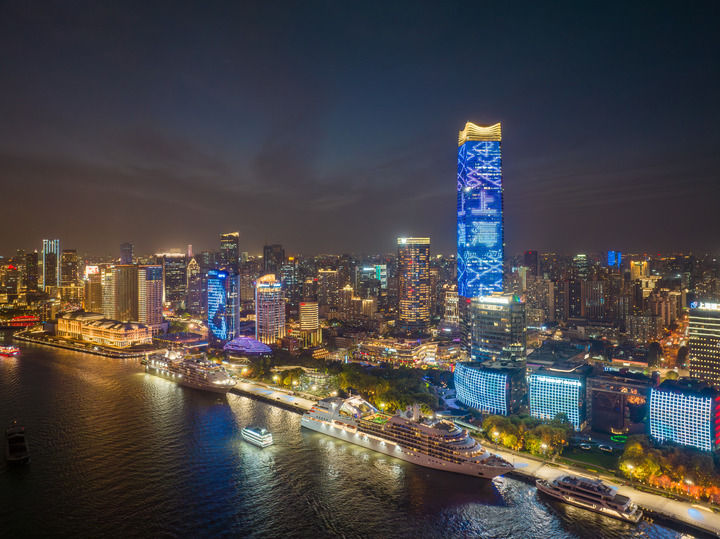
锚定全球标杆 发挥示范引领——上海“五个中心”建设描摹“十五五”新图景
Xin Hua Wang· 2025-12-15 02:28
Economic Performance - Shanghai's GDP surpassed 4 trillion yuan in the first three quarters, with a financial market transaction volume growth of 12.7% year-on-year [1] - The manufacturing output increased by 8.5% year-on-year, and Shanghai Port's container throughput reached 50.56 million TEUs, expected to set a new annual record [1] - The region's GDP growth for the first three quarters was 5.5%, with strategic emerging industries accounting for 44.1% of the total industrial output [5] Development of "Five Centers" - The "Five Centers" initiative is driving high-quality economic and social development, with a focus on enhancing overall, platform, amplification, and radiation effects [1][4] - The establishment of the IMF Shanghai Center and other international organizations in the region signifies Shanghai's growing importance as a global financial hub [4] - Shanghai has seen a rise in high-tech enterprises, with 25,000 companies and an average of 320 new tech firms emerging daily [5] Innovation and Technology - Innovation is becoming a strategic cornerstone for the "Five Centers" construction, with significant growth in China's biopharmaceutical R&D market [9] - The internal rate of return for China's biopharmaceutical R&D is 8.5%, significantly higher than the 3.6% in the U.S., showcasing China's efficiency in innovation [9] - The city is focusing on key sectors like integrated circuits, biomedicine, and artificial intelligence to enhance its industrial competitiveness [10] Mergers and Acquisitions - Mergers and acquisitions are seen as a vital driver for resource optimization and economic transformation, with Shanghai's "M&A Twelve Articles" promoting a favorable environment for such activities [9][11] - By the end of September, Shanghai completed 25 M&A transactions totaling 220.4 billion yuan, enhancing the core competitiveness of industrial clusters [10] - The "M&A Alliance" aims to support over 1.2 trillion yuan in national M&A transactions and 400 billion yuan in the Shanghai region over the next three years [11] Future Goals and Challenges - The "Fifteen Five" period is viewed as a critical phase for Shanghai's "Five Centers" construction, emphasizing the need for continuous improvement and international benchmarking [12] - Shanghai aims to enhance its international shipping services and financial systems to compete with global leaders like Singapore and London [13] - The city is addressing challenges in offshore finance and cross-border services to strengthen its financial ecosystem [13]




沪市并购观察:产业并购成主力,2025年多个“超大单”落地
Di Yi Cai Jing· 2025-12-15 01:43
Core Insights - The article highlights the significant increase in merger and acquisition (M&A) activities in the A-share market, particularly driven by the "Six Merger Rules" implemented in 2024, which have led to a more active and innovative M&A environment [2][4][5]. Group 1: M&A Activity Overview - In 2025, the Shanghai Stock Exchange recorded over 800 new asset mergers, marking an 11% year-on-year increase, with 90 major asset restructurings, a 55% increase from the previous year [2][4]. - More than 50% of the new major asset restructurings in 2025 were industry mergers, while 20% involved large shareholder injections [3][4]. - The focus of M&A activities has shifted towards high-quality development, with a notable emphasis on long-term value and quality enhancement rather than mere scale expansion [3][8]. Group 2: Policy and Regulatory Impact - The implementation of the "Six Merger Rules" has transformed the regulatory landscape, shifting from an approval-oriented approach to one focused on efficiency and industry guidance [4][5]. - The China Securities Regulatory Commission's revisions to the Major Asset Restructuring Management Measures have further stimulated M&A market activity by simplifying review processes and enhancing regulatory inclusivity [4][5]. Group 3: Notable Transactions and Trends - Significant transactions include the cross-border mergers and innovative payment structures, such as the first cross-border merger that achieved consolidation and the first acquisition of unprofitable assets [5][6][7]. - Major mergers like Guotai Junan's acquisition of Haitong Securities and China Shipbuilding's merger with China Shipbuilding Industry Corporation highlight the trend of large-scale consolidations in the financial and industrial sectors [6][7]. - The emergence of innovative cross-border M&A transactions, such as cash privatizations and share swaps, reflects a growing trend towards international integration and strategic asset acquisition [7][8]. Group 4: Sector-Specific Insights - The semiconductor, automotive, and hard technology sectors have seen a concentration of M&A activities, with 60% of the targets belonging to new productivity industries [3][10]. - Central state-owned enterprises are increasingly participating in industry consolidation, focusing on long-term value creation and the cultivation of new growth drivers [8][10]. - The trend of "stock optimization" is evident, with a significant number of IPO companies becoming M&A targets, indicating a shift towards resource optimization and industry upgrading [8][9].





南向资金今日成交活跃股名单(12月12日)
Zheng Quan Shi Bao Wang· 2025-12-12 15:45
Core Viewpoint - On December 12, the Hang Seng Index rose by 1.75%, with southbound funds recording a total transaction amount of HKD 116.99 billion, resulting in a net sell of HKD 5.29 billion [1] Group 1: Southbound Fund Transactions - Total transaction amount for southbound funds was HKD 116.99 billion, with buy transactions at HKD 55.85 billion and sell transactions at HKD 61.14 billion, leading to a net sell of HKD 5.29 billion [1] - The southbound trading through Stock Connect (Shenzhen) had a total transaction amount of HKD 63.08 billion, with net buy of HKD 1.31 billion, while the Shanghai Stock Connect recorded a total transaction amount of HKD 53.91 billion with a net sell of HKD 6.59 billion [1] Group 2: Active Stocks - Alibaba-W had the highest transaction amount among southbound funds at HKD 9.43 billion, followed by Xiaomi Group-W at HKD 6.31 billion and Tencent Holdings at HKD 5.38 billion [2] - The stocks with the highest net buy amounts included Meituan-W at HKD 2.48 billion, Xiaomi Group-W at HKD 2.36 billion, and Beike-W at HKD 0.10 billion, while Alibaba-W had the highest net sell amount at HKD 3.37 billion [2] - Meituan-W and Xiaomi Group-W were among the stocks that appeared on both Shenzhen and Shanghai Stock Connect active stock lists, with Meituan-W having a total transaction amount of HKD 5.20 billion and a net buy of HKD 2.48 billion [2] Group 3: Continuous Buying and Selling - Xiaomi Group-W and Meituan-W were the only stocks with continuous net buying for more than three days, with Xiaomi Group-W having a total net buy of HKD 10.77 billion and Meituan-W at HKD 4.08 billion [3] - Tencent Holdings and SMIC were the stocks with the highest continuous net sell amounts, totaling HKD 1.72 billion and HKD 1.55 billion respectively [3]



港股通(深)净买入13.09亿港元
Zheng Quan Shi Bao Wang· 2025-12-12 15:45
Group 1 - On December 12, the Hang Seng Index rose by 1.75%, closing at 25,976.79 points, while southbound funds through the Stock Connect recorded a net sell of 5.287 billion HKD [1] - The total trading volume for the Stock Connect on December 12 was 116.989 billion HKD, with a net sell of 5.287 billion HKD [1] - In the Shanghai Stock Connect, the trading volume was 53.910 billion HKD with a net sell of 6.595 billion HKD, while in the Shenzhen Stock Connect, the trading volume was 63.080 billion HKD with a net buy of 1.309 billion HKD [1] Group 2 - In the top ten active stocks in the Shanghai Stock Connect, Alibaba-W had the highest trading volume at 3.598 billion HKD, followed by SMIC and Xiaomi Group-W with trading volumes of 2.071 billion HKD and 2.057 billion HKD respectively [1] - In terms of net buy and sell amounts, Changfei Optical Fiber Cable had a net buy of 0.07 million HKD, while Alibaba-W had the highest net sell of 626 million HKD, despite its closing price increasing by 2.32% [1] - In the Shenzhen Stock Connect, Alibaba-W also led in trading volume with 5.836 billion HKD, followed by Xiaomi Group-W and Meituan-W with 4.252 billion HKD and 3.826 billion HKD respectively [2] - The net buy amount for Xiaomi Group-W was the highest at 2.959 billion HKD, with its closing price rising by 1.85%, while Alibaba-W had a net sell of 2.742 billion HKD, closing up by 2.32% [2]
中芯国际因受限制股份单位获归属而发行的1.34万股
Zhi Tong Cai Jing· 2025-12-12 14:25
Core Viewpoint - Semiconductor Manufacturing International Corporation (SMIC) announced the issuance of 13,400 ordinary shares on December 12, 2025, as a result of restricted stock units granted under the 2014 share-based compensation plan adopted on June 13, 2013 [1] Group 1 - The shares are being issued to non-directors of the company [1] - The issuance is part of the company's ongoing compensation strategy to incentivize and retain talent [1]
在消费性电子与AI新品驱动下,3Q25前十大晶圆代工产值季增8.1%
Xin Lang Cai Jing· 2025-12-12 14:14
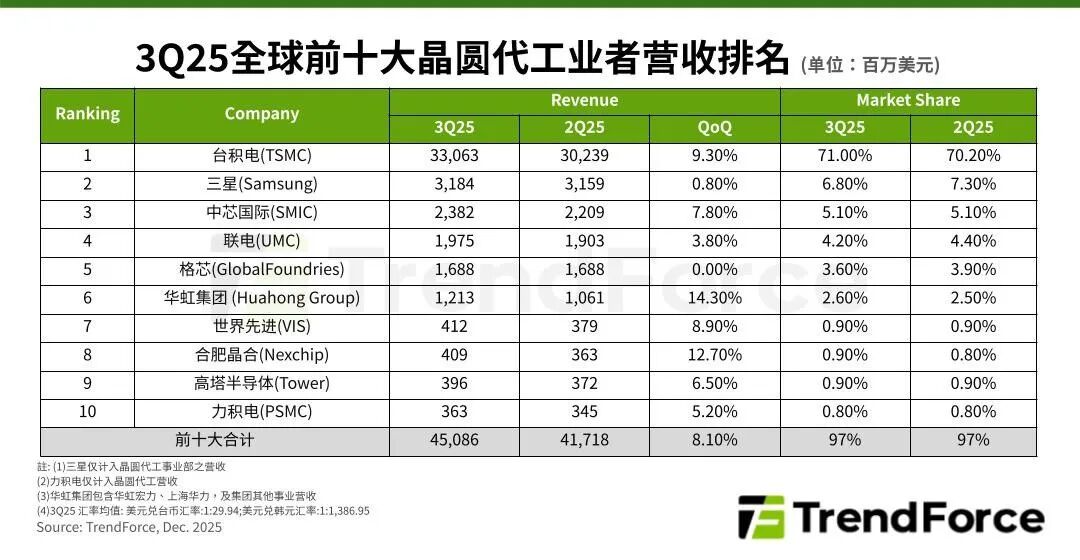
Industry Insights - The global wafer foundry industry is expected to continue benefiting from AI high-performance computing (HPC) and demand for new consumer electronics chips, with advanced processes (7nm and below) significantly contributing to revenue, leading to a quarterly revenue increase of 8.1% for the top ten foundries, reaching nearly $45.1 billion in Q3 2025 [1][7] - Despite the positive outlook for Q3 2025, the industry anticipates a conservative demand shift for mainstream terminal applications in 2026 due to international conditions, with limited growth momentum for capacity utilization in Q4 2025 [1][7] Company Performance - TSMC (Taiwan Semiconductor Manufacturing Company) reported a revenue of approximately $33.1 billion in Q3 2025, a 9.3% increase from the previous quarter, supported by strong demand from smartphones and HPC, increasing its market share to 71% [2][8] - Samsung's revenue remained stable at about $3.2 billion, with a slight increase in capacity utilization but limited contribution to revenue, maintaining a market share of 6.8% [3][9] - SMIC (Semiconductor Manufacturing International Corporation) achieved a revenue of $2.4 billion, a 7.8% increase, driven by improved capacity utilization and wafer shipments [3][9] - UMC (United Microelectronics Corporation) reported a revenue of nearly $2 billion, a 3.8% increase, benefiting from demand for ICs related to smartphones and PCs, with a market share of 4.2% [3][9] - GlobalFoundries maintained its revenue at approximately $1.7 billion, with a slight decline in market share to 3.6% due to competitive pressures [3][9] - HuaHong Group's revenue grew to over $1.2 billion, a 14.3% increase, with improved wafer shipments and ASP [3][9] - Nexchip (合肥晶合) saw a revenue increase of 12.7% to $409 million, surpassing Tower Semiconductor to become the eighth largest foundry [4][10] - PSMC (Powerchip Semiconductor Manufacturing Corporation) reported a revenue growth of 5.2% to $363 million, driven by strong demand for DRAM and improved foundry prices [4][10]


存储器涨价等因素扰动供应链转趋保守 机构预计第四季晶圆代工产值季增幅收窄
Zheng Quan Shi Bao Wang· 2025-12-12 12:52
Core Insights - The global wafer foundry industry is experiencing growth driven by the AI boom, with the top ten foundries' revenue increasing by 8.1% to nearly $45.1 billion in Q3 2025 [1][2] - However, due to international conditions and rising memory prices, the supply chain is becoming conservative regarding demand for mainstream terminal applications in 2026, leading to a forecasted slowdown in capacity utilization growth in Q4 [1][7] Group 1: Industry Performance - The top ten foundries' revenue growth in Q3 2025 was significantly supported by high-performance computing (HPC) and consumer electronics, particularly from advanced processes of 7nm and below [2] - TSMC's revenue reached approximately $33.1 billion, a 9.3% increase, with a market share rise to 71%, driven by smartphone and HPC demand [2] - Samsung's revenue remained stable at about $3.18 billion, with a market share of 6.8%, while SMIC's revenue grew by 7.8% to $2.38 billion, ranking third [2] Group 2: Future Outlook - The wafer foundry industry is projected to grow by 19% in 2026, with AI-related demand driving advanced process markets to a 28% annual increase [2] - TSMC is advancing to 2nm production and plans to move towards 1nm technology, with advanced packaging capacity expected to grow by 27% next year [3] - The semiconductor industry is focusing on increasing capacity and technological trends, especially with the rise of ASIC chips and domestic chip innovations from companies like Huawei and Cambrian [3] Group 3: Consumer Electronics Impact - Consumer electronics are a significant driver for wafer foundry performance, affecting the rankings of the top ten foundries [4] - Nexchip's revenue increased by 12.7% to $409 million, allowing it to surpass Tower Semiconductor to rank eighth [4] - UMC's revenue grew by 3.8% to nearly $1.98 billion, benefiting from demand for smartphones and PCs, while GlobalFoundries' revenue remained stable at about $1.69 billion [5] Group 4: Q4 Expectations - The growth rate for Q4 is expected to slow due to conservative demand forecasts influenced by international conditions and rising memory prices [7] - SMIC's Q4 revenue guidance indicates a modest growth of 2%, reflecting cautious customer production planning amid price pressures [7] - Hua Hong Group anticipates Q4 sales revenue between $650 million and $660 million, with limited growth expected [8]
智通港股通活跃成交|12月12日





智通财经网· 2025-12-12 11:02
Core Insights - On December 12, 2025, Alibaba-W (09988), SMIC (00981), and Xiaomi Group-W (01810) were the top three companies by trading volume in the Southbound Stock Connect, with trading amounts of 3.598 billion, 2.071 billion, and 2.057 billion respectively [1] - In the Shenzhen-Hong Kong Stock Connect, Alibaba-W (09988), Xiaomi Group-W (01810), and Meituan-W (03690) led the trading volume, with amounts of 5.836 billion, 4.252 billion, and 3.826 billion respectively [1] Southbound Stock Connect Trading Activity - **Top Active Companies in Southbound Stock Connect**: - Alibaba-W (09988): Trading amount of 3.598 billion, net buy of -0.626 billion [2] - SMIC (00981): Trading amount of 2.071 billion, net buy of -0.292 billion [2] - Xiaomi Group-W (01810): Trading amount of 2.057 billion, net buy of -0.597 billion [2] - Tencent Holdings (00700): Trading amount of 1.882 billion, net buy of -0.193 billion [2] - Changfei Optical Fiber (06869): Trading amount of 1.409 billion, net buy of +0.64978 million [2] Shenzhen-Hong Kong Stock Connect Trading Activity - **Top Active Companies in Shenzhen-Hong Kong Stock Connect**: - Alibaba-W (09988): Trading amount of 5.836 billion, net buy of -2.742 billion [2] - Xiaomi Group-W (01810): Trading amount of 4.252 billion, net buy of +2.959 billion [2] - Meituan-W (03690): Trading amount of 3.826 billion, net buy of +2.850 billion [2] - Tencent Holdings (00700): Trading amount of 3.495 billion, net buy of -0.803 billion [2] - SMIC (00981): Trading amount of 1.447 billion, net buy of -0.287 billion [2]