LI AUTO-W(02015)

Search documents
理想汽车战略(李想第一人称)
数说新能源· 2025-09-15 03:03
Core Viewpoint - The company emphasizes that consensus is the key to execution, and strategic discussions should start from the mission, vision, and strategy before product planning [1][29]. Mission and Vision - The mission is to change transportation through technology for the benefit of more people [2]. - The vision is to become a leader in the automotive transportation sector [3]. Corporate Culture - The corporate culture focuses on creating value for customers, improving efficiency for the company, and fostering continuous growth for employees [4]. Strategic Direction - The essence of strategy is to clearly define the market, timing, and competitors, which involves significant trade-offs in market selection [4][30]. - The company aims to target high-growth markets and ensure victory within those markets [15][30]. Market Segmentation - The company anticipates that by 2020, the domestic new energy vehicle production and sales will reach 2 million units, with specific market segments including: - 1 million range-extended and plug-in hybrid vehicles [6]. - 1 million pure electric vehicles, primarily serving daily commuting needs [8]. - 200-300 million low-speed electric vehicles, filling a gap in the market [11]. Target Market - The focus is on creating popular models in three market segments, particularly in the 300,000 to 500,000 price range, which is expected to grow despite economic challenges [13][14]. Competition - The company recognizes that competition is primarily with fuel vehicles, and it must offer competitive pricing to capture market share [31][16]. Technology and Innovation - The company prioritizes technology and innovation to meet user needs, eliminate competition, and achieve cost advantages [19]. - Key technological focuses include range-extended systems, smart technology, and advanced driver assistance systems [20][21][22]. Quality and Cost Control - Quality control is critical, as safety is a result of quality management throughout the design, supply chain, and manufacturing processes [24]. - The company aims to minimize costs by optimizing operations and leveraging innovative business models [26]. Product Planning - Product planning should integrate user needs and business requirements, ensuring a long-term value proposition [27]. - The planning process involves designing from the user's perspective, establishing a commercial framework, and creating a technical architecture [28].



机器人Q4迎重磅催化 看好T链核心主线 | 投研报告
Zhong Guo Neng Yuan Wang· 2025-09-15 01:25
Core Insights - The automotive sector showed a mixed performance in early September 2025, with passenger car sales declining while new energy vehicle sales increased slightly [1][2] - The A-share automotive sector outperformed the market, with a 3.9% increase, ranking 13th among sub-industries [1][2] - Key companies to watch include Geely, Xpeng, Li Auto, BYD, and others, indicating a focus on high-quality domestic brands [2][5] Weekly Data - Passenger car sales reached 368,000 units, down 9.5% year-on-year and down 29.8% month-on-month [1][2] - New energy vehicle sales were 221,000 units, up 3.1% year-on-year but down 23.6% month-on-month [1][2] - New energy penetration rate was 60.2%, an increase of 4.8 percentage points from the previous month [1][2] Market Performance - The automotive sector's performance was stronger than the broader market, with the A-share automotive sector rising 3.9% compared to the CSI 300's 2.9% [1][2] - Sub-sectors such as auto parts and services saw significant gains, with auto parts up 6.7% and auto services up 4.8% [1][2] Upcoming Catalysts - Chery Automobile is preparing for a significant IPO in Hong Kong, which could be the largest for a car company this year [4] - NIO announced plans to issue 181.8 million Class A ordinary shares to fund core technology development for smart electric vehicles [4] Investment Recommendations - Focus on high-quality domestic brands in the passenger car segment, including Geely, Xpeng, Li Auto, and BYD [5] - In the auto parts sector, recommendations include companies involved in smart driving and intelligent cockpits [5] - For the robotics sector, attention is drawn to companies involved in automotive robotics [5]



辩证看待李想说加快技术平台和产品更新迭代速度
理想TOP2· 2025-09-14 12:25
Core Viewpoint - The company aims to accelerate the iteration speed of its technology platform and product updates to maintain a competitive edge in the automotive market, particularly in the context of AI advancements [1][3]. Group 1: Product Development Strategy - The company plans to shorten the product replacement cycle, moving from a four-year cycle to a faster pace, although the exact speed remains uncertain [1]. - There is a commitment to invest more resources in refining product definitions and details in the pure automotive dimension, despite uncertainties regarding the prioritization of these efforts [1][2]. - The development approach prioritizes advanced models over refining existing versions, reflecting a strategic focus on long-term outcomes rather than immediate improvements [2]. Group 2: Market Feedback and Response - Recent sales declines of the L series prompted the company to accelerate product iterations as a response to market feedback [3]. - The company recognizes that the extent of its commitment to product iteration will be influenced by ongoing market responses and feedback [3]. - The current market situation has caused some discomfort for the company, but it is not perceived as a critical pain point that would drive drastic changes [3].

What Does Wall Street Think About Li Auto Inc. (LI)?
Insider Monkey· 2025-09-14 05:17
Core Insights - Artificial intelligence (AI) is identified as the greatest investment opportunity of the current era, with a strong emphasis on the urgent need for energy to support its growth [1][2][3] - A specific company is highlighted as a key player in the AI energy sector, owning critical energy infrastructure assets that are essential for meeting the increasing energy demands of AI technologies [3][7][8] Investment Landscape - Wall Street is investing hundreds of billions into AI, but there is a looming question regarding the energy supply needed to sustain this growth [2] - AI data centers consume energy equivalent to that of small cities, indicating a significant strain on global power grids [2] - The company in focus is positioned to benefit from the surge in demand for electricity driven by AI advancements [3][6] Company Profile - The company is described as a "toll booth" operator in the AI energy boom, collecting fees from energy exports and benefiting from the onshoring trend due to tariffs [5][6] - It possesses critical nuclear energy infrastructure assets, making it integral to America's future power strategy [7] - The company is noted for its ability to execute large-scale engineering, procurement, and construction projects across various energy sectors, including oil, gas, and renewables [7][8] Financial Position - The company is completely debt-free and has a cash reserve equivalent to nearly one-third of its market capitalization, positioning it favorably compared to other energy firms burdened with debt [8] - It holds a significant equity stake in another AI-related company, providing indirect exposure to multiple growth opportunities in the AI sector [9][10] Market Sentiment - There is a growing interest from hedge funds in this company, which is considered undervalued and off-the-radar, trading at less than 7 times earnings excluding cash and investments [10][11] - The company is recognized for delivering real cash flows and owning critical infrastructure, making it a compelling investment opportunity in the context of the AI and energy sectors [11][12] Future Outlook - The future of AI is closely tied to energy advancements, with a strong emphasis on the need for infrastructure to support this growth [6][14] - The ongoing influx of talent into the AI field is expected to drive continuous innovation and advancements, reinforcing the importance of investing in AI-related opportunities [12][13]
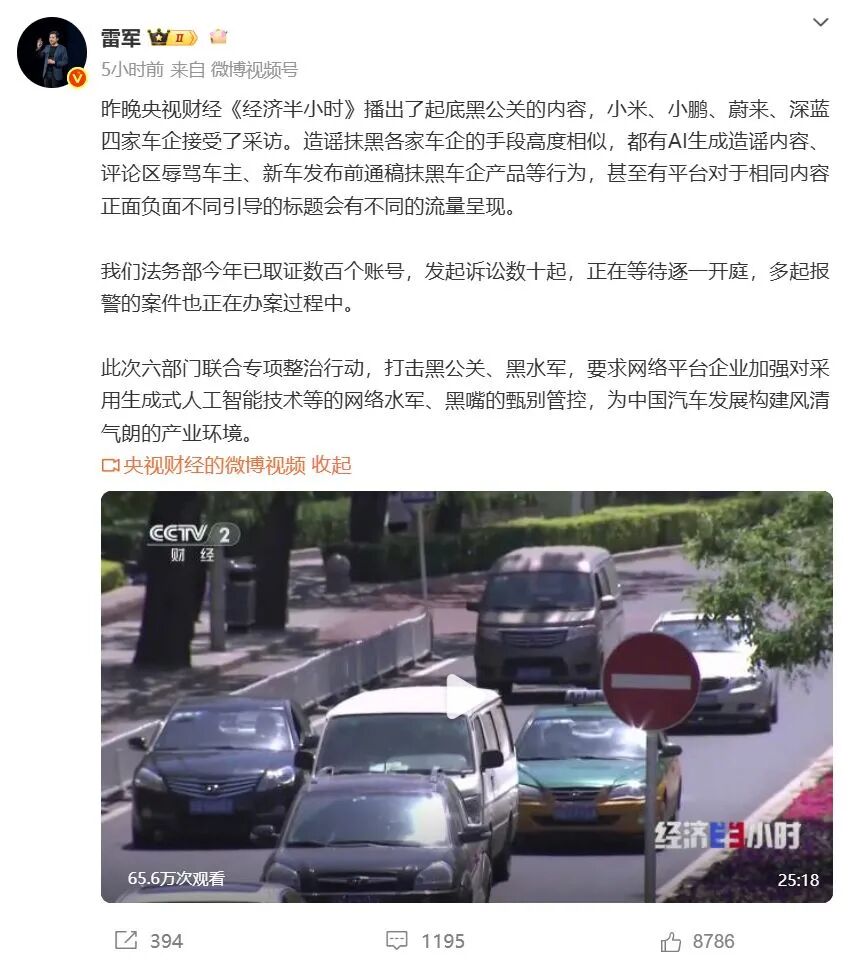
雷军已发起诉讼!央视起底“黑公关”:某些虚假测评能赚数百万元
Hua Xia Shi Bao· 2025-09-14 00:32
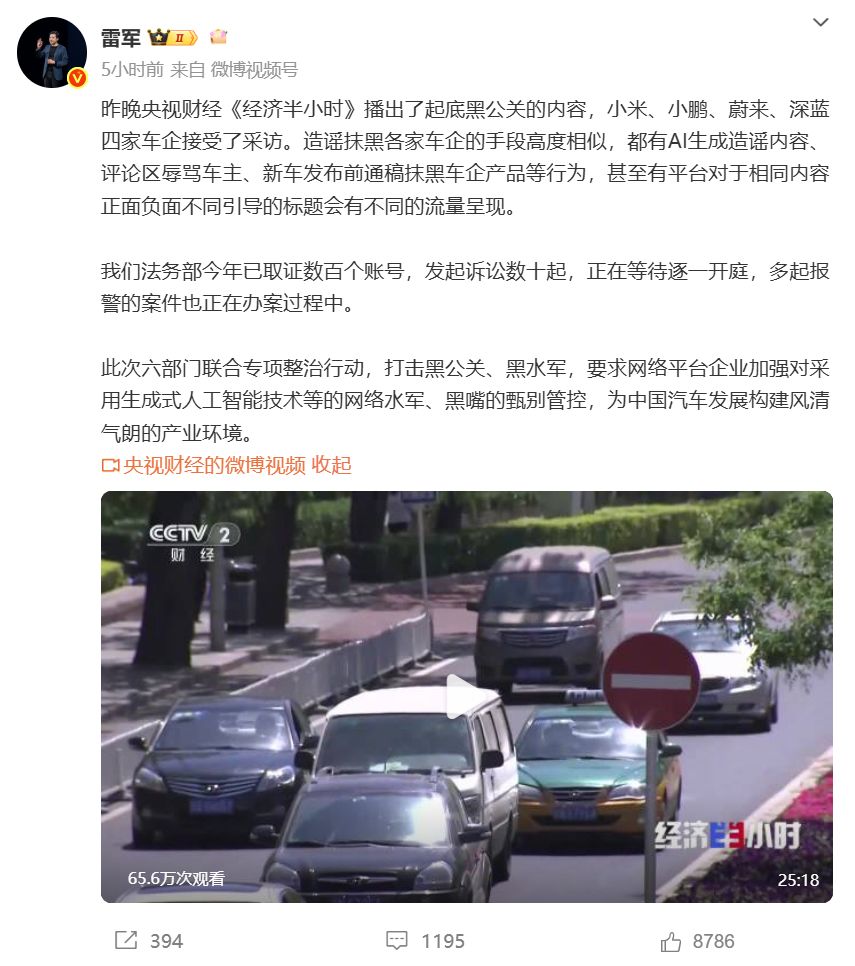
Core Viewpoint - The article discusses the rising issue of black public relations (PR) and malicious misinformation targeting automotive companies in China, particularly Xiaomi, Xiaopeng, NIO, and Deep Blue, highlighting the need for regulatory action and legal recourse against such practices [2][6][10]. Group 1: Black PR Tactics - Automotive companies are facing similar tactics of misinformation, including AI-generated false content, derogatory comments towards car owners, and negative press releases before new product launches [2][6]. - Specific instances of misinformation include false claims about NIO vehicles catching fire and Xiaomi cars being unable to open doors after a collision, which were later proven to be fabricated [6][8]. Group 2: Legal Actions and Regulatory Response - Xiaomi's legal department has collected evidence against hundreds of accounts and initiated dozens of lawsuits, with multiple cases currently under investigation [2]. - Xiaopeng Motors recently won a court case against a company that published defamatory content, resulting in a public apology and financial compensation [3]. - NIO and other companies have also reported similar issues and are actively participating in a joint regulatory effort to combat black PR and improve the industry’s public image [4][12]. Group 3: Industry Impact and Call for Action - The black PR issue is significantly disrupting market order and harming consumer rights, prompting companies to take legal action against malicious actors [4][10]. - Industry leaders emphasize the need for stronger regulatory measures and collaboration among industry associations to create a healthier public discourse around automotive brands [12].


AI应用公司负责人分享对理想VLA的理解
理想TOP2· 2025-09-13 11:50
Core Viewpoint - The core value of VLA (Vehicle Learning Assistant) lies in its ability to effectively utilize data for training foundational models and personal memory, enhancing user experience through self-evolution without the need for OTA updates [2][5][6]. Group 1: VLA Functionality - VLA's memory function captures various driving habits and preferences, allowing for a personalized driving experience that evolves over time [2][12]. - The system operates by tokenizing and summarizing collected data, which is then utilized to enhance the driving experience [10][13]. - Users are encouraged to actively engage with VLA by driving frequently to improve its performance and adaptability [8]. Group 2: Strategic Insights - The strategy involves a decentralized approach to personal memory data, AI infrastructure, and hardware integration, positioning the company to leverage user data effectively [6][20]. - The focus is on creating a unified experience across various devices, similar to Apple's ecosystem, which enhances user reliance on the brand [20][25]. - The importance of foundational model capabilities and the need for proprietary chip development to support advanced AI functionalities are emphasized [22][23]. Group 3: Market Positioning - The company is currently leading in the development of VLA and its memory capabilities, with competitors like Huawei and Horizon still in the early stages [15][19]. - The concept of "persistent memory" is highlighted as a key investment theme, enabling AI to evolve from a one-time tool to a reliable long-term partner [16][25]. - The integration of personalized memory with AI models is seen as a significant challenge but essential for creating customized driving experiences [25].
雷军:法务部今年已取证数百个账号,发起诉讼数十起!
Mei Ri Jing Ji Xin Wen· 2025-09-13 08:44
Core Viewpoint - The article discusses the issue of black public relations and online smear campaigns targeting several automotive companies in China, including Xiaomi, Xpeng, NIO, and Li Auto, highlighting the coordinated efforts by these companies to combat misinformation and protect their brand integrity [1][4][11]. Group 1: Company Responses - Xiaomi's legal department has collected evidence against hundreds of accounts and initiated multiple lawsuits in response to the smear campaigns, which involve AI-generated false content and targeted harassment [1]. - Xpeng Motors has actively responded to the Ministry of Industry and Information Technology's initiative to combat online chaos in the automotive industry, emphasizing the protection of its legal rights [4]. - NIO has reported that a specific account has published thousands of defamatory statements against the company and its users, leading to a court ruling for the removal of the content and compensation for damages [11]. Group 2: Legal Actions and Court Rulings - The Guangzhou Internet Court ruled in favor of Xpeng Motors, ordering a company to delete infringing content and issue a public apology for damages caused [4]. - Li Auto's legal team has identified multiple accounts spreading false information about its products, including fabricated complaints and misleading claims about the performance of its upcoming model, the i6 [8]. - Legal actions have been taken against various MCN organizations and accounts involved in disseminating defamatory content against NIO and other companies, with ongoing monitoring and evidence collection [11][13]. Group 3: Industry-Wide Initiative - A joint initiative by six government departments aims to crack down on black public relations and online misinformation in the automotive sector, requiring platforms to enhance their monitoring and control over AI-generated content and malicious accounts [1][4]. - The automotive industry is facing significant challenges from organized smear campaigns that disrupt market order and harm consumer rights, prompting companies to take legal and administrative actions [8][11].
摩根士丹利建议理想i6定价下探20万元区间,理想暂无回应
Cai Jing Wang· 2025-09-13 07:26
Core Viewpoint - Morgan Stanley's recent report emphasizes the critical importance of the upcoming i6 model for Li Auto, suggesting a more aggressive pricing strategy to lower the guidance price from the previously estimated range of 250,000-300,000 yuan to 200,000-250,000 yuan [1] Company Summary - The i6 model is deemed essential for Li Auto's future performance and market positioning [1] - Li Auto has not yet responded to media inquiries regarding the pricing strategy and the i6 model [1] Industry Summary - The recommendation for a more aggressive pricing strategy reflects the competitive landscape in the automotive industry, particularly in the electric vehicle segment [1]

蔚小理零米“血战”盈利线
Hu Xiu· 2025-09-12 13:00
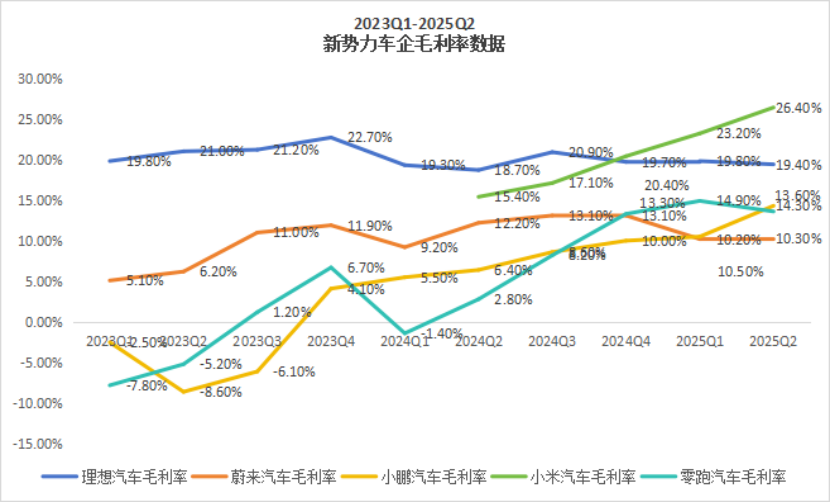
Core Viewpoint - The electric vehicle (EV) market is shifting focus towards profitability, with major players setting clear targets for achieving positive earnings by the end of 2025, moving away from reliance on subsidies and external investments [1][2][4]. Group 1: Profitability Targets - NIO's founder, Li Bin, stated that the company must achieve quarterly profitability by Q4 2025, relying solely on operational capabilities [1]. - XPeng's founder, He Xiaopeng, also indicated that XPeng aims for profitability by Q4 2025 [2]. - Xiaomi's founder, Lei Jun, mentioned that losses in Xiaomi's automotive business are narrowing, with expectations to achieve profitability between Q3 and Q4 of this year [3]. Group 2: Current Financial Performance - Li Auto achieved a net profit of 1.1 billion yuan in Q2, while Leap Motor reported a net profit of 160 million yuan [6]. - Li Auto's revenue for Q2 was 30.2 billion yuan, a year-on-year decrease of 4.5%, with R&D and marketing expenses also declining [9]. - Leap Motor is in an expansion phase, with significant increases in marketing and R&D expenses, yet still maintaining profitability [8]. Group 3: Strategies for Profitability - Xiaomi is focusing on increasing revenue while also investing more, with automotive revenue reaching 20.6 billion yuan, more than double the previous year's figure [16]. - XPeng's revenue grew by 125.3% year-on-year, with a focus on smart technology investments while maintaining efficient R&D spending [21]. - NIO is implementing cost-cutting measures, with a significant reduction in sales and management expenses, aiming to narrow losses to 4.9 billion yuan in Q2 [25]. Group 4: Market Positioning and Challenges - Li Auto is facing challenges with declining sales and revenue, with a projected Q3 sales guidance of only 90,000 to 95,000 units, down from 111,000 in Q2 [11]. - NIO's strategy involves maintaining a pure electric model while facing challenges in scaling its battery swap stations, which require a significant vehicle ownership base to become profitable [40]. - Leap Motor and XPeng are working to diversify their brand identities beyond just "cost-performance" to enhance their market positioning [32]. Group 5: Future Outlook - The EV market is entering a mature phase, with companies focusing on transitioning to profitable operations while navigating technological advancements such as L3 autonomous driving [48]. - The success of new product launches will be critical, as failures could significantly impact a company's market position and viability [48].
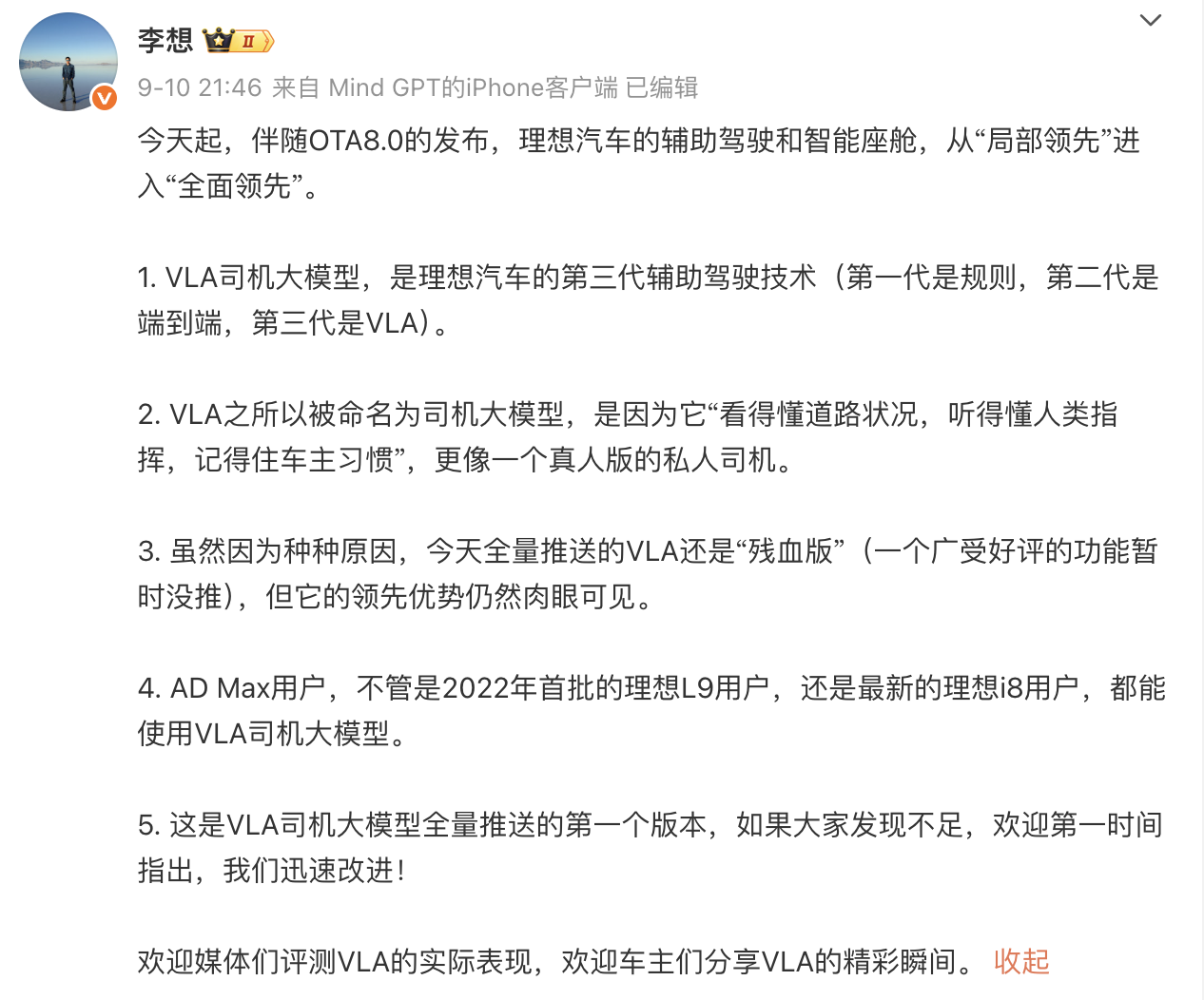
理想汽车推送OTA 8.0版本,李想称公司辅助驾驶开始“全面领先”,VLA优于世界模型?
Mei Ri Jing Ji Xin Wen· 2025-09-12 10:06
Core Viewpoint - Li Auto's advanced driver assistance and smart cockpit have transitioned from "partially leading" to "fully leading" following the OTA 8.0 update of their vehicle system [1] Group 1: OTA 8.0 Update - The OTA 8.0 version has officially launched, enhancing driver assistance, smart cockpit, and smart electric features [3] - The new VLA (Vision-Language-Action Model) driver model is being fully pushed to Li MEGA and L series AD Max models [3] - Li Auto's chairman, Li Xiang, described VLA as the third generation of their driver assistance technology, emphasizing its ability to understand road conditions, comprehend human commands, and remember user habits [3] Group 2: VLA Model Features - The current version of VLA is referred to as a "crippled version" due to the temporary absence of a highly praised feature [4] - Li Auto has acknowledged the need for a cautious approach in rolling out new features, especially after the suspension of the VLA remote summon function [4] - The VLA model enhances the accuracy of route selection in complex scenarios and remembers user speed preferences for specific roads [6] Group 3: Industry Competition and Technology - Other companies like Yuanrong Qixing and XPeng Motors are also developing VLA models, indicating a competitive landscape in this technology [7] - The VLA model is seen as an "intelligent enhanced version" of end-to-end models, addressing challenges in handling unseen scenarios [8] - The VLA model integrates perception, action execution, and language processing, enhancing its ability to understand and make decisions in complex environments [8] Group 4: Differing Approaches - Huawei's approach focuses on the World Action model, which bypasses the language processing step, emphasizing direct control through vision [12] - The debate between VLA and world models highlights differing strategies in achieving advanced autonomous driving capabilities [12][13] - Experts suggest that both VLA and world models can coexist and complement each other, with different companies choosing paths based on their specific goals [13]