LI AUTO-W(02015)

Search documents
国联民生:维持理想汽车-W买入评级 9月或实现理想汽车智能体全面进化
Zhi Tong Cai Jing· 2025-09-12 09:15
Core Viewpoint - The report from Guolian Minsheng indicates that Li Auto's sales and profitability are under pressure due to intensified industry competition, with projected revenues and net profits showing fluctuations from 2025 to 2027 [1] Group 1: Sales Performance - In August 2025, Li Auto delivered 28,529 vehicles, reflecting a year-on-year decrease of 40.7% and a month-on-month decrease of 7.2% [1][2] - The performance of pure electric models is accelerating, with the Li MEGA Home achieving over 3,000 deliveries in August and expected production capacity to exceed 3,500 units in September [2] - The Li i8 is ramping up production, with expected deliveries between 8,000 to 10,000 units by the end of September, while the Li i6 is anticipated to launch in September with a price range of 250,000 to 300,000 yuan [2] Group 2: AI Development - Li Auto is accelerating its investment and development in AI, leveraging its computational power and data scale advantages, which may help maintain its leading position in the future [3] - The launch and delivery of the i8 will coincide with the rollout of the VLA driver model and the Li Xue intelligent system, enhancing the product strength in the AI domain [3] - An OTA 8.0 update is expected to be fully pushed to all AD Max models in September, marking a significant evolution of the Li Xue intelligent system [3] Group 3: Charging Infrastructure - As of August 31, 2025, Li Auto has established 543 retail centers across 156 cities, along with 536 after-sales service and authorized repair centers in 222 cities [4] - The company has deployed 3,190 Li Supercharging stations, equipped with 17,597 charging piles nationwide, contributing to the improvement of its pure electric ecosystem [4]


国联民生:维持理想汽车-W(02015)买入评级 9月或实现理想汽车智能体全面进化
智通财经网· 2025-09-12 09:10
Core Viewpoint - The report from Guolian Minsheng indicates that due to intensified industry competition, Li Auto's sales and profitability are under pressure, with projected revenues and net profits showing fluctuations from 2025 to 2027 [1] Group 1: Sales Performance - In August 2025, Li Auto delivered 28,529 new vehicles, representing a year-on-year decline of 40.7% and a month-on-month decrease of 7.2% [1][2] - The performance of pure electric models is accelerating, with the Li MEGA Home achieving over 3,000 deliveries in August and expected production capacity to exceed 3,500 units in September [2] - The Li i8 is ramping up production, with anticipated deliveries of 8,000 to 10,000 units by the end of September, while the Li i6 is expected to launch in September with a price range of 250,000 to 300,000 yuan [2] Group 2: AI Development - Li Auto is accelerating its investment and development in AI, leveraging its computational power and data scale advantages, which may help maintain its leading position in AI capabilities [3] - With the launch and delivery of the i8, Li Auto will also deliver the VLA driver model and the Li Xue intelligent system, enhancing the product strength in the AI domain [3] - The OTA 8.0 update will be fully pushed to all AD Max models in September, marking a significant evolution of the Li Xue intelligent system [3] Group 3: Charging Infrastructure - As of August 31, 2025, Li Auto has established 543 retail centers across 156 cities, along with 536 after-sales service and authorized repair centers in 222 cities [4] - The company has deployed 3,190 Li Supercharging stations, with a total of 17,597 charging piles in operation nationwide, contributing to the improvement of its pure electric ecosystem [4]
大摩建议理想i6定价下探20万区间,理想暂无回应
Xin Lang Ke Ji· 2025-09-12 05:53
对此,新浪科技就相关情况询问理想汽车方面,对方暂无回应。 责任编辑:李思阳 9月12日消息,摩根士丹利在最新研报中称,即将于9月下旬推出的i6车型对理想汽车至关重要,建议采 取更激进的定价策略,将指导价从此前暂定的25-30万元下探至20-25万元区间。 ...

反内卷牛或成为行情上行新动力
Huachuang Securities· 2025-09-12 05:44
Group 1 - The "anti-involution bull" is seen as a crucial opportunity for the market to switch between the two halves of the bull market, with the first half driven by financial re-inflation and the second half by real asset re-inflation, leading to a return of blue-chip stocks driven by both valuation and performance [2][11][12] - The recent policy shift from the central government marks a significant turning point for "anti-involution," which is expected to drive inflation recovery and facilitate the transition between the two halves of the bull market [2][11][14] - The improvement in local government finances has provided the central government with the confidence to implement policies effectively, as evidenced by the recovery in land auction activities and the narrowing decline in land transfer revenues [2][11][14] Group 2 - The recent two months have seen a strengthening of policy determination from the top down, alongside an increase in corporate willingness to cooperate from the bottom up, alleviating previous market concerns regarding the execution of "anti-involution" policies [3][28][29] - The central government's intervention has shifted from industry association-led self-regulation to more direct involvement, with significant policy announcements aimed at curbing irrational competition in key sectors such as photovoltaics and new energy vehicles [3][29][32] - Corporations, particularly in the photovoltaic sector, have begun to respond positively to "anti-involution" initiatives, with major companies committing to production cuts and inventory control to align with industry-wide efforts [3][33][34] Group 3 - Industries that are expected to benefit from "anti-involution" include glass fiber, coal, energy metals, cement, commercial vehicles, and wind power equipment, identified through various criteria such as state-owned enterprise ratios and industry concentration [3][38] - The report emphasizes the importance of monitoring price elasticity and tax implications in identifying potential beneficiaries of the "anti-involution" strategy, with a focus on cyclical resource products [3][38]



悬赏10万美金!特朗普政治盟友枪击案嫌犯照片公布;美三大股指齐创新高,金龙指数涨近3%;小红书回应被罚;西贝创始人称将起诉罗永浩丨每经早参
Mei Ri Jing Ji Xin Wen· 2025-09-11 21:58
Market Performance - The three major US stock indices closed at all-time highs, with the Dow Jones rising by 617.08 points (1.36%), the Nasdaq increasing by 0.72%, and the S&P 500 up by 0.85% [3] - Major tech stocks showed mixed results, with Apple rising over 1%, while Oracle and Netflix fell by over 6% and 3%, respectively [3] - Chinese concept stocks mostly rose, with the Nasdaq China Golden Dragon Index increasing by 2.89%, Alibaba up over 8%, and NIO up over 6% [3][31] Commodity Prices - International oil prices collectively fell, with WTI crude oil down by 2.25% to $62.24 per barrel, and Brent crude oil down by 1.78% to $66.29 per barrel [4] - Gold futures on COMEX decreased by 0.23% to $3673.40 per ounce, while silver futures rose by 1.12% to $42.07 per ounce [3] Economic Developments - Mexico plans to impose tariffs of up to 50% on automobiles and other products from China, with China's Foreign Ministry opposing such unilateral measures [6] - The People's Bank of China and Bank Indonesia launched a bilateral currency settlement framework to facilitate trade and investment [6] - The Chinese government approved a pilot program for market-oriented allocation of factors in ten regions, aiming to enhance economic reform [8] Automotive Industry - In the first eight months of this year, China's automobile production and sales both exceeded 20 million units for the first time, with production at 21.05 million and sales at 21.12 million, marking year-on-year growth of 12.7% and 12.6% respectively [9] - New energy vehicles accounted for 45.5% of total new car sales, with production and sales of 9.63 million units, reflecting year-on-year growth of 37.3% and 36.7% [9] Corporate News - Evergrande Property announced it received a letter from liquidators seeking to sell shares held by China Evergrande Group, with potential transactions still in preliminary stages [17] - Xibei's founder announced plans to sue Luo Yonghao for damages related to reputational harm [20] - Li Auto's legal team is pursuing action against malicious online campaigns that have harmed its brand image [21] Technology and Innovation - WeChat launched an "intelligent reply" feature for official accounts, supported by Tencent's AI technology [24] - Alipay's "Tap to Pay" feature surpassed 200 million users, with half of the new users acquired in the last four months [26]



智能汽车:颠覆式革新,供给创造需求
Shanghai Aijian Securities· 2025-09-11 12:36
Investment Rating - The report maintains an "Outperform" rating for the automotive industry [1]. Core Insights - The current period until next year is expected to be a breakthrough window for the maturity of advanced driving technologies, policy regulations, user acceptance, and business models, emphasizing the importance of automotive intelligence [6]. - The transformation of the automotive industry is characterized by a shift from a single focus on electrification to a core emphasis on intelligence, making intelligent features essential for survival rather than just an added benefit [6]. - The competition landscape is expected to evolve from a fragmented market to a concentrated one, where leading companies with a strategic focus on intelligence and cost reduction will widen the gap with competitors [6]. - The automotive industry is projected to see rapid growth in intelligent vehicle sales from 2025 to 2030, with a significant increase in the penetration rate of electric vehicles [15][19]. Summary by Sections 1. Intelligent Automotive: Disruptive Innovation - The integration of AI, big data, and IoT will transform vehicles from traditional fuel-based transportation to AI-driven mobile terminals [15]. - The penetration rate of electric vehicles in the Chinese market is expected to rise from 10% to over 50% between 2020 and 2024, with projections of reaching 80% by 2030 [15]. 2. Upstream Components: Computing Power as a Foundation - The competition in the automotive parts industry is shifting from scale and cost to technology, architecture, and ecosystem integration [6]. - Companies that can develop complete system solutions and possess Tier 0.5 capabilities will dominate the automotive intelligence landscape [6]. 3. Midstream Vehicles: New Entrants Leading and Benefiting from Intelligence - Leading companies with self-developed large models and computing power will be the primary beneficiaries of automotive intelligence [6]. - The transition from electrification to intelligence is a critical change period, with AI large model technology driving industry development [6]. 4. Downstream Operations: New Business Models Accelerating Based on Advanced Driving - The maturity of advanced driving technologies will accelerate the commercialization of new business models like Robotaxi, which is expected to become a core infrastructure for urban mobility [6]. - The report anticipates that Robotaxi will shift from technical validation to scalable profitability within the next 1-2 years [6]. 5. Investment Highlights - The report suggests focusing on companies that are leading in advanced driving solutions and system-level solution providers, as they are likely to benefit from the commercialization of Robotaxi [6].


追踪18家上市车企:60天账期承诺是否达成?
Hu Xiu· 2025-09-11 11:34
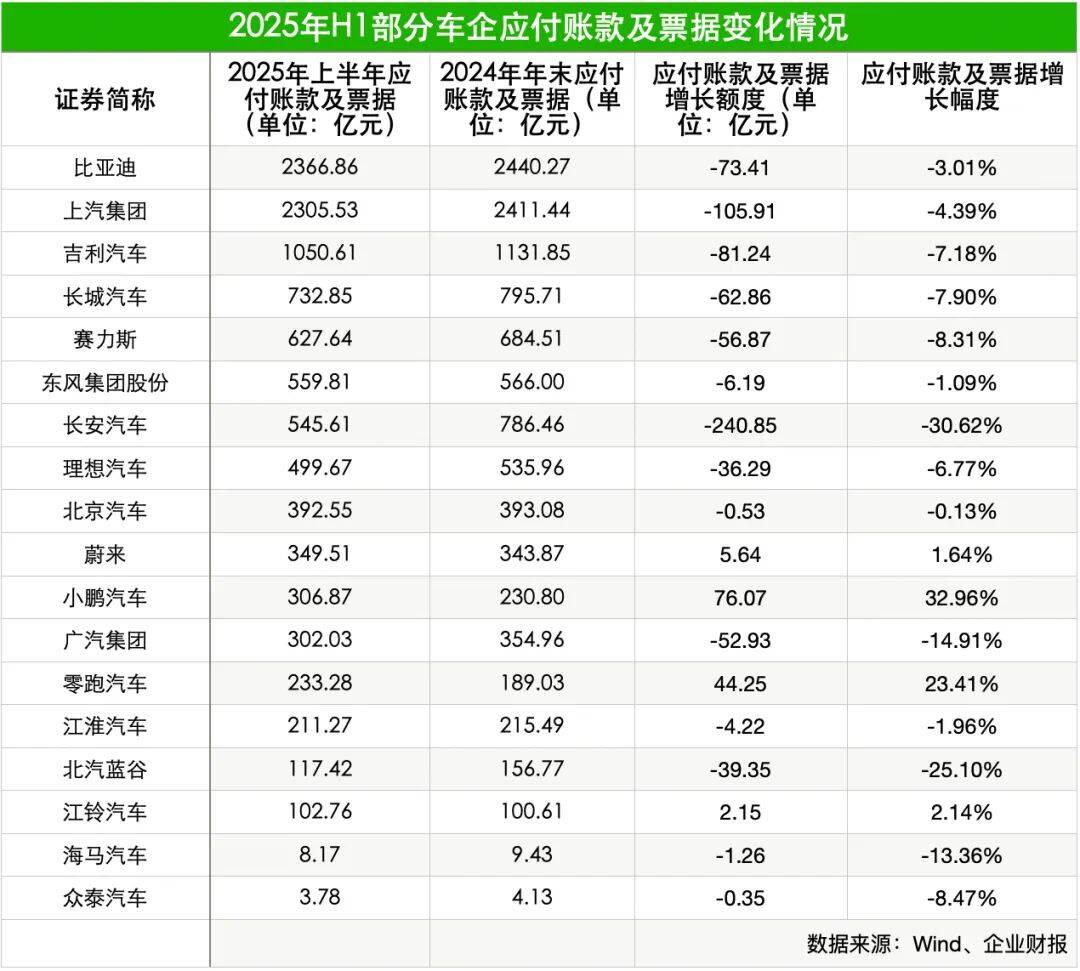
Core Viewpoint - The automotive industry is experiencing a trend of "anti-involution," with 17 companies committing to reduce supplier payment terms to within 60 days, aimed at alleviating financial pressure on parts manufacturers [1] Group 1: Financial Performance of Automotive Companies - As of the first half of the year, 18 listed automotive companies reported a total accounts payable and notes payable of 1,020.903 billion yuan, a decrease of 62.934 billion yuan compared to the end of last year [2] - The average turnover days for accounts payable increased to 192.46 days, up by 6.17 days from the end of last year, indicating a divergence between total reduction and extended payment terms [2] - BYD, SAIC Motor, and Geely Automobile had the highest accounts payable, with amounts reaching 236.686 billion yuan, 230.553 billion yuan, and 105.061 billion yuan respectively [3] Group 2: Changes in Accounts Payable - 14 automotive companies saw a reduction in accounts payable compared to the end of last year, with Changan Automobile, SAIC Motor, and Geely Automobile showing the largest decreases of 24.085 billion yuan, 10.591 billion yuan, and 8.124 billion yuan respectively [4] - Conversely, NIO, XPeng Motors, and Leap Motor reported increases in accounts payable, with XPeng Motors rising by 7.607 billion yuan, a 32.96% increase [7] Group 3: Turnover Days Analysis - Only 6 companies improved their accounts payable turnover days compared to the end of last year, with XPeng Motors achieving the most significant reduction of approximately 63 days, bringing it down to 170 days [9] - In contrast, companies like Seres and BYD experienced increases in turnover days, with Seres rising to 266.3 days, an increase of over 100 days [11] Group 4: Cash Flow and Payment Terms - The overall trend shows a reduction in accounts payable but an increase in turnover days, suggesting that companies are accelerating cash collection and proactively making payments [12] - Some companies, like Ideal Automotive, have adjusted their payment terms to comply with the 60-day requirement, with cash flow expected to improve in the fourth quarter [15][16] - However, challenges remain in managing cash flow and ensuring timely payments to suppliers, as highlighted by industry analysts [17][18] Group 5: Cash Reserves and Coverage of Payables - Among the 18 companies, only Jiangling Motors and Haima Automobile have cash reserves sufficient to cover their accounts payable [19] - Companies like BYD, Geely, and NIO have cash reserves that fall short of their accounts payable, indicating pressure on short-term liquidity [20]



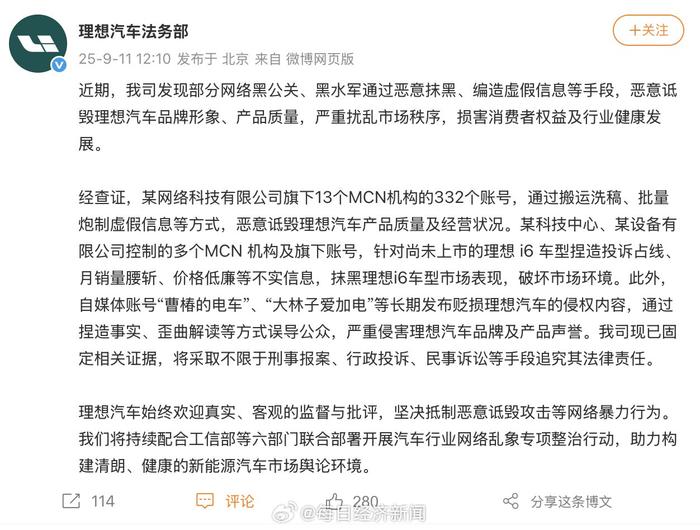
理想汽车法务部称332个账号恶意诋毁品牌
Mei Ri Jing Ji Xin Wen· 2025-09-11 11:14
#理想汽车法务部发声# 【#理想称被332个账号恶意诋毁# 】理想汽车法务部发文:经查证,某网络科技 有限公司旗下13个MCN机构的332个账号,通过搬运洗稿、批量炮制虚假信息等方式,恶意诋毁理想汽 车产品质量及经营状况。某科技中心、某设备有限公司控制的多个MCN机构及旗下账号,针对尚未上 市的理想i6车型捏造投诉占线、月销量腰斩、价格低廉等不实信息,抹黑理想i6车型市场表现,破坏市 场环境。此外,自媒体账号"曹椿的电车"、"大林子爱加电"等长期发布贬损理想汽车的侵权内容,通过 捏造事实、歪曲解读等方式误导公众,严重侵害理想汽车品牌及产品声誉。我司现已固定相关证据,将 采取不限于刑事报案、行政投诉、民事诉讼等手段追究其法律责任。(每日经济新闻,泽塔) ...
理想汽车CEO李想辟谣VLA残血版不实信息
Xin Lang Ke Ji· 2025-09-11 10:20
Core Viewpoint - The founder and CEO of Li Auto, Li Xiang, has publicly refuted claims circulating online regarding the "bloodied version" of the OTA 8.0 update for the Li VLA driver model, urging the public not to believe or spread misinformation [1] Group 1 - Li Auto's CEO addressed misinformation regarding the OTA 8.0 version of the Li VLA driver model [1] - The company emphasizes the importance of verifying information before sharing it [1]

VLA:有人喊“最强解法”,有人说“跑不动”
3 6 Ke· 2025-09-11 08:17
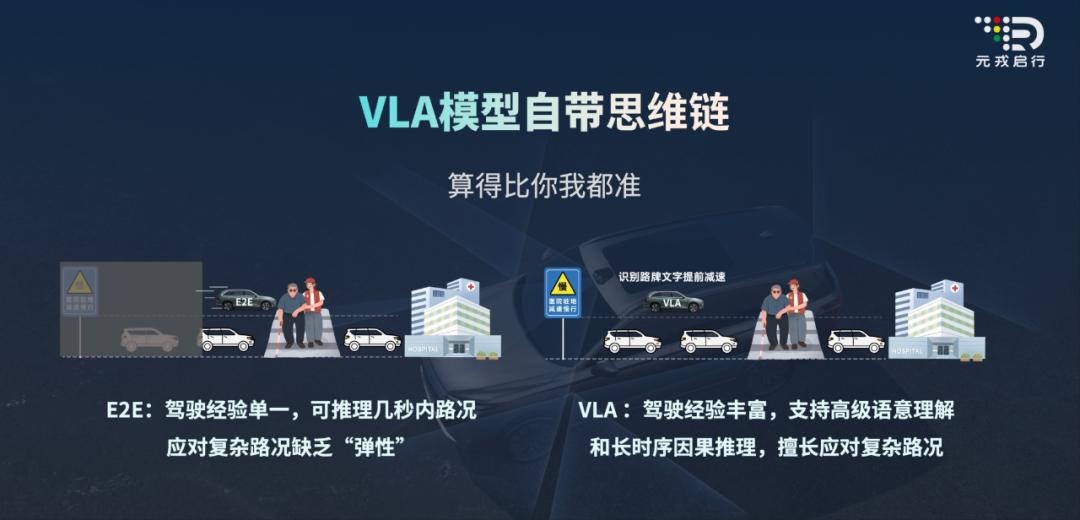
Core Viewpoint - The intelligent driving industry is at a critical juncture with the emergence of VLA (Vision-Language-Action) technology, leading to a division among key players regarding its potential and implementation [1][2][3]. Group 1: VLA Technology and Its Implications - VLA is seen as a potential solution to the limitations of end-to-end systems in intelligent driving, which can only address about 90% of the challenges [6][10]. - The introduction of language as a bridge in the VLA model aims to enhance the system's understanding and decision-making capabilities, allowing for more complex and nuanced driving actions [12][14][18]. - VLA is believed to improve three key areas: understanding dynamic traffic signals, enabling natural voice interactions, and enhancing risk prediction capabilities [19][20][21]. Group 2: Challenges and Criticisms of VLA - Despite the potential advantages, VLA faces significant challenges, including the need for substantial financial investment and the technical difficulties of aligning multimodal data [31][32]. - Critics argue that VLA may not be necessary for achieving higher levels of autonomous driving, with some suggesting it is more of a supplementary enhancement rather than a fundamental solution [35][36]. - The current limitations of existing intelligent driving chips hinder the effective deployment of VLA models, raising concerns about their practical application in real-world scenarios [31][32]. Group 3: Industry Perspectives and Strategies - Companies like Li Auto, Yuanrong, and Xiaopeng are betting on VLA, emphasizing high investment and computational intensity to pursue its development [41][42]. - In contrast, players like Huawei and Horizon are focusing on structural solutions and world models, arguing that these approaches may offer more reliable paths to achieving advanced autonomous driving [43][46]. - The ongoing debate over VLA reflects broader strategic choices within the industry, with companies prioritizing different technological pathways based on their resources and market positioning [47].