NAYUKI(02150)

Search documents
商业那点事儿|更换Logo后,奈雪被曝悄悄涨价;美团外卖推出“堂食店”标签功能
Bei Jing Shang Bao· 2025-05-19 23:48
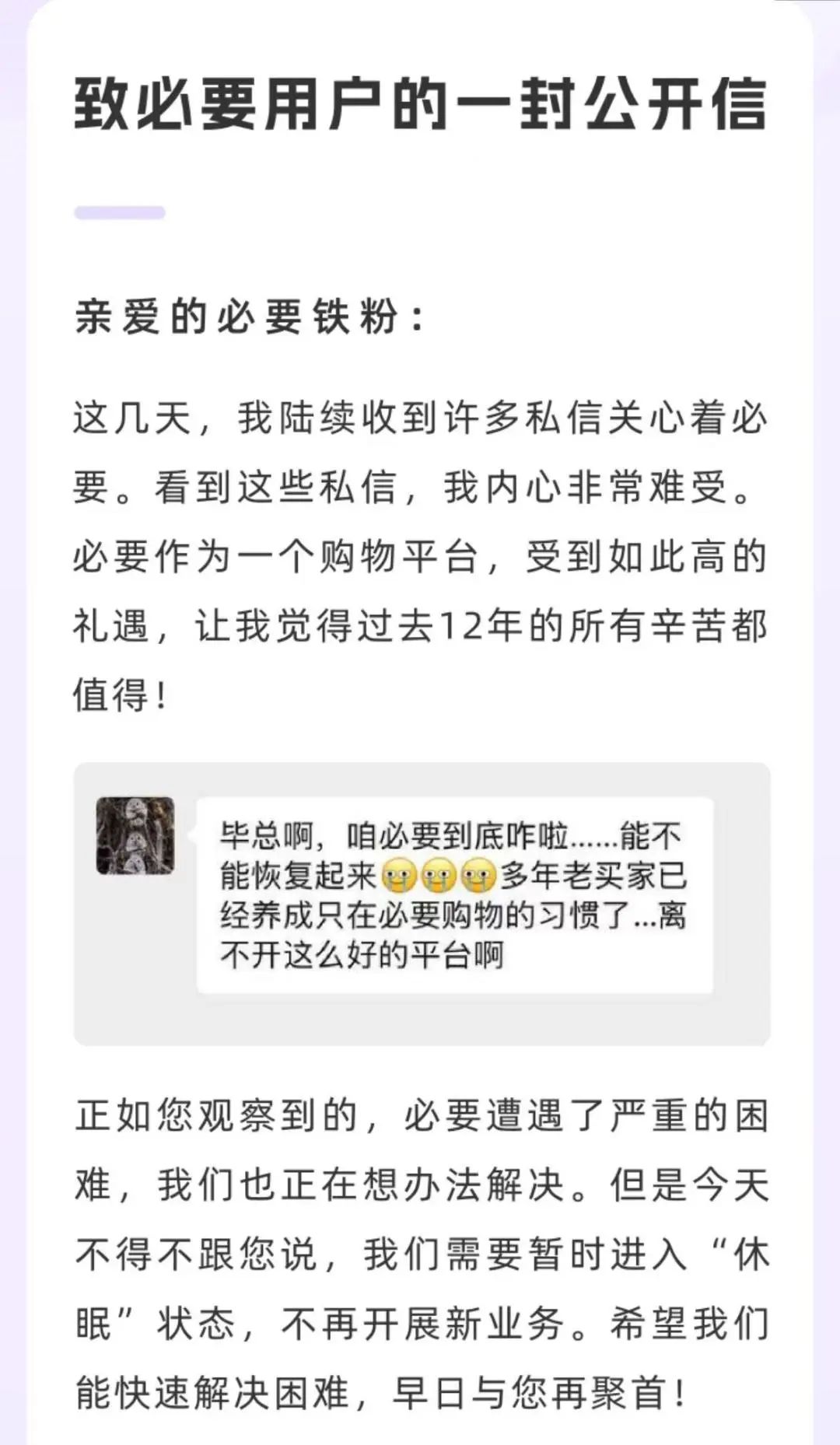
Group 1: Luxury Retail Expansion - Wangfu Central has expanded its high-end brand matrix by introducing the first Chinese flagship store of British jewelry brand GRAFF and LE LABO's fragrance laboratory in Beijing [1] - The dining sector has welcomed 17 new national or Beijing first stores, including certified Thai restaurant "CHINCHIN" and a Cantonese social dining space "DING+DIMBAR" [1] - Wangfu Central has launched cultural events such as intangible cultural heritage art exhibitions and coffee tastings, and upgraded its tax refund services for international travelers [1] Group 2: Gold Price Fluctuations - International gold prices have seen a significant decline from approximately $3430 per ounce to around $3240 per ounce, with a notable drop of $72 per ounce on May 14 [2] - Domestic gold prices have also decreased, with the price of gold from Chow Tai Fook falling to 986 yuan per gram, down 36 yuan from a week prior [2] - Shenzhen's water bay gold price dropped from 792 yuan per gram to 756 yuan per gram, reflecting a decline of over 4% due to international price changes [2] Group 3: Pricing Changes at Nai Xue - Nai Xue has increased prices for breakfast sets, requiring customers to pay for a membership card to access the original price of 9.9 yuan, with non-members facing a starting price of 15.9 yuan [3] - Several classic baked goods have been removed from the breakfast set, with new additions requiring an extra charge of 6 yuan [3] - The brand has recently changed its logo, removing "of tea" and introducing a new design that resembles both a snowflake and a fruit [3] Group 4: Necessary Mall Suspension - Necessary Mall has announced a temporary suspension of operations due to severe difficulties, with the app and mini-program still accessible but product links showing as "out of stock" [4][6] - Founded in July 2015, Necessary Mall was one of the early adopters of the C2M business model in China, initiated by CEO Bi Sheng [6] Group 5: Meituan's New Features - Meituan has upgraded its "Mingchu Plan" by introducing a "Dine-in Store" label to enhance transparency for restaurant merchants [8] - The label will be prominently displayed on the platform, helping merchants with physical stores gain more exposure [8] - Meituan has increased subsidies for small and medium-sized restaurants, with a total subsidy amounting to 50 million yuan for hardware and installation costs [8] Group 6: Dingdong Maicai's Financial Performance - Dingdong Maicai reported a revenue of 5.48 billion yuan for Q1 2025, marking a year-on-year growth of 9.1% and maintaining positive growth for five consecutive quarters [9] - The GMV reached 5.96 billion yuan, with a year-on-year increase of 7.9% [9] - Dingdong Maicai has achieved profitability under Non-GAAP standards for ten consecutive quarters and under GAAP standards for five consecutive quarters [9] Group 7: Cancellation of Meicheng Food Company - Meicheng Food Company has been deregistered, transitioning from active status to cancellation [11] - The company was involved in controversy over the authenticity of its mooncakes, leading to regulatory scrutiny and operational suspension [11]



港股概念追踪|新茶饮赛道上演资本市场“敲钟潮” 头部品牌发展势头强劲(附概念股)
智通财经网· 2025-05-19 06:43
Group 1 - The HuRun Research Institute released the "2025 HuRun China New Tea Beverage Brand TOP 20," featuring brands like Mixue Ice City, Gu Ming, and Heytea [1] - Chinese companies account for over half of the 47 food and beverage enterprises on the global unicorn and future unicorn list, with 26 brands, including new tea beverage brands [1] - The new tea beverage industry has deeply integrated into the Chinese tea industry chain, with the tea used by these brands accounting for nearly 10% of China's total tea production [1] Group 2 - The global ready-to-drink beverage market is expected to grow at a compound annual growth rate (CAGR) of 7.2% from 2023 to 2028, reaching a market size of $1,103.9 billion by 2028 [1] - China and Southeast Asia are projected to be the fastest-growing markets during 2023-2028, with respective CAGRs of 17.6% and 19.8%, contributing nearly 40% of the global market growth [1] - On May 8, Heytea successfully listed on the Hong Kong Stock Exchange, while Green Tea Group initiated its IPO on the same day, indicating a trend of mainland restaurant companies pursuing dual strategies of opening stores and listing in Hong Kong [1] Group 3 - Notable brands like Mixue Group, Haidilao, and Green Tea Group are among those aiming for IPOs in Hong Kong, leveraging the market for international experience and capital [2] - Mixue Ice City has established its leading position in the competitive ready-to-drink beverage market through supply chain scale effects and a strong brand image [2] Group 4 - Relevant companies in the tea beverage industry listed on the Hong Kong Stock Exchange include Mixue Group (02097), Cha Bai Dao (02555), Heytea (02589), Gu Ming (01364), Nai Xue's Tea (02150), and Green Tea Group (06831) [3]
亏掉9个亿后,奈雪的茶悄悄涨价
Hu Xiu· 2025-05-18 23:39
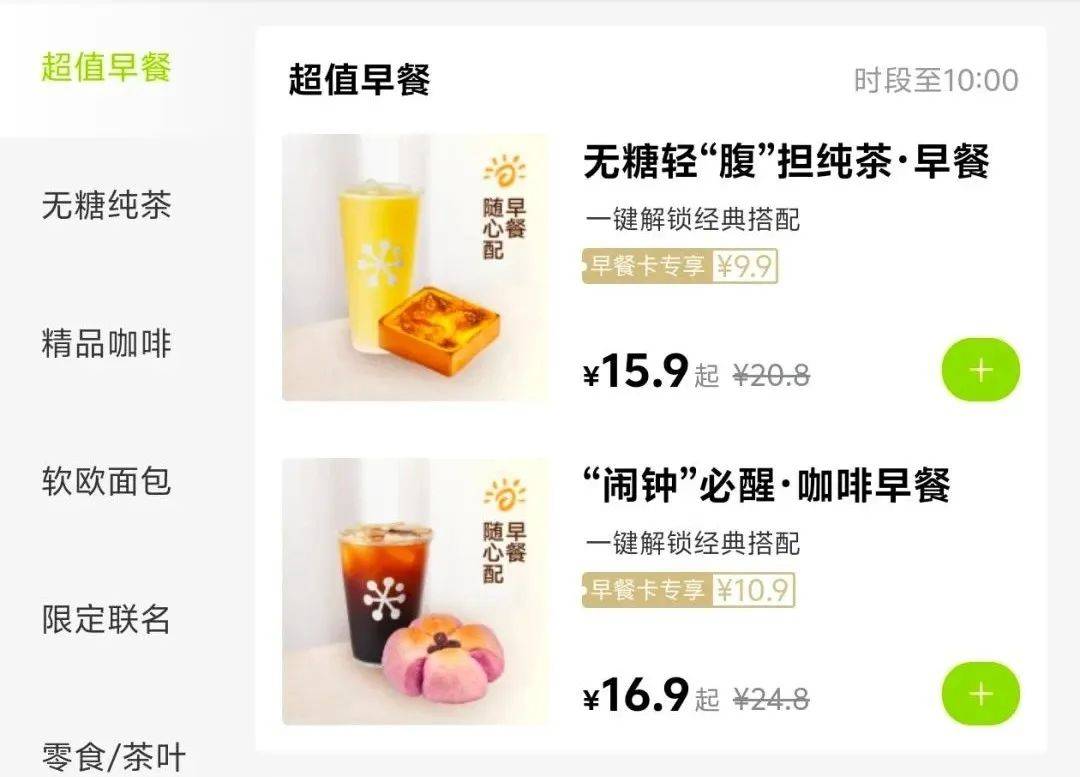
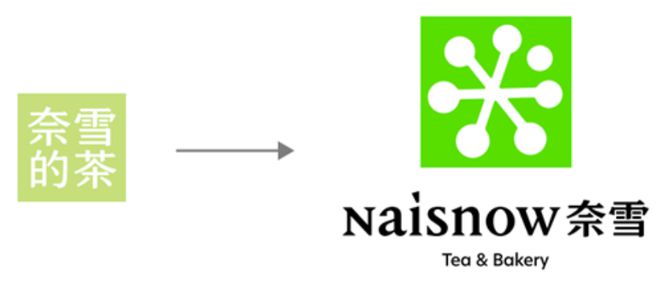
Core Viewpoint - Naixue's recent price increase on breakfast items, following a logo change, has led to consumer dissatisfaction and potential loss of loyal customers due to perceived value reduction and increased costs [1][3][12]. Group 1: Price Adjustments - Naixue has significantly altered its breakfast offerings in the Guangzhou and Shenzhen regions, requiring customers to purchase a membership card to access the previous 9.9 yuan breakfast package [2][3]. - Without the membership card, the breakfast package price has increased to a minimum of 15.9 yuan [4]. - The previous breakfast items, such as the purple sweet potato and taro double filling, have seen price increases from 9.9 yuan to 15.9 yuan, and other items have also increased in price [6][10]. Group 2: Consumer Reactions - Many consumers have expressed dissatisfaction on social media, feeling that the new pricing structure is a disguised price hike and creates barriers to purchase [12][13]. - Customers have noted that the membership card does not allow the use of stored value balances, leading to frustration and disappointment [14]. Group 3: Business Performance - Naixue's breakfast business saw a remarkable sales increase of 620% year-on-year in the first half of 2023, but overall revenue has been under pressure due to rising costs and market competition [20][21]. - The company reported a revenue of 4.92 billion yuan for 2024, a decline of 4.7% year-on-year, and a net loss of 920 million yuan, compared to a profit of 20.09 million yuan in 2023 [24][23]. Group 4: Strategic Changes - In response to financial pressures, Naixue plans to implement various strategies, including innovative brand marketing and the introduction of new store formats to enhance market share [27][29]. - The recent logo change aims to refresh the brand identity, with the new name "NaiSnow" reflecting a blend of nature, art, and imagination [28].
茶咖日报|淘宝闪购加码“奶茶免单”;星巴克或出售部分在华业务
Guan Cha Zhe Wang· 2025-05-16 12:06
Group 1: Company Updates - Nayuki Tea announced the appointment of Ms. Ong Mei Yi as the company secretary and authorized representative, effective from May 17, 2025, following the resignation of Ms. Shi Chao [1] - Starbucks is considering selling part of its business in China and has reached out to private equity and technology companies for potential investment, with the deal possibly valued at several billion dollars [2][3] - Grid Coffee has partnered with renowned coffee expert Esther Maasdam to launch limited-time tasting events featuring four premium coffee beans in Beijing and Chengdu [6] Group 2: Industry Developments - Starbucks reported over 7.4 billion USD in net revenue from its Chinese operations for the quarter ending March 31, while its competitor Luckin Coffee generated 12 billion USD in the same period [2] - The first Yunnan Gems of Coffee competition successfully concluded, with 19 coffee beans awarded from 144 participating teams, marking a significant step for Yunnan coffee in the international market [5] - The 2025 Kunshan International Coffee Industry Expo opened, attracting over 500 exhibitors and showcasing coffee beans from major producing countries, highlighting the growth of the coffee industry in Kunshan [7]

食饮吾见 | 一周消费大事件(5.11-5.16)
Cai Jing Wang· 2025-05-16 08:47
Group 1: Guizhou Moutai - Guizhou Moutai announced the adjustment of the venue for the 2024 annual shareholder meeting due to the number of registered attendees exceeding the original venue capacity [1] Group 2: Zhangyu A - Zhangyu A's management acknowledged shortcomings in positioning and marketing, which contributed to the decline in performance, and emphasized the need for improvement [2] - The company aims to achieve 1 billion revenue from overseas wineries despite current challenges [2] Group 3: Huiquan Beer - Huiquan Beer discussed avoiding competition with Yanjing Beer, highlighting the importance of base market effects and sales radius in the beer industry [3] - The company plans to strengthen its market presence in Fujian and Jiangxi while expanding its overall market reach [3] Group 4: Dairy Industry - "Raising a Cow" launched a new children's brand "Moo Star" with three A2 type pure milk products targeting children aged 1-12 [4] Group 5: Food and Beverage - Qiaqia Foods clarified that it has no plans for a liquor business and is set to launch a new ice cream product next month [5] - Wahaha confirmed the termination of its contract with a co-packer due to quality issues found in some batches of bottled water [6] Group 6: Zhongju High-tech - Zhongju High-tech reported an expected improvement in sales for Q2 compared to Q1, with a decrease in inventory levels and recovery in sales across regions [7][8] Group 7: Farmer Spring - Farmer Spring introduced a new product, Chenpi White Tea beverage, on its Tmall flagship store [9] Group 8: Golden Dragon Fish - Golden Dragon Fish stated that its health products generally have higher profit margins than regular grain and oil products, which is expected to contribute to sales growth and profit [10] Group 9: Sanquan Foods - Sanquan Foods announced plans to absorb and merge its subsidiary Zhengzhou Fast Kitchen to optimize resource allocation and improve operational efficiency [11] Group 10: Laiyifen - Laiyifen addressed consumer concerns regarding a product issue, stating that they have taken swift action to investigate and resolve the matter [12] Group 11: Liziyuan - Liziyuan plans to focus on milk powder and dairy product production and sales while extending into the upstream supply chain [13] Group 12: Huiyuan Juice - Huiyuan Juice refuted negative online claims about its business, asserting that its operations have been improving since its restructuring in 2022 [14] Group 13: Walmart - Walmart reported Q1 2026 total revenue of $165.6 billion, with a 2.5% year-on-year increase, and a significant growth in its China e-commerce business [17]




“娃哈哈纯净水由今麦郎代工”冲上热搜 代工模式在饮料行业常见吗?
Mei Ri Jing Ji Xin Wen· 2025-05-15 14:05
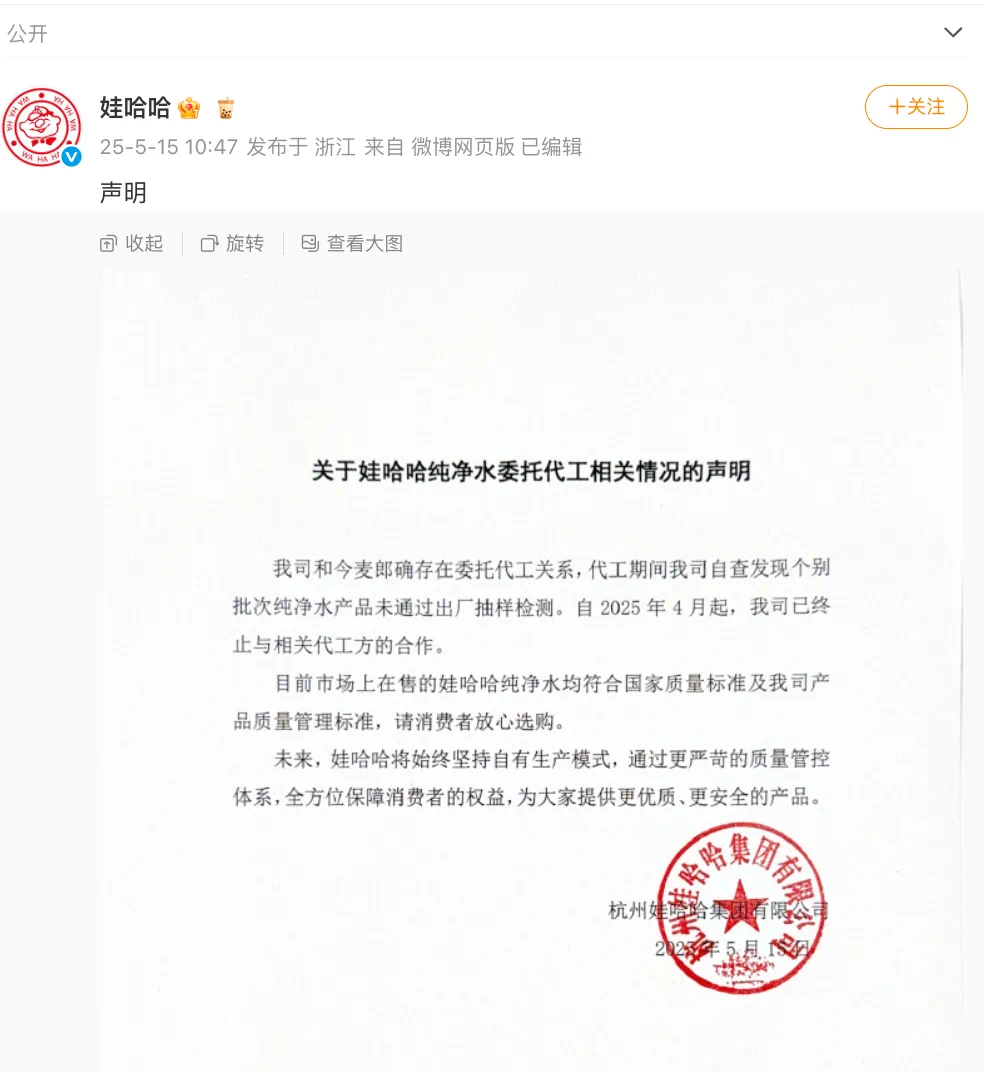
Core Viewpoint - The controversy surrounding Wahaha's bottled water being produced by Jinmailang highlights the common practice of contract manufacturing in the beverage industry, with Wahaha confirming its partnership with Jinmailang and announcing the termination of this relationship by April 2025 [1][4]. Group 1: Contract Manufacturing in the Beverage Industry - Contract manufacturing is a prevalent practice in the beverage and fast-moving consumer goods (FMCG) sectors, with many products in supermarkets being produced by third-party manufacturers [5]. - Companies like Wahaha resort to contract manufacturing when facing temporary capacity constraints, while others may use it to expand into new markets without the immediate need for their own production facilities [5][6]. - New and smaller brands often choose contract manufacturing to minimize costs and risks associated with entering the market, as establishing their own production facilities can be complex and costly [5][6]. Group 2: Major Players and Their Strategies - Major beverage companies, such as Coca-Cola and Pepsi, utilize contract manufacturing in China, partnering with local bottlers for production, which is part of their global strategy [6]. - The relationship between large companies and their contract manufacturers often evolves into a deep partnership, where manufacturers may exclusively produce for these brands [6][7]. Group 3: Advantages of In-House Production - While contract manufacturing is common, companies like Wahaha are investing in their own production facilities to ensure stable supply chains and maintain control over their products [7][8]. - Owning production facilities allows companies to protect proprietary recipes and reduce long-term costs compared to relying on contract manufacturers [7][8]. - The trend towards in-house production is evident in companies like Genki Forest, which has invested over 6 billion yuan in its own factories, moving away from contract manufacturing as their market stabilizes [7][8].




新标识被吐槽越改越丑!奈雪的茶能靠品牌升级拓宽海外市场?
Nan Fang Du Shi Bao· 2025-05-15 12:50
Core Viewpoint - The recent rebranding of the tea brand Naixue has sparked significant public debate, with the new logo featuring a combination of a snowflake-like graphic and the name "Naìsnow奈雪" [1][3][5] Group 1: Brand Change and Strategy - Naixue's rebranding coincides with its tenth anniversary and aims to focus on health, globalization, and image renewal [3][5] - The design agency UDL stated that the previous all-Chinese logo limited the brand's recognition in global markets, leading to the new bilingual logo [7][8] - The new logo incorporates elements of snow and fruit, reflecting the brand's core values of health and nature [5][8] Group 2: Market Reception and Feedback - Public reaction to the new logo has been mixed, with some users criticizing it as unattractive or lacking sophistication, while others acknowledge the challenges of logo design [5][8] - UDL's co-founder emphasized that the controversy indicates high public interest in the brand, suggesting that the new logo will gain acceptance over time [7][8] Group 3: Global Expansion and Performance - Naixue is actively pursuing a global strategy, with plans to open its first store in the United States and several locations in Southeast Asia [14] - Despite the expansion efforts, Naixue's financial performance has declined, with a reported revenue drop of 4.71% to 4.921 billion yuan in 2024 and a significant net loss [14][15]
奈雪官宣战略升级,北上广深同步开30家轻饮轻食店
Xin Jing Bao· 2025-05-13 14:20
Core Insights - Nai Xue's Tea is undergoing a comprehensive health transformation, marked by a new logo, product launches, and the opening of new store formats [1][2] - The new logo incorporates elements of "snowflakes" and "fruits," reflecting the brand's core values of nature, art, and imagination [1] - The company has opened 30 new "green" stores in major cities, emphasizing healthy drinks and light meals, with a focus on low-calorie and nutritious options [1][2] Product and Store Innovations - The introduction of the "Feather Light Apple Green Bottle" and various energy bowls highlights the company's commitment to health [1] - The "Energy Beef Kimchi Bowl" exemplifies the balanced and diverse food offerings, appealing to young consumers and fitness enthusiasts [1] - Nai Xue's health strategy includes innovations such as sugar-free fruit tea and participation in nutrition grading trials [2] Strategic Direction - The company is shifting its focus from traditional tea products to a health-oriented approach, aiming to enhance nutritional elements in its offerings [2] - Nai Xue's founder has emphasized the need for both subtraction and addition in health products, indicating a forward-looking strategy for 2025 [2]
新茶饮狂掀上市潮!“盛宴”还是“剩宴”?
Zhong Guo Ji Jin Bao· 2025-05-11 11:39
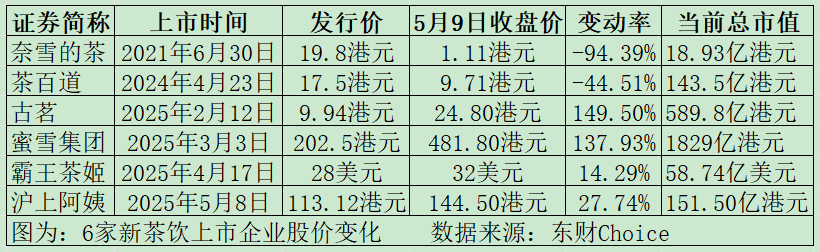
Core Insights - The new tea beverage industry is experiencing a significant wave of IPOs, with major companies like Gu Ming, Mixue Group, and others going public since February 2025, leading to notable stock price increases on their debut [1][4] - However, a clear differentiation in stock performance has emerged among these companies post-IPO, indicating a shift into a more competitive phase characterized by homogenization and excessive scaling [1][4][15] Group 1: IPO Performance - Gu Ming and Mixue Group saw stock price increases of 149.50% and 137.93% respectively since their IPOs, while other companies like Bawang Chaji and Hushang Ayi had more modest gains of 14.29% and 27.74% [2][4] - Naixue Tea and Chabaidao, which went public earlier, have faced significant declines in stock prices, with decreases of 94.39% and 44.51% respectively since their IPOs [10][14] Group 2: Market Dynamics - The new tea beverage industry is transitioning from a growth phase focused on market share acquisition to a more mature phase emphasizing differentiation and refined strategies [22][23] - The industry faces challenges such as product homogenization, oversupply of stores, and declining operational efficiency, which have led to a decrease in profitability for several companies [15][16] Group 3: Financial Performance - In 2024, Mixue Group, Bawang Chaji, and Gu Ming reported net profit growth rates of 39.8%, 213.3%, and 36.2% respectively, while Hushang Ayi and Chabaidao experienced declines of 15.2% and 58.55% [14] - Gu Ming's single-store GMV decreased by 4.3% year-on-year, and the average daily sales per store fell by 8.59%, indicating challenges in maintaining sales performance [16][17] Group 4: Strategic Responses - Companies are increasingly focusing on differentiation strategies, with Mixue Group leveraging its supply chain capabilities to gain competitive advantages [24][25] - The industry is also exploring international expansion, with several companies listing overseas to support their global business initiatives [28]
外卖三国杀,得咖啡奶茶者得天下?
创业邦· 2025-05-11 03:25
Core Viewpoint - The article discusses the resurgence of competition in the food delivery market, particularly focusing on the intense rivalry among major players like JD, Meituan, and Ele.me, which has led to significant subsidies and promotional activities in the coffee and tea sector [3][5][12]. Group 1: Market Dynamics - The food delivery market has reignited competition, with JD and Meituan engaging in disputes over issues like exclusive partnerships and rider benefits [3]. - Ele.me has launched a substantial subsidy program, "Er Bu Chao Bai Yi," to attract customers without engaging in public disputes [5]. - The introduction of "Taobao Flash Purchase" has linked consumers directly to Ele.me's delivery services, resulting in a surge in orders [5][12]. Group 2: Impact on Coffee and Tea Brands - The ongoing delivery war has significantly increased traffic for coffee and tea brands, with some brands experiencing order volume growth of over 300% during peak periods [7][12]. - Brands like Kudi Coffee and Nayuki have seen their order volumes multiply, indicating a strong consumer response to the promotional activities [7][12]. - The competitive pricing strategies have forced many coffee and tea brands to engage in price wars, with some prices dropping to as low as 5.9 yuan [14][15]. Group 3: Consumer Behavior and Brand Strategies - Consumers are actively participating in the promotional offers, with many taking advantage of low prices and discounts [11][19]. - The article highlights the shift in consumer preferences towards lower-priced options, with a significant increase in the proportion of purchases under 10 yuan [14]. - Brands are adapting their strategies, with some opting to withdraw from aggressive price competition while focusing on enhancing brand presence through delivery services [15][22]. Group 4: Sustainability of Subsidy Models - The sustainability of the current subsidy model is questioned, as it relies on balancing the interests of consumers, merchants, and delivery personnel [21][22]. - The article emphasizes that for the delivery model to be viable, all parties must benefit, otherwise, the cycle of subsidies may not last [22]. - Companies like Luckin Coffee have shown that avoiding price wars can lead to stable revenue growth, suggesting a potential shift in strategy for other brands [22].