MEITUAN(03690)

Search documents
北水成交净买入1.05亿 北水逢低抢筹科网股 抛售盈富基金超51亿港元
Zhi Tong Cai Jing· 2025-11-21 13:53
Group 1: Market Overview - On November 21, the Hong Kong stock market saw a net inflow of 105 million HKD from northbound trading, with a net buy of 498 million HKD from the Shanghai Stock Connect and a net sell of 393 million HKD from the Shenzhen Stock Connect [2] - The most bought stocks included Tencent (00700), Xiaomi Group-W (01810), and Alibaba-W (09988), while the most sold stocks were the Tracker Fund of Hong Kong (02800), Hua Hong Semiconductor (01347), and Ganfeng Lithium (01772) [2] Group 2: Stock Performance - Alibaba-W had a net inflow of 8.47 billion HKD, with a buy amount of 41.80 billion HKD and a sell amount of 33.33 billion HKD [3] - Xiaomi Group-W recorded a net inflow of 9.48 billion HKD, with a buy amount of 29.79 billion HKD and a sell amount of 20.31 billion HKD [3] - Tencent Holdings had a net inflow of 9.61 billion HKD, with a buy amount of 22.87 billion HKD and a sell amount of 13.25 billion HKD [3] Group 3: Sector Insights - Northbound funds are actively buying technology stocks, with Tencent, Alibaba, Kuaishou-W, and Meituan-W receiving significant net buys [6] - Xiaomi Group-W's strong third-quarter performance, with a revenue increase of 22.3% to 113.1 billion HKD and a net profit growth of 80.9% to 11.3 billion HKD, is driven by its high-end smartphone strategy and automotive business [6] - Semiconductor stocks like SMIC (00981) and Hua Hong Semiconductor (01347) faced net sells of 1.89 billion HKD and 3.37 billion HKD respectively, amid reports of potential delays in U.S. semiconductor import tariffs [7] Group 4: Commodity Market Impact - Ganfeng Lithium (01772) experienced a net sell of 1.9 billion HKD, influenced by recent adjustments in lithium carbonate futures trading fees and limits, leading to a drop in futures prices [7] - The overall sentiment in the lithium market is shifting as recent price movements are increasingly driven by market speculation rather than fundamental supply-demand dynamics [7] Group 5: ETF Performance - The Southern Hang Seng Technology ETF (03033) saw a net buy of 72.34 million HKD, while the Tracker Fund of Hong Kong (02800) faced a significant net sell of 5.142 billion HKD [8] - The divergence in ETF performance reflects broader market uncertainties, particularly regarding U.S. interest rate policies and inflation concerns [8]




智通港股通活跃成交|11月21日
智通财经网· 2025-11-21 11:19
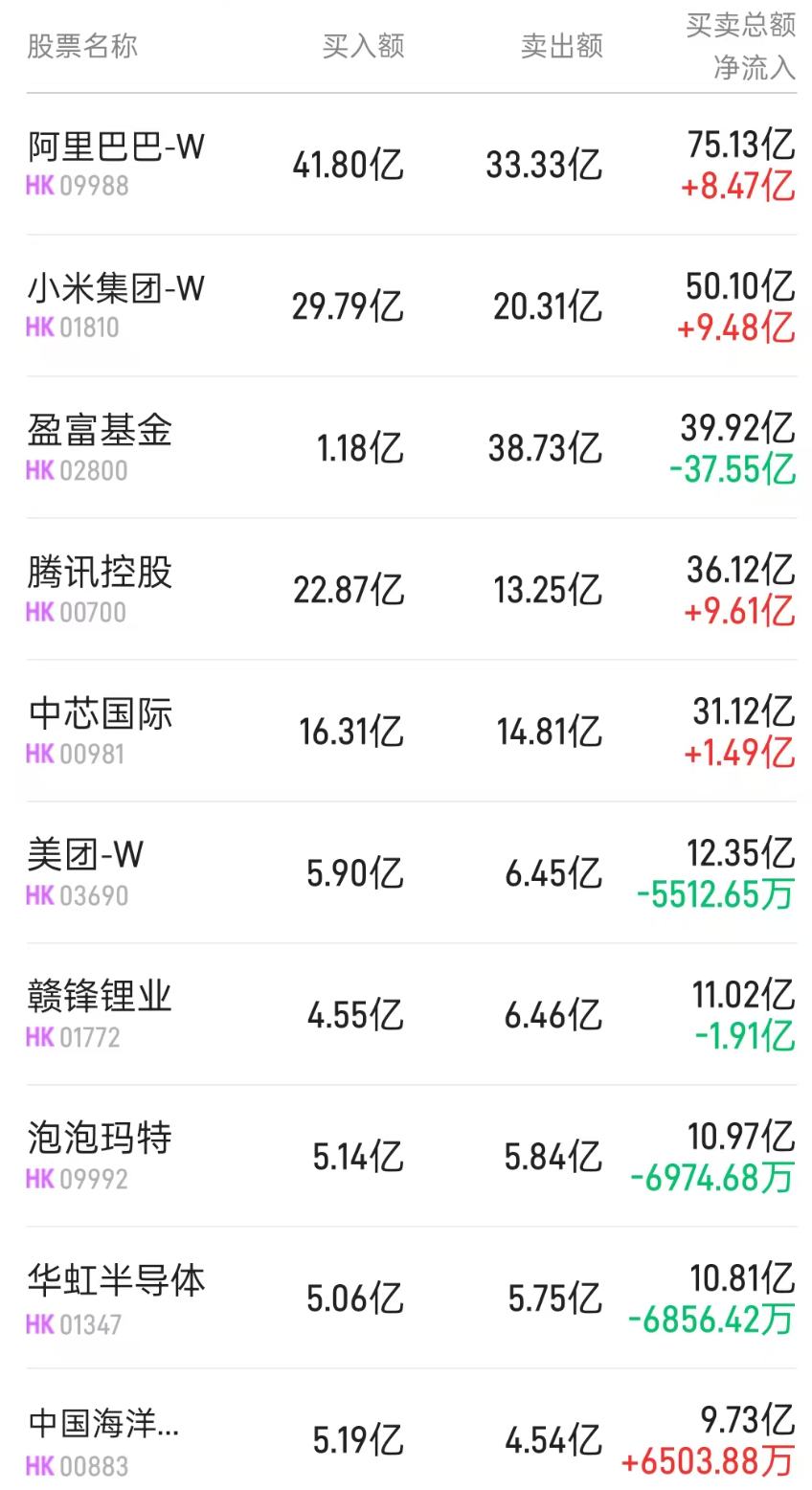
Core Insights - On November 21, 2025, Alibaba-W (09988), Xiaomi Group-W (01810), and Yingfu Fund (02800) were the top three stocks by trading volume in the Southbound Stock Connect, with trading amounts of 75.13 billion, 50.10 billion, and 39.92 billion respectively [1] - In the Shenzhen-Hong Kong Stock Connect, Alibaba-W (09988), Xiaomi Group-W (01810), and Tencent Holdings (00700) also ranked as the top three, with trading amounts of 59.52 billion, 26.55 billion, and 24.41 billion respectively [1] Southbound Stock Connect - Top Active Companies - Alibaba-W (09988) had a trading amount of 75.13 billion with a net buying amount of +8.47 billion [1] - Xiaomi Group-W (01810) recorded a trading amount of 50.10 billion with a net buying amount of +9.48 billion [1] - Yingfu Fund (02800) had a trading amount of 39.92 billion but a net selling amount of -37.55 billion [1] - Tencent Holdings (00700) saw a trading amount of 36.12 billion with a net buying amount of +9.61 billion [1] - SMIC (00981) had a trading amount of 31.12 billion with a net buying amount of +1.49 billion [1] - Meituan-W (03690) recorded a trading amount of 12.35 billion with a net selling amount of -55.12 million [1] - Ganfeng Lithium (01772) had a trading amount of 11.02 billion with a net selling amount of -1.91 billion [1] - Pop Mart (09992) recorded a trading amount of 10.97 billion with a net selling amount of -6.97 million [1] - Hua Hong Semiconductor (01347) had a trading amount of 10.81 billion with a net selling amount of -6.86 million [1] - China National Offshore Oil Corporation (00883) recorded a trading amount of 9.73 billion with a net buying amount of +650.39 million [1] Shenzhen-Hong Kong Stock Connect - Top Active Companies - Alibaba-W (09988) had a trading amount of 59.52 billion with a net buying amount of +3.10 billion [1] - Xiaomi Group-W (01810) recorded a trading amount of 26.55 billion with a net buying amount of +3.20 billion [1] - Tencent Holdings (00700) saw a trading amount of 24.41 billion with a net buying amount of +7.75 billion [1] - SMIC (00981) had a trading amount of 24.07 billion with a net selling amount of -3.39 billion [1] - Southern Hang Seng Technology (03033) recorded a trading amount of 14.79 billion with a net buying amount of +723.43 million [1] - Yingfu Fund (02800) had a trading amount of 14.01 billion with a net selling amount of -13.88 billion [1] - Meituan-W (03690) recorded a trading amount of 10.17 billion with a net buying amount of +2.01 billion [1] - Hua Hong Semiconductor (01347) had a trading amount of 8.68 billion with a net selling amount of -2.69 billion [1] - XPeng Motors-W (09868) recorded a trading amount of 7.82 billion with a net buying amount of +1.34 billion [1] - Kuaishou-W (01024) had a trading amount of 6.63 billion with a net buying amount of +2.36 billion [1]


北水动向|北水成交净买入1.05亿 北水逢低抢筹科网股 抛售盈富基金(02800)超51亿港元
智通财经网· 2025-11-21 10:19
Group 1: Market Overview - Northbound capital recorded a net buy of 105 million HKD on November 21, with the Shanghai-Hong Kong Stock Connect contributing a net buy of 498 million HKD and the Shenzhen-Hong Kong Stock Connect showing a net sell of 393 million HKD [1] - The most bought stocks included Tencent (00700), Xiaomi Group-W (01810), and Alibaba-W (09988), while the most sold stocks were the Tracker Fund of Hong Kong (02800), Hua Hong Semiconductor (01347), and Ganfeng Lithium (01772) [1] Group 2: Stock Performance - Alibaba-W had a buy amount of 4.18 billion HKD and a sell amount of 3.33 billion HKD, resulting in a net inflow of 847 million HKD [2] - Xiaomi Group-W saw a buy amount of 2.979 billion HKD and a sell amount of 2.031 billion HKD, leading to a net inflow of 948 million HKD [2] - Tencent Holdings had a buy amount of 2.287 billion HKD and a sell amount of 1.325 billion HKD, resulting in a net inflow of 961 million HKD [2] Group 3: Company-Specific Insights - Xiaomi Group-W reported a strong Q3 performance with a revenue increase of 22.3% year-on-year to 113.1 billion HKD and an adjusted net profit of 11.3 billion HKD, up 80.9% year-on-year, driven by its high-end smartphone strategy and automotive business [5] - Xpeng Motors-W (09868) received a net buy of 134 million HKD, with expectations for better seasonal performance in Q1 next year due to the launch of three new range-extended electric vehicle models [5] - Ganfeng Lithium (01772) faced a net sell of 190 million HKD, influenced by recent adjustments in lithium carbonate futures trading fees and limits, leading to a price drop [6]

图解丨南下资金净买入腾讯、小米和阿里
Ge Long Hui A P P· 2025-11-21 09:59
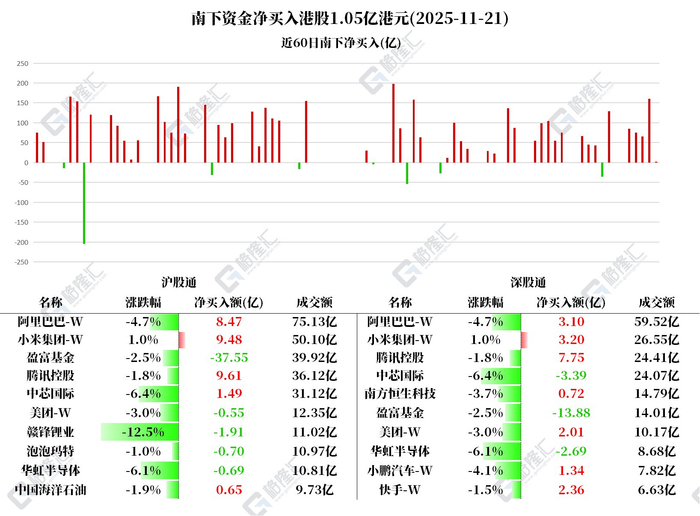
Group 1 - Hong Kong stocks experienced a significant decline, with southbound funds net buying HKD 105 million in Hong Kong stocks [1] - Notable net purchases included Tencent Holdings at HKD 1.736 billion, Xiaomi Group at HKD 1.268 billion, and Alibaba at HKD 1.158 billion [1] - Southbound funds have continuously net bought Alibaba for 7 days, totaling HKD 13.321 billion, and have net bought Xpeng Motors for 4 days, totaling HKD 1.87077 billion [1] Group 2 - Major net sales included the Tracker Fund of Hong Kong at HKD 5.143 billion and Hua Hong Semiconductor at HKD 337 million [1] - Semiconductor companies like Ganfeng Lithium and SMIC also saw net sales of HKD 190 million and HKD 189 million respectively [1] - The overall market sentiment reflected a downward trend, with several companies experiencing declines in stock prices, including SMIC down by 6.4% and Ganfeng Lithium down by 12.5% [3]

大众点评出海记:从迪拜街头到八年千城 “全球黄页”怎么做?
2 1 Shi Ji Jing Ji Bao Dao· 2025-11-21 06:48
Core Insights - Dazhong Dianping is expanding its international presence, particularly targeting Chinese tourists and overseas Chinese communities, with ambitions to become a global platform for local lifestyle needs [1][4][9] - The company has established a foreign team and is focusing on building foundational capabilities rather than immediate commercialization [2][3] - Dazhong Dianping has launched operations in over 1,000 cities across more than 200 countries, emphasizing cities with high Chinese tourist traffic [4][6] Group 1: International Expansion Strategy - Dazhong Dianping's international expansion began in Southeast Asia in 2017 and is accelerating in 2025, with a focus on key cities [2][3] - The company aims to create a "global yellow pages" product that meets local lifestyle needs, moving beyond just serving Chinese tourists [9][10] - The establishment of a local team, comprising both Chinese and local personnel, is crucial for penetrating local markets [6][7] Group 2: Market Penetration Challenges - The acceptance of Dazhong Dianping's business model by local restaurant owners in overseas markets is challenging [2][5] - The company is leveraging local agents and teams to build merchant relationships and gather essential local information [6][8] - High-end restaurants in markets like Singapore show reluctance to adopt new promotional tools, preferring traditional advertising methods [7][8] Group 3: Competitive Landscape - Dazhong Dianping faces competition from platforms like Xiaohongshu, which are also trying to integrate the entire customer journey from discovery to booking [9][10] - Google Maps remains a significant competitor in providing location-based services and user reviews, posing a challenge for Dazhong Dianping to attract non-Chinese users [10] - The success of Dazhong Dianping's international strategy will depend on its ability to localize effectively and potentially develop a new app tailored for foreign markets [10]

冷空气带动餐饮“预订热” 上千万00后上美团预订定制化体验
2 1 Shi Ji Jing Ji Bao Dao· 2025-11-21 04:07
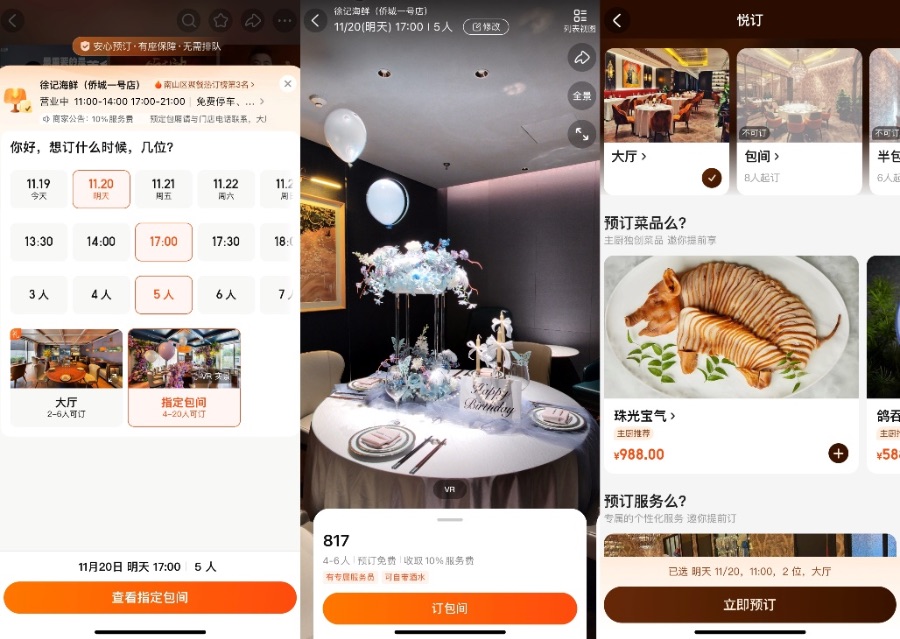
Core Insights - The winter dining reservation trend is surging, with Meituan reporting a 30% year-on-year increase in average daily online reservations, which is 1.1 times that of spring 2023 [1] - Over 10,000 leading brand stores have partnered with Meituan to offer unique scene reservation services, enhancing dining experiences and catering to diverse consumer needs [1] - The shift from simply reserving seats to booking customized experiences is particularly popular among younger consumers, with over 20 million post-2000s users making reservations on Meituan this winter [1] Group 1 - The introduction of VR reservation services has significantly improved the dining experience, allowing restaurants to showcase their spaces more vividly, thus lowering the decision-making barrier for customers [3] - Restaurants offering unique scene reservation services on Meituan have seen a booking conversion rate that is 5 to 8 percentage points higher than the average [3] - The daily average order volume for private rooms at Xu Ji Seafood increased by 38% during the trial period of VR reservations, indicating a strong consumer interest in this service [3] Group 2 - Xu Ji Seafood has successfully leveraged birthday-themed banquets as a core attraction, with orders for their bundled "birthday theme banquet + decoration service" increasing by over 145% week-on-week [4] - Meituan has launched various service products, including VR reservations and smart ordering, aimed at enhancing the overall dining experience for consumers and improving service efficiency for businesses [4] - The future focus will be on upgrading products based on the entire dining journey of consumers and the service flow of merchants, ensuring a broader reach for innovative offerings [4]
恒生科技指数ETF、恒生互联网ETF连续16日获资金净申购
Sou Hu Cai Jing· 2025-11-21 02:53
Group 1 - The Hong Kong stock market opened lower today, with the Hang Seng Technology Index dropping by 2.21% and the Hang Seng Internet ETF and Hang Seng Technology Index ETF falling by 2% and 1.6% respectively, influenced by unexpected strong U.S. non-farm payroll data and a decline in U.S. stocks [1] - Despite the market downturn, there has been a significant net inflow into the Hang Seng Technology Index ETF, totaling 4.472 billion yuan over 16 trading days from October 30 to November 20, even as the index fell by 10.11% during this period [1] - The Hang Seng Internet ETF also saw a net inflow of 2.518 billion yuan over the same 16 days, with a decline of 10.24% [1] Group 2 - The recent adjustment in the Hong Kong stock market is attributed to factors such as the "AI bubble theory," tightening liquidity in the U.S. market, and profit-taking by institutions after a more than 20% increase in the Hang Seng Technology Index this year [1][2] - The Hang Seng Technology Index has experienced a cumulative decline of over 18% since October 3, indicating a potential buying opportunity [2] - Positive developments include strong Q3 financial results and Q4 guidance from Nvidia, which may help alleviate concerns regarding the "AI bubble," alongside Alibaba's upcoming earnings report on November 25 [2] Group 3 - The Federal Reserve's decision to pause balance sheet reduction on December 1, coupled with rising unemployment rates over the past three months, suggests a cautious approach to monetary policy [3] - The Hang Seng Technology Index ETF has a current scale of 46.49 billion yuan, including major Chinese tech companies such as SMIC, Alibaba, Tencent, Baidu, Xiaomi, and Lenovo [4] - The Hang Seng Internet ETF, with a scale of 34.284 billion yuan, has over 80% weight in leading internet stocks, with an AI content exceeding 90% [4]

港股开盘再度走低,资金近期密集流入港股科技ETF
Xin Lang Cai Jing· 2025-11-21 02:27
Group 1 - Recent focus on the unlocking of restricted shares in the Hong Kong stock market, with significant declines observed in stock prices, such as a drop of 8.75% for CATL's H-shares [1] - Upcoming unlocks for companies including Sanhua Intelligent Control and Hengrui Medicine, with Hai Tian Flavor Industry scheduled for December, potentially exerting pressure on stock prices [1] - The Hang Seng Technology Index has experienced a correction of over 18% since its peak after the National Day holiday, indicating a broader market trend [1] Group 2 - Continuous inflow of funds into the Hang Seng Technology/ Hong Kong Technology/ Hong Kong Stock Connect Internet sectors, with the Hong Kong Technology ETF (159751) seeing a net inflow of 50.63 million yuan over four days [1] - The average daily net inflow for the Hong Kong Technology ETF reached 12.66 million yuan, highlighting investor interest [1] - Institutional investors are expected to have reduced pressure for profit-taking in November and December, leading to a neutral upward expectation for the index despite economic meeting forecasts [1] Group 3 - The CSI Hong Kong Stock Connect Technology Index (931573) includes top-weighted stocks such as Alibaba, Tencent, and SMIC, with the top ten stocks accounting for 66.81% of the index [2]
越跌越买!规模最大的恒生科技指数ETF、恒生互联网ETF连续16日获资金净申购
Ge Long Hui· 2025-11-21 01:56
Group 1 - The Hong Kong stock market opened lower today, with the Hang Seng Technology Index dropping by 2.21%, and the Hang Seng Internet ETF and Hang Seng Technology Index ETF falling by 2% and 1.6% respectively [1] - Despite the declines, there has been a net inflow of funds into the Hang Seng Technology Index ETF totaling 4.472 billion yuan over 16 trading days from October 30 to November 20, during which the index fell by 10.11% [1] - The Hang Seng Internet ETF also saw a net inflow of 2.518 billion yuan over the same period, despite a 10.24% decline [1] Group 2 - Recent adjustments in the Hong Kong stock market are attributed to factors such as the "AI bubble theory," tightening liquidity in the US market, and profit-taking by institutions after a more than 20% increase in the Hang Seng Technology Index this year [1] - The Hang Seng Technology Index has experienced a cumulative decline of over 18% since October 3, which may present a buying opportunity [1] - Positive factors include strong Q3 financial results and Q4 guidance from Nvidia, which may help alleviate concerns regarding the "AI bubble," along with Alibaba's upcoming financial report on November 25 [1] Group 3 - The Hang Seng Internet ETF has a weight of over 80% in leading internet stocks, with an AI content exceeding 90%, including major companies like Alibaba, Tencent, NetEase, JD.com, and Baidu [2]

在迪拜送外卖:没有“电驴”、运力不稳,配送费约3.9元到5.8元
第一财经· 2025-11-21 00:11
Core Viewpoint - The article discusses the evolving food delivery market in Dubai, highlighting the challenges and opportunities for foreign platforms like Meituan's Keeta in a culturally distinct environment [3][14]. Group 1: Market Overview - Dubai's food delivery market is still developing, with various platforms competing for market share, but it has not yet achieved "delivery freedom" [4][12]. - The online food delivery market in the UAE is projected to reach $1.87 billion by 2025 and $2.46 billion by 2030, with a user penetration rate of 31.4% by 2025 [12]. Group 2: Local Challenges - The delivery model in Dubai differs from China, with many riders being non-locals from South Asia, leading to a "one order one delivery" approach that affects efficiency [5][6]. - High living costs in Dubai result in higher food delivery prices, making it less common for residents to order food frequently [6][7]. Group 3: Platform Dynamics - Keeta, a platform under Meituan, is attempting to penetrate the market with a no-commission model, contrasting with other platforms that charge commissions of 17% to over 30% [10][14]. - The user experience on Keeta is enhanced by features like real-time rider tracking and timely delivery, which are seen as competitive advantages [15][20]. Group 4: Competitive Landscape - Talabat and COME COME are notable local competitors, with Talabat having over 6 million active users and 119,000 active riders, while COME COME focuses on Chinese cuisine [13][14]. - Keeta has rapidly expanded in the Middle East, entering Dubai and Abu Dhabi after establishing a presence in Saudi Arabia [13][20]. Group 5: Strategic Insights - Chinese platforms like Keeta leverage their domestic experience to navigate the unique cultural and regulatory landscape of the Middle East, focusing on product variety, reliable delivery, and competitive pricing [20][21]. - The article emphasizes the importance of adapting strategies based on local market research and conditions to succeed in the diverse Middle Eastern market [21].