
MEITUAN(03690)

Search documents
传媒2025Q4基金持仓分析:重仓股配置力度环比下降,个股配置分化
Zhongyuan Securities· 2026-01-27 09:11
Investment Rating - The report maintains an "Outperform" rating for the media industry, indicating an expected increase of over 10% relative to the CSI 300 index in the next six months [1][37]. Core Insights - The report highlights a decrease in the allocation of public funds to media sector heavyweights, with a total market value of 40.569 billion yuan at the end of Q4 2025, down 31.70% from Q3 2025 [6][10]. - The gaming sector continues to see increased allocation, with a market value of 30.206 billion yuan, representing 74.46% of the total media sector allocation, marking a 1.14 percentage point increase [11][15]. - The report notes a concentration of investment in top gaming companies, with eight out of the top ten heavyweights being gaming firms, reflecting a high level of institutional interest [20][21]. Summary by Sections Heavyweight Stock Allocation - The allocation of public funds to media heavyweights has decreased, with a total market value of 40.569 billion yuan, down 188.25 billion yuan from Q3 2025, resulting in a 31.70% decline [6][10]. - The allocation ratio for the media sector is approximately 1.22%, down 0.56 percentage points from the previous quarter [10][11]. Gaming Sector Performance - The gaming sector's market value is 30.206 billion yuan, accounting for 74.46% of the total media allocation, with a 40.09% over-allocation ratio, the highest recorded [11][15]. - The top three heavyweights in the media sector are gaming, advertising, and film exhibition, with the gaming sector showing the most significant over-allocation [11][15]. Individual Company Focus - The top ten heavyweights in the media sector include major gaming companies such as Giant Network, Century Huatong, and Kaineng Network, with a notable shift in rankings from Q3 2025 [20][23]. - The report indicates a divergence in individual stock allocations, with some previously high-performing companies seeing reduced allocations, possibly due to profit-taking [35][36]. Investment Recommendations - The report suggests focusing on high-growth segments such as AI applications and gaming, which are expected to benefit from favorable policies and upcoming product launches in 2026 [35][36]. - Recommended companies for investment include 37 Interactive Entertainment, Perfect World, Kaineng Network, and others [35][36].






短剧赛道成关键“抓手”,视频及电商平台纷纷入局
Xin Lang Cai Jing· 2026-01-27 08:31
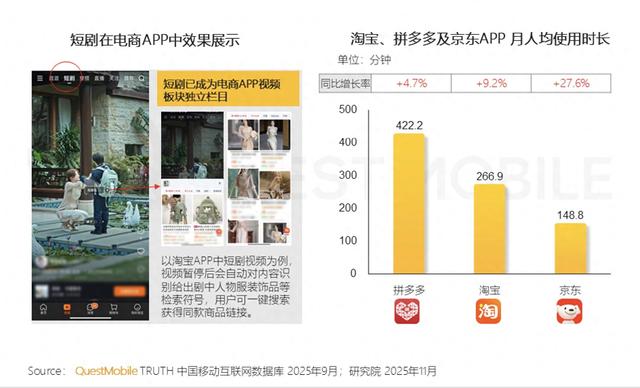
Group 1 - The internet industry is increasingly focusing on short dramas, with Tencent's chairman Ma Huateng emphasizing their importance at the annual meeting, stating that while there may not be many hits by 2025, patience is needed for growth [1] - Ma Huateng has reiterated the significance of short dramas for the second consecutive year, acknowledging their substantial impact on long-form content and committing to a high-quality short drama strategy [1] - The rise of short dramas is reshaping the video industry landscape, with Hongguo's free short dramas reaching 236 million monthly active users by September 2025, surpassing Bilibili and significantly leading Youku [1] Group 2 - Various platforms beyond video services, including e-commerce and payment applications, are adopting short drama content to enhance user engagement and retention [2] - As a result of this strategy, by September 2025, the average monthly usage time for Pinduoduo, Taobao, and JD apps reached 422.2 minutes, 266.9 minutes, and 148.8 minutes respectively, showing year-on-year growth of 4.7%, 9.2%, and 27.6% [2] Group 3 - The integration of e-commerce and short dramas is deepening, with platforms like Hongguo testing features that direct traffic to Douyin e-commerce and establishing dedicated short drama sections within their apps [4] - The user base for micro short dramas in China has reached 662 million, with a market size exceeding 50 billion yuan, surpassing box office revenues and emerging as a new content consumption sector [4]





美团-W(03690.HK):4Q外卖补贴趋于理性 关注高客单竞争
Ge Long Hui· 2026-01-27 06:40
Core Viewpoint - The company is expected to report an adjusted net loss of 13.2 billion yuan in Q4 2025, with a revenue growth of 4% year-on-year to 91.9 billion yuan, resulting in an adjusted net loss margin of 14% [1] Group 1: Q4 2025 Performance Expectations - The company anticipates a core local business operating loss of 11.5 billion yuan, with an operating profit margin (OPM) of -17.8%, aligning with previous expectations [1] - In the food delivery segment, competition intensity has decreased during the off-season, with expected order volume growth slowing to 13% year-on-year; despite a reduction in average user expenditure loss compared to Q3 2025, it is still projected to exceed 2 yuan [1] - The flash purchase segment is expected to see a strong year-on-year order volume growth of 30%, with average losses per order less than 1 yuan, resulting in an OPM of -19.5% [1] - The in-store travel and accommodation segment is projected to maintain stable growth in gross transaction value (GTV) and revenue, but OPM is expected to decline to 25.6% due to competition from Douyin [1] Group 2: Competitive Landscape and Future Outlook - Entering 2026, competition uncertainty remains, particularly in the food delivery sector, where focus is shifting towards high-ticket markets and non-food retail; the company aims to strengthen consumer recognition of its user experience advantages [2] - Regulatory interventions against unfair competition are expected to curb irrational competitive behaviors in the industry, with a need to monitor the pace and specifics of these regulations [2] - Competitors are enhancing their agent capabilities and integrating into various life scenarios, with AI potentially becoming a variable affecting competition [2] - In the in-store travel and accommodation sector, competition is currently more rational compared to 2023, but attention is needed on Douyin's potential expansion into more verticals and Alibaba's increased investment in the in-store domain [2] Group 3: Profit Forecast and Valuation - The company maintains its adjusted net profit forecast for 2025 at -16.8 billion yuan, while lowering the 2026 forecast from 19.6 billion yuan to -9.7 billion yuan, and reducing the 2027 forecast by 34% to 29.9 billion yuan [2] - The company is rated to outperform the industry, with a target price of 125 HKD, corresponding to a 23x adjusted P/E for 2027E and a 28% upside potential; the current price corresponds to an 18x adjusted P/E for 2027E [2]
美团旅行:“反向过年”机票预订同比增长84%
Bei Ke Cai Jing· 2026-01-27 06:15
Group 1 - The core viewpoint of the articles highlights a significant increase in travel bookings for the 2026 Spring Festival, particularly for "reverse New Year" trips, with flight bookings up by 84% year-on-year during early February to mid-February [1] - The top ten popular destinations for "reverse New Year" flights include major cities such as Beijing, Shanghai, and Chengdu, as well as smaller destinations, benefiting from lower ticket prices and less congestion [1] - The data indicates a notable rise in travel to specific locations, such as a 166% increase in flight bookings to Jieyang, driven by cultural events, and a 517% increase in tourism interest in the area [1] Group 2 - The Spring Festival travel period is officially set from February 2 to March 13, 2026, lasting for 40 days, with peak travel days identified [2] - The top ten destinations for train travel include cities like Qingdao and Chongqing, while for air travel, the top destinations mirror those for "reverse New Year" trips, emphasizing the popularity of major urban centers [2]
美团旅行:“反向过年”机票预订增84%
Xin Lang Cai Jing· 2026-01-27 04:21
格隆汇1月27日|美团旅行数据显示,2026年春运期间,"反向过年"的车票预订量增长明显。2月初至2 月中下旬,"反向过年"的机票预订量同比去年增长84%。春节假期的火车票虽未开售,预约单量也增长 过半。从机票的预订情况看,"反向过年"Top10热门目的地为北京、上海、成都、重庆、广州、深圳、 昆明、西安、杭州、天津。 ...
20家互联网公司2025年Q3广告营收:效率、生态与技术,正在重写平台增长逻辑
3 6 Ke· 2026-01-27 02:47
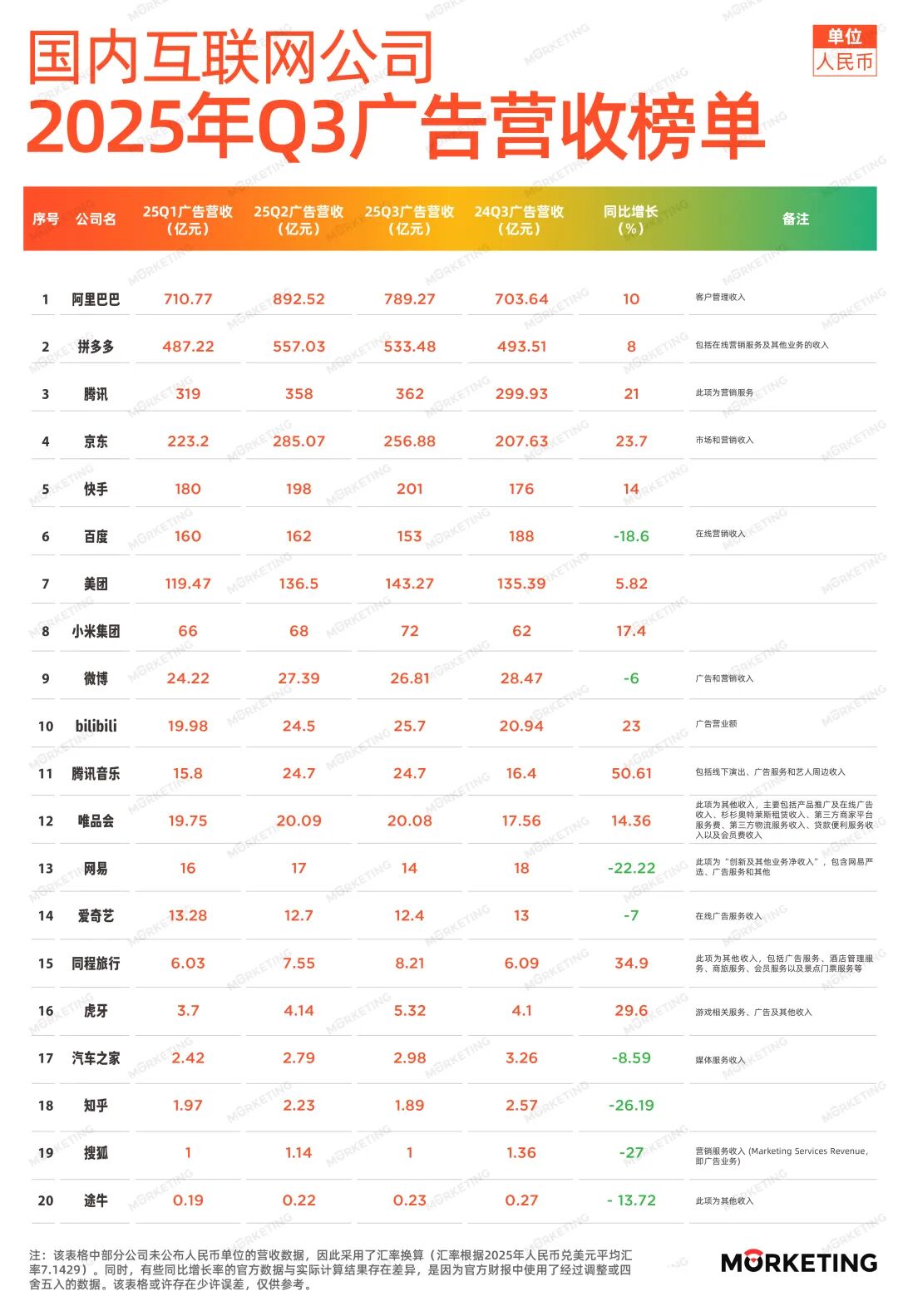
Core Insights - The Chinese internet advertising industry has transitioned from a phase of "incremental traffic acquisition" to a focus on "efficiency extraction from existing resources" [1][2] - The new rule emerging from this differentiation is that technology determines efficiency, efficiency drives revenue, and ecosystem shapes the landscape [2] Group 1: Advertising Revenue Performance - Alibaba's advertising revenue for Q3 2025 reached 789.27 billion yuan, a 10% year-on-year increase and a slight 2.1% quarter-on-quarter growth, maintaining its leading position in the industry [5] - Pinduoduo's online marketing service revenue was 533.48 billion yuan, an 8% year-on-year increase but a 1.2% quarter-on-quarter decline, indicating a strategic focus on long-term ecosystem development [6][7] - Tencent's marketing service revenue grew by 21% to 362 billion yuan, showcasing the effectiveness of its technology-driven approach [7][8] - JD.com's market and marketing revenue increased by 23.7% to 256.88 billion yuan, driven by the growth of its food delivery business and AI-enabled advertising solutions [10] - Bilibili's advertising revenue reached 25.7 billion yuan, with a 23% year-on-year growth, attributed to the maturation of its user base [11] Group 2: Challenges Faced by Mid-Tier Platforms - Baidu's online marketing revenue fell by 18.6% to 153 billion yuan, primarily due to budget cuts from advertisers and the restructuring of search scenarios by AI [12][14] - Zhihu's advertising revenue declined by 26.19%, reflecting a mismatch between its high-knowledge user base and consumer conversion needs [15] - Automotive media service revenue for Che168 dropped by 8.59%, as traditional advertising models struggle against the evolving strategies of new energy vehicle companies [16] Group 3: Industry Trends and Future Outlook - The differentiation in advertising revenue among internet companies in Q3 2025 signifies a reconstruction of internet marketing value logic, focusing on traffic depth, transaction closure, and technology adaptation [16] - Platforms achieving growth typically exhibit a combination of extensive traffic, ecosystem closure, and deep integration of AI technology, while declining platforms often lack these comprehensive advantages [16] - The future of internet marketing will prioritize platforms that can achieve ecosystem synergy, embedded technology, and full-link value delivery, moving away from traditional single-channel models [16]


美团取得出入口标注和路线规划方法专利
Jin Rong Jie· 2026-01-27 01:42
Group 1 - The core point of the article is that Beijing Sankuai Online Technology Co., Ltd. has obtained a patent for a method, device, medium, and electronic equipment related to "entry and exit marking and route planning" with the authorization announcement number CN113360787B, applied for in March 2020 [1] Group 2 - Beijing Sankuai Online Technology Co., Ltd. was established in 2011 and is located in Beijing, primarily engaged in internet and related services [1] - The company has a registered capital of 504.577 million USD [1] - According to data analysis, the company has invested in 10 enterprises, participated in 303 bidding projects, holds 12 trademark information, and has 5000 patent information, along with 35 administrative licenses [1]
智通港股沽空统计|1月27日
智通财经网· 2026-01-27 00:24
Group 1 - The top short-selling ratios are recorded for China Resources Beer (100.00%), Anta Sports (100.00%), and Li Ning (100.00%) [1][2] - The highest short-selling amounts are for Pop Mart (1.209 billion), Xiaomi Group (1.075 billion), and Alibaba (0.974 billion) [1][2] - The highest deviation values are for CRRC (42.51%), Li Ning (38.82%), and Ping An Insurance (30.07%) [1][2] Group 2 - The top short-selling amounts list includes Pop Mart (1.209 billion), Xiaomi Group (1.075 billion), and Alibaba (0.974 billion) with respective short-selling ratios of 28.53%, 19.43%, and 8.66% [2] - The top short-selling ratio rankings show China Resources Beer, Anta Sports, and Li Ning all at 100.00% with short-selling amounts of 19.28 thousand, 9.50 thousand, and 10.09 thousand respectively [2] - The deviation values indicate that CRRC has a significant deviation of 42.51%, followed by Li Ning at 38.82% and Ping An at 30.07% [2][3]




智通ADR统计 | 1月27日
智通财经网· 2026-01-26 22:46
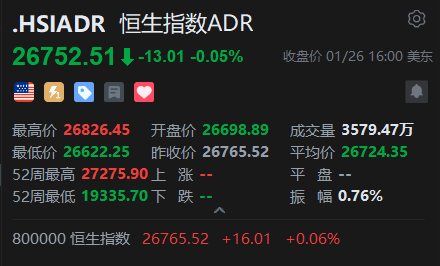
Market Overview - The Hang Seng Index (HSI) closed at 26,752.51, down by 13.01 points or 0.05% as of January 26, 16:00 Eastern Time [1] - The index reached a high of 26,826.45 and a low of 26,622.25 during the trading session, with a trading volume of 35.7947 million [1] - The 52-week high for the index is 27,275.90, while the 52-week low is 19,335.70, indicating a trading range of 0.76% [1] Blue-Chip Stocks Performance - HSBC Holdings closed at HKD 132.695, up by 1.29% compared to the Hong Kong market close [2] - Tencent Holdings closed at HKD 600.708, reflecting a slight increase of 0.2% from the Hong Kong market close [2] - Alibaba Group (BABA) saw a decline of 1.96%, closing at HKD 165.200 [3] - Xiaomi Group (01810) decreased by 2.81%, closing at HKD 35.220 [3] - AIA Group (01299) remained unchanged at HKD 83.050 [3] Notable Stock Movements - New World Development (00016) experienced a significant increase of 3.93%, closing at HKD 119.000 [3] - Kuaishou Technology (01024) fell by 3.26%, closing at HKD 78.600 [3] - JD.com (09618) rose by 1.05%, closing at HKD 116.000 [3] - Ctrip Group (09961) increased by 1.40%, closing at HKD 492.200 [3]

携手美团、叮当快药,平安健康升级\"医药险\"一体化服务闭环
Xin Lang Cai Jing· 2026-01-26 11:16
Core Insights - Ping An Health has deepened its collaboration with Meituan and Dingdang Kuaiyao, launching the "Lightning Delivery Service" on its apps, aiming to enhance the drug purchasing experience and service efficiency through supply chain integration and data connectivity [1][4] Group 1: Service Enhancement - The upgraded drug service network aims to optimize the purchasing experience and service timeliness, promoting an integrated service model of "health + insurance + pharmaceuticals" [1][4] - The collaboration allows for extensive coverage of offline pharmacies and intelligent storage resources, significantly expanding the range of available medications, particularly for common and chronic diseases [2][6] - The service includes a 24/7 online consultation and medication advice from a professional doctor team, creating a seamless one-stop online drug purchasing experience [2][6] Group 2: Targeted Client Solutions - The service upgrade extends quality and convenient pharmaceutical services to commercial insurance and corporate scenarios, aiming for precise health service value delivery [3][7] - The integration of pharmaceutical services with insurance guarantees allows clients to access drug delivery services directly through designated apps while enjoying online consultations and chronic disease management [3][7] - Employees of corporate clients under Ping An Group can utilize health accounts for quick drug delivery and online consultation services, enhancing workplace health and satisfaction [3][7] Group 3: Strategic Vision - The collaboration is a key initiative for building a comprehensive service network, focusing on connecting services to various delivery points, including homes and enterprises [4][8] - The company aims to leverage technology as a core driver for continuous innovation and collaboration with partners, striving to create a more accessible and reliable smart healthcare service network [4][8]