MEITUAN(03690)

Search documents
智通港股沽空统计|1月21日
智通财经网· 2026-01-21 00:23
Group 1 - The core viewpoint of the news highlights the top short-selling ratios and amounts for various companies, indicating significant market sentiment towards these stocks [1][2]. - AIA Group (81299) and JD Group (89618) have the highest short-selling ratios at 100.00%, while Ping An Insurance (82318) follows with a ratio of 82.04% [1][2]. - The top three companies by short-selling amount are Pop Mart (09992) with 1.008 billion, Xiaomi Group (01810) with 0.825 billion, and Meituan (03690) with 0.777 billion [1][2]. Group 2 - The top short-selling ratio rankings show that AIA Group and JD Group both have a short-selling amount of 73,700 and 50,600 respectively, with Ping An Insurance at 1.6862 million [2]. - The short-selling amount rankings indicate that Pop Mart leads with 1.008 billion, followed by Xiaomi Group at 0.825 billion and Meituan at 0.777 billion [2]. - The deviation values, which reflect the difference between current short-selling ratios and the average over the past 30 days, show Ping An Insurance at 49.32%, JD Group at 43.39%, and Wanwu Cloud (02602) at 34.47% [1][2].




智通ADR统计 | 1月21日
智通财经网· 2026-01-20 22:29
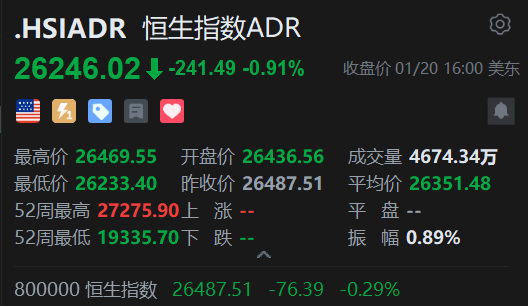
Market Overview - The Hang Seng Index closed at 26,246.02, down by 241.49 points or 0.91% [1] - The index reached a high of 26,469.55 and a low of 26,233.40 during the trading session [1] - The average price for the day was 26,351.48, with a trading volume of 46.7434 million [1] Major Blue-Chip Stocks Performance - HSBC Holdings closed at HKD 128.682, up by 0.22% compared to the Hong Kong close [2] - Tencent Holdings closed at HKD 593.183, down by 1.30% compared to the Hong Kong close [2] - Alibaba Group (W) closed at HKD 159.700, down by 0.44% [3] - Xiaomi Group (W) closed at HKD 35.480, down by 2.74% [3] - Meituan (W) closed at HKD 97.350, down by 1.17% [3] Stock Price Changes - Tencent Holdings saw a decrease of HKD 9.000, or 1.48% [3] - HSBC Holdings increased by HKD 1.400, or 1.10% [3] - China Ping An rose by HKD 0.600, or 0.88% [3] - BYD Company experienced a decline of HKD 3.700, or 3.67% [3] - Kuaishou Technology (W) fell by HKD 0.700, or 0.91% [3]






南向资金今日净买入36.63亿港元,腾讯控股净买入6.63亿港元
Zheng Quan Shi Bao Wang· 2026-01-20 15:44
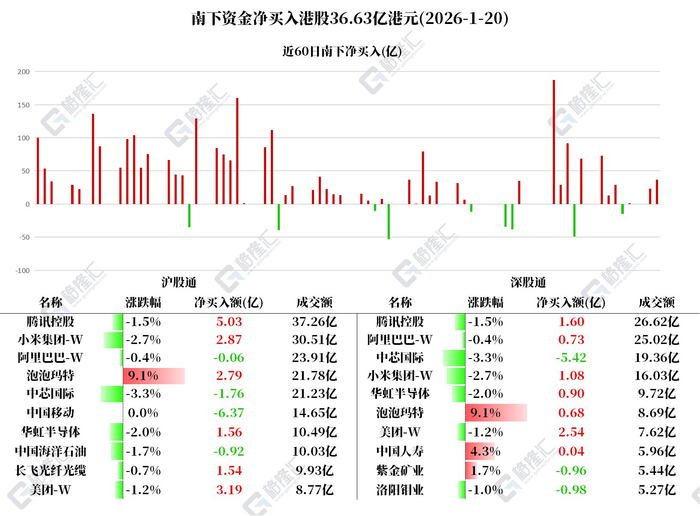
Core Viewpoint - The Hang Seng Index fell by 0.29% on January 20, with southbound capital transactions totaling HKD 97.283 billion, resulting in a net inflow of HKD 36.63 billion [1] Group 1: Southbound Capital Transactions - Total southbound capital transactions amounted to HKD 97.283 billion, with buy transactions at HKD 50.473 billion and sell transactions at HKD 46.810 billion, leading to a net buy of HKD 36.63 billion [1] - The Hong Kong Stock Connect (Shenzhen) recorded a total transaction amount of HKD 37.804 billion, with net buying of HKD 2.18 billion, while the Hong Kong Stock Connect (Shanghai) had a total transaction amount of HKD 59.479 billion, with net buying of HKD 34.44 billion [1] Group 2: Active Stocks - Tencent Holdings had the highest transaction amount among active stocks, totaling HKD 63.88 billion, with a net buy of HKD 6.63 billion, despite a closing price drop of 1.48% [1][2] - Other notable stocks included Alibaba-W and Xiaomi Group-W, with transaction amounts of HKD 48.94 billion and HKD 46.53 billion, respectively [1] - The most significant net sell was recorded for SMIC, with a net sell of HKD 7.18 billion and a closing price drop of 3.25% [1][2] Group 3: Continuous Net Buying - Five stocks experienced continuous net buying for more than three days, with Tencent Holdings leading at 10 days, followed by Alibaba-W at 7 days and Huahong Semiconductor at 4 days [2] - The total net buying amounts during this period were HKD 106.21 billion for Tencent Holdings, HKD 47.56 billion for Alibaba-W, and HKD 14.29 billion for Xiaomi Group-W [2]


港股通(深)净买入2.18亿港元
Zheng Quan Shi Bao Wang· 2026-01-20 15:44
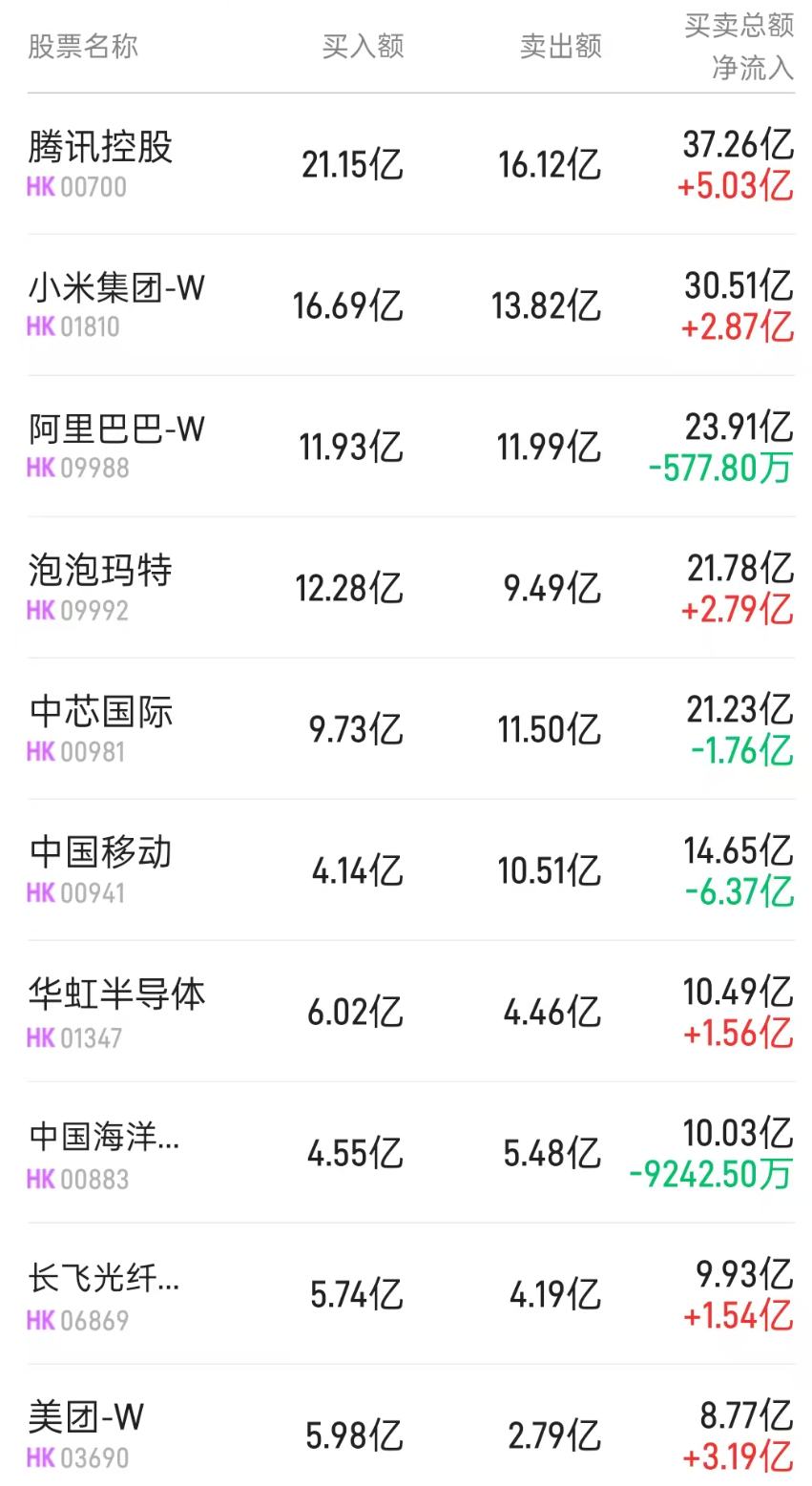
Core Viewpoint - On January 20, the Hang Seng Index fell by 0.29%, closing at 26,487.51 points, while southbound funds through the Stock Connect recorded a net buy of HKD 36.63 billion [1]. Group 1: Market Activity - The total trading volume for the Stock Connect on January 20 was HKD 972.83 billion, with a net buy of HKD 36.63 billion [1]. - The Shanghai Stock Connect accounted for HKD 594.79 billion in trading volume with a net buy of HKD 34.44 billion, while the Shenzhen Stock Connect had a trading volume of HKD 378.04 billion and a net buy of HKD 2.18 billion [1]. Group 2: Active Stocks - In the Shanghai Stock Connect, Tencent Holdings was the most actively traded stock with a transaction amount of HKD 37.26 billion, followed by Xiaomi Group-W and Alibaba-W with transaction amounts of HKD 30.51 billion and HKD 23.91 billion, respectively [1]. - Tencent Holdings had a net buy of HKD 5.03 billion, despite its closing price dropping by 1.48% [1]. - China Mobile recorded the highest net sell amount of HKD 6.37 billion, closing flat [1]. Group 3: Shenzhen Stock Connect Activity - In the Shenzhen Stock Connect, Tencent Holdings also led with a transaction amount of HKD 26.62 billion, followed by Alibaba-W and SMIC with transaction amounts of HKD 25.02 billion and HKD 19.36 billion, respectively [2]. - Meituan-W had the highest net buy amount of HKD 2.54 billion, although it closed down by 1.17% [2]. - SMIC experienced the largest net sell amount of HKD 5.42 billion, closing down by 3.25% [2].


昆仑万维周亚辉投资笔记:AI时代的Super App之战打响|甲子光年
Sou Hu Cai Jing· 2026-01-20 13:15
Core Viewpoint - The analysis suggests that Zhang Yiming will be the richest person in China and Asia in the next ten to twenty years due to his strong motivation, learning ability, execution power, and the resources of ByteDance [1]. Group 1: ByteDance's Strategic Position - ByteDance is expected to accelerate its international expansion, particularly with the launch of the Doubao phone and its entry into the automotive sector, aiming for a position in autonomous driving [2]. - The future of AI will see a significant reduction in the number of Super Apps, with only 3-4 likely to exceed 500 million monthly active users (MAU), compared to 10+ in the mobile internet era [2][3]. - The value of Super Apps in the AI era is projected to be several times greater than in the mobile internet era, with higher daily active users (DAU) to MAU ratios [2]. Group 2: Competitive Landscape - The competition for Super App dominance is intensifying, with Alibaba's Qwen positioned as a strong competitor to Doubao, marking a significant face-off between Zhang Yiming and Jack Ma [7]. - Other contenders for the Super App battle include Tencent, Meituan, Pinduoduo, JD.com, and Baidu, while smaller players like Xiaohongshu may struggle to compete effectively [7]. - The market for AI Super Apps is anticipated to be worth 1 trillion RMB, necessitating significant investment from companies with substantial cash reserves [7]. Group 3: Industry Insights - Huawei is unlikely to enter the Super App market due to its strategic focus on becoming a leading automotive group in China, while Tencent is seen as a stable player with a strong product matrix [8]. - The potential shift in user engagement from WeChat to Doubao could significantly alter the competitive dynamics in the app ecosystem, with Doubao's influence expected to grow rapidly [8].




携程反垄断调查再思考:为何它比阿里、美团更值得警惕?
Sou Hu Cai Jing· 2026-01-20 11:40
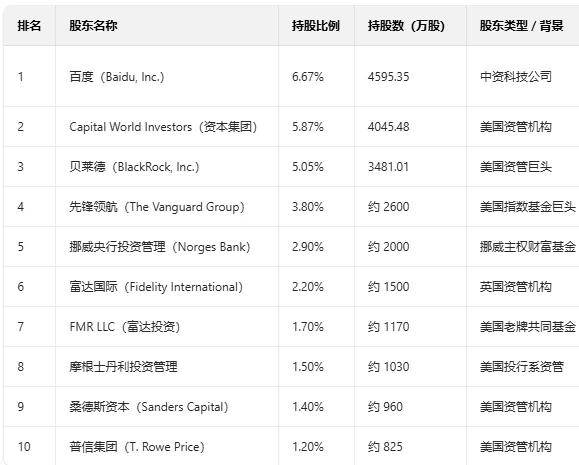
Core Viewpoint - Ctrip Group is under investigation for alleged abuse of market dominance, leading to a significant loss in market value, highlighting the severity of its monopolistic practices in the travel industry compared to previous cases involving Alibaba and Meituan [1] Group 1: Market Dominance and Impact - Ctrip's market share in the travel sector is projected to reach 56% by 2024, with competitors like Meituan, Fliggy, and Douyin holding only 13%, 8%, and 3% respectively [1] - The monopolistic nature of Ctrip is described as more insidious, with many platforms appearing independent but actually operating under Ctrip's control [2][11] Group 2: Ctrip's Business Structure - Ctrip's subsidiaries can be categorized into four types: fully controlled platforms, platforms with board representation, financial investment platforms, and those with deep cooperation agreements [2] - The company's growth strategy has heavily relied on stock acquisitions and capital operations, effectively consolidating its market position [3][5] Group 3: Financial Backing and Strategy - Ctrip's ownership structure is characterized by a high degree of dispersion, with seven of the top ten shareholders being prominent U.S. asset management firms [7] - The focus of these investors is on long-term expansion rather than short-term returns, allowing Ctrip to reinvest profits into acquisitions and market expansion [8][9] Group 4: Consumer Experience and Market Dynamics - Ctrip's monopolistic practices have led to poor consumer experiences, with issues such as price opacity, bundled sales, and complicated refund processes being prevalent [9][10] - Unlike the competitive landscape in e-commerce and food delivery, consumers in the travel sector face limited choices due to Ctrip's dominance, resulting in a significant power imbalance [11] Group 5: Antitrust Investigation Outcomes - The investigation could lead to three potential outcomes: structural separation of Ctrip's assets, substantial fines, or no action at all, with the latter being the least likely scenario [12][13] - A structural separation would directly address the monopolistic control, while fines could serve as a deterrent but may not significantly impact Ctrip's operations due to its high profitability [13][14]
北水动向|北水成交净买入36.63亿 泡泡玛特时隔两年回购 北水抢筹超3亿港元
智通财经网· 2026-01-20 11:07
Group 1 - The core point of the news is that the Hong Kong stock market saw significant net buying from northbound capital, totaling HKD 36.63 billion, with Tencent, Meituan, and Xiaomi being the most purchased stocks [2][6] - Tencent Holdings (00700) had a net inflow of HKD 5.03 billion, with total buy and sell amounts of HKD 21.15 billion and HKD 16.12 billion respectively [3][5] - Meituan (03690) recorded a net inflow of HKD 3.19 billion, with total buy and sell amounts of HKD 5.98 billion and HKD 2.79 billion respectively [3][6] Group 2 - Semiconductor stocks showed divergence, with Hua Hong Semiconductor (01347) receiving a net inflow of HKD 2.45 billion, while SMIC (00981) faced a net outflow of HKD 7.17 billion [7] - The report from Open Source Securities indicated that TSMC raised its capital expenditure forecast significantly, reflecting strong long-term demand driven by AI [7] - Long-distance fiber optic cable stocks like Changfei Optical Fiber (06869) saw a net inflow of HKD 1.54 billion, supported by rising prices in the G.652.D fiber market [7] Group 3 - Xiaomi Group-W (01810) received a net inflow of HKD 3.95 billion, while China Mobile (00941) faced a net outflow of HKD 6.37 billion [8] - The report from Bank of America noted that the growth in metal demand is no longer cyclical, as economies are restructuring their energy infrastructure [8] - The sentiment around resource competition is affecting copper prices, which may remain volatile in the short term [8]
智通港股通活跃成交|1月20日
智通财经网· 2026-01-20 11:01
Core Insights - On January 20, 2026, Tencent Holdings (00700), Xiaomi Group-W (01810), and Alibaba-W (09988) were the top three companies by trading volume in the Southbound Stock Connect, with trading amounts of 3.726 billion, 3.051 billion, and 2.391 billion respectively [1] - In the Shenzhen-Hong Kong Stock Connect, Tencent Holdings (00700), Alibaba-W (09988), and SMIC (00981) led the trading volume, with amounts of 2.662 billion, 2.502 billion, and 1.936 billion respectively [1] Southbound Stock Connect Trading Activity - The top active companies in the Southbound Stock Connect included: - Tencent Holdings (00700) with a trading amount of 3.726 billion and a net buying amount of +0.503 billion [2] - Xiaomi Group-W (01810) with a trading amount of 3.051 billion and a net buying amount of +0.287 billion [2] - Alibaba-W (09988) with a trading amount of 2.391 billion and a net selling amount of -5.778 million [2] - Other notable companies included Pop Mart (09992) and SMIC (00981) with trading amounts of 2.178 billion and 2.123 billion respectively [2] Shenzhen-Hong Kong Stock Connect Trading Activity - The top active companies in the Shenzhen-Hong Kong Stock Connect included: - Tencent Holdings (00700) with a trading amount of 2.662 billion and a net buying amount of +0.160 billion [2] - Alibaba-W (09988) with a trading amount of 2.502 billion and a net buying amount of +7.257 million [2] - SMIC (00981) with a trading amount of 1.936 billion and a net selling amount of -5.420 billion [2] - Other notable companies included Xiaomi Group-W (01810) with a trading amount of 1.603 billion and a net buying amount of +0.108 billion [2]


图解丨南下资金连续10日净买入腾讯,连续12日净卖出中国移动
Ge Long Hui A P P· 2026-01-20 10:07
Group 1 - Southbound funds net bought Hong Kong stocks worth HKD 3.663 billion today [1] - The top net purchases included Tencent Holdings at HKD 663 million, Meituan-W at HKD 573 million, and Xiaomi Group-W at HKD 395 million [1] - Continuous net buying trends were observed for Tencent over 10 days totaling HKD 10.62116 billion and Alibaba over 7 days totaling HKD 4.75655 billion [1] Group 2 - Southbound funds net sold shares of SMIC at HKD 717 million and China Mobile at HKD 637 million [1] - China Mobile has seen continuous net selling for 12 days, amounting to HKD 9.29936 billion [1] - Hua Hong Semiconductor and Xiaomi also experienced net buying trends over multiple days, with Hua Hong totaling HKD 1.33901 billion over 4 days and Xiaomi HKD 1.42914 billion over 3 days [1]
北水动向|北水成交净买入36.63亿 泡泡玛特(09992)时隔两年回购 北水抢筹超3亿港元
智通财经网· 2026-01-20 10:01
Core Viewpoint - The Hong Kong stock market experienced significant net inflows from northbound trading, with a total net buy of HKD 36.63 billion on January 20, 2023, indicating strong investor interest in certain stocks [1]. Group 1: Net Buying and Selling Activities - Tencent (00700) received the highest net buy of HKD 21.15 billion, with a total trading volume of HKD 37.26 billion, reflecting a net inflow of HKD 5.03 billion [2]. - Meituan-W (03690) saw a net buy of HKD 16.69 billion, with a total trading volume of HKD 30.51 billion, resulting in a net inflow of HKD 2.87 billion [2]. - Xiaomi Group-W (01810) had a net buy of HKD 3.95 billion, contributing to the overall positive sentiment in the tech sector [7]. - Conversely, SMIC (00981) faced the largest net sell of HKD 9.73 billion, with a total trading volume of HKD 21.23 billion, indicating a net outflow of HKD 1.76 billion [2]. - China Mobile (00941) also experienced significant net selling, with a net outflow of HKD 6.37 billion [7]. Group 2: Sector Insights and Market Trends - The technology sector, particularly companies like Tencent, Meituan, and Alibaba, is seeing increased investment interest, driven by expectations of growth in AI and cloud computing [4]. - The semiconductor sector showed divergence, with Hua Hong Semiconductor (01347) receiving a net buy of HKD 2.45 billion, while SMIC faced a net sell of HKD 7.17 billion, reflecting varying investor confidence [5]. - The optical fiber and cable industry is experiencing a price recovery, with Longi Optical Fiber (06869) receiving a net buy of HKD 1.54 billion, supported by rising market prices for G.652.D optical fibers [5]. - The mining sector, particularly Zijin Mining (02899) and Luoyang Molybdenum (03993), faced net selling pressures, attributed to changing market sentiments regarding metal demand and supply dynamics [6].