
Haitong Securities(06837)

Search documents
国泰海通|非银:销售费新规落地,优化短期赎回费要求
国泰海通证券研究· 2026-01-04 13:14
Core Viewpoint - The new regulations aim to enhance the competitiveness of public funds while considering the liquidity needs of holders of off-market index and bond funds, thus promoting high-quality development in the public fund industry [2][3]. Summary by Sections Regulatory Changes - The new regulations, effective from January 1, 2026, optimize short redemption fee policies for off-market index and bond funds, addressing feedback from the consultation draft [2][3]. - The maximum subscription fee for actively managed mixed equity funds has been raised from 0.5% to 0.8%, while the maximum for index funds is set at 0.3% [2]. - New provisions allow for different redemption fee standards for individual investors holding off-market index and bond funds for more than seven days, and for institutional investors holding bond funds for more than thirty days [2][3]. Impact on Fund Sales - The regulations continue to guide fund sales towards a focus on long-term holding, while also accommodating liquidity needs for off-market index and bond fund holders [3]. - The average maximum subscription fee for stock index funds, previously at 0.73%, is expected to decrease further, enhancing the attractiveness of these funds for long-term investors [3]. Investment Recommendations - The new regulations are seen as favorable for the development of bond funds, with ETF holdings becoming a key focus in the fund distribution model [3]. - It is recommended to prioritize brokers with strong ETF comprehensive service capabilities and investment advisory business [3].



券商行业2025年十大事件:行业首例“三合一” 券商纷纷“换帅”
Nan Fang Du Shi Bao· 2026-01-01 23:10
Core Viewpoint - In 2025, the Chinese securities industry underwent profound changes under the strategy of "cultivating first-class investment banks," marked by resource integration, technological empowerment, and ecological restructuring, signaling a new chapter for the industry. Group 1: Major Events - The merger of Guotai Junan and Haitong Securities in 2025 established a new "dual leader" pattern in the industry, with the combined entity "Guotai Haitong" reporting a net profit of 22.074 billion yuan, closely following CITIC Securities' 23.159 billion yuan, both surpassing the 20 billion yuan mark [4] - The first "three-in-one" integration in the industry is being planned by CICC, Dongxing Securities, and Xinda Securities, which, if completed, will create a new model for industry integration with total assets exceeding 1 trillion yuan [5] - The margin trading balance reached a historical high of 2.551734 trillion yuan by December 29, 2025, accounting for 2.59% of the A-share market's circulating market value, with a 288% year-on-year increase in new accounts opened in September 2025 [6] Group 2: Regulatory and Structural Changes - The China Securities Regulatory Commission revised and renamed the "Securities Company Classification Evaluation Regulations" in 2025, focusing on guiding the industry to serve national strategies and enhancing professional capabilities [7] - AI applications in securities firms accelerated, with leading institutions showcasing advancements at the 2025 World Artificial Intelligence Conference, enhancing capabilities in investment research and risk control [8] Group 3: Leadership and Talent Dynamics - Over 10 chief economists in the securities industry changed positions in 2025, primarily due to the merger wave, indicating a significant reshuffling of talent [9] - More than 50 securities firms experienced changes in leadership roles, with approximately one-third of firms undergoing a "leadership change," driven by factors such as retirement and shareholder changes due to mergers [10] Group 4: Market Competition and Trends - Despite the rising trend of "anti-involution," a price war among securities firms intensified, with commission rates dropping to as low as 0.01% and financing rates falling below 4%, highlighting the need for the industry to return to its core financial services [11] - Securities firms were first included as issuers of Sci-Tech Innovation Bonds in May 2025, with total issuance exceeding 80 billion yuan since then, enhancing their competitive edge [12] - The wave of public fund business that began in 2022 receded in 2025, with several institutions withdrawing their applications for public fund qualifications, indicating a shift in business models [14]


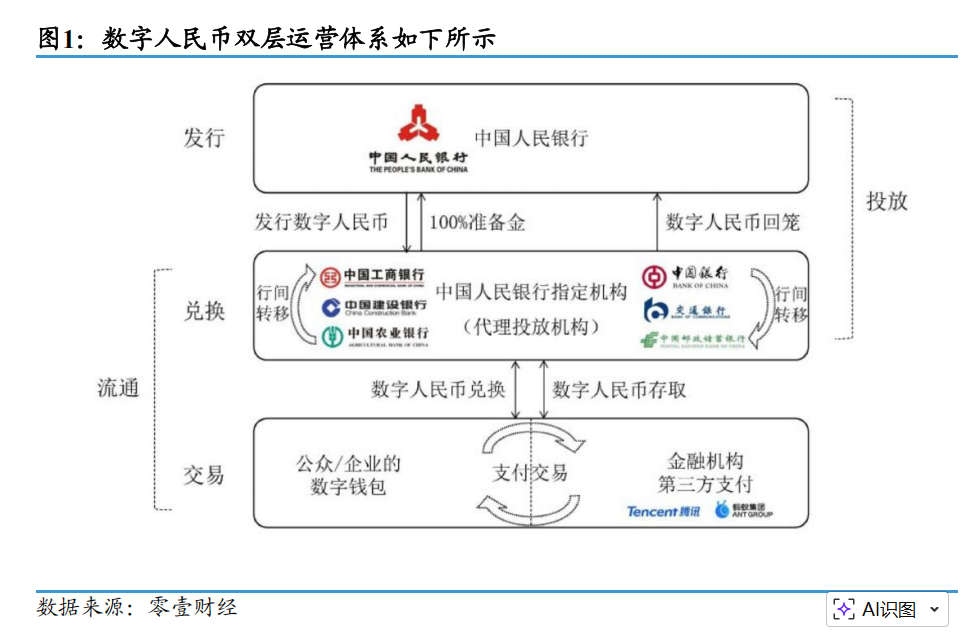
数字人民币2.0:“计息数字货币”的机制与技术创新
Hua Er Jie Jian Wen· 2026-01-01 08:06
Core Viewpoint - The People's Bank of China is officially transitioning the digital yuan from a "cash-type 1.0" to a "deposit currency type 2.0," introducing a historical transformation that enhances its functionality as a financial asset with value storage capabilities [1][2]. Group 1: Mechanism Innovation - The core mechanism innovation of version 2.0 is characterized by the redefinition of liability attributes and the incorporation of a macro framework, allowing digital yuan balances in commercial banks to be classified as "account-based commercial bank liabilities" [3][6]. - The cancellation of the "non-interest" policy for digital yuan enables liquidity to flow directly into the electronic wallet system, marking the end of the cash era [3][6]. - The new framework enhances user willingness to hold and use digital yuan while providing banks with a manageable asset-liability space [6]. Group 2: Technical Architecture - The technical architecture features three major innovations: an account system, a currency string, and smart contracts, which facilitate a digital path for the digital yuan [7]. - The upgrade maintains compliance with existing bank account rules while introducing a "currency string" for value transfer and offline circulation, enhancing verification and system resilience [7]. - Smart contracts embedded in the funding flow can trigger conditions and automate verification in various scenarios, reducing misuse risks and compliance costs [7]. Group 3: Cross-Border Applications - The transition to "digital deposit currency" is reshaping the liquidity foundation and settlement efficiency of the multilateral central bank digital currency bridge (mBridge) [11]. - As of November 2025, digital yuan holds a dominant position in mBridge operations, accounting for 95.3% of transactions, with a total of 4,047 cross-border payments amounting to 387.2 billion yuan [14]. - The introduction of deposit insurance significantly lowers the risk costs for foreign participants holding digital yuan, enabling more robust fund position management [14].


2025年度债券承销排行榜
Wind万得· 2025-12-31 22:50
Key Points - The total bond market in mainland China reached 196.18 trillion yuan by the end of 2025, an increase of 20.30 trillion yuan from the beginning of the year, with interest rate bonds at 123.61 trillion yuan, credit bonds at 52.88 trillion yuan, and interbank certificates at 19.69 trillion yuan [3] - In 2025, the issuance of various bonds in mainland China totaled 89.0 trillion yuan, a year-on-year increase of 11%, with interest rate bonds reaching 33.0 trillion yuan, up 18% from the previous year [3] - The issuance of government bonds increased by 28% year-on-year, while local government bonds grew by 5%, and policy financial bonds rose by 17% [3] - Credit bonds issuance was 22.2 trillion yuan, an 8% increase year-on-year, and interbank certificates totaled 33.8 trillion yuan, up 7% [3] Bond Issuance Statistics - Interest rate bonds: 3,534 issues, 329,829.6 billion yuan, 18% growth [4] - Government bonds: 206 issues, 160,140.2 billion yuan, 28% growth [4] - Local government bonds: 2,449 issues, 102,901.0 billion yuan, 5% growth [4] - Policy bank bonds: 879 issues, 66,788.4 billion yuan, 17% growth [4] - Credit bonds: 24,003 issues, 222,246.7 billion yuan, 8% growth [4] - Financial bonds: 1,499 issues, 56,780.6 billion yuan, 25% growth [6] Bank Underwriting Rankings - The top three banks in total underwriting amount (including local government bonds) are China Bank (16,765.2 billion yuan), Industrial and Commercial Bank (16,479.0 billion yuan), and Construction Bank (15,020.5 billion yuan) [12] - In the detailed local government bond underwriting, the top three are Industrial and Commercial Bank (22,584.8 billion yuan), China Bank (16,312.8 billion yuan), and Construction Bank (14,568.1 billion yuan) [17] Securities Firm Underwriting Rankings - The top three securities firms (excluding local government bonds) in total underwriting amount are CITIC Securities (16,136.2 billion yuan), Guotai Junan (13,613.4 billion yuan), and CITIC Jianzhong (12,419.6 billion yuan) [21] - In the local government bond underwriting (averaged), the top three are CITIC Securities (22,491.6 billion yuan), CITIC Jianzhong (17,333.3 billion yuan), and Guotai Junan (16,426.2 billion yuan) [26] NAFMII Debt Financing Tool Underwriting Rankings - CITIC Bank leads the NAFMII debt financing tool underwriting with 9,043.4 billion yuan, followed by Industrial Bank with 8,412.7 billion yuan and Construction Bank with 6,077.7 billion yuan [36] Credit Bond Underwriting Rankings - The top three in credit bond underwriting are CITIC Securities (16,136.2 billion yuan), Guotai Junan (13,613.4 billion yuan), and CITIC Jianzhong (12,419.6 billion yuan) [40]

调研速递|浙江托普云农接待国泰海通证券等5家机构调研 AI赋能智慧农业 病虫害识别准确率超90%
Xin Lang Cai Jing· 2025-12-31 10:35
Company Overview - Zhejiang Top Yun Nong Technology Co., Ltd. is a national-level specialized and innovative "little giant" enterprise focused on smart agriculture, established in 2008 [1] - The company utilizes IoT, AI, big data, and algorithms to provide comprehensive solutions for data collection, analysis, decision-making, and scientific management in agriculture [1] Industry Insights - The smart agriculture industry in China is in its early growth stage, with significant market potential due to late development compared to global standards [2] - Government policies and financial investments are increasingly supporting the industry, but there are few companies that offer integrated hardware and AI-enabled solutions [2] Strategic Focus - The company aims to develop an "AI + Agriculture" strategy, creating three core systems: a perception monitoring system, a decision-making system based on model algorithms, and an execution system centered on smart agricultural machinery [3] - The strategic plan includes a timeline of "ten years for planning, three years for regulation, and one year for implementation" to transition agriculture from traditional production to a digital ecosystem [3] Product and Technology Integration - The company has developed various technologies, including smart instruments for plant digital phenotyping and algorithms for corn tassel identification, enhancing breeding efficiency [4] - New products like the AR glasses "Crop Guardian" and the robotic dog "Field Scout" are being developed to assist in precision agriculture management [4] AI Application and Success Cases - The company has achieved over 90% accuracy in pest and disease identification through its smart plant protection system, which integrates AI applications and monitoring equipment [5][6] - The intelligent pest monitoring lamp has won first place in national competitions for three consecutive years, showcasing the company's strong capabilities in agricultural data [6]
中国资本市场2025:十大“最”时刻
Xin Lang Cai Jing· 2025-12-31 08:18
Core Insights - The year 2025 marked significant transformations in China's capital market, characterized by index breakthroughs and ecological restructuring, including the Shanghai Composite Index surpassing 4000 points and the handling of the Dongxu Group's 600 billion yuan fraud case [1][10] Group 1: Major Transformations - The most important ideological shift was from "heavy financing" to "coordinated investment and financing," emphasizing a balanced ecosystem and investor returns through improved systems for dividends, buybacks, and mergers [2][12] - A strong consensus emerged around market value management, transitioning from a niche practice to a standard across the market, with 1001 A-share companies disclosing value management systems by November, a fivefold increase from earlier in the year [2][12] Group 2: Key Market Trends - The hottest sectors were AI and hard technology, with the launch of DeepSeek-R1 in January triggering a massive influx of capital into the AI industry chain, leading to a significant revaluation of related stocks [2][13] - A major shift in funding structures occurred, with insurance and social security funds increasing equity asset allocations, and a "deposit migration" trend among residents as savings rates fell below 1% [2][14] Group 3: Regulatory Environment - 2025 was marked by stringent regulatory enforcement, highlighted by the forced delisting of major companies like Dongxu Group for significant fraud, with over 60 companies delisted throughout the year [3][5] - The year also saw a focus on mergers and acquisitions as a strategic solution for asset revaluation, with notable transactions including Guotai Junan's acquisition of Haitong Securities [3][15] Group 4: Notable Reforms - The launch of the "1+6" reform series for the Sci-Tech Innovation Board aimed to enhance the inclusivity and adaptability of the capital market, facilitating the listing of unprofitable companies [5][16] Group 5: Market Performance - The Shanghai Composite Index reached a ten-year high, crossing the 4000-point mark for the first time since August 2015, reflecting a significant recovery in market confidence [6][16] - The total trading volume of A-shares reached a record 29.92 trillion shares, with a total transaction value exceeding 419.86 trillion yuan, marking a 63% increase from 2024 [6][16] Group 6: Unexpected Developments - Hong Kong's stock market made a remarkable comeback, becoming the world's best-performing market with IPO fundraising returning to the top globally and the Hang Seng Index achieving its best annual performance since 2017 [7][17] - The most profitable new stocks were the domestic GPU companies, Moer Thread and Muxi Co., with record profits from initial public offerings, indicating strong market support for domestic GPU alternatives [8][18]


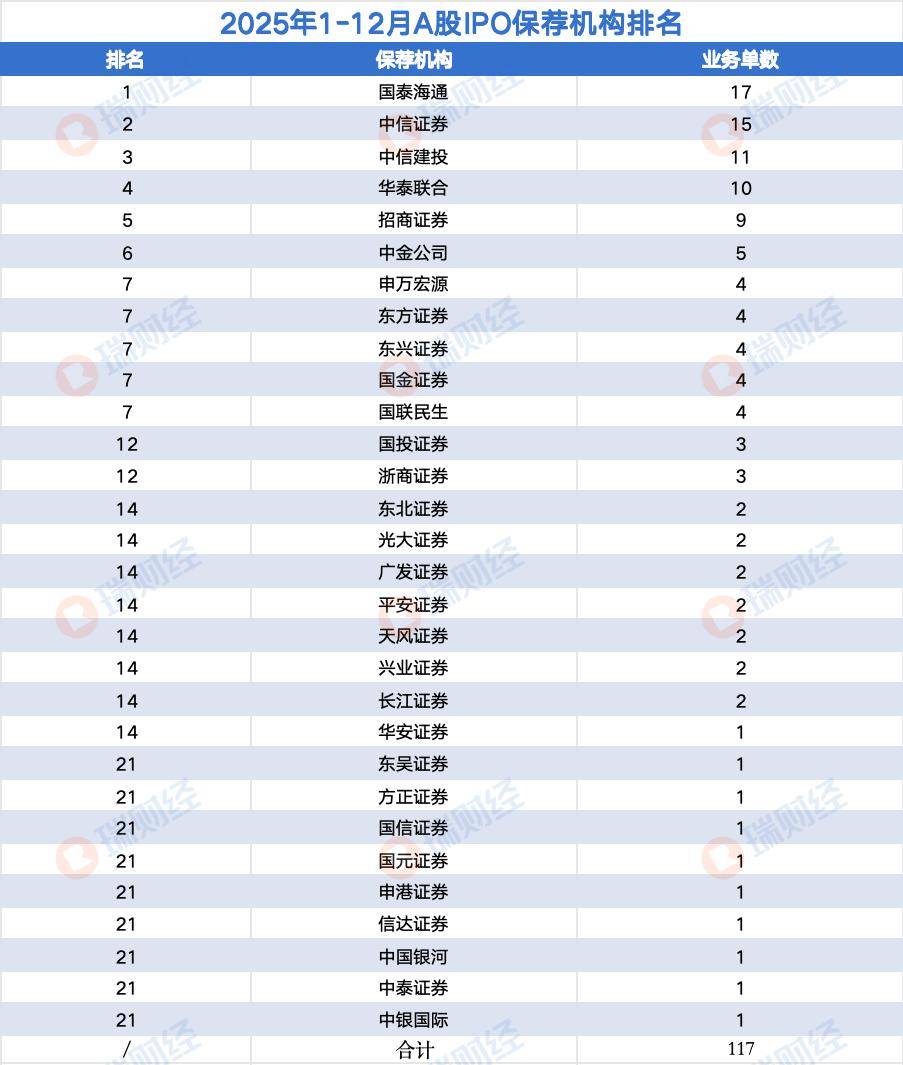
2025年A股IPO保荐机构排名:5家分走一半业务,国泰海通17单居首
Sou Hu Cai Jing· 2025-12-31 04:26
Group 1 - The A-share IPO market in 2025 saw a total of 116 companies complete their listings, representing a 16% year-on-year increase [2] - The total fundraising amount reached 122.025 billion yuan, marking a significant year-on-year growth of 104.25% [2] - The distribution of listings included 23 on the Shanghai main board, 19 on the Sci-Tech Innovation Board, 15 on the Shenzhen main board, 33 on the Growth Enterprise Market, and 26 on the Beijing Stock Exchange, with the Growth Enterprise Market and Beijing Stock Exchange accounting for over 50% of the total IPOs [2] Group 2 - A total of 30 underwriting institutions participated in the IPO business for the 116 newly listed companies, with the total number of underwriting business units reaching 117 due to two institutions being hired by Huadian New Energy for one business each [3] - The top five underwriting institutions dominated the market, collectively handling 62 business units, which is over half of the total [3] - Guotai Junan ranked first with 17 business units, followed by CITIC Securities with 15, CITIC Jianzhong with 11, Huatai United with 10, and China Merchants Securities with 9 [3][4]
并购重组风起云涌,2025券商十大事件,万亿赛道谁执牛耳
Nan Fang Du Shi Bao· 2025-12-31 03:48
Core Insights - The Chinese capital market is at a historical intersection of deepening reform and high-quality development in 2025, with significant transformations in the brokerage industry driven by resource integration, technological empowerment, and ecological restructuring [2] - The brokerage industry is experiencing a year of both challenges and breakthroughs, marked by major events that symbolize the ongoing transformation and the journey towards becoming a first-class investment bank [2] Group 1: Major Mergers and Acquisitions - The merger of Guotai Junan and Haitong Securities marks the largest A+H dual-market merger in China's capital market history, establishing a new "giant" in the brokerage industry, Guotai Haitong [2][3] - In 2025, both CITIC Securities and Guotai Haitong achieved over 20 billion yuan in net profit, solidifying a "dual leader" position in the industry [3] Group 2: Innovative Integrations - The planned merger of China International Capital Corporation (CICC) with Dongxing Securities and Xinda Securities represents the first "three-in-one" integration in the brokerage industry, potentially creating a new "trillion-yuan brokerage" [5] - The combined assets of the three firms reached 1,009.58 billion yuan, positioning them among the top in the industry [5] Group 3: Market Developments - The margin trading market reached a historical high of 25,517.34 billion yuan by December 29, 2025, accounting for 2.59% of the A-share market's circulating value [7] - The number of new margin trading accounts surged by 288% year-on-year in September, indicating increased investor activity [7] Group 4: Regulatory Changes - The China Securities Regulatory Commission revised the classification regulations for securities companies, emphasizing the need for firms to enhance their professional capabilities and better serve the real economy [9] - The new regulations focus on improving return on equity (ROE) and reducing the emphasis on total revenue rankings [9] Group 5: Technological Advancements - The brokerage industry is rapidly adopting AI technologies, with significant advancements showcased at the 2025 World Artificial Intelligence Conference [11] - CITIC Securities introduced a "digital employee" system to enhance operational efficiency, reflecting a broader trend of digital transformation in the industry [11] Group 6: Leadership Changes - Over 50 brokerages experienced changes in their core management teams in 2025, indicating a significant reshuffling of leadership within the industry [15] - The changes are driven by factors such as retirement and the impact of mergers, with a notable shift towards younger leadership [15] Group 7: Competitive Landscape - A price war has emerged in the brokerage industry, with commission rates dropping significantly, reflecting the competitive pressures and the industry's response to market conditions [17] - The average commission rate in Shanghai decreased by 8.2% year-on-year, with some firms offering financing rates below 4% [17] Group 8: New Financial Instruments - Securities companies were included as issuers of sci-tech bonds for the first time in 2025, with over 80 billion yuan in bonds issued since May [19] - This expansion aims to enhance the industry's ability to support technological innovation and align with national strategies [19] Group 9: Market Trends - The enthusiasm for public fund business among brokerages has waned, with several firms withdrawing their applications for public fund licenses [21] - The industry is shifting towards alternative models such as equity participation in public funds, indicating a strategic pivot in business operations [21] Conclusion - The brokerage industry in China is navigating a transformative landscape characterized by mergers, technological advancements, regulatory changes, and evolving market dynamics, all while striving to enhance its competitive edge and service capabilities [23]
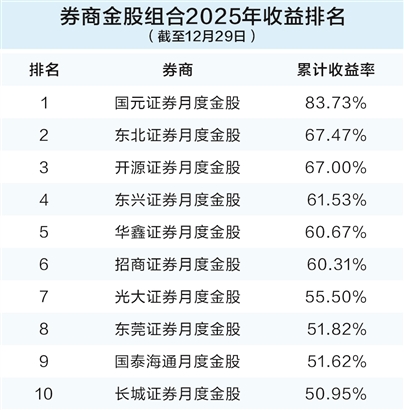
年度行情收官 10家券商金股组合收益率亮眼超过50%
Zheng Quan Shi Bao· 2025-12-31 01:28
Core Insights - The report highlights the performance of stock recommendations from various brokerages, with 10 brokerages achieving over 50% returns in 2025, showcasing their ability to identify and recommend stocks early in the market cycle [2][3]. Group 1: Brokerage Performance - The highest cumulative return was achieved by Guoyuan Securities at 83.73%, followed by Northeast Securities and Kaiyuan Securities with returns of 67.47% and 67% respectively [2]. - Other brokerages such as Dongxing Securities, Huaxin Securities, and China Merchants Securities also reported returns exceeding 60%, while Everbright Securities, Dongguan Securities, Guotai Junan, and Changcheng Securities had returns above 50% [2]. Group 2: Stock Selection Strategy - The success of these brokerages is attributed to their strategy of identifying stocks at low points and consistently recommending them, which has led to significant gains [4][5]. - For instance, Kaiyuan Securities recommended Xinyisheng for four consecutive months, resulting in a total increase of 440% from May to August [6]. Group 3: Popular Stocks - Tencent Holdings emerged as the most recommended stock, being favored by around seven brokerages each month, making it the most popular stock of the year [7]. - The report indicates that the most popular stocks varied throughout the year, with technology stocks dominating in the first quarter, consumer stocks in the second, financial stocks in the third, and a return to technology stocks in the fourth quarter [7].





六大案例看2025券商并购大年: 强强合并重塑行业格局
Sou Hu Cai Jing· 2025-12-30 17:20
Core Viewpoint - The article discusses the ongoing trend of mergers and acquisitions in the Chinese securities industry, highlighting significant cases and the regulatory environment that encourages the formation of influential financial institutions by 2025 [1]. Group 1: Major Mergers and Acquisitions - Guolian Minsheng Securities officially rebranded after merging, reporting a revenue of 4.011 billion yuan and a net profit of 1.127 billion yuan for the first half of the year, marking a year-on-year growth of 269.4% and 1185.19% respectively [2]. - The merger of Guotai Junan and Haitong Securities, which became Guotai Haitong, is noted as the largest A+H market merger in Chinese capital market history, with Guotai Haitong achieving a net profit of 15.737 billion yuan in the first half of the year, surpassing CITIC Securities [4]. - The merger between Zhejiang Securities and Guodu Securities is progressing, with Zhejiang Securities establishing control over Guodu Securities through a series of share acquisitions [5][6]. Group 2: Regulatory Approvals and Market Impact - The merger of Xibu Securities and Guorong Securities received regulatory approval, with Xibu Securities planning to acquire a 64.5961% stake for 3.3217 yuan per share, totaling 3.825 billion yuan [8]. - The acquisition of Wanhe Securities by Guosen Securities was approved, with Guosen Securities aiming to gain control over Wanhe Securities, which has significantly smaller assets and profits compared to Guosen [9][10]. - Central Huijin's stake in CICC will increase to 1.936 billion shares post-merger with Dongxing Securities and Xinda Securities, maintaining its status as the controlling shareholder [13].



