HAIDILAO(06862)

Search documents
海底捞“小便门”当事人登报道歉
Huan Qiu Wang· 2026-01-08 02:52
本文转自【智通财经】; 2026年1月8日,《人民法院报》3版刊登了海底捞小便当事人唐某及其父母的道歉声明。 以下是致歉声明原文: 2025年2月24日凌晨,唐某、吴某于酒后到餐厅用餐,用餐过程中实施不当行为且吴某将拍摄的视频发布在网上,严重侵害了餐厅的合法权益。后 经上海市黄浦区人民法院审理,并作出(2025)沪0101民初9213号民事判决书,判令本人及监护人进行赔礼道歉以及赔偿餐具损耗费、清洗消毒 费、经营损失及商誉损失、维权开支若干。现判决书已生效,我深刻认识到自己的错误行为,在此向四川新派餐饮管理集团有限公司、上海捞派 餐饮管理有限公司表示真诚的歉意。我也接受到了来自家长、学校、公安、法院,以及网络广大消费者的批评与教育,我会吸取深刻的教训,改 过自新。长大后,我要努力成为一位对家庭,对国家,对社会有担当的人。作为监护人,我们对于孩子做出的不当行为深表歉意!对判决结果没 有异议,今后一定引以为戒,加强对孩子的教育,引导他成长为一名行为规范的好公民。肇事孩子父母真诚道歉。 智通财经记者 郑浩 2026年1月8日,《人民法院报》3版刊登了海底捞小便当事人唐某及其父母的道歉声明。 人民法院报电子版截图 据 ...


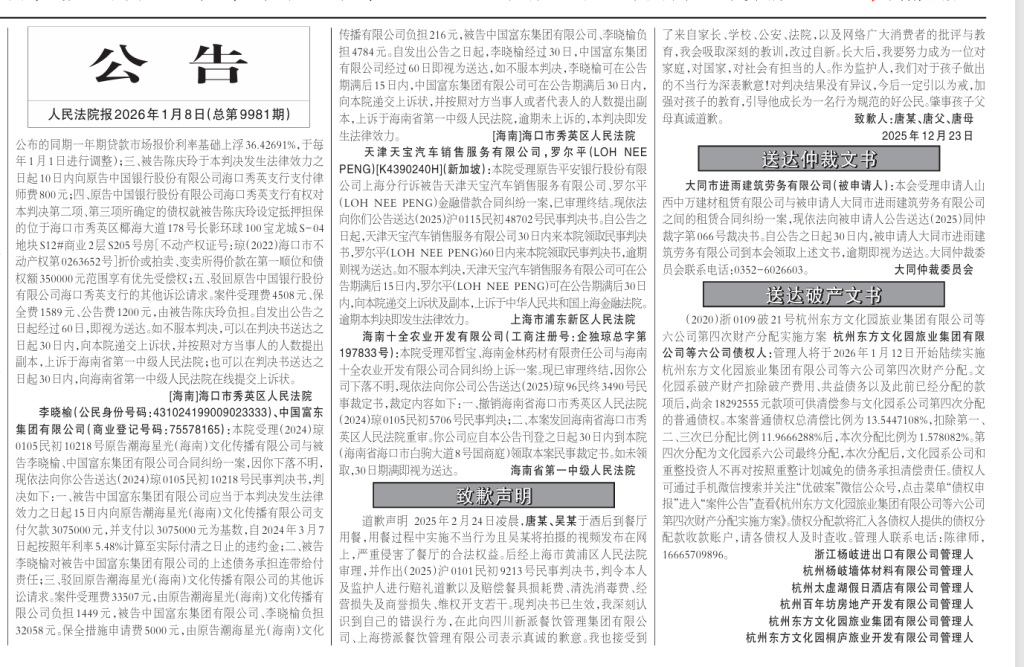
海底捞“小便门”当事人登报道歉:承认错误,改过自新
Xin Lang Cai Jing· 2026-01-08 02:52
2026年1月8日,《人民法院报》3版刊登了海底捞小便当事人唐某及其父母的道歉声明。 唐某在道歉声明称,"我深刻认识到自己的错误行为,在此向四川新派餐饮管理集团有限公司、上海捞 派餐饮管理有限公司表示真诚的歉意。我也接受到了来自家长、学校、公安、法院,以及网络广大消费 者的批评与教育,我会吸取深刻的教训,改过自新。" 据此前报道,2025年3月,一则海底捞火锅店内有人"向火锅小便"的短视频引发关注,之后涉案的唐某 (男,17岁)和吴某(男,17岁)被行政拘留。2025年9月,上海市黄浦区人民法院判令两名未成年人 及其监护人在指定报刊上赔礼道歉,赔偿涉事餐饮公司经济损失共计220万元。 以下是致歉声明原文: 2025年2月24日凌晨,唐某、吴某于酒后到餐厅用餐,用餐过程中实施不当行为且吴某将拍摄的视频发 布在网上,严重侵害了餐厅的合法权益。后经上海市黄浦区人民法院审理,并作出(2025)沪0101民初 9213号民事判决书,判令本人及监护人进行赔礼道歉以及赔偿餐具损耗费、清洗消毒费、经营损失及商 誉损失、维权开支若干。现判决书已生效,我深刻认识到自己的错误行为,在此向四川新派餐饮管理集 团有限公司、上海捞派餐饮 ...
县域市场成消费“新蓝海” 企业竞逐增长新空间
Xin Hua Cai Jing· 2026-01-07 12:40
Group 1 - The core viewpoint is that the county-level market in China is showing strong consumer vitality and growth potential, becoming a new "blue ocean" for businesses to expand and seek incremental growth [1][2] - The sales performance of Hema stores in county-level cities has exceeded expectations, indicating a significant shift in consumer demand towards quality and experiential consumption in these areas [1] - Data from the National Bureau of Statistics shows that rural market sales growth is steady, with rural retail sales accounting for 38.7% of total social retail sales by November 2025 [1] Group 2 - Well-known brands in the hotel, restaurant, and retail sectors are accelerating their entry into the county-level market, reflecting optimism about the consumption prospects in these areas [2] - The rapid development of county-level hotels is highlighted, with major hotel groups expanding their presence and introducing culturally integrated products to penetrate the high-end market [2] - The consumer purchasing power in county and rural areas has significantly increased, driven by economic development and rising incomes, leading to a stronger demand for quality living [2] Group 3 - The strategy of chain brands to expand into lower-tier markets is seen as a wise move in response to market trends, as competition in first and second-tier cities intensifies [3] - The diverse and personalized consumer demands in lower-tier markets provide ample space for innovation, positioning these markets as new growth engines for consumption in China [3] - Lower-tier markets are expected to play a crucial role in promoting domestic demand and facilitating high-quality economic development [3]
海底捞上线“扫盘结算”:餐盘内植入食材价格芯片
Ge Long Hui A P P· 2026-01-07 09:17
Core Viewpoint - The introduction of a new payment method using scanning technology at Haidilao restaurants demonstrates the company's commitment to integrating high-tech solutions into traditional dining experiences, catering to the evolving preferences of consumers, particularly younger demographics [1] Company Summary - A Haidilao restaurant in Wuhan has implemented a novel payment system that utilizes scanning technology to calculate the total bill based on the food items on the plates [1] - Each plate is embedded with a chip that corresponds to the price of the ingredients, allowing for automatic billing when placed in a designated area [1] - The restaurant's approach reflects a shift towards a self-service dining model, enhancing customer experience through technology [1] Industry Summary - The launch of the "Dapaidang Hotpot" business model by Haidilao, combined with smart payment technology, serves as a demonstration for the entire hotpot industry on how to innovate traditional dining formats [1] - This initiative aims to tap into the existing market by enhancing customer experience and meeting the complex demands of modern consumers [1]
鼓励出游和文体消费,出行链和会展体育迎板块机遇
GOLDEN SUN SECURITIES· 2026-01-07 05:59
Investment Rating - The report maintains a "Buy" rating for the industry, indicating a positive outlook for the sector's performance in the coming months [5]. Core Insights - The report highlights the encouragement of travel and cultural consumption through policies aimed at enhancing employee leisure activities, which is expected to boost the travel and cultural sectors significantly [2][4]. - The introduction of additional public holidays and policies supporting paid leave is anticipated to stimulate cultural and tourism consumption, particularly during traditionally low seasons [4]. - Data from travel platforms indicates a substantial increase in ticket bookings during recent holiday periods, showcasing a growing consumer interest in travel and leisure activities [3]. Summary by Sections Policy Initiatives - The report discusses the issuance of guidelines by various government bodies to promote employee cultural and sports activities, allowing for up to four organized trips per year and the distribution of cultural consumption vouchers [1][2]. Market Trends - Significant growth in ticket bookings was observed during the autumn and snow holidays, with some regions reporting increases of over 300% in ticket reservations compared to previous years [3]. - The report notes that the policy-driven encouragement of travel is likely to transform traditionally slow tourism periods into more active seasons, benefiting sectors such as duty-free, hotels, and sports events [4]. Investment Recommendations - The report suggests focusing on sectors with potential for growth, particularly in Hainan and during the upcoming Spring Festival, as well as sectors benefiting from new consumer trends and favorable policies [5][8]. - Specific companies are recommended for investment, including those in the duty-free, hotel, and new retail sectors, which are expected to perform well in the current market environment [8].




海底捞(06862) - 截至2025年12月31日止月份之股份发行人的证券变动月报表
2026-01-07 04:00
股份發行人及根據《上市規則》第十九B章上市的香港預託證券發行人的證券變動月報表 截至月份: 2025年12月31日 狀態: 新提交 致:香港交易及結算所有限公司 公司名稱: 海底捞国际控股有限公司 呈交日期: 2026年1月7日 I. 法定/註冊股本變動 | 1. 股份分類 | 普通股 | 股份類別 不適用 | | | 於香港聯交所上市 (註1) | | 是 | | | --- | --- | --- | --- | --- | --- | --- | --- | --- | | 證券代號 (如上市) | 06862 | 說明 | | | | | | | | | | 法定/註冊股份數目 | | | 面值 | | 法定/註冊股本 | | | 上月底結存 | | | 10,000,000,000 | USD | | 0.000005 USD | | 50,000 | | 增加 / 減少 (-) | | | 0 | | | USD | | 0 | | 本月底結存 | | | 10,000,000,000 | USD | | 0.000005 USD | | 50,000 | 本月底法定/註冊股本總額: USD 50 ...
一个月10多个副牌齐开,餐饮巨头们在急什么?
3 6 Ke· 2026-01-07 02:44
Core Insights - The restaurant industry is witnessing a resurgence of "sub-brands" as major players like Haidilao, Yum China, and others launch new concepts to capture market share and cater to specific consumer needs [1][2] Group 1: Sub-brand Launches - Major restaurant brands are intensifying their focus on sub-brands, with Haidilao introducing a lively hot pot concept, Yum China launching two new independent sub-brands, and others like Jiumaojiu and Maliuji also expanding their offerings [1] - The recent trend shows a shift from blindly expanding product categories to targeting specific customer segments and dining scenarios [1][2] Group 2: Strategic Focus and Upgrades - Brands are prioritizing quality and price-performance ratio, as seen with Xiabuxiabu's new self-service hot pot, which offers competitive pricing while aiming to differentiate from its main brand [3] - Jiumaojiu is narrowing its sub-brand strategy, focusing on upgrading its flagship brand Tai Er, which is evolving into a more diverse dining experience [3] Group 3: Cost Structure and Operational Efficiency - Major brands are adopting a "light asset" model for sub-brands, reducing operational costs and risks by leveraging existing resources [13][14] - KCOFFEE exemplifies this model by utilizing KFC's infrastructure for rapid expansion, while Pizza Hut's new sub-brand also follows a similar cost-saving strategy [14][16] Group 4: Market Penetration Strategies - The industry is increasingly targeting lower-tier cities and international markets, with brands like Haidilao and Jiumaojiu making strategic moves to penetrate these areas [23][25] - Haidilao's acquisition of "Jugaogao" aims to meet the demand for affordable dining in lower-tier cities, while Jiumaojiu's acquisition of BigWayHotPot facilitates its entry into the North American market [25]

暖市烟火 热力开年 润州元旦假期消费热力迸发
Zhen Jiang Ri Bao· 2026-01-06 21:43
假期里的润州餐饮界,是实打实的"人气爆棚"。海底捞跨年时段的订位早早约满,不少市民特意错 峰前往;佬土鹅肠火锅门店忙得热火朝天。从永安鱼庄的本地菜到福鱼糖水的暖甜滋味,从排着长队的 老字号酥饼到茶颜悦色的网红茶饮,烟火气里的美味,成了市民假期里最暖心的"仪式感"。 逛西津渡西津大市、赶京畿路 "新年有喜市"。两大主题市集齐聚区级非遗展演、文创好物、特色 美食,让市民一站式解锁传统匠心魅力,淘遍新潮创意尖货。在传统与创新的交融中,为市民带来沉浸 式的年味体验。 润州区相关负责人介绍,这个元旦假期,润州通过多元消费场景与温馨节日氛围,让"烟火 气"与"幸福感"交织相融,也为新年消费市场拉开红火序幕。各类活动注重提升服务品质与消费体验, 进一步释放区域消费潜力,推动消费市场持续升温,为市民打造了参与感强、体验丰富的假日生活。 (润萱 记者 孙晨飞) 元旦期间,润州大街小巷烟火升腾,消费热情高涨。商业综合体、餐饮门店与特色市集共同发力, 勾勒出一幅红火热闹的节日消费图景。 作为区域消费主阵地,万达广场成为市民假期"打卡首选"。除了跨年夜当天的倒数活动,"欢乐新 年季"主题活动也同步展开:惊喜盲盒满载实用好礼、"一号顾 ...
海底捞-日核心要点:翻台率改善,利润率管控加强
2026-01-06 02:23
Summary of Haidilao International Holding (6862.HK) Conference Call Company Overview - **Company**: Haidilao International Holding - **Industry**: Consumer & Leisure, specifically in the restaurant sector Key Points Recent Updates - **Table Turn**: Remained flat year-over-year (yoy) in December and for the second half of 2025 [1] - **Revenue Impact**: Conversion of direct-operated stores to franchise stores, net closures, and smaller party sizes per table led to a slight dip in restaurant revenue. However, overall group revenue in 2025 is expected to be supported by strong growth in delivery and other brands' revenue [1][10] - **Store Count**: Approximately 1,300 stores in 2025, indicating a net decrease compared to 2024 [10] - **Pricing**: Remained largely flat yoy in 2025, with table turnover also flat in December and the second half of 2025 [10] Financial Projections - **Gross Margin**: Expected to improve in the second half of 2025 compared to the first half, with stable labor costs and expense ratios [10] - **Store Openings**: Projected gross openings of stores to increase by mid-single digits percentage (MSD%) yoy in 2026, with a potential slowdown in franchise store expansion [10] - **Cost Savings**: Anticipated from automation and depreciation & amortization (D&A) reductions, with several hundred million expected in savings for 2026 and 2027 [10] Strategic Initiatives - **Multi-Brand Strategy**: Shifted to a top-down approach, focusing on Haidilao seafood street stall and Ru Sushi in 2026. The goal is to incubate 1-3 brands with over 500 stores within three years [1][10] - **Performance of Other Brands**: Yanqing underperformed due to subdued demand and competition, while Miaoshixiong and Ju Gao Gao showed healthy performance [10] Payout Ratio - **Dividend Policy**: Aiming to maintain a high payout ratio of 90% in 2023 and 95% in 2024, though not yet finalized [1][11] Market Outlook - **Price Target**: Neutral rating with a 12-month target price of HK$14.70, based on a 9.5x 2026E EV/EBITDA [12] - **Risks**: Include variability in table turn recovery, expansion rates, performance of new business models, cost savings, and food safety issues [12] Financial Metrics (2025 Estimates) - **Revenue**: Rmb 42,630.9 million - **EBITDA**: Rmb 7,062.0 million - **EPS**: Rmb 0.69 - **P/E Ratio**: 18.5x - **Dividend Yield**: 5.1% [13] Additional Insights - **Competition Landscape**: Management noted the emergence of segmented hotpot categories and a strong demand for value-for-money food services [9] - **Store Expansion Strategy**: Management does not expect aggressive store expansion in the next 2-3 years, indicating a cautious approach to growth [10] This summary encapsulates the key takeaways from the conference call, highlighting the company's current performance, strategic direction, and market outlook.
2026年元旦餐饮消费升温,异地打卡流量翻倍,跨年夜海底捞接待超450万人次
Sou Hu Cai Jing· 2026-01-05 10:20
2026年元旦假期期间,餐饮消费市场呈现显著升温态势。中国烹饪协会发布的《2026年元旦假期餐饮业经营情况调研》显示,受访餐饮企业中,元旦当天客 流量同比增长或持平的企业占比为58.1%,外卖订单量同比增长或持平的企业占比为69.6%。 新茶饮赛道同样表现活跃。奈雪的茶方面称,元旦假期全国多地门店销量比节前增长超700%,珠海、南京等部分门店在跨年当日出现单笔订单超1000杯的 情况。另一品牌茉莉奶白在跨年当日全国销量近190万杯,元旦当日售出153万杯,部分位于景区与交通枢纽的门店销售额环比增长接近300%。 在地方层面,浙江省商务厅监测数据显示,元旦假期该省重点监测的43家大型餐饮企业销售额同比增长13.5%。相关平台监测的省内3000余家商户营业额及 消费人次同比分别增长18%和26%。北京市商务局发布的元旦消费数据显示,1月1日至1月3日,重点监测的餐饮业态销售额日均同比增长4.6%,其中正餐日 均同比增长25.4%。广州市商务局数据显示,元旦假期该市餐饮业消费同比增长18.9%。 市场有风险,投资需谨慎。本文为AI基于第三方数据生成,仅供参考,不构成个人投资建议。 来源:市场资讯 美团平台数据显示, ...