POP MART(09992)

Search documents
大行评级|美银:泡泡玛特今年有多个增长动能因素 维持“买入”评级
Ge Long Hui· 2026-01-14 03:57
Core Viewpoint - Bank of America Securities projects multiple growth drivers for Pop Mart by 2026, including significant monetization potential for existing IPs and the introduction of new variants of popular IPs [1] Group 1: Growth Drivers - Existing IPs like the Monsters series have substantial upside potential, with plans to further monetize them and globalize IPs such as Skullpanda and Hirono [1] - New IP launches are expected to regain momentum this year, particularly those targeting overseas markets [1] Group 2: Financial Outlook - The firm anticipates improved visibility for Pop Mart by the time of the March earnings announcement, which may trigger a revaluation of the company [1] - A "buy" rating is maintained with a target price set at 300 HKD [1] Group 3: Market Expansion - Pop Mart's global recognition from last year is expected to lead to strategic partnerships with more well-known global consumer brands [1] - Sales growth in regions outside of China, including other parts of Asia, the United States, and Europe, is projected to surpass that of China, with overseas sales expected to account for over 50% of total sales [1]

荣耀与泡泡玛特合作推出MOLLY 20周年限定版礼盒
Bei Jing Shang Bao· 2026-01-14 03:57
Core Viewpoint - Honor Mobile has announced a collaboration with Pop Mart to launch the Honor 500 Pro MOLLY 20th Anniversary Limited Edition Gift Box, set to be officially released on January 19 at 19:30 [1] Group 1 - The collaboration centers around the 20th anniversary of Pop Mart's IP MOLLY, integrating fantasy and fun elements into the design of the limited edition gift box [1] - Specific product details will be revealed during the launch event [1]
中国品牌浪潮:从世界工厂到全球心智占领
Sou Hu Cai Jing· 2026-01-14 02:49
Core Insights - The article discusses the transformation of Chinese brands from being known as "Made in China" to becoming global brand leaders through emotional connections and cultural exports, highlighting four key characteristics of this shift [1][10][14]. Group 1: Brand Globalization - The speed of brand globalization has significantly increased, with the time required to establish brand recognition in overseas markets reduced from ten years to just 3-5 years [14]. - Enhanced infrastructure, including cross-border e-commerce platforms and social media marketing, has facilitated this rapid expansion, shifting the approach from a "prolonged battle" to a "lightning war" [14][15]. Group 2: Evolution of Export Categories - The scope of exports has evolved from physical products to include cultural IP and services, with IP product exports growing at a rate of 8%, surpassing the average growth of consumer goods exports [15][19]. - This evolution signifies a transition for Chinese brands from being mere suppliers to becoming co-creators of value through deeper interactions with consumers [15][19]. Group 3: Deepening Export Models - The export model has shifted from simple trade to a comprehensive global supply chain layout, indicating that Chinese brands are moving from being participants in the global market to becoming network builders [16]. - Companies are now integrating R&D and production globally, enhancing their competitiveness and embedding themselves within local economic ecosystems [16]. Group 4: Consumer Connection Channels - Brands are moving away from reliance on third-party platforms like Amazon, adopting a multi-channel operation system that includes DTC (Direct-to-Consumer) models [17]. - This transition allows brands to directly reach consumers, gain insights into their needs, and accumulate user assets more effectively [17]. Group 5: Regional Market Opportunities - The Asia-Pacific market is experiencing rapid demand growth, particularly in beauty and fashion sectors, due to localized innovation and cost advantages [22]. - In contrast, the North American and European markets prioritize technology, design, and sustainability, making consumer electronics and high-end appliances more likely to gain acceptance [23]. - Latin America presents opportunities for high-cost performance products like smartphones and white goods, while the Middle East and Africa focus on basic needs, with daily necessities and communication devices achieving scale through cost optimization [24]. Group 6: Strategic Paths for Exporting Companies - Companies are forming three strategic paths based on their strengths: - A-class "Scale Guardians" like Haier focus on global supply chain integration and localized operations to enhance value in existing markets [21]. - B-class "Value Heights" brands like Miniso leverage IP collaborations and localized co-creation to build emotional connections with consumers [21]. - C-class "New Star Disruptors" like Huaxizi utilize "super products + cultural symbols" strategies to rapidly capture market attention and occupy niche segments [21]. Group 7: Case Studies - Haier has successfully established a localized operational system, achieving overseas revenue of 143.81 billion yuan in 2024, marking a 5.43% increase [33]. - Miniso's overseas revenue grew by 41.9% to 6.68 billion yuan in 2024, with a focus on flagship stores in prime locations to enhance brand experience [38]. - Huaxizi has entered over 110 countries, with significant sales in Japan, leveraging unique product designs and cultural narratives to build brand recognition [42][43].




智通港股沽空统计|1月14日
智通财经网· 2026-01-14 00:38
Group 1 - Anta Sports (82020), Lenovo Group (80992), and Kuaishou (81024) have the highest short-selling ratios at 100.00%, 78.04%, and 71.83% respectively [1][2] - Alibaba (09988), Tencent Holdings (00700), and Xiaomi Group (01810) lead in short-selling amounts, with 2.968 billion, 1.700 billion, and 1.588 billion respectively [1][2] - China National Building Material (03323), Jiangsu Nanjing Highway (00177), and China Liansu (02128) have the highest deviation values at 33.68%, 31.58%, and 22.77% respectively [1][2] Group 2 - The top short-selling stocks by amount include Alibaba (09988) at 2.968 billion, Tencent Holdings (00700) at 1.700 billion, and Xiaomi Group (01810) at 1.588 billion [2] - The top short-selling ratios are led by Anta Sports (82020) at 100.00%, followed by Lenovo Group (80992) at 78.04%, and Kuaishou (81024) at 71.83% [2] - The highest deviation values are recorded for China National Building Material (03323) at 33.68%, Jiangsu Nanjing Highway (00177) at 31.58%, and China Liansu (02128) at 22.77% [2][3]



智通ADR统计 | 1月14日
智通财经网· 2026-01-13 22:43
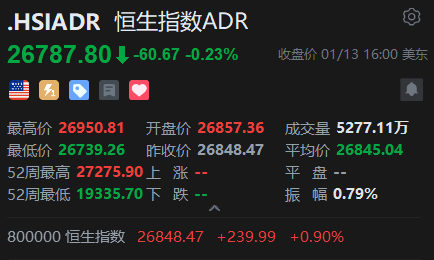
Core Viewpoint - The Hang Seng Index (HSI) experienced a slight decline, closing at 26,787.80, down 0.23% from the previous close, indicating a mixed performance in the Hong Kong stock market [1]. Group 1: Market Performance - The Hang Seng Index closed at 26,787.80, down 60.67 points or 0.23% [1]. - The index reached a high of 26,950.81 and a low of 26,739.26 during the trading session, with a trading volume of 52.77 million shares [1]. - The average price for the session was 26,845.04, with a 52-week high of 27,275.90 and a low of 19,335.70 [1]. Group 2: Major Blue-Chip Stocks - HSBC Holdings closed at HKD 127.188, up 0.62% compared to the previous close [2]. - Tencent Holdings closed at HKD 624.864, down 0.42% from the previous close [2]. - Alibaba Group saw a price increase of 3.63%, closing at HKD 159.900 [3]. - Other notable performances include AIA Group up 0.84% at HKD 84.400 and China Construction Bank up 1.17% at HKD 7.810 [3].




泡泡玛特(9992.HK):横向引领 纵向成长
Ge Long Hui· 2026-01-13 22:14
Core Viewpoint - Bubble Mart, established in 2010, is a leading cultural and entertainment company in China, focusing on five key areas: global artist discovery, IP incubation and operation, consumer engagement, promotion of trendy toy culture, and investment integration in related industries [1] Horizontal Performance - The Chinese IP derivative and toy market shows strong growth potential, with the market size projected to increase from 99.4 billion yuan in 2020 to 174.2 billion yuan by 2024, reflecting a compound annual growth rate (CAGR) of 15.1%. By 2029, the market is expected to reach 335.7 billion yuan, with a CAGR of 14.0% from 2024 to 2029 [1] - The Chinese trendy toy market is relatively fragmented, maintaining a healthy IP matrix. Compared to Europe and the U.S., China's per capita spending on IP toys is low, and the consumer base is expanding to include adults as significant buyers [1] Vertical Performance - The company employs a diversified channel strategy for sales, including offline, online, wholesale, and other channels. Key offline sales channels include retail stores and robot stores [2] - The company's box machines are innovating in scene-based and entertainment aspects, effectively linking online and offline traffic through holiday marketing strategies, which has expanded the access scale of WeChat mini-programs [2] - The company demonstrates strong revenue-generating capabilities and growth potential, with steady increases in net assets, improved scale effects, and declining main fee rates. Profitability is also on the rise, with steady improvements in gross and net profit margins [2] Investment Recommendations - IP operation and creative design are critical for the company's sustainable development. As a leading global trendy toy IP platform, the company has successfully created multiple popular cultural IP images through a mature IP operation system [3] - The company is expected to increase its overall revenue from 33.83 billion yuan in 2025 to 61.83 billion yuan in 2027, with growth rates of 159.5%, 41.7%, and 29.0% respectively. Net profit attributable to the parent company is projected to grow from 7.95 billion yuan to 13.82 billion yuan during the same period, with year-on-year growth rates of 154.2%, 36.0%, and 27.9% respectively [3] - The company is optimistic about the growth logic of its IP matrix incubation and operation platform and has initiated coverage with a "recommended" rating [3]
荣耀×泡泡玛特,潮玩手机要来了
Xin Lang Cai Jing· 2026-01-13 13:36
Core Viewpoint - Pop Mart is set to launch a trendy toy mobile phone in collaboration with a well-known smartphone brand, which has garnered significant attention from both toy enthusiasts and the digital community [1] Group 1: Collaboration Details - Pop Mart clarified that the upcoming mobile phone is not a self-developed product but a collaborative effort with a leading smartphone manufacturer [1] - The partner for this collaboration is Honor, a top domestic smartphone brand in China [1] - The collaboration will focus on Honor's 500 series, with the new product scheduled for release on January 19, 2026 [1]
泡泡玛特被曝将与荣耀合作,推“行业首款潮玩手机”
Xin Lang Cai Jing· 2026-01-13 13:36
Core Insights - Honor and Pop Mart are collaborating to launch the Honor 500 series, marketed as the "first trendy toy phone" set to be released on January 19 [1][2] - The collaboration is not a simple "sticker" marketing approach; it integrates Pop Mart's core IP MOLLY into the phone's design, system themes, boot animations, and ringtones [2] - Pop Mart has successfully developed multiple popular IPs, including LABUBU, MOLLY, and SKULLPANDA, with significant revenue growth projected for 2025 [2][3] Company Overview - Honor was established in 2013 as a sub-brand of Huawei, focusing on the young consumer market with mid-range smartphones priced below 3000 yuan [2] - In November 2020, Honor became an independent brand following its separation from Huawei and is currently pursuing an IPO [2] Pop Mart's Strategy - Pop Mart aims to maximize the commercial value of its IPs and established an IP licensing department in 2020 to facilitate cross-industry collaborations [2] - Recent collaborations include exhibitions and partnerships with various brands, indicating a strategy to diversify its revenue streams beyond single blockbuster products [3] Leadership Changes - Pop Mart has appointed a former executive from LVMH as a non-executive director to enhance its strategic direction towards luxury branding [4]
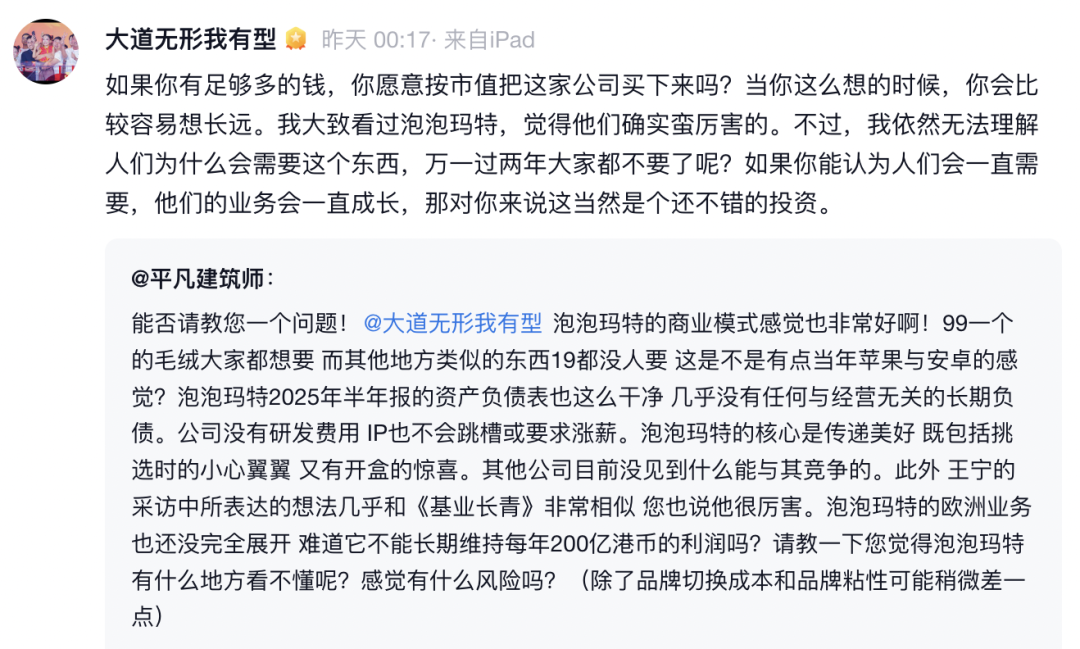
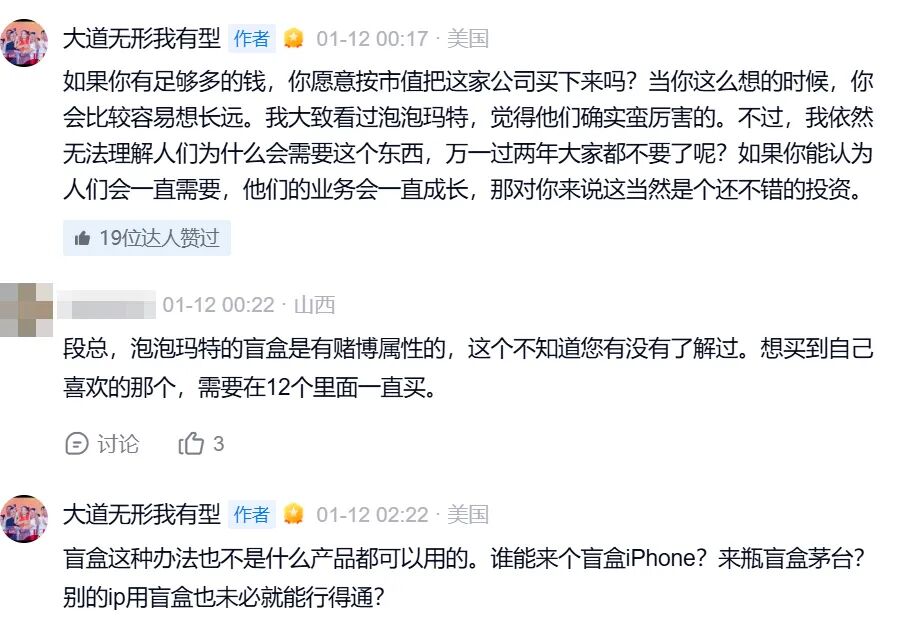
段永平再谈泡泡玛特:确实厉害,但不理解人们为何需要,万一过两年大家都不要了呢?
Mei Ri Jing Ji Xin Wen· 2026-01-13 11:57
Group 1 - The core viewpoint expressed by Duan Yongping is that while he acknowledges the success of Pop Mart, he questions the sustainability of its business model and the long-term demand for its products [1][3]. - Duan Yongping highlights that the blind box concept may not be applicable to all products, suggesting that not every brand can successfully implement this model [1]. - He emphasizes that the emotional value associated with products like Pop Mart's offerings is significant, but he personally does not understand the broader appeal of such products [3]. Group 2 - The timing of Duan Yongping's comments is notable, as they coincide with a significant decline in Pop Mart's stock price, which was reported at 197.00 HKD per share, with a total market capitalization of 264.56 billion HKD as of January 12, 2026 [4]. - Pop Mart's stock price had previously reached a high of 335.40 HKD per share on August 26, 2025, with a market cap exceeding 450 billion HKD, indicating a substantial drop in value [4].
5个月市值蒸发1858亿港元,段永平再谈泡泡玛特:确实厉害,但不理解人们为何需要,灵魂发问“万一过两年大家都不要了呢?”
Xin Lang Cai Jing· 2026-01-13 11:54
Core Viewpoint - Renowned investor Duan Yongping expressed skepticism about Pop Mart's business model, questioning the long-term demand for its products and suggesting that if investors believe in sustained demand, it could be a good investment opportunity [1][3][9] Company Performance - As of January 12, 2026, Pop Mart's stock price was HKD 197.00 per share, with a total market capitalization of HKD 264.56 billion, down from a peak of HKD 335.40 per share and a market cap exceeding HKD 450 billion in August 2025 [3][11] - The stock has declined over 41% in less than five months, resulting in a market value loss of approximately HKD 185.8 billion [6][14] Financial Results - For Q3 2025, Pop Mart reported a revenue increase of 245% to 250% year-on-year, with Chinese market revenue growing by 185% to 190% and overseas market revenue increasing by 365% to 370% [8][16] - In the first half of 2025, the company achieved revenue of CNY 13.88 billion, a year-on-year growth of 204.4%, and an adjusted net profit of CNY 4.71 billion, up 362.8% [8][16] - The founder, Wang Ning, projected full-year revenue for 2025 to be no less than CNY 30 billion, emphasizing the importance of sustainable growth and data management [8][16] Market Sentiment - The market sentiment has been shaken by the declining market premium of core IPs like Labubu and short-selling pressures, despite ongoing overseas expansion and expected strong net profits for 2025 [6][14] - Morgan Stanley reported that Pop Mart is transitioning from explosive growth to sustainable growth, predicting a significant slowdown in revenue growth for Labubu in 2026 [8][16]